
The friend everyone messages after a difficult school day often hears the same advice: psychology must be the right subject. That advice confuses being supportive with enjoying an academic discipline. A student can care about people and still dislike designing studies, analysing results or writing cautious conclusions.
Choosing psychology after 12th needs a better test than being the group's good listener. The useful question is whether investigating human behaviour remains interesting when the work involves evidence, uncertainty and sustained study.
Table of Contents
- What Psychology After 12th Actually Leads To
- What the Degree Asks Beyond Talking About Behaviour
- Myths About Mind Reading and Instant Empathy
- Signs Your Curiosity May Suit Academic Psychology
- How to Test Your Interest Before You Apply
- How These Skills Grow If You Practise Them
- Decide With Evidence Not a Personality Label
What Psychology After 12th Actually Leads To
A Class 12 certificate or a bachelor's degree alone doesn't qualify someone as a clinical psychologist. A student who enjoys late-night conversations with friends needs to separate the work that sounds meaningful from the training that makes it possible.
What each psychology pathway actually requires
| Imagined outcome | Study stage that can support it | Regulated clinical practice | What a bachelor's alone does |
|---|---|---|---|
| HR, research assistance, NGO or behaviour-related content | BA or BSc Psychology plus role-specific skills and on-the-job learning | No | Can be an entry point, not a specialist title |
| Counselling-related work | Further training and supervised practice after the degree | Clinical responsibilities require the relevant recognised credentials; employer eligibility rules also apply | Does not by itself authorise independent counselling |
| Clinical psychologist | Specialised postgraduate training, applicable RCI-recognised qualifications and supervised experience | Yes | Does not qualify the graduate to practise as a clinical psychologist |
| Academic or lab research | Bachelor's projects, then a master's or research degree | No | Builds methods; does not confer a professional licence |
A degree seat and a professional qualification aren't interchangeable. A directory reporting AISHE-based psychology listings, published in 2026, records 961 institutes and 158,727 approved seats per year across 33 states.
The need for advanced training has historical context. An older government manpower assessment, reported by the Press Information Bureau, estimated that India required 17,250 clinical psychologists against 898 available at the time. That isn't a current vacancy count or a promise of employment.
Starting rule: A student should circle the desired work outcome before comparing colleges.
The subject-choice reflection resource can sit beside that exercise. Interest in the subject and willingness to complete the required training deserve separate answers.
What the Degree Asks Beyond Talking About Behaviour
A normal study week involves more than discussing why people behave differently. Students define a problem, form a hypothesis, test it, analyse data and report a conclusion that may be narrower than their original guess.
Say a student's marks fall after changing schools. Calling the student unmotivated ends the enquiry too early; considering sleep, teaching conditions, peer relationships and prior achievement creates questions that can be investigated.
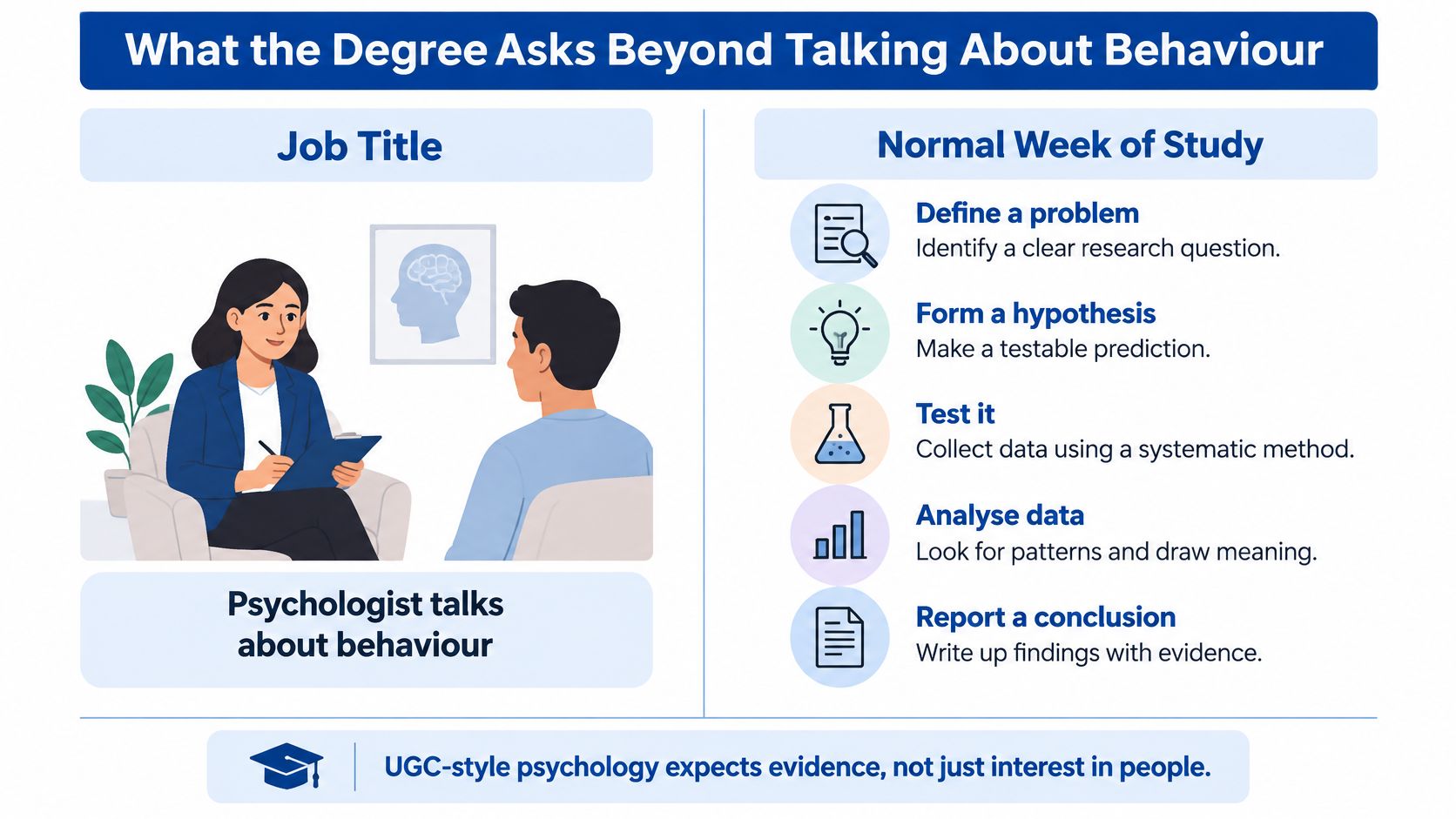
Practical work can include experiments or psychological tests using group data, alongside interviews and observations. Students learn to ask whether a measure is consistent (reliability), whether it measures the intended idea (validity) and which comparison group informs its interpretation (norms).
BA, BSc and diploma psychology at a glance
| Course | Eligibility to verify | Study load to expect | Typical admission route |
|---|---|---|---|
| BA Psychology | Often any stream; confirm the university's rule | Theory, human development and social topics, plus projects and statistics | Merit or CUET-UG under university rules |
| BSc Psychology | Not automatically science-only; verify stream, aggregate and category requirements | Often greater emphasis on experimental methods, laboratory work and statistics | CUET-UG or a university test; check subject combinations |
| Diploma or certificate | Institute-specific entry requirements | Applied skills rather than the full research degree | Direct admission or institute test; not a substitute for regulated practice |
The Central University of Haryana's official eligibility listing permits B.Sc. (Hons.) Psychology applicants with recognised 10+2 qualifications in any discipline and at least 50% aggregate, with a 5-percentage-point relaxation for SC, ST, PwD and OBC-NCL applicants. This is an institutional example, not a national rule.
BA and BSc titles suggest emphasis, not a guaranteed syllabus. Postgraduate directions include clinical, counselling, industrial-organisational and HR, developmental and educational, and forensic psychology, each with its own entry requirements.
Science, commerce and arts students should mark these cells in an official admission notice:
- Stream rule: Accepted school subjects.
- Aggregate: Minimum marks and applicable category provisions.
- Study load: Statistics, research methods and practicals.
- Entry route: CUET-UG, university test or merit.
Myths About Mind Reading and Instant Empathy
Psychology isn't access to someone else's thoughts
A quiet classmate might be concentrating, tired, uncomfortable, or uninterested in that conversation. Observing silence doesn't establish the reason for it. Psychology and human behaviour become interesting precisely because the same visible action can support competing explanations.
A student researcher must distinguish description from interpretation. Noting that someone spoke less during a group task is a description; deciding that the person has low confidence is an interpretation requiring more evidence. Ethical boundaries also matter: classmates aren't material for amateur diagnosis, and private conversations aren't permission to publish personal details.
The UGC psychology framework includes descriptive, experimental, correlational and theoretical approaches, alongside ethical considerations in research, analysis and reporting. It also includes observation, ethnography, interviews, thematic analysis, surveys, experiments, case studies and archival methods. These are ways of examining claims, not shortcuts to certainty.
A student who needs certainty about another person's thoughts may find psychology deliberately frustrating.
Feelings don't remove the need for methods
Another common assumption is that psychology is a feelings subject with no numbers. Yet a claim about exam anxiety might require a carefully designed questionnaire, a defensible sample and an analysis that distinguishes an association from a cause.
For example, students who sleep less might also report more stress. That finding alone wouldn't establish whether sleep loss increased stress, stress disrupted sleep, or another condition affected both. Learning to resist an attractive explanation is part of the work.
Qualitative work isn't an escape from rigour either. Interviewing someone requires thoughtful questions, careful records and an explanation of how themes were identified. A moving account can matter without proving that every student has the same experience.
Empathy helps, but it doesn't complete the coursework
An empathetic student may notice when a friend needs space. That sensitivity can support respectful listening, but it doesn't automatically produce a clear literature review, a fair survey question or an accurate practical report.
- Listening needs boundaries: Supporting a friend doesn't mean taking responsibility for solving every problem.
- Coursework needs discipline: Reading, referencing, analysing and revising remain necessary even when the topic feels personally meaningful.
- Professional work needs preparation: Placements and emotionally demanding settings require training and supervision, not confidence alone.
Already understanding people isn't an entry requirement, either. A student who readily admits uncertainty may approach a case more carefully than someone who assigns personality labels after a brief conversation. The subject should make quick judgments harder to defend.
Families also need a clear boundary around the clinic-opening myth: psychology after 12th, including a general bachelor's degree, isn't independent clinical qualification. Clinical practice requires specialised postgraduate training and the applicable Rehabilitation Council of India (RCI)-recognised route.
A useful replacement for a myth is a method. Instead of assuming an ability to read people, a student could become interested in learning how an interview question avoids suggesting its own answer.
Signs Your Curiosity May Suit Academic Psychology
During a cricket discussion, a disagreement turns into a group argument. A student rewatches the exchange, not to declare a winner, but to notice what changed: an interruption, laughter from others, a captain's comment or an audience joining in.
That student then reads an introductory chapter about group behaviour and checks whether the explanation fits. This isn't proof of suitability. It is an example of curiosity moving beyond opinion towards investigation.
Questions that outlast the gossip
Genuine interest in psychology often appears in ordinary situations. A student wonders why the same advice reassures one cousin and annoys another, or why a revision plan works during a relaxed school period but collapses near board examinations.
The important habit isn't producing an impressive answer. It's staying interested after the obvious answer becomes doubtful.
- Attention to context: A student notices that someone participates differently with familiar friends and unfamiliar classmates.
- Patience with alternatives: Competing explanations feel worth comparing rather than irritating.
- Interest beyond personal stories: A chapter about memory remains engaging even when it doesn't explain a current friendship.
- Willingness to revise: New evidence leads to a changed explanation rather than an argument defending the first guess.
These habits aren't a pass-fail personality checklist. A student may enjoy reading about development but need practice interpreting graphs. Another may like organising results in a spreadsheet while finding reflective writing unfamiliar.
Learning preferences matter more than a type
Academic psychology often asks students to stay with a long chapter, distinguish similar concepts and write carefully about limited evidence. Enjoying short videos about personality doesn't necessarily predict enjoyment of that work. Neither does being the most emotionally expressive person in class.
A commerce student who enjoys spreadsheets may feel comfortable with introductory statistics. An arts student who reads closely may notice ambiguity in an interview transcript, while a science student may enjoy experimental design. The reverse can also happen; no stream owns these abilities.
Interest is a direction of attention, not proof that laboratory work will be enjoyable.
Parents can listen for these learning habits rather than announce that a child is a psychology type. A more useful conversation concerns which activities held attention, which felt difficult and whether the student wanted to continue despite the difficulty.
A student who notices little of this yet shouldn't self-reject. Limited exposure can look like limited interest, and nervousness can hide curiosity. The fair test is an opportunity to try the work, followed by reflection on the experience rather than a permanent label.
How to Test Your Interest Before You Apply
A small, two-week trial can fit around board-exam preparation without becoming another high-pressure project. Its purpose is to sample the work, not to diagnose classmates or prove a hidden talent.
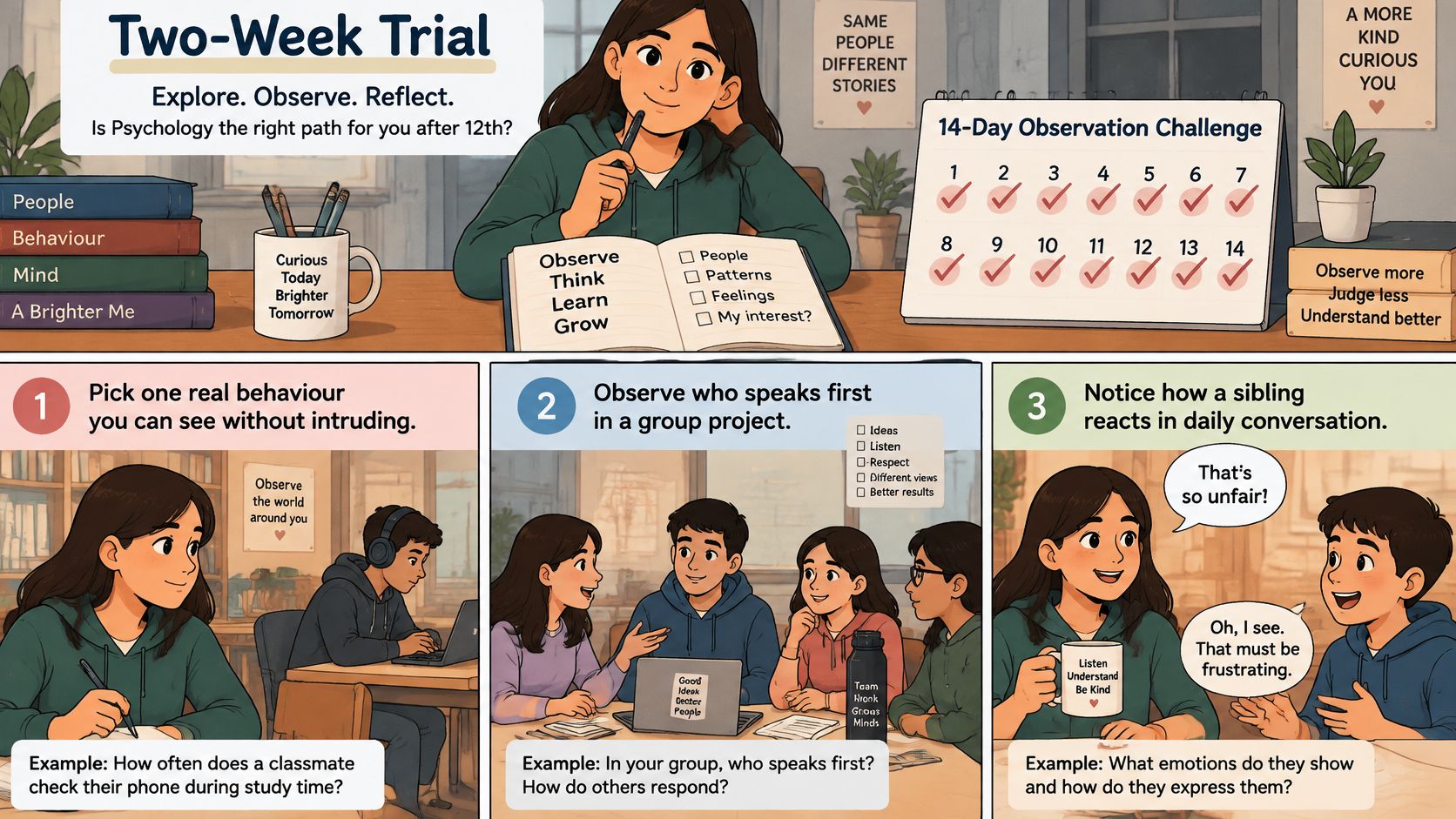
A manageable subject trial
Choose an ordinary, visible behaviour. Suitable examples include who speaks first during a group project or how a sibling organises revision after a disappointing test. Private distress, conflict and sensitive disclosures aren't suitable observation exercises.
Separate observation from explanation. The student records what happened, possible explanations and something observation cannot reveal. For instance, starting revision late might reflect uncertainty about the task rather than laziness.
Read an introductory psychology article. Attention should go to how the explanation was developed, not only its reassuring message. The student notes whether the method creates further questions or feels like an obstacle to the interesting story.
Draft an anonymous class survey. A short draft might explore study environments without asking for names, diagnoses or family details. Questions should use neutral wording, and the draft shouldn't be circulated without a teacher's permission.
Compare a BA and a BSc syllabus. Highlight statistics, practicals and research methods, then inspect the actual assignments where available. A programme title isn't enough to judge the learning experience.
Build an application sheet. Columns can include university, required subjects, category, aggregate, admission route and desired work outcome. A notes column should record unresolved questions rather than treating assumptions as facts.
A companion interest-reflection resource can help organise reactions to the activities. The important evidence remains what the student wanted to investigate, what required effort and what seemed unappealing after genuine exposure.
Admission figures aren't personal odds
In the NTA's CUET-UG 2024 subject statistics, Psychology recorded 31,815 registered candidates and 20,547 appearing, an appearance rate of approximately 64.6%, with a 200-mark paper and 1,602 candidates in the final reported performance category. These figures describe examination participation and reporting categories, not an admission probability.
Participating universities prepare their own merit lists. Seats, category rules, required subject combinations and institutional cut-offs affect selection, so dividing a reported performance count by registrations doesn't produce a student's chance of admission.
The same care applies to eligibility. An application sheet should record the target university's actual stream rule rather than assume that only science students can apply. It should also separate meeting minimum eligibility from obtaining admission.
The trial has been useful if investigating behaviour still feels worthwhile after reading an explanation and examining the syllabus. Enjoying advice-giving alone doesn't answer that question. Disliking a trial task isn't failure either; it identifies something to investigate before committing to a degree.
How These Skills Grow If You Practise Them
A student doesn't need to arrive already analytical enough or emotional enough. Observation, questioning and writing limited conclusions are skills developed through repeated attempts and feedback.
Early difficulty isn't a verdict. However, improvement requires more than liking the subject's public image; students need opportunities to practise the less glamorous parts.
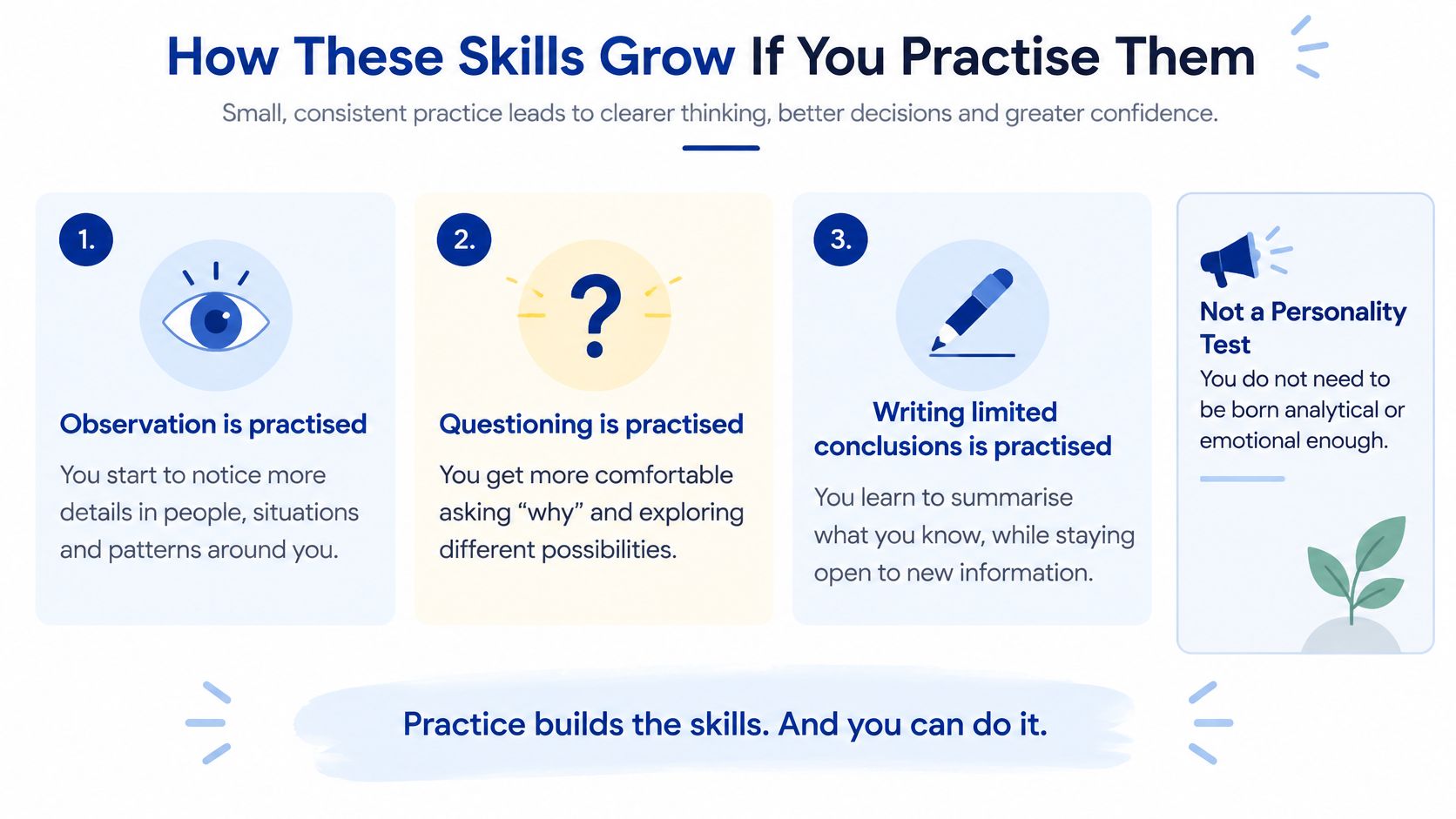
Small drills with a clear purpose
- Keep an observation log: Across a few school days, record an event, an interpretation and an uncertainty. Avoid offering advice as part of the exercise; the aim is noticing the difference between seeing and assuming.
- Test competing explanations: Consider a harmless household disagreement and identify what evidence would weaken each explanation. If nothing could change an opinion, it isn't being examined fairly.
- Join a revisable project: A school investigation works well when students can change their conclusion after collecting information. The useful habit is explaining the change rather than hiding it.
- Turn a claim into a question: After reading a short methods explanation, rewrite a broad claim as something investigable. A claim that music improves studying becomes a question about which task, which setting and which measure of performance.
Parents can discuss these exercises without grading a child's personality. Questions about values, beliefs, aspirations and abilities encourage self-awareness in students more effectively than praise for being naturally insightful.
A skills-reflection resource can accompany these observations. The emphasis should remain on what needs practice, not on finding a permanent ceiling.
Practice principle: Skills can grow, but they still need deliberate practice.
A need for support isn't evidence of subject fit
Personal distress needs a different response from academic exploration. The Indian Express account of the IC3 2025 survey describes roughly 8,500 students in Classes 8–12: one in five rarely felt calm, motivated or excited, nearly 40% didn't know where to seek professional help at school, and nearly half had never received structured career counselling; among Class 12 students, about three-quarters reported sleeping fewer than seven hours on school nights because of academic pressure and overthinking.
An attraction to psychology can partly reflect a wish for personal support, social meaning or relief from academic pressure. None of those motives is shameful, but distress doesn't establish readiness for statistics, research or emotionally demanding work. Studying a subject isn't a substitute for receiving care.
Persistent sadness, anxiety, sleep loss or safety concerns call for a trusted adult and qualified support. Immediate danger requires urgent human assistance, not completion of a subject-choice exercise.
For students still comparing streams, the guide to choosing a stream after Class 10 can help slow the decision into manageable questions. Stream selection should remain an educational decision, not a diagnosis.
Decide With Evidence Not a Personality Label
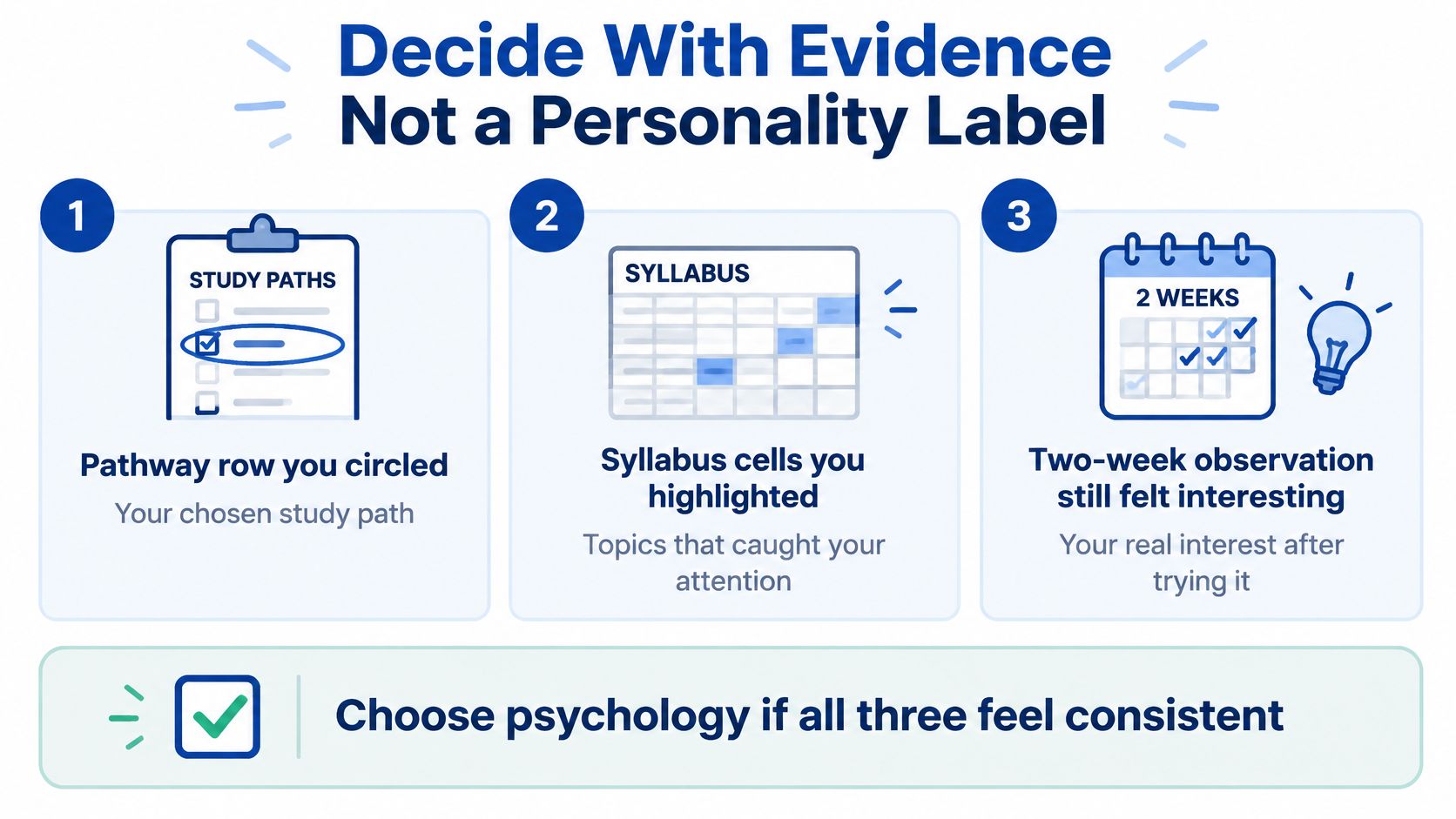
The strongest decision comes from placing the desired pathway, the marked syllabus and the observation notes side by side. Psychology deserves serious consideration when the student wants the actual study, accepts unfinished answers and is prepared for the additional training their goal requires.
A pause is sensible when the main attraction is being recognised as kind or feeling less lost. Those needs deserve attention without being turned into a degree commitment.
Common student questions
Can introverts study psychology?
Yes. Listening, reading and writing don't require a loud personality, although interviews and collaborative work require practised communication.
Is empathy enough?
No. Empathy supports respectful engagement; academic progress also requires methods, analysis, ethical judgment and sustained effort.
Must students already understand human behaviour?
No. Curiosity and willingness to revise an explanation matter more than arriving with confident answers about people.
Reflection without a score
Useful written prompts include:
- Attention: Which activity holds the student's attention through sustained effort?
- Listening: Can a conversation remain useful without immediate advice?
- Contradiction: What happens when evidence challenges a preferred explanation?
- Privacy: Can sensitive topics be discussed without gossip?
- Direction: Which work outcome is genuinely appealing?
- Avoidance: Which syllabus component creates reluctance, and why?
Edvdo is a Student Understanding & Decision Intelligence platform that helps students explore interests, strengths and decision-making patterns through guided reflection. Its structured exploration of interests, stream-selection resource and values reflection can support that process, not provide a clinical diagnosis or a final verdict.
In a hypothetical example, a BA student might stop seeing the degree as a dead end after comparing HR, counselling-related and research-support routes. Separately, Megha, a BA Psychology student, described gaining direction after a mentor helped her recognise applications in HR, counselling and marketing.
Before paying an application fee, the student should complete the observation note and university sheet.
Edvdo offers guided activities and structured reflection to help students understand their interests, strengths and decision-making patterns. Students considering psychology after 12th can visit Edvdo to explore those patterns alongside real syllabi and training requirements, then make a more informed subject choice.