

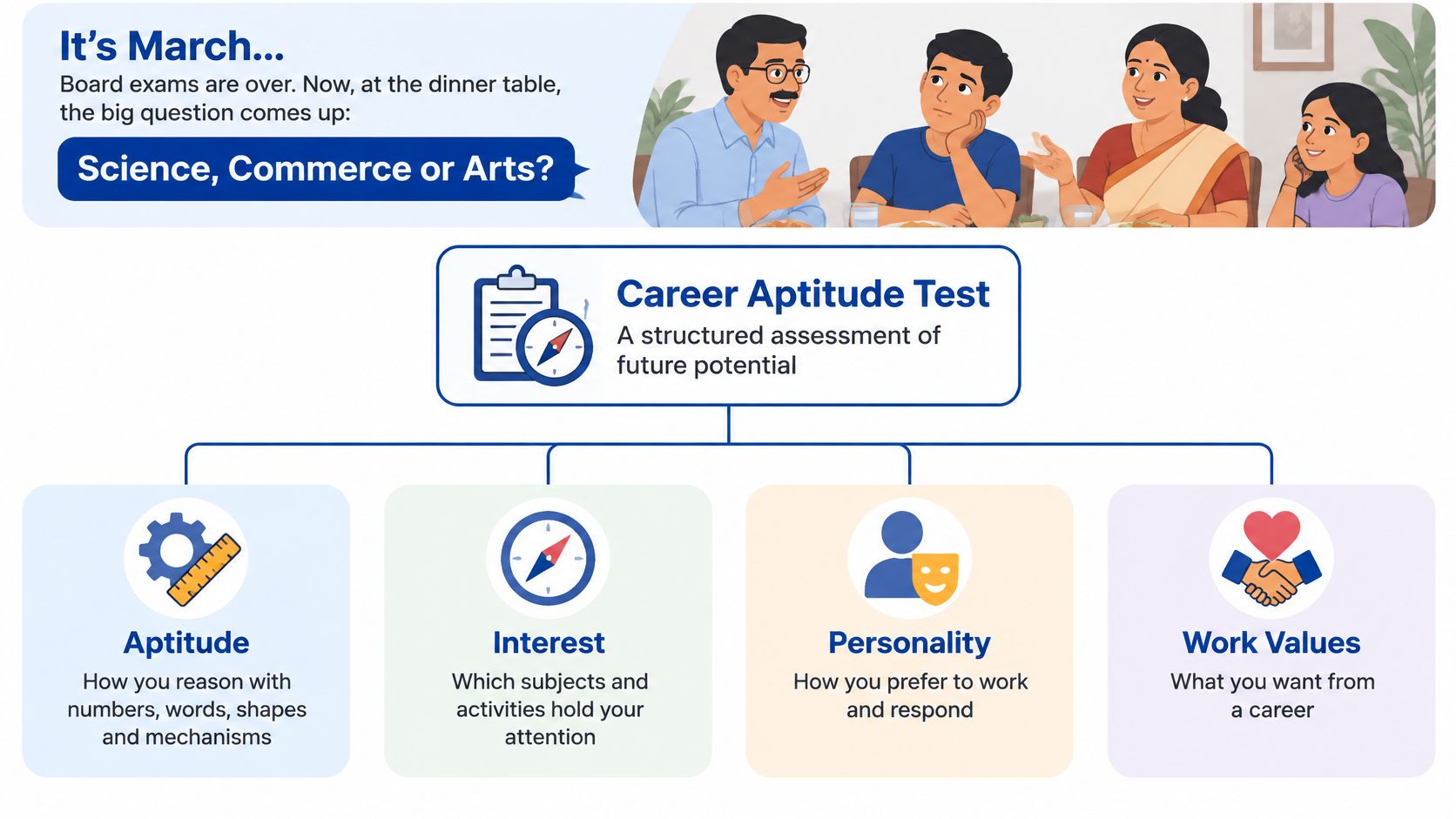
It's March, the board exams are over, and dinner has become a discussion about Science, Commerce or Arts. A parent points to strong Maths marks. A relative recommends engineering. The student enjoys Biology but isn't sure whether that means medicine. Everyone wants a sensible choice, yet everyone is using different evidence.
A career aptitude test after 10th can give that conversation a clearer starting point. Its most useful result isn't a stream label. It's a set of possibilities that the student and family can check against actual coursework, admission requirements and everyday realities.
Table of Contents
- What a Career Aptitude Test After 10th Actually Measures
- Stream Options After 10th and the Aptitudes That Fit Them
- Choosing the Right Aptitude Test for Class 10
- Take the Test and Read the Report Without Misreading It
- Combine the Report With Marks, Money and Counselling
- Turn Your Report Into a Confident Stream Choice
What a Career Aptitude Test After 10th Actually Measures
At that dinner table, the word aptitude can sound like another word for intelligence. It isn't. A structured aptitude assessment examines how a student handles particular kinds of problems, helping identify potential strengths and areas that may need support.
Board marks describe demonstrated academic performance. They reflect learning, preparation, effort and examination conditions. An interest questionnaire answers a different question: which activities attract the student's attention? Neither measure, on its own, explains the whole person.
The dimensions behind a useful profile
A broad career assessment should distinguish between these dimensions rather than combine everything into an unexplained overall score:
- Cognitive abilities: Numerical reasoning involves interpreting quantities; verbal reasoning involves understanding language; spatial reasoning involves mentally handling shapes; logical reasoning involves recognising relationships.
- Occupational interests: These concern activities the student would willingly explore, such as investigating, designing, organising or helping people.
- Personality and work preferences: These describe preferred ways of working, including independent concentration, group discussion, structured tasks or open-ended projects.
- Values and motivations: These concern what matters in future work, such as security, creativity, service, autonomy or opportunities to learn.
The following visual separates these elements so families can discuss them without treating them as interchangeable.
Consider a student who enjoys watching science documentaries. An interest assessment can help distinguish enthusiasm for a topic from enthusiasm for the tasks associated with it. The student might prefer explaining discoveries through writing rather than conducting laboratory experiments.
Several readings, not a single verdict
A broad assessment resembles a health check-up: several readings need interpretation together. Strong reasoning doesn't automatically establish interest, and enthusiasm doesn't automatically establish readiness.
The Government of India's vocational-education statement describes vocational modules in Classes 9–10 and vocational courses in Classes 11–12, intended to support choices based on aptitude, competence and aspirations. A useful assessment therefore needs to consider academic streams, National Skills Qualifications Framework (NSQF) vocational options and diploma pathways together.
Practical rule: A report should explain the student's pattern of strengths, interests, working preferences and motivations, not simply announce a destination.
The honest boundary is straightforward: assessment findings support exploration. They don't establish an unchangeable future.
Stream Options After 10th and the Aptitudes That Fit Them
Post-10th pathways mapped to aptitude profiles
| Pathway | Aptitude profile that fits | Example careers | Key subjects or prerequisites |
|---|---|---|---|
| Science (PCM) | Numerical, logical and spatial reasoning; comfort with abstract problems | Engineering, architecture, data science, defence, commercial aviation | Physics, Chemistry and Maths; check course-specific entrance and eligibility requirements |
| Science (PCB) | Careful observation, understanding biological systems and sustained scientific interest | Medicine, dentistry, pharmacy, biotechnology, forensic science | Physics, Chemistry and Biology; check the entrance and subject requirements for the particular course |
| Commerce | Numerical fluency, verbal reasoning and interest in organisations or markets | Chartered accountancy, banking, economics, company secretary, digital marketing | Accountancy, Business Studies and Economics; check whether a target degree requires Maths |
| Humanities (Arts) | Verbal and social reasoning, creativity and curiosity about people | Law, psychology, civil services, journalism, design, teaching | Relevant available subjects, such as History, Political Science, Psychology or Economics; strong reading and writing |
| Vocational (NSQF) | Practical problem-solving and preference for learning through application | Technician, hospitality, healthcare support, IT services, automotive trades | An appropriate school-based vocational course; confirm its qualification level and progression routes |
| Diploma or polytechnic | Applied technical reasoning and interest in practical technical study | Technical assistant, technician, design assistant, engineering-related roles | Check the institution's Class 10 eligibility, admission process and branch-specific conditions |
These are starting profiles, not entry restrictions. A quiet student can study law. A creative student can become an engineer. A student interested in helping people can explore healthcare, teaching, social work or other routes rather than assuming medicine is the only possibility.
Career names also need careful interpretation. Studying a stream doesn't automatically qualify someone for every occupation listed alongside it. Architecture, commercial aviation, pharmacy and forensic science, for example, require separate checks of the relevant programme and professional pathway.
Popularity isn't evidence of personal fit
A Ministry of Education study reported by DNA found that, between 2012 and 2022, Arts enrolment increased from approximately 30.9 lakh to 40 lakh, while Science increased from about 30.7 lakh to 42 lakh.
The same account reported Science participation at about 17% in Punjab, Haryana and Assam, compared with more than 60% in Andhra Pradesh, Telangana and Tamil Nadu. Those differences undermine the idea that the stream most familiar in a family's surroundings must be the right choice for every student.
A family should examine the actual subject combinations offered locally. A school may offer Humanities without Psychology, or Commerce with a limited choice of optional subjects. The stream name alone doesn't establish whether the desired route remains open.
Compare the work, not the label
An accompanying personality assessment can prompt discussion about preferred working conditions, but it shouldn't exclude a stream. Preference for independent work, for example, matters differently across laboratory research, accounting practice and journalism.
Before comparing advanced coursework, a student can use MasteryMind to find topics to revise by subject, then identify gaps in relevant foundations. Revision is useful preparation for a trial lesson, not proof of suitability.
The practical comparison is personal profile plus actual local provision, not prestige, popularity or a relative's experience.
Choosing the Right Aptitude Test for Class 10
Which aptitude test should a student take after 10th? The useful answer starts with what the assessment explains, rather than how impressive its certificate looks.
Checks before starting
- Separate measures: The assessment should distinguish cognitive ability, occupational interests, work preferences and values. A personality label alone isn't an aptitude profile.
- Indian pathway relevance: Recommendations should connect to available academic streams, vocational courses and diploma options, rather than stop at broad descriptions such as creative or analytical.
- Technical transparency: The publisher should explain the intended age group, comparison group and evidence supporting the assessment. Families should look for reliability information and whether validation included Indian students.
- Clear costs and deliverables: Before payment, the family should know what the report contains, whether interpretation costs extra and whether course research is included.
- Accessible interpretation: The student should be able to understand the questions and discuss the findings in a comfortable language, with appropriate human support.
What a sample report should reveal
A sample report is more informative than a promise of accuracy. It should show why a recommendation follows from particular findings, identify uncertainties and distinguish measured results from automated interpretation.
A confident-looking chart isn't the same as a well-supported recommendation.
A self-directed online assessment can organise an initial exploration. A counsellor-led interpretation is more appropriate when the family faces disagreement, unfamiliar pathways or a financially demanding decision.
An extremely short quiz that promises the single best career deserves caution. The concern isn't brevity alone. It's whether the questions provide enough information to support the strength of the claim being made.
Take the Test and Read the Report Without Misreading It
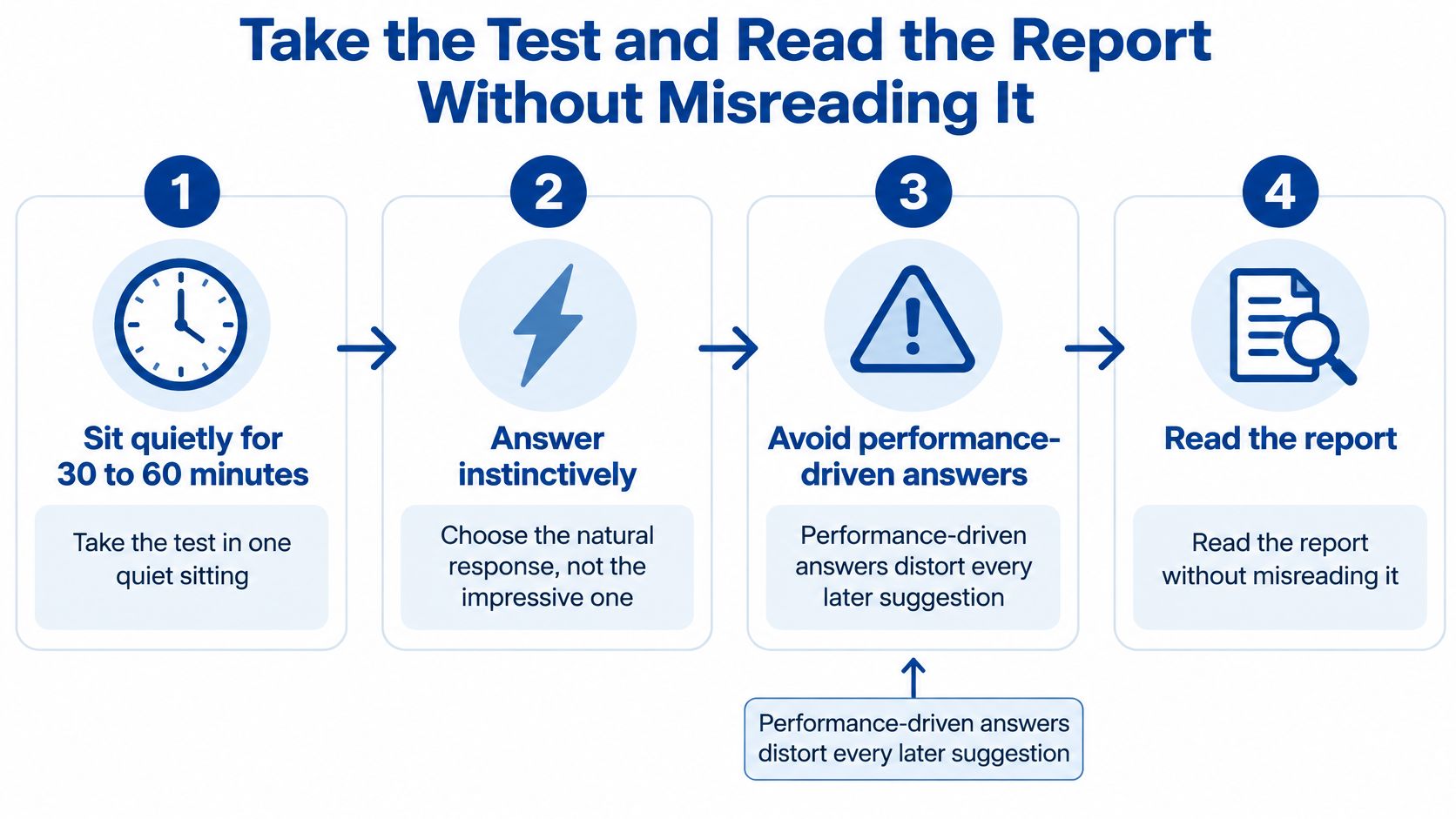
Preparation should make the assessment fair, not make the student look impressive. A quiet setting, working device and uninterrupted time help, but the assessment's own timing and accessibility instructions take priority.
For preference questions, the student should answer according to normal behaviour rather than a parent's expectations. Ability questions require a different approach: careful effort, permitted tools only and compliance with any time limit.
The visual below summarises the preparation sequence; the provider's instructions remain authoritative for the actual assessment.
Reading the report in a useful order
Separate the domain results.
Start with numerical, verbal, logical and spatial findings individually, then examine interests and preferences. A broad headline can hide a meaningful difference between strong verbal reasoning and less-developed numerical fluency.The student should also record whether a section felt unfamiliar, rushed or difficult to understand. Those observations provide context, although they don't automatically invalidate a result.
Examine uncertainty.
Look for confidence bands, reliability notes or warnings about inconsistent responses. If the report doesn't explain a score's precision, the family shouldn't assume that a small difference between scores is meaningful.A percentile, if used, describes standing within a stated comparison group. It isn't the percentage of a career the student can perform successfully. The comparison group therefore matters.
Treat stream recommendations as ranked hypotheses.
A hypothesis is a possibility supported by evidence that still needs checking. A Science recommendation might reflect reasoning strengths, but the student still needs to examine the relevant subjects and study demands.The runner-up option deserves attention too. A useful report explains why alternatives remain plausible rather than presenting a winner without context.
Verify career prerequisites independently.
Match each proposed occupation to a specific course and institution. Record required school subjects, the admission route and any additional eligibility conditions using current official admission information.Broad advice can mislead here. A family shouldn't assume that every finance qualification requires school Maths, or that every health-related programme follows the same entrance route. The particular qualification determines the check.
Identify a workable alternative route.
If the preferred stream isn't available, the next step is pathway research, not an immediate declaration that the career is impossible. The family should examine recognised alternatives and confirm where each leads.A diploma, vocational qualification and academic degree aren't interchangeable. Progression, recognition and later admission opportunities need checking before an alternative becomes a backup.
Prepare a short decision summary.
The student can record the leading stream hypotheses, supporting evidence, unanswered questions and a practical activity for investigating each. This is more useful in a counselling appointment than a screenshot of the top recommendation.An accompanying skills assessment can help identify a capability to practise during exploration, provided current skills aren't mistaken for permanent limits.
Misreadings that need correction
- Final verdict: A recommendation should lead to a trial of relevant work, not unquestioning enrolment.
- Parent-pleasing answers: Preferences should reflect the student's experience, even when family hopes differ.
- Top-result fixation: Close alternatives and uncertainty notes deserve attention alongside the headline.
- Prestige-first selection: A recommendation should survive a comparison of actual coursework and opportunities.
- Fixed-ability thinking: New learning and classroom evidence can justify reviewing an earlier interpretation.
The accompanying video can serve as a discussion prompt after the written results have been examined.
Interpretation errors aren't always the student's fault. Reports can also be unclear, overstated or poorly matched to the student's context. A responsible reading includes permission to question the instrument as well as its recommendations.
Combine the Report With Marks, Money and Counselling
The 2025 Bharat Career Aspirations Report, covering 21,239 students in Classes 9–12 across 14 Indian districts, found that only 10.4% had received professional career guidance, according to Deccan Herald's account. That gap makes interpretation important: access to a test doesn't necessarily provide access to an informed decision.
A family needs to combine the assessment with recent academic work, affordable study arrangements, local provision and the student's own priorities. None of these considerations should override the others.
If-then plans for common decision conflicts
| Signal conflict | What it may mean | What to do next |
|---|---|---|
| High Maths marks but a low numerical-reasoning score | Marks may reflect sustained coaching and effort; unfamiliarity or testing conditions may also affect the assessment | Compare familiar exercises with unfamiliar reasoning problems and discuss the discrepancy with a teacher |
| Report favours Science but the family expects Commerce | Family preferences and assessment evidence point in different directions | Compare career lists, prerequisites and total study costs together |
| Strong interest in a field with weak measured ability there | Motivation is present, but relevant skills may need development | Trial a foundation topic with support and review performance before committing |
| Recommended stream has no seat at nearby schools | Local provision limits the immediate choice | Investigate recognised vocational, diploma or alternative-school routes and verify progression |
| Leading streams score almost equally | Measured ability may not distinguish the options clearly | Compare representative careers by everyday tasks, study demands, fees and working conditions |
High marks combined with a weaker reasoning result need particular care. Coaching can help a student master familiar question patterns, but effort and disciplined practice are genuine strengths, not reasons to dismiss achievement. Equally, a disappointing test result shouldn't be explained away because the family prefers the marks.
The useful question is whether the student can transfer understanding to an unfamiliar problem. A teacher can help distinguish a conceptual gap from anxiety, language difficulty or lack of exposure.
Build a budget around the whole route
A realistic cost sheet includes school fees, transport, equipment, examination applications and any planned coaching. Later study may add accommodation, relocation or professional training expenses.
The family should distinguish essential expenditure from optional support. An expensive coaching package shouldn't be treated as an automatic requirement merely because peers have enrolled.
A backup plan needs the same scrutiny as the preferred route. Its entry requirements, costs and application process should be written down before an admission deadline makes the decision urgent.
Family discussion prompt: Which option remains workable if the expected marks, budget or local availability changes?
Preferences deserve explicit discussion too. A work-values assessment can provide vocabulary for concerns such as financial security, service or independence without pretending that a score settles a family disagreement.
Human support for difficult trade-offs
The guidance gap crosses school sectors: the report's findings, summarised by Jagran Josh, put professional guidance access at approximately 9% among government-school students and 12% among private-school students. Private schooling alone shouldn't be assumed to provide adequate career support.
An AI mentor or report FAQ can clarify terminology and help prepare questions. Family pressure, distress, budget trade-offs and a possible stream change deserve discussion with a trained human counsellor.
For families whose conversations have become tense, DeTalks' guide to counseling that eases career anxiety offers a relevant starting point for discussing emotional concerns alongside academic choices.
A productive appointment examines evidence that contradicts the result, circumstances that would change the recommendation and the least costly activity that could test it. Review is sensible when board results differ from expectations, an unfamiliar subject proves challenging or early classroom work reveals a different pattern.
Another assessment may add information. It won't replace transparent costs, a feasible backup and an honest conversation.
Turn Your Report Into a Confident Stream Choice
A career aptitude test after 10th becomes useful when the student produces evidence beyond the report. A short exploration period can remain manageable if each activity answers a specific unresolved question.
A practical month of exploration
- Opening week, prepare the shortlist: Select the leading stream possibilities and write down why each remains plausible. Include the main concern about each option, not only its attractions.
- Following week, sample the work: Try an introductory senior-secondary chapter, a suitable online lesson or a small practical task. A conversation with a professional should cover ordinary duties and difficulties, not only achievements.
- Middle of the month, check feasibility: Confirm subject combinations, official prerequisites, costs and local availability. Record the institution and document behind each important admission assumption.
- Before deciding, hold an evidence-led family discussion: Compare completed work, teacher feedback and pathway information. Parents can explain financial limits while the student explains which activities sustained attention.
- By the end of the month, record a provisional choice: Name a backup route and the circumstances that would trigger reconsideration. The family should also record when the decision will be reviewed.
The dates are an organising suggestion, not a reason to miss an earlier school deadline. Where admissions move quickly, the family can compress the activities while retaining the checks.
From assessment to follow-through
Edvdo's process follows Assess, Explore, Connect and Track: assessment of strengths, interests and goals; exploration of career and academic options; connection with an expert counsellor; and progress monitoring.
Its free assessment takes less than two minutes to begin, with AI-powered personalised insights covering strengths, interests, opportunities and personal growth. Edvdo also offers a free first career counselling session for students who want human support interpreting the decision.
The report needn't lock a teenager into a lifelong occupation. A well-tested provisional choice gives the student a reason for enrolment, a practical next step and permission to learn more.
Edvdo offers assessment-led exploration and a free first career counselling session to help students connect their results with realistic stream choices. Families can visit Edvdo to begin, then bring recent marks, pathway questions and budget concerns to the counselling conversation.