

The report card is on the dining table. A Class 11 student wants to explore sports analytics, a parent prefers engineering, and a teacher has suggested choosing subjects based on marks. Everyone wants a sensible decision, but they're using different evidence.
A student SWOT analysis can organise that conversation. SWOT stands for strengths, weaknesses, opportunities and threats. Used carefully, it separates what a student can demonstrate from what other people expect. It shouldn't turn a difficult term, limited exposure or emotional distress into a permanent judgement about potential.
Table of Contents
- Sorting Your Student SWOT Into Four Boxes
- How to Run a Student SWOT Analysis Step by Step
- Opportunities Students Overlook in Sports Analytics
- When a SWOT Points to Wellbeing, Not Career Planning
- Common Mistakes That Make a SWOT Useless
- Book a Review Before You Choose Your Stream
Sorting Your Student SWOT Into Four Boxes
Start with an empty grid, not a list of careers. The student belongs at the centre, with personal capabilities distinguished from surrounding conditions.
| Helpful factors | Factors needing attention | |
|---|---|---|
| Internal to the student | Strengths | Weaknesses |
| External to the student | Opportunities | Threats |
The visual below shows the basic separation.
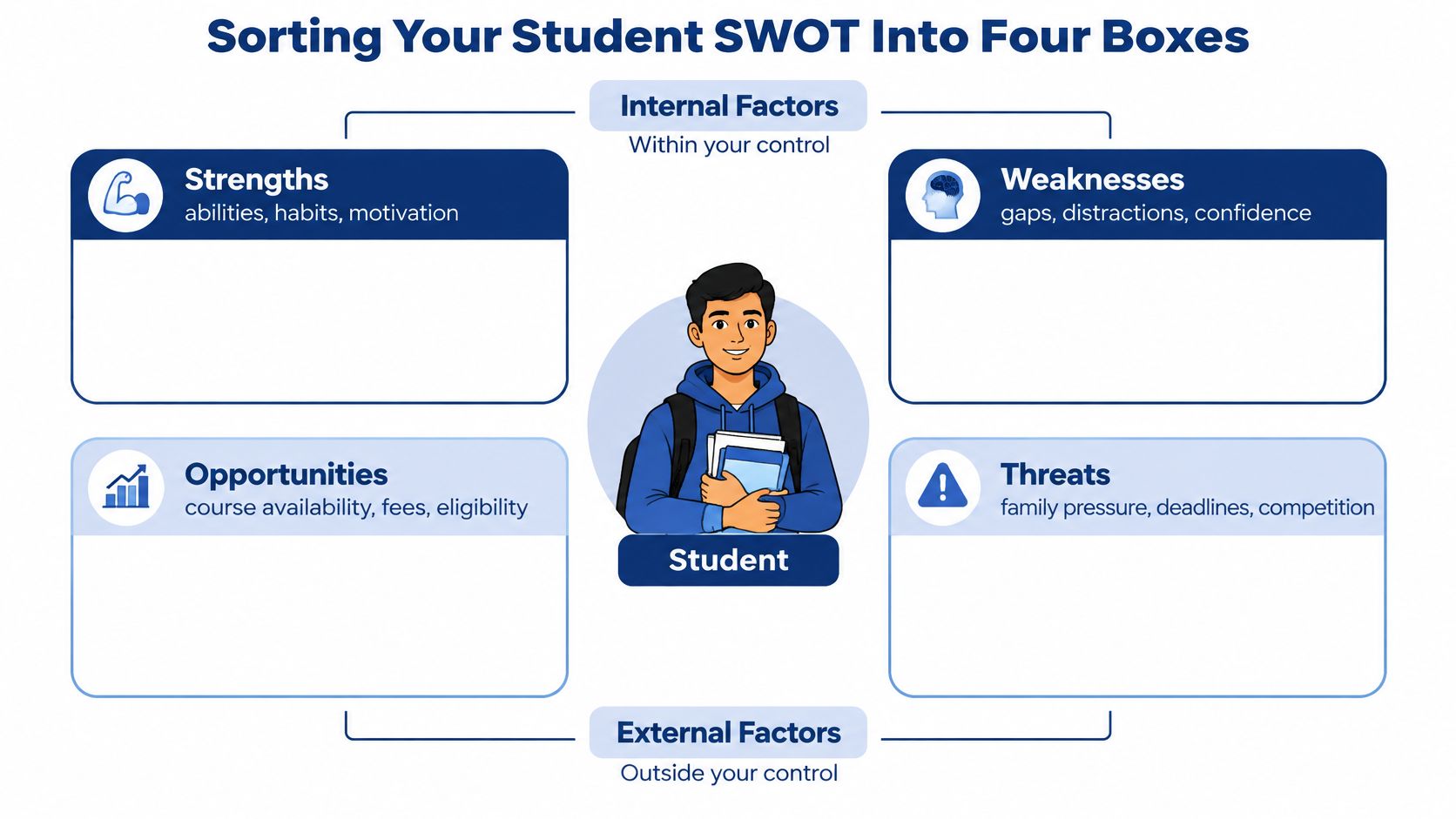
Consider a hypothetical Class 12 student interested in sports analysis. Enjoying cricket isn't enough to establish analytical ability, but a carefully maintained team statistics sheet provides something concrete to examine.
The four quadrants of a student SWOT
| Quadrant | Holds | Test question | Sports analyst example |
|---|---|---|---|
| Strengths | Internal abilities supported by evidence | Can the student point to past work that proves this? | Built a season stats sheet for a school team |
| Weaknesses | Internal gaps or habits | Does this appear across different tasks and terms? | Avoids formula-heavy work and stalls on it |
| Opportunities | External conditions that help | Is this accessible locally or online? | A local sports data course and club analytics volunteering |
| Threats | External conditions that block or pressure | Can the student address this alone, or is help needed? | Family expects engineering and there's no nearby analytics programme |
Separate the person from the setting
A useful first test is whether the item would remain true after changing school or city. An established spreadsheet skill would probably travel with the student; an unavailable local course wouldn't. This is a sorting prompt, not an absolute rule, because confidence and habits can also change with the environment.
Low maths marks in a particular term need context: missed lessons, unfamiliar question formats or weak algebra foundations. Repeated difficulty across comparable tasks provides stronger evidence of a skill gap. Even then, describe the gap precisely rather than labelling the student incapable.
Social patterns deserve similar caution. A Demography study using nationally representative National Sample Survey data found that humanities' share of higher-secondary enrolment fell from 56% in 2007–08 to 42% by 2014, while science rose from 31% to 39%. Stream popularity isn't evidence of an individual student's suitability.
Practical rule: A family preference belongs under threats only when it restricts exploration or creates pressure. It isn't a weakness within the student.
For reflection, the habit behind collecting and revisiting book quotes can help students maintain a record of ideas that repeatedly interest them. Those observations can inform prompts in a skill-exploration worksheet, but completed work remains stronger evidence than an appealing quotation.
Keep each quadrant selective, attach a line of evidence to each entry, and connect an accessible opportunity to an action during the coming month.
How to Run a Student SWOT Analysis Step by Step
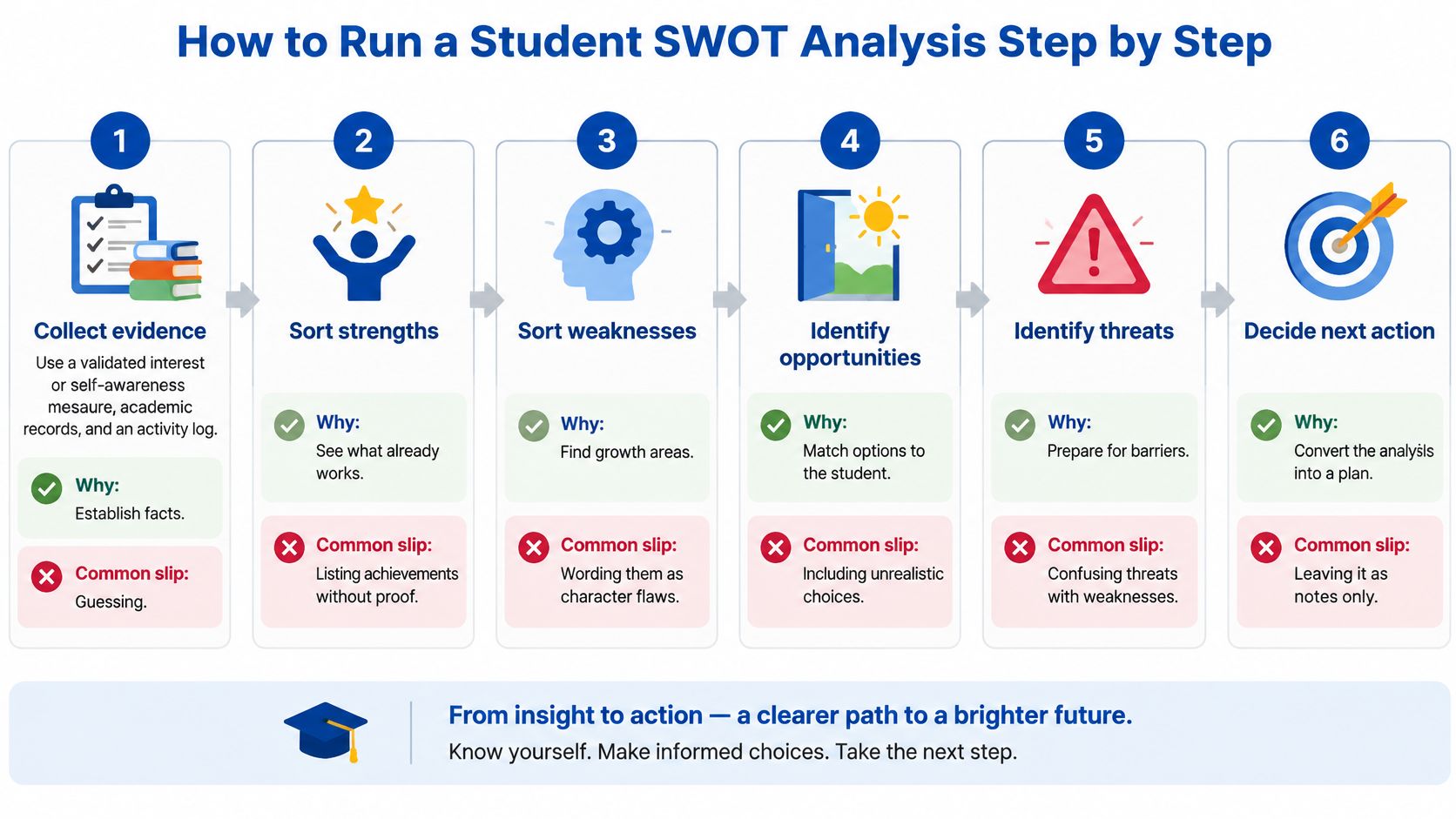
A useful student SWOT analysis begins with records and ends with a testable plan. The student should write the first draft, while a parent or counsellor helps question unsupported conclusions.
The overview below provides a visual starting point.
Build the worksheet from evidence
Collect records before making judgements. Bring academic results, teacher feedback, an activity portfolio and a short reflection about tasks the student enjoys or avoids; a validated interest or self-awareness measure can add another perspective. Starting from the mood after a disappointing exam is the common slip, because that mood may overshadow work completed earlier.
Classify internally attributable findings. Strengths and weaknesses should describe observable abilities, habits or learning gaps, such as explaining match statistics clearly or abandoning spreadsheet formulas when errors appear. A label such as hardworking needs a behaviour behind it, perhaps completing practice tasks consistently and correcting mistakes without prompting.
Record external conditions separately. Check course availability, fees, eligibility, family expectations, occupational requirements and access to guidance. A course brochure proves that a programme exists, not that its entry requirements, timetable or costs suit the student.
Rate evidence, importance and controllability. Use simple low, medium and high ratings, with a reason beside each. A high-importance claim supported only by an assumption needs checking before it influences subject selection; adding the ratings into a supposed career-fit score would create false precision.
Choose priorities and write a contingency. Convert the most consequential findings into a primary plan and a backup, naming the action, responsible person and completion point. The common mistake is treating another version of the same inaccessible course as a genuine alternative.
Set a review trigger. Revisit the worksheet after term results, teacher feedback or a practical learning experience. Record what changed and why, rather than keeping an old weakness because it appeared on the original sheet.
Require a plan, not just completed boxes
The need for a contingency is concrete: the 2025 Bharat Career Aspirations survey of 21,239 students across 14 districts in seven states, reported by Jagran Josh, found that only 22% had a backup career plan. A completed worksheet should therefore contain supporting evidence, an actionable pathway and a workable alternative.
Parents can help by asking what would confirm or challenge each entry. Disagreement should lead to a small investigation, not a contest over whose judgement carries more weight.
For a supplementary explanation, the following video can accompany the written exercise.
In the hypothetical sports example, the primary plan might be a six-week introductory data course, subject to checking its suitability. The backup could be supervised volunteering with a club's video team, with a review scheduled before the next exam period.
The review would examine actual outputs: whether the student completed calculations, corrected errors and enjoyed explaining findings. That produces a better next decision, not a verdict about an entire career.
Opportunities Students Overlook in Sports Analytics
Limited exposure shouldn't be mistaken for limited ability. A student who hasn't encountered match coding or spreadsheet analysis cannot reasonably be expected to know whether either activity suits them.
An NCAER analysis of Ministry of Education U-DISE data for 2019–20 found that fewer than 2% of students enrolled in secondary or higher-secondary education had received vocational training under the National Skills Qualifications Framework. That is evidence of an exposure gap, not a measure of students' potential.
Look beyond the job title
Sports analytics should be explored through its component tasks. Watching matches, cleaning data, checking calculations, coding video and explaining results require different habits. A student may enjoy one activity and dislike another.
Pathways to check and their prerequisites
| Pathway | Prerequisite to check |
|---|---|
| Performance or video analysis roles with clubs and academies | Consistent note-taking and viewing habits |
| Sports statistics writing | Basic statistics and clear writing |
| Data courses teaching spreadsheets and basic statistics | Spreadsheet skill and basic maths |
| Match-logging volunteering | Consistent note-taking and viewing habits |
| Fan-content or broadcast analytics | Basic statistics and spreadsheet skill |
These are directions to investigate, not promises of placements or eligibility. A school student should ask about age requirements, supervision and permission before approaching a club or academy.
For an initial practical exercise, the student could log events from a publicly available match in Microsoft Excel or Google Sheets. The sheet should define each event consistently, identify missing information and distinguish observations from interpretations. A short written explanation should state what the figures support and what they don't.
A useful trial tests whether the student enjoys the work behind the sport, not merely the sport itself.
Career descriptions in a jobs and career-search resource can help identify unfamiliar role titles. The student should then compare the listed tasks with the work sample, rather than choosing whichever title sounds most exciting.
An opportunity becomes useful when there's a reachable next step: a confirmed beginner course, a supervised activity or feedback from a knowledgeable teacher. A programme requiring unavailable qualifications or unaffordable travel belongs on a longer-term exploration list.
If an option cannot realistically be reached within the coming year, it shouldn't carry the primary plan. A smaller local project may provide more decision-making evidence than an impressive but inaccessible programme.
When a SWOT Points to Wellbeing, Not Career Planning
Before interpreting poor concentration or low motivation as a weakness, the student and a trusted adult should run a wellbeing checkpoint. This can begin with a calm conversation tonight, without requiring the student to defend a career preference.
- Sleep and recovery: Has sleep changed, and does the student feel rested?
- Stress and workload: Which demands feel manageable, and which feel overwhelming?
- Motivation across settings: Does disengagement appear only during a particular subject, or also at home and with friends?
- Support access: Is there a named adult the student feels safe approaching?
The 2025 IC3 Student Well-being Pulse survey of more than 8,500 students in Classes 8–12, reported by The Indian Express, found that one in five rarely felt calm, motivated or excited, and 40% didn't know where to seek mental-health help at school. These findings make support access an important part of the conversation.
Signals that call for support before a career decision
| Signal noticed | What it may point to | Next step |
|---|---|---|
| Low energy and concentration for several weeks | Possible stress or burnout | Check sleep and workload, then talk to a trusted adult |
| Rating almost every ability as weak | Low confidence or pressure rather than a specific skill gap | Seek a teacher's feedback on a manageable task |
| Strengths change whenever the grid is revisited | Unsettled motivation or outside influence | Keep a short observation log before choosing |
| Fear of telling family about an interest | External pressure | Prepare evidence and a conversation plan with a counsellor |
| Persistent distress or an unsafe home situation | Needs beyond self-analysis | Contact a school counsellor or trusted adult now |
Distinguish learning needs from support needs
These signals aren't diagnoses. Difficulty using formulas may call for teaching; persistent distress calls for appropriate support rather than another assessment. An unsafe situation shouldn't wait for a completed worksheet or observation log.
A personality-reflection exercise may help organise preferences, but it shouldn't be used to diagnose anxiety, burnout or other mental-health concerns. Career conclusions should remain provisional when wellbeing is affecting the evidence.
For parents: sustained low energy, visible distress or fear of expressing an interest deserves a discussion with the school counsellor before comparing course options. The student's immediate need may be safety, rest or a supportive conversation, not a firmer career recommendation.
Common Mistakes That Make a SWOT Useless
A neatly completed grid can still support a poor decision. The most damaging mistakes are often hidden behind language that sounds positive or decisive.
Four errors worth challenging
Generic praise without evidence. Creative and hardworking do not identify what the student can do. The review sheet should name a project, work sample or feedback record that demonstrates the claimed strength.
External barriers written as personal faults. Calling unaffordable tuition a weakness makes the student responsible for something that needs a family-level affordability discussion. The correction is to record the barrier, its consequences and who can help address it.
A single recommendation presented as certainty. A suggested career needs comparison with credible alternatives, including options with different entry routes. The sheet should name the alternative and explain what evidence would favour it.
No financial feasibility check. Tuition alone doesn't describe the full commitment. Record equipment, travel or accommodation requirements where relevant, and identify a fallback if expected funding doesn't become available.
Measure what changed
Attendance at a counselling session isn't the same as being ready to decide. In an IC3 survey of 2,252 high-school students from India and Nepal, 94% agreed that career and college counselling was important, but only 15% strongly agreed that school counselling was adequate, according to the IC3 Institute Student Quest Survey report.
A better review records the alternatives researched, whether entry requirements and costs are known, whether confidence has changed, and which agreed actions were completed. Confidence without better information shouldn't be treated as the main success measure.
| Review field | What should be visible |
|---|---|
| Evidence | Named work sample or feedback |
| Cost | Confirmed fee information and relevant additional expenses |
| Alternative | A researched route with a clear reason for considering it |
| Fallback | An action available if the preferred route fails |
Decision standard: Every recommendation needs supporting evidence, prerequisite skills, an education pathway, an affordability check and a fallback.
Blank fields are useful because they reveal unfinished work. A counsellor should be able to say that more information is needed, rather than fill the gap with an overly confident recommendation.
Book a Review Before You Choose Your Stream
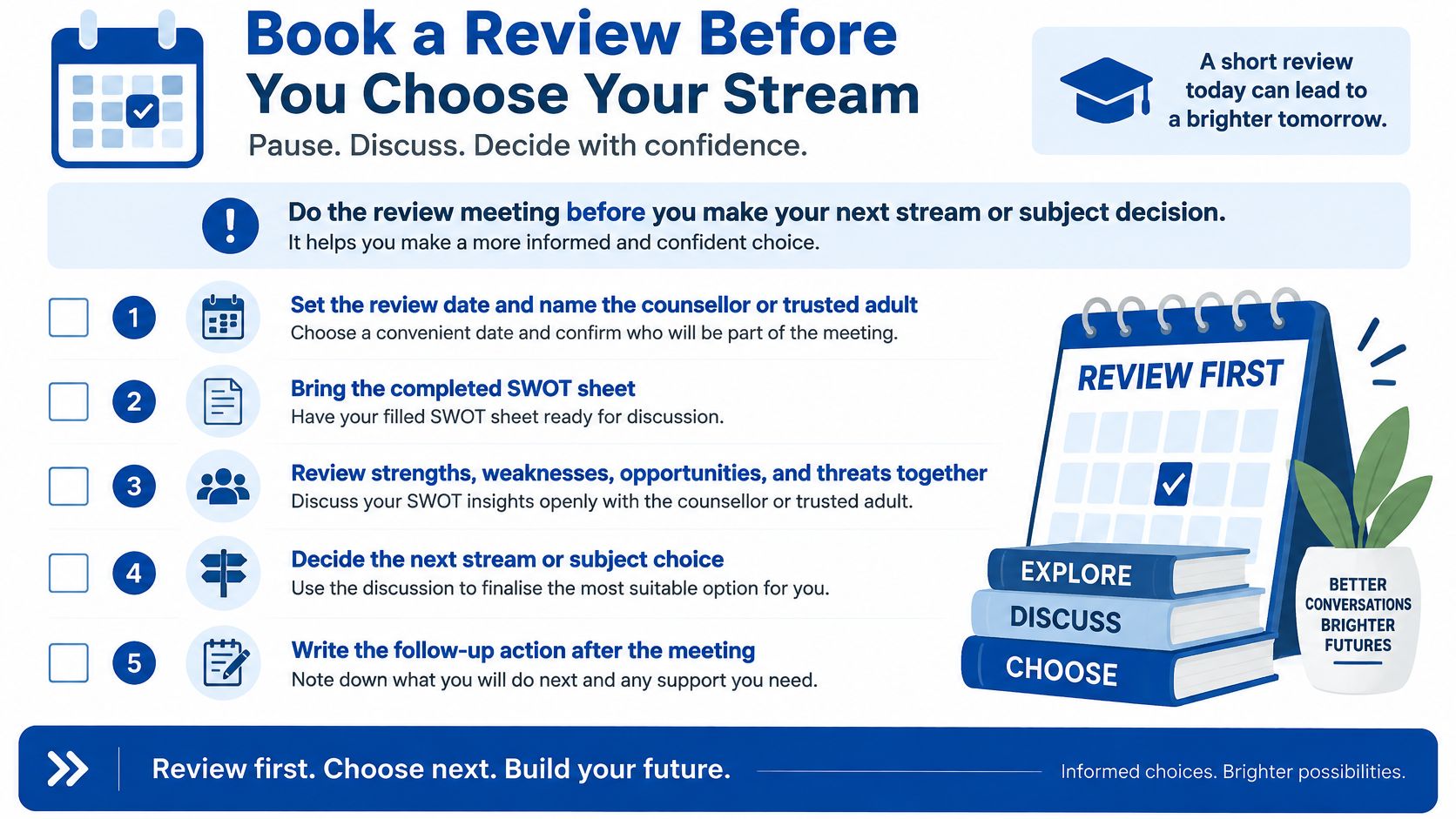
The next action is a dated conversation with a counsellor or trusted adult before the subject-selection deadline. For a Class 12 student, the equivalent decision may concern a course, entrance route or application shortlist.
- Set the appointment: Record the meeting date, the adult attending and the exact decision under discussion.
- Bring selected evidence: Attach the work samples and feedback behind the highest-priority SWOT entries.
- Confirm opportunities: Check eligibility, fees and intake dates directly with the school, college or course provider.
- Prepare the decision page: Put the primary plan and backup together, with responsibilities clearly assigned.
- Schedule follow-up: Choose a review point after relevant results or a practical learning milestone.
The checklist below can accompany the meeting notes.
Keep the student involved in the decision
Parents should read the evidence column before arguing for a preferred route. The student should have space to explain what remains uncertain, especially when family expectations affect the options under consideration.
An online assessment or career report can be brought as another discussion input. Edvdo offers a free assessment that takes less than 2 minutes to begin, with AI-powered personalised insights, strengths and interests discovery, opportunities to explore and personal growth insights. That describes the starting process, not a guarantee that a career decision can be completed in minutes.
Edvdo's process moves through Assess, Explore, Connect and Track, including scheduling a session with an expert career counsellor and monitoring progress. The student still needs to verify institutional requirements directly.
The meeting should finish with a written action, an owner and a completion date. A student SWOT analysis is most useful when the student leaves knowing what to investigate next, rather than feeling permanently classified by a tool.
Edvdo combines assessment insights, career exploration and access to expert career counsellors to help students turn a SWOT worksheet into practical next steps. Students and parents can visit Edvdo to begin the assessment and arrange a conversation, bringing academic records and questions about the options that need checking.