

The Class 10 table at home can feel like a small courtroom. A parent wants the safer path, a cousin talks about prestige, a tuition teacher points to marks, and the student is left trying to decide a future between dinner plates and opinions. That is usually the moment when a stream selection test starts to matter, not as a magic answer, but as a way to quiet the noise long enough to see what the student wants and how the student learns.
A good test does not replace family discussion, school rules, or realistic planning. It gives the student and parents a clearer picture of interests, strengths, learning preferences, and decision patterns, which is often the missing piece when everyone is talking at once. For families looking for a broader planning lens, the student career clarity path can also help frame the conversation in a calmer way.
Table of Contents
- The Class 10 Decision Most Students Face
- What a Stream Selection Test Actually Is
- Why Stream Choice Is a High-Stakes Decision in India
- What a Good Test Measures and How to Read the Report
- Beyond the Big Three Streams and Subject Combinations
- Family, Status, and the Conversation Around the Result
- Turning Test Results into Next Steps
The Class 10 Decision Most Students Face
By the time Class 10 results are close, many homes start sounding alike. One person says Science is the safest path, another says Commerce is practical, and someone else treats Humanities as a fallback. The student is left holding a mark sheet while everyone else holds an opinion.
That pressure matters because stream choice is often treated like a fixed label, when it is really a school decision with trade-offs attached. Families want security, relatives want status, and the student is expected to settle the matter quickly. The problem is simple: a choice made in panic can ignore what the student can handle for the next two years.
A stream selection test gives that conversation some structure. It helps the student and parents notice patterns that are easy to miss in a tense discussion, such as which tasks feel natural, which subjects hold attention, and which decisions come from confidence rather than pressure.
A useful test sits alongside school research and subject planning before the subject list is finalised. For families already exploring support tools, the student career clarity path can help frame the discussion in a calmer way. The point is not to label a student quickly. It is to narrow the debate while there is still room to choose carefully.
What a Stream Selection Test Actually Is
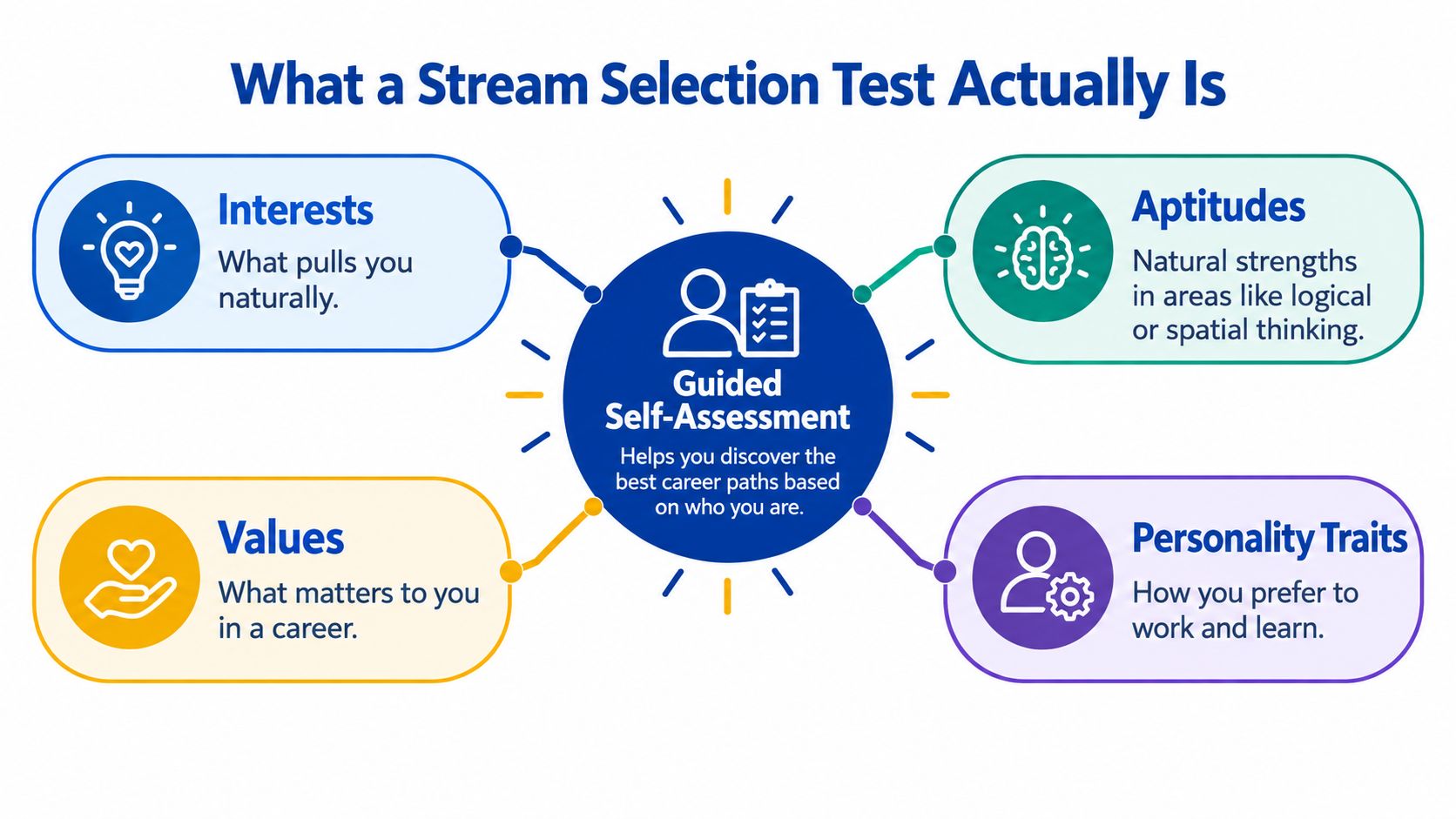
A stream selection test is a guided self-assessment, not a paper with right answers. It is meant to show how a student thinks, what holds attention naturally, and which study setting feels manageable. A useful test works more like a mirror than a verdict.
For a Class 10 student, that matters because stream choice is rarely about one score alone. A student may do well in one subject, struggle in another, and still have a clear pattern of interest, comfort, and effort. The test helps separate those strands instead of treating them as the same thing.
Interests and strengths
Interests are the subjects, problems, and themes a student keeps returning to. A child who keeps choosing puzzles, building tasks, or debates is showing a pattern that matters more than one good or bad mark.
Strengths are the places where a student learns faster, works more steadily, or handles difficulty with less friction. They are not limited to top scores. A student can be strong in logical thinking, language, visual understanding, memory, or practical problem-solving, even if one exam does not show it cleanly.
Learning preferences and decision patterns
Learning preferences show how information lands best. Some students need diagrams, some need discussion, some need hands-on practice, and some need reading time before anything makes sense. This is why a stream can feel easier for one student even when marks look similar on paper.
Decision patterns show how the student chooses under pressure. Some decide by interest, some by marks, some by peer influence, and some by status or parental expectations. Two students with the same ability can still end up in very different streams because they make different choices when the pressure rises.
A good test brings these lenses together instead of forcing everything into a single aptitude score. Edvdo's student assessment page fits that wider approach because it looks at student understanding in more than one dimension.
For teachers and parents, tools that track exam completion times can show how guided responses are collected in a classroom setting.
Why Stream Choice Is a High-Stakes Decision in India
A Class 10 student in one home is being told to choose Science because it sounds safe. In another, the family is asking whether Commerce will keep more doors open. That choice matters because it shapes the next stage of study, and often the kind of work that follows.
India's Ministry of Education-linked analysis shows why the decision carries so much weight. The share choosing Science rose from 31% in 2012 to 42% in 2022, Arts and Humanities increased from 31% to 40%, and Commerce grew only from 13.7 lakh students in 2012 to 14.4 lakh in 2022. DNA India reporting on the Ministry-linked analysis The numbers show a system where stream choice affects millions, not just one classroom.
National trends do not tell the whole story
Regional patterns add another layer. The same analysis found Science was especially common in Andhra Pradesh, Telangana, and Tamil Nadu, while Arts and Humanities was more prevalent in Gujarat, Punjab, and Rajasthan. Families often treat these patterns as proof that one stream is the “right” one, but local popularity only shows what is common nearby.
That is where a stream selection test can help, if it is used properly. It should work like a mirror, not a label maker. The goal is to reflect the student's interests, strengths, learning preferences, and decision habits against the subject combinations they may face.
A default choice can feel safe because it is familiar. A student may hear that a subject path is normal in one state and discouraged in another, even when neither view fits the student well. National averages can describe movement, but they cannot decide a child's classroom reality.
Simple check: if the only reason a stream sounds right is that “many students choose it,” the choice still needs a personal fit test.
What a Good Test Measures and How to Read the Report
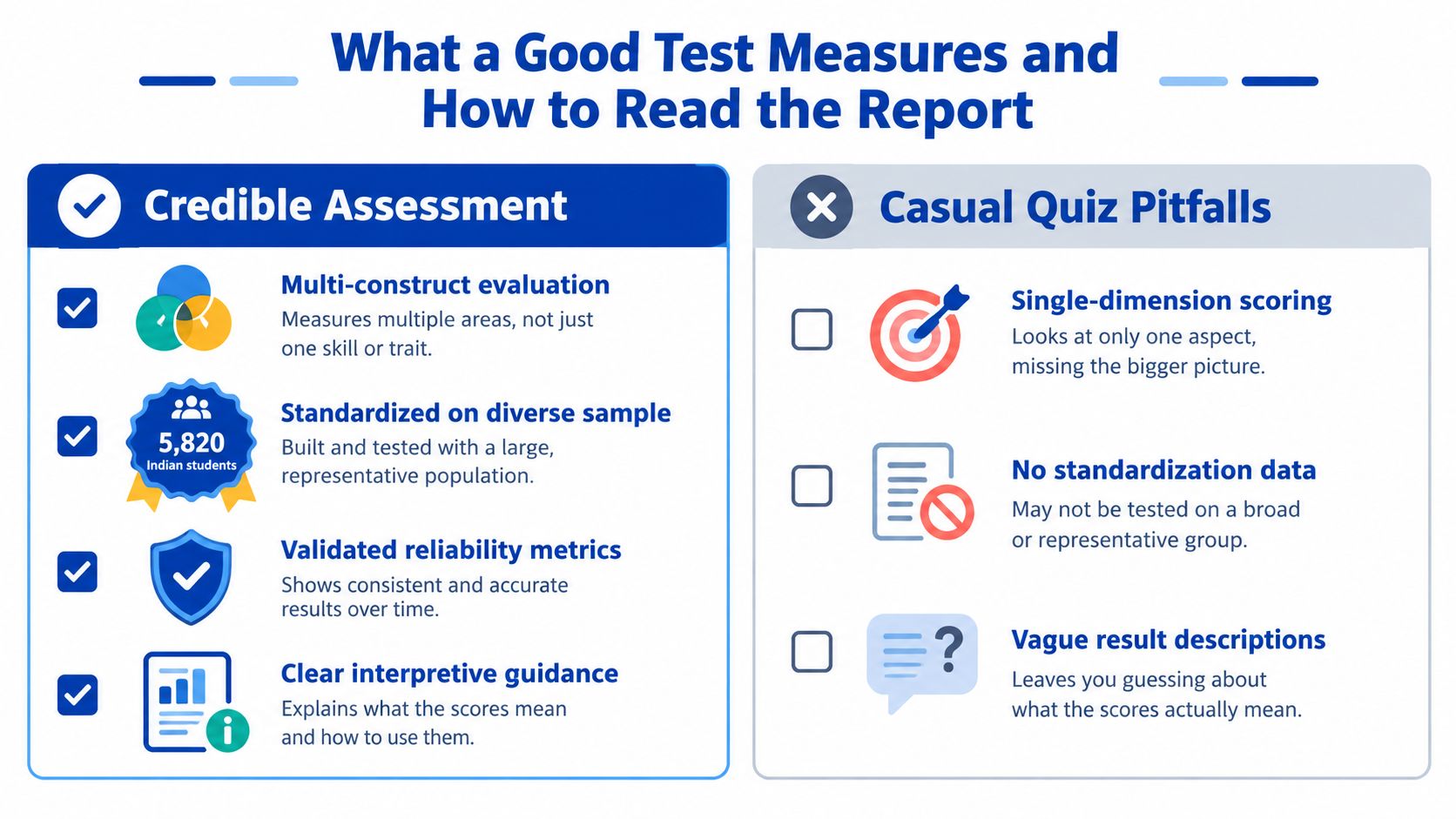
A credible assessment should read like a student profile, not a coin toss. The India-standardised Streampik instrument was built on a sample of 5,820 students and reported a validation correlation threshold of at least 0.32, with internal consistency supporting reliability Streampik standardisation study. That is very different from a casual online quiz that has never been checked against a real student group.
What the report should show
A usable report should separate the result into clear parts instead of dropping out one stream name. A student should be able to read each part without guessing what it means.
- Interest areas, so the student can see which themes attract attention naturally.
- Strengths profile, so the student can see where learning tends to come easier.
- Learning-preference summary, so the student understands how information is processed and remembered.
- Decision-pattern explanation, so the student can spot whether the choice is being driven by interest, pressure, or status.
That kind of report matters because a stream selection test should support reflection, not automatic obedience. The report should explain why a recommendation appears and show where confidence is stronger or weaker. A single stream name without context can look tidy, but it rarely helps a family make a careful choice.
For a practical example of a structured report flow, the Edvdo skill test shows how a result can be presented through more than one lens.
Beyond the Big Three Streams and Subject Combinations
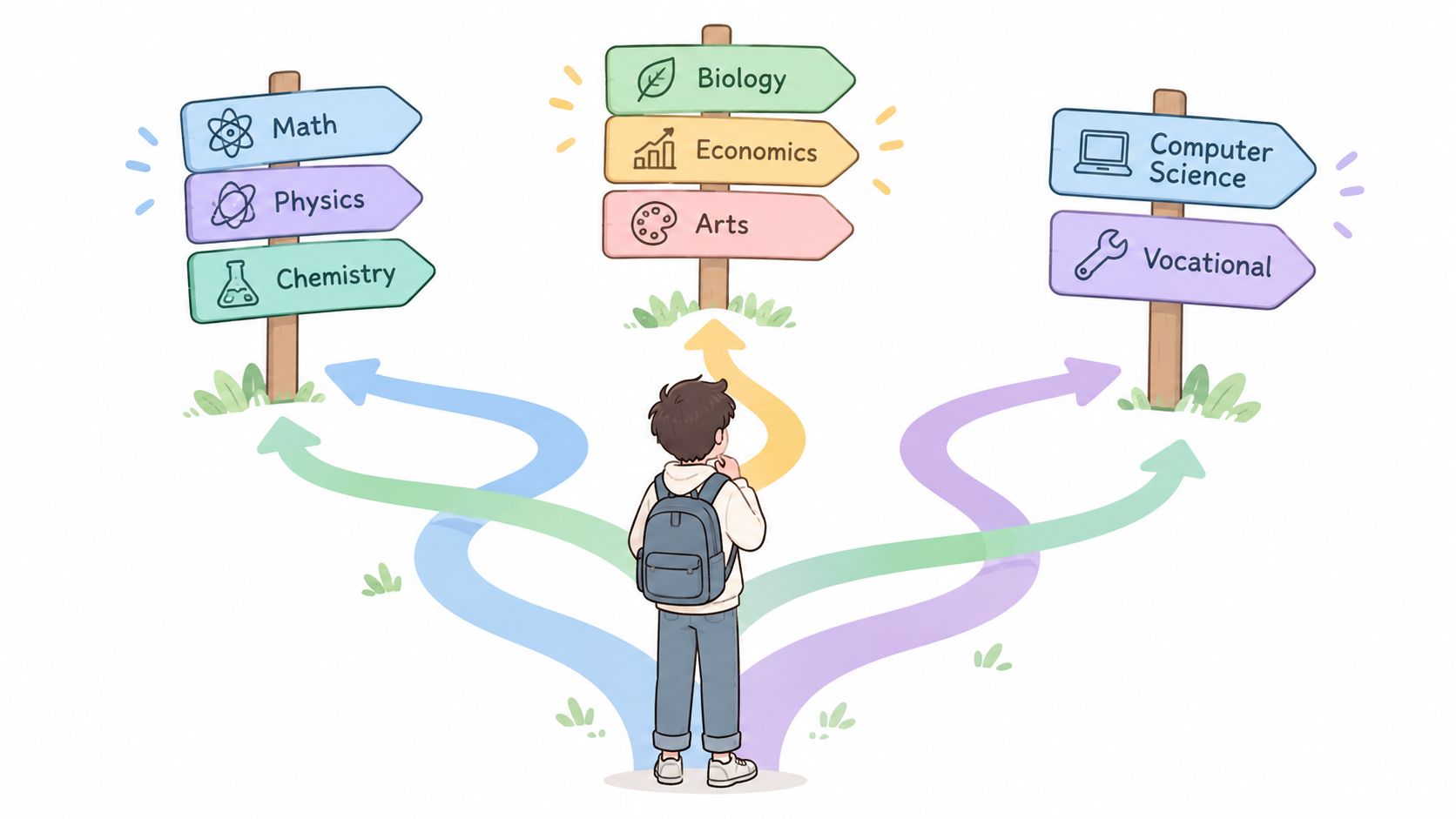
The old shorthand of Science, Commerce, and Arts is useful only if it stays flexible. The National Education Policy 2020 pushes for greater subject flexibility and rejects rigid separation among science, humanities, arts, vocational, and academic education NEP 2020. That shift matters because students do not always fit neatly into one label.
Subject combinations matter more than slogans
In CBSE senior secondary classes, students generally choose a minimum of five subjects, continue the subjects chosen in Class XI into Class XII, and one of the two language subjects must be Hindi or English CBSE senior secondary curriculum. That means the central question is not only “Which stream?” It is also “Which combination is available, and what does it keep open later?”
A student can love a subject mix that looks ideal on paper and still run into a school timetable that does not offer it. Another student can choose a combination that seems fashionable and later discover that a desired course or entrance path requires a subject that was dropped. Policy may point in one direction, but school availability, board rules, and course prerequisites still decide what is possible.
The smartest planning starts with the subject set, not the social label.
That is why a useful assessment should connect results to feasible combinations, not just broad stream names. It should help the family check school offerings early, before a flattering idea becomes an impossible schedule. Edvdo's interest test fits naturally into that kind of planning because it focuses attention on what a student is drawn to before the final subject list is locked.
Family, Status, and the Conversation Around the Result
A test result can look neat on paper and still leave a family stuck at the kitchen table. In a mixed-method study of students in Pilani, Rajasthan, students said they had room to choose, but social reputation could still pull parents into the decision, and weak school career-counselling support made things harder Pilani study. The issue is often not a shortage of opinions. It is a shortage of a structured conversation.
A UNESCO-hosted Indian school initiative describes the same pressure pattern, with peer influence, parental expectations, and perceived prestige shaping stream decisions, along with decision stress in the Indian context UNESCO-hosted initiative. A student can look confident at school and still feel pulled in different directions at home.
A calmer way to discuss the result
The family conversation works better when it separates three things:
- Capability, meaning what the student can handle and where learning feels strongest.
- Family constraints, meaning money, distance, safety, and practical limits.
- Status narrative, meaning the prestige story attached to a stream or subject.
When those three are blended together, the talk turns emotional fast. When they are separated, the family can discuss facts instead of arguing about identity. The test result belongs on the table as shared input, not as a verdict from software or from an older relative.
There also needs to be room for uncertainty. A student may like a field but still not be ready for the subject load it demands. A parent may support the interest and still worry about later options. The best conversation does not erase those tensions, it names them clearly and keeps the student at the centre of the decision.
Turning Test Results into Next Steps
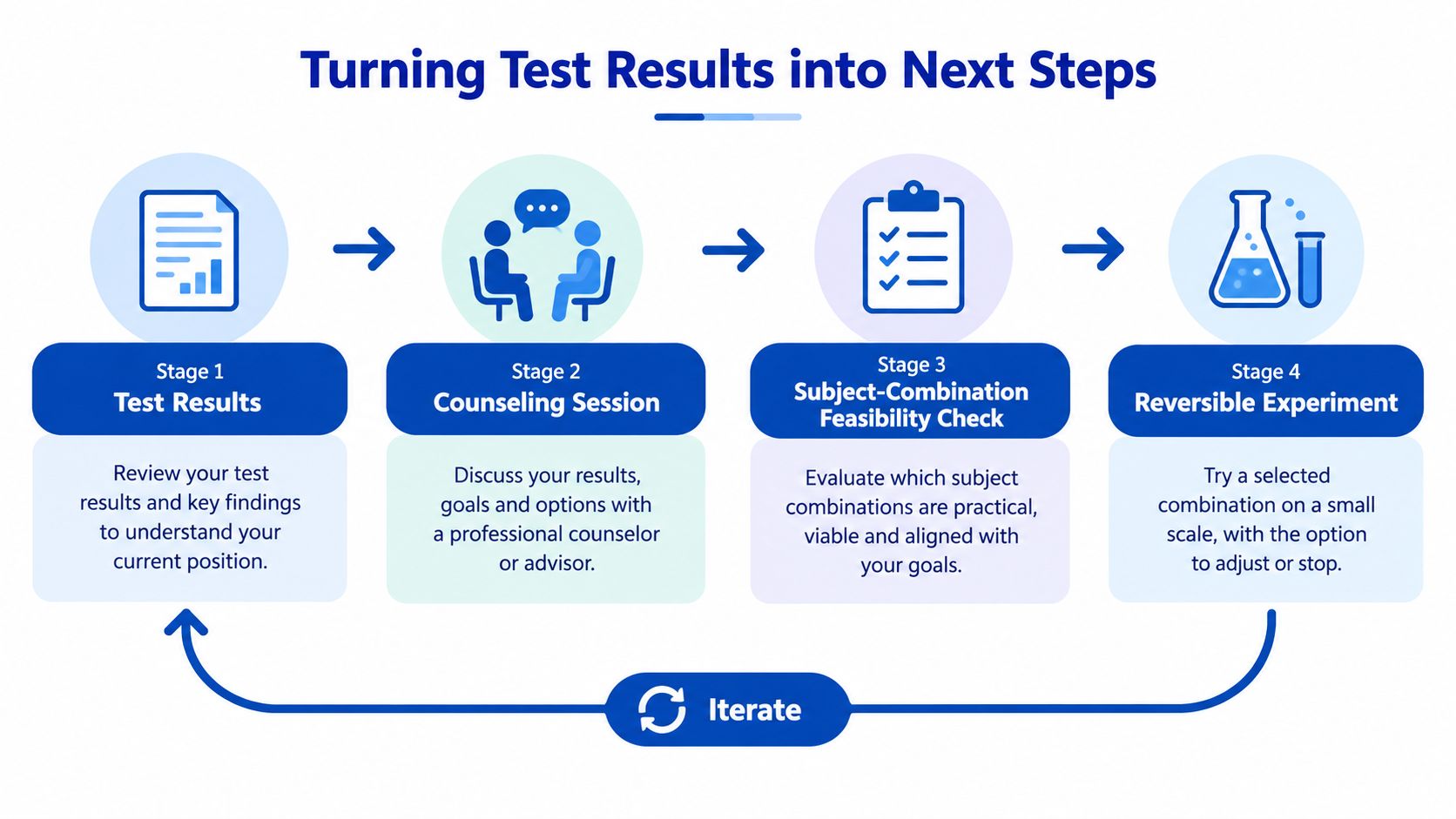
A stream selection test helps most when it starts a conversation, not when it ends one. A student may see a strong match on paper and still need help translating that result into a subject choice, a school option, and a family discussion.
The strongest programmes pair testing with guided interpretation, because assessment output only becomes useful when someone qualified helps the student read it. That is the same reason a career report matters more than a raw score sheet. It turns several signals, such as interests, learning patterns, and decision habits, into something a family can discuss.
A practical sequence
A sensible process looks like this:
- Read the result with an adult who understands the student. A teacher, parent, or counsellor can help separate signal from worry.
- Check subject feasibility. The student should confirm school offerings, subject rules, and future eligibility before getting attached to a combination.
- Try reversible experiments. Short projects, subject tasters, or informational interviews can test whether the interest still feels real outside the report.
- Revisit the result if the student changes. A new school environment, stronger marks, or a shift in motivation can justify another look.
For families and educators who want a structured way to compare options, frameworks for academic research can offer a useful model for slowing the choice down without making it muddy.
The point is not to treat a test like a prophecy. It is to use it as a grounded starting point, then move through the next steps with evidence and conversation. The four-stage image below shows that path clearly. A report can point to strengths, but the next decision still depends on the subjects a school offers, the student's real interests, and what the family can support. Like a map, the result shows direction, but someone still has to choose the road.
A stream selection test should make the next conversation easier, not more confusing. Edvdo helps students look at strengths, interests, learning patterns, and decision habits in one place, then turns that insight into a report they can discuss with family and school. Visit Edvdo to see how a structured assessment can support a calmer, more practical subject choice.