

Only 10% knew the cost of their courses in a report covering students in Classes 9–12 across Indian districts, according to India Today's coverage of the career-guidance survey. That reframes future planning for students: choosing an appealing career isn't enough if the subjects, fees and application requirements remain unclear.
A useful plan connects self-understanding with practical decisions. It also leaves room for uncertainty, emotional support and an affordable alternative, rather than treating an assessment result as a final verdict on a student's future.
Table of Contents
- Where Future Planning Fits Across Classes 7 to 12
- How to Run a Self-Check Before Choosing a Stream
- Career Clusters Most Students Never Compare
- How to Check Cost, Eligibility and Timelines for Each Route
- How to Test Options Through Experience and Build a Fallback
- Handling Anxiety and Family Pressure Without Stalling
- Confirm Your Next Step This Term
Where Future Planning Fits Across Classes 7 to 12
A student who chooses Commerce without Mathematics could later discover that a preferred course requires it. The problem isn't necessarily the stream choice. It's checking the destination's requirements after the subject decision has already been made.
India's National Education Policy 2020 supports continuing career guidance based on students' abilities and interests, alongside vocational exposure from Grade 6, as described in the Vivekananda Development Foundation's policy publication. Planning therefore belongs throughout school, not just during the final rush towards admission.
Decisions due at each stage of school
| Class | Decisions that usually arrive | What to prepare now |
|---|---|---|
| Class 7 to 8 | Optional subjects, first exposure to vocational courses | Note activities chosen without prompting and tasks completed |
| Class 9 | Subject mix for Classes 10 and 11; early vocational and skill options | Try a project, club or workshop and record what held attention |
| Class 10 | Stream choice for Class 11; ITI, polytechnic or diploma options | Check prerequisite subjects for the likeliest routes |
| Class 11 | Confirming the subject combination; entrance preparation for some routes | Confirm eligibility rules and exam calendars |
| Class 12 | Board results, entrance exams, applications and admissions | Keep a fallback route open and compare total costs |
| After Class 12 | Degree, diploma, vocational training or work | Review the plan against actual results and offers |
Put school decisions on a calendar
This table is a planning guide, not a universal admissions calendar. Exact dates and available subject combinations differ by board, state and school, so families should obtain their own school's deadlines.
Class 10 can bring stream decisions before students have investigated course requirements. In Class 11, schools may restrict later subject changes; in Class 12, examination preparation and admission paperwork can compete for attention.
A shared notebook or calendar helps separate these tasks. BlokNotes for student organization from BlokNotes is one option for keeping subject questions, documents and deadlines together.
An initial subject self-check can provide discussion points, but marks, completed work and teacher feedback should accompany any result. A subject recommendation doesn't override an institution's eligibility rules.
Practical rule: A student should find the relevant row, read the following rows, and write down the nearest decision and its confirmed deadline.
How to Run a Self-Check Before Choosing a Stream
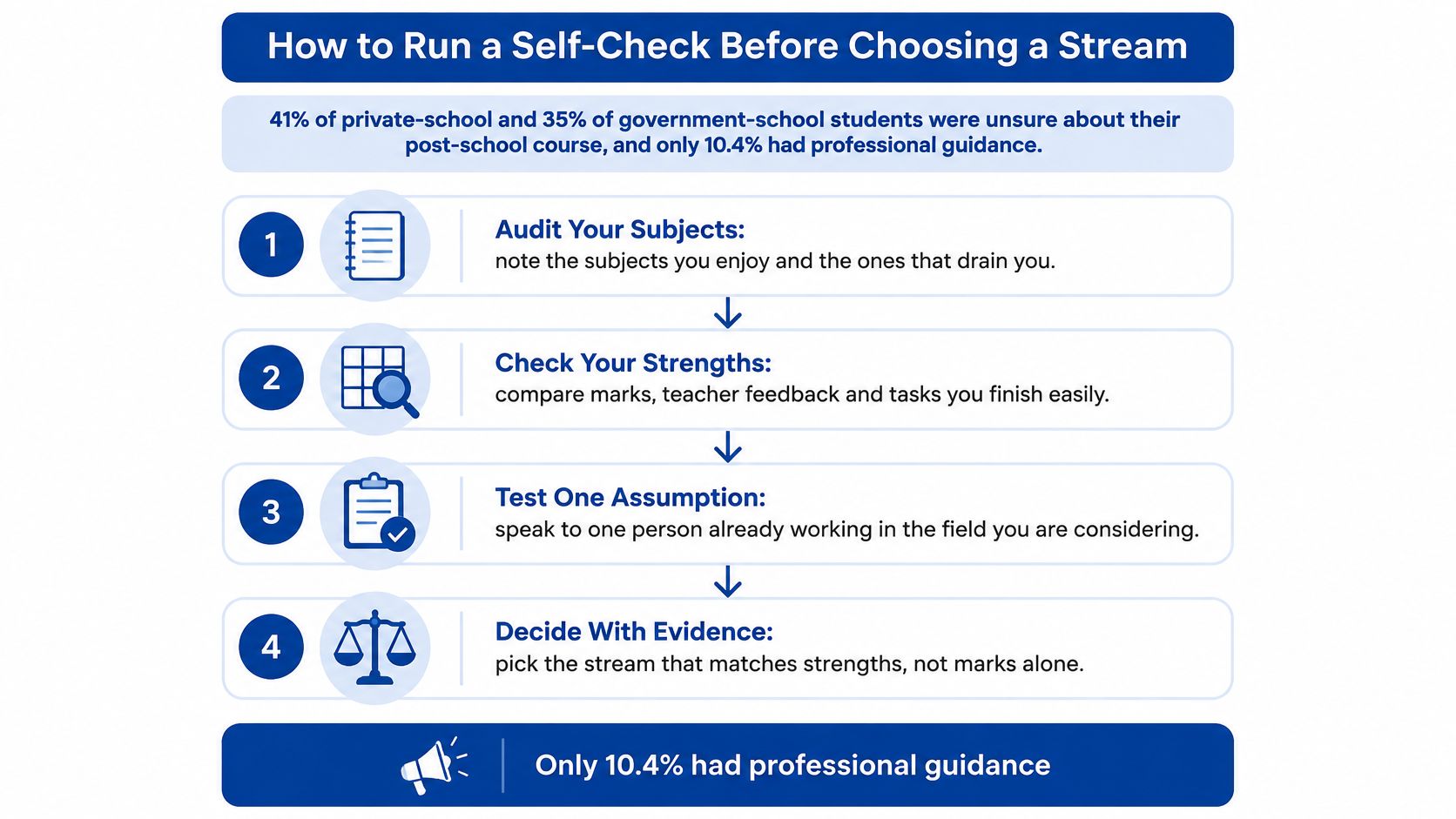
A self-check works the way a doctor's history-taking does: observations first, interpretation second. Before a stream decision, the student gathers evidence about enjoyment, performance and practical limits, so the eventual choice rests on weeks of recorded behaviour gathered well before results day.
Uncertainty at this stage is common. In a survey of students across Indian districts, 41% of private-school and 35% of government-school students were unsure about their post-school course choice, while only 10.4% had received professional guidance, according to ETV Bharat's report. Uncertainty like this calls for investigation before anyone reaches for a label such as unmotivated or indecisive.
The starting point is self-knowledge, because exploration, pathway checks and practical testing become far more useful once a student can describe what attracts their attention and where effort pays off. The check is also repeatable: running it again after a term shows whether the answers hold, and answers that shift are a normal part of the cycle, since a self-check produces working hypotheses instead of verdicts.
Gather evidence before interpreting results
Record freely chosen activities. The student lists activities chosen during the previous few months without reminders and notes the approximate time spent on each. Editing a video, repairing a bicycle or explaining homework to a sibling can reveal more than a broad claim of being creative or helpful.
Rate enjoyment and performance separately. A working sheet can cover ten subjects or tasks, with separate ratings for enjoyment and current ability. High marks don't automatically mean lasting interest, while enthusiasm alone doesn't yet demonstrate readiness for demanding study.
Describe useful learning conditions. The student notes whether practice, diagrams, discussion or reading helps with a particular task, together with the conditions that interrupt concentration. Each entry is an observation to test, and any of them can change after another term of evidence.
Write down practical constraints. Family budget, travel distance, language of instruction, health needs and preparation time belong on the same sheet. Recording them early keeps an attractive recommendation from becoming an unrealistic commitment, and it prices the fallback route while there is still time to plan one.
Request specific outside feedback. A teacher and a sibling, for example, can each describe a strength and an occasion when it appeared. Concrete observations carry more weight than praise such as bright or talented.
Compare the evidence. Where enjoyment and demonstrated performance overlap, the student has a candidate worth exploring. Where interest is high but performance is weak, a manageable project can show whether the gap reflects limited practice or a deeper difficulty.
The visual summary organises the same conversation in another form.
Finish with strengths that can be checked
An interest reflection can introduce questions that a student hasn't considered. Its result sits beside the examples on the sheet as one more hypothesis, and the examples carry the deciding weight.
A finished self-check contains a short set of evidence-backed strengths. Accurately summarising a difficult chapter for classmates is stronger evidence than calling someone a good communicator.
The sheet keeps its unresolved questions as well. Enjoying Biology while disliking laboratory work raises a useful question about which activities the student prefers, and that question is exactly what the next round of checking is for.
Career Clusters Most Students Never Compare
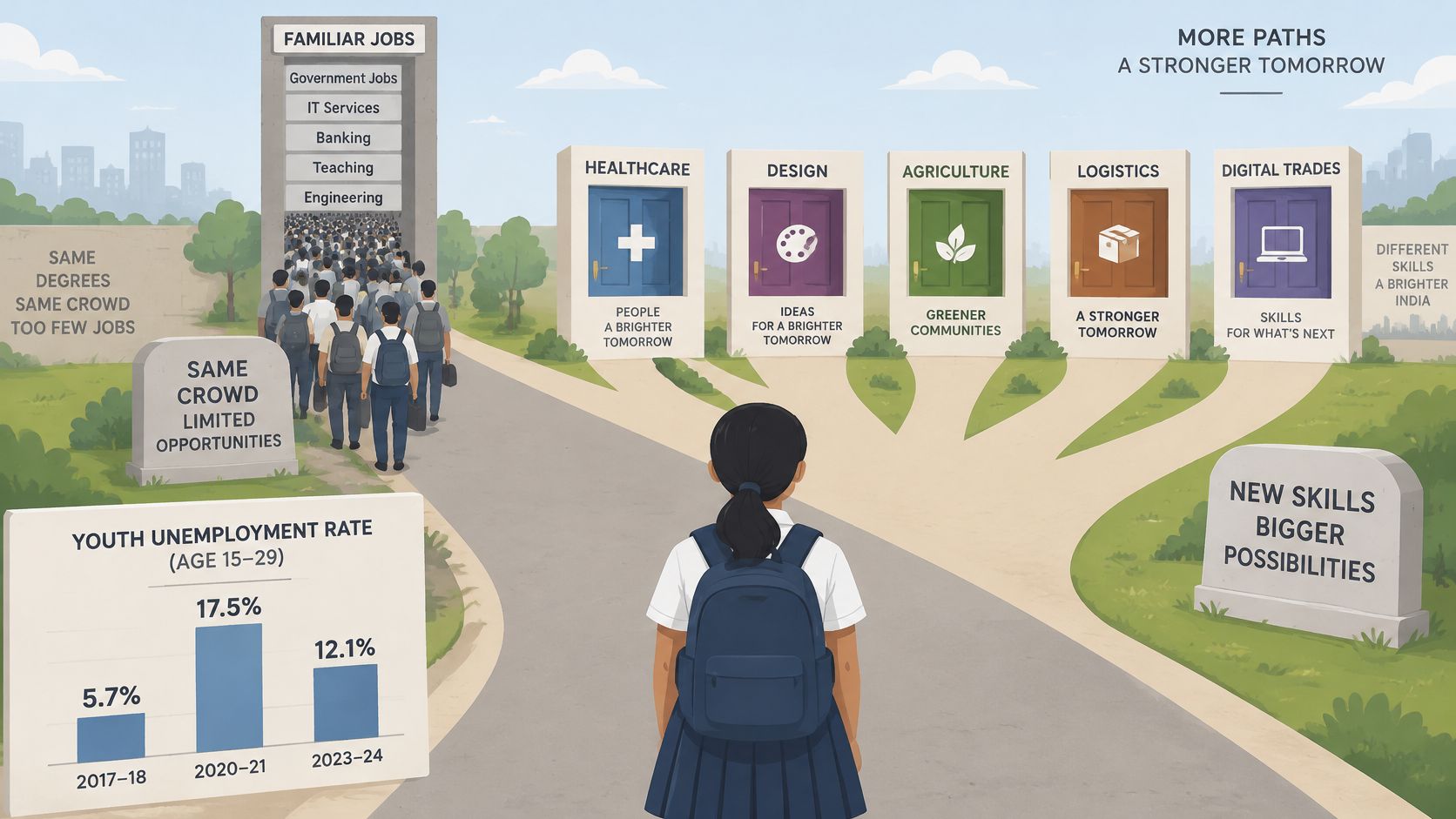
India's youth unemployment rose from 5.7% in 2000 to 17.5% in 2019, before declining to 12.1% in 2022, according to the International Labour Organization's India Employment Report 2024. These figures don't predict an individual student's outcome, but they underline why choosing a familiar job title isn't sufficient preparation.
A wider comparison helps students distinguish the work itself from the prestige attached to its name.
Career clusters, entry routes and subjects that keep options open
| Cluster | Example roles | Common entry routes | Subjects that keep options open |
|---|---|---|---|
| Engineering and technology | Software developer, civil engineer, data analyst | B.E./B.Tech through JEE or state exams; diploma and eligible lateral-entry routes | Mathematics, Physics |
| Medicine and health sciences | Doctor, nurse, physiotherapist, lab technician | MBBS/BDS through NEET; nursing, physiotherapy and laboratory programmes | Physics, Chemistry, Biology |
| Commerce, finance and business | Chartered accountant, banker, business analyst | B.Com, BBA, professional accounting routes; CUET or university admission processes | Mathematics, Economics, Commerce |
| Law and public service | Lawyer, policy researcher, civil services aspirant | Integrated law programmes through CLAT or other admission routes; degree followed by relevant recruitment exams | Humanities, Economics, English |
| Design, media and communication | UX designer, animator, journalist, content strategist | Design entrance tests, media degrees and portfolio-based admissions | Art, English, Computer Science |
| Skilled trades and technical vocations | Electrician, automobile technician, IT hardware technician | ITI, polytechnic diploma, apprenticeships | Basic Mathematics, workshop practice |
| Teaching and research | School teacher, lecturer, research scientist | Eligible teacher-education routes; postgraduate study and research qualifications | Subject of specialisation, strong English |
Compare tasks, not just titles
The table is an exploration map, not an eligibility guarantee. Students should select a couple of promising clusters and compare their tasks, training requirements and practical constraints.
Medicine and engineering require especially careful subject checks. Commerce and humanities applicants should verify whether the chosen institution uses CUET, another test or a different admission process; vocational applicants should check the particular programme's entry requirements.
Consider a student who draws well but struggles with Mathematics. Communication design, animation and mass communication merit comparison with architecture, rather than assuming all visually creative careers require the same preparation.
A searchable list of career roles can help turn a broad cluster into specific occupations. Each shortlisted role needs a question about daily work, entry requirements or skill development.
The following video can accompany a guided career-exploration discussion.
The exercise is straightforward: the student records several roles across different clusters, with an unanswered question beside each. That produces a research list rather than another premature commitment.
How to Check Cost, Eligibility and Timelines for Each Route
Families can recognise an occupation without knowing how to finance the qualification leading to it. Tuition alone isn't the price of a pathway, and a scholarship application isn't the same as confirmed funding.
Every shortlisted route needs a written check against current institutional information. Brochures can introduce a programme, but admission notices, fee schedules and scholarship conditions should support the final decision.
Checks to complete for every route before committing
| Check | What to verify | Common miss |
|---|---|---|
| Total cost | Tuition plus hostel, transport, books, examination and application fees throughout the course | Comparing tuition only |
| Entrance exam | Exam name, permitted attempts, registration window, syllabus and result date | Missing registration |
| Prerequisite subjects | Required school subjects and minimum marks | Discovering a missing subject too late |
| Scholarships and aid | Central, state and institutional schemes, income limits and deadlines | Applying after the deadline |
| Location and mobility | Distance, accommodation and language of instruction | Assuming local availability |
| Duration and exits | Time to qualification, lateral entry and credit-transfer conditions | Assuming every qualification transfers |
| Job pathway | Recruitment routes, starting roles and required registration | Accepting placement claims without checking |
Calculate the household commitment
A spreadsheet should list expenses for every academic year, including deposits, equipment, accommodation, travel and application charges. Families can then subtract confirmed aid, while keeping conditional or competitive scholarships in a separate scenario.
The affordability question is whether the household can sustain the route, not merely pay the first instalment. A gap year adds preparation and living expenses; moving city adds accommodation and travel commitments.
Entrance rules also need careful reading. Where an examination limits attempts, the student should verify remaining eligibility before treating another attempt as an available fallback.
For a design applicant, bridging the portfolio gap before university from The Online College of Art & Design (OCAD) offers a relevant preparation resource. Any additional course still belongs in the cost calculation, and students should check whether their target institution requires that preparation.
A lower-cost route is useful only when its qualification, practical training and next-step opportunities support the intended work.
Compare alternatives to the same goal
For a student exploring graphic design, the comparison could read:
- Plan A, specialist design degree: Record the full-course cost from the institution's fee schedule and the exact entrance-registration and application deadlines.
- Plan B, accessible local degree with design practice: Record degree fees, commuting, software and portfolio-development expenses, alongside the college's admission deadline.
- Plan C, practical diploma: Record course fees, equipment, travel and the application closing date, then check progression opportunities.
No invented price makes this comparison useful. The student needs actual amounts, dated fee documents and calendar entries, plus a clear answer to what happens if the preferred offer doesn't arrive.
How to Test Options Through Experience and Build a Fallback
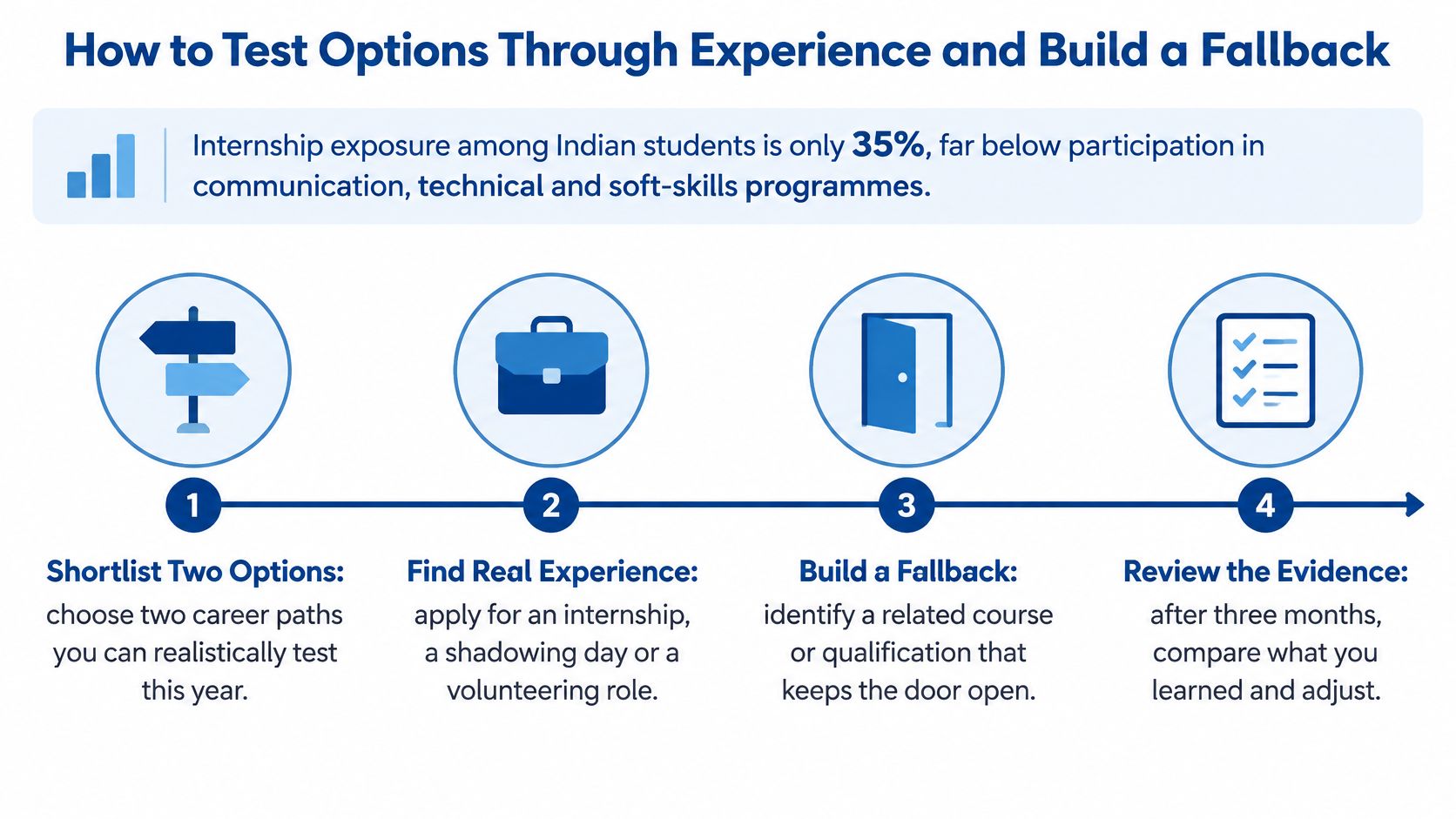
An India-focused employability review reported internship exposure at only 35% among the study participants, highlighting limited practical exposure alongside skills-development participation in the published review. That finding shouldn't be read as a school-wide rate, but it supports a practical question: has the student tried anything resembling the proposed work?
A school project, supervised community assignment or work simulation can provide useful evidence without requiring formal employment.
Run a supervised work experiment
The cycle starts with the target role's requirements, followed by a gap check, an applied task and feedback. For a school-age student, a trusted adult should help arrange safe, age-appropriate participation.
Consider a hypothetical Class 11 student interested in graphic design. A short poster project for a local shop could involve interpreting a brief, drafting alternatives, responding to written feedback and delivering the final files.
The student keeps the original brief, drafts, finished poster and feedback in a portfolio. A reflection log records which tasks felt engaging, which needed assistance and whether the student enjoyed revisions as much as the initial creative work.
The visual below summarises how testing and fallback planning can work together.
Review separate capabilities
A completed project shouldn't receive only a single overall judgement. Feedback becomes more actionable when it separates:
- Communication: Understanding the brief and explaining choices.
- Technical capability: Using tools and preparing usable files.
- Problem-solving: Adapting when the first draft doesn't work.
- Professional behaviour: Meeting commitments and responding constructively.
A career-report review can support the discussion, but the project evidence should remain visible. A prediction about fit is less useful than a clear explanation of what the student managed and what still needs practice.
The design student might retain a design degree as the primary route and a Commerce route with continued portfolio work as an alternative. That fallback needs its own affordability and admission checks.
Switch conditions: The family should name the events that would activate the alternative, such as an unaffordable final offer or failure to meet a required admission condition.
A fallback isn't a punishment for missing the preferred route. It's a prepared response to a defined outcome.
Handling Anxiety and Family Pressure Without Stalling
The 2025 IC3 Student Well-Being Pulse, covering 8,542 students in Classes 8–12, found that nearly half had never received structured career counselling and more than 40% didn't know where to access mental-health support at school, according to Curriculum Magazine's coverage. A student's uncertainty may therefore reflect distress or missing support, not missing career information.
An assessment result can't settle a decision when the student feels frightened, exhausted or unable to disagree with adults. Emotional readiness belongs in the planning process.

Notice patterns without diagnosing
Exhaustion across subjects, disrupted sleep and reduced enjoyment beyond school deserve attention before a major pathway decision. Difficulty concentrated around a particular subject may prompt a different conversation, especially when related activities remain interesting.
Neither pattern proves burnout or subject mismatch. Persistent low mood, anxiety or impaired daily functioning calls for support from a school counsellor, trusted teacher or healthcare professional.
Refresh Psychiatry & Therapy's guide to recognizing back-to-school anxiety symptoms can help adults prepare that conversation. It shouldn't replace individual assessment or local professional support.
A small, reversible experiment can reduce the pressure to decide everything immediately. A subject project, supervised shadowing opportunity or brief skills challenge gives the student something observable to discuss.
Prepare a parent conversation around concerns
A productive family discussion needs more than a preferred career name. The student can bring:
- Evidence of fit: The self-check summary and examples of completed work.
- Feasible alternatives: Cost-checked routes with admission requirements.
- A question for parents: Which concern matters most, affordability, security, distance or academic readiness?
- A review agreement: A calendar date and the evidence needed before reconsideration.
Parents can then evaluate a proposal rather than react to an unfamiliar occupation. Students should revisit the decision after meaningful evidence, such as results or project feedback, rather than interpreting a difficult week as proof that the whole plan is wrong.
Confirm Your Next Step This Term
The student should select the decision with the nearest confirmed deadline from the school-stage timeline. That decision becomes the centre of a one-page plan, rather than remaining part of a vague intention to become successful.
The page should be short enough for a teacher or parent to review without searching through multiple reports. Every unfinished check needs a named person responsible for completing it.
Make the plan checkable
A useful working page contains:
- Main route: Intended course or qualification, institution shortlist and verified eligibility.
- Fallback route: A viable alternative, not just another institution with the same unaffordable fees.
- Financial commitment: Total cost and funding assumptions for each route.
- Application dates: Confirmed registration, submission and payment deadlines.
- Practical test: The task that will produce evidence during the term.
- Review appointment: A calendar date, participants and the information they'll examine.
This page makes missing information visible. A blank fee estimate or unconfirmed eligibility condition becomes an action to complete, not a detail to overlook.
Use available guidance
Edvdo's process follows Assess, Explore, Connect and Track: evaluating strengths, interests and goals; exploring personalised careers and academic pathways; connecting with an expert career counsellor; and monitoring progress. For a counselling session, students only need to provide their academic background and career aspirations.
A school counsellor, teacher or informed family member can also help organise questions, inspect assumptions and keep the next action manageable. The student should use whichever appropriate support is available first, while seeking specialist advice for admission, financial or health questions beyond that person's expertise.
The test of a useful plan is practical. The student can explain the action due shortly, identify the evidence being collected and name what would justify changing direction.
Edvdo offers a free first career counselling session to help students connect their strengths and aspirations with academic choices. Students and families can visit Edvdo with their academic background, career aspirations and nearest decision deadline to begin turning uncertainty into a workable next step.