
Two students chose Humanities in Class 11. One enjoys challenging a textbook's argument and wants to study law; the other notices how people behave in groups and is drawn to psychology. Their school subjects overlap, but their next steps should look very different.
Humanities after Class 12 isn't a single path. The main humanities courses after 12th include broad academic degrees, professional programmes, creative training and community-focused qualifications. Choosing between them means comparing everyday work, not just collecting course names.
Parents often worry that Arts offers limited career options. That overlooks pathways into law, psychology, design, media, economics, languages, teaching and social work. None guarantees employment, and each demands skills beyond passing examinations.
A useful starting distinction
- Academic degrees develop subject knowledge and research skills, often supporting postgraduate study.
- Professional programmes connect study with occupational training, although recognition and practice requirements need checking.
- Creative programmes demand sustained practice, critique and a portfolio or performance record.
An international perspective, such as Keybaki's guide to Social Sciences, can broaden subject awareness, but Indian institutional notices must determine admission decisions.
The strongest shortlist connects interest with evidence: enjoyment of reading, comfort with numbers, willingness to practise, or patience with people. The options below give students and parents practical ways to test those connections.
Table of Contents
- 1. BA Specialisations (General and Honours) After Class 12
- 2. Psychology (BA or BSc Honours in Psychology)
- 3. Law (Five-Year Integrated BA LLB, BBA LLB, and Other Law Pathways)
- 4. Journalism and Mass Communication (BJMC and Related Programmes)
- 5. Design (Bachelor of Design and Related Creative Pathways)
- 6. Social Work (BSW and Community Development Pathways)
- 7. Economics (BA or BSc Honours in Economics)
- 8. Foreign Languages (BA in French, German, Spanish, Japanese, and Other Languages)
- 9. Teaching-Related Pathways (B.El.Ed and Integrated BA B.Ed)
- 10. Fine Arts and Performing Arts (BFA, BA in Music, Dance, Theatre, and Visual Arts)
- How the 10 humanities pathways compare at a glance
- Shortlist Three Courses and Test Them Against Your Strengths
1. BA Specialisations (General and Honours) After Class 12
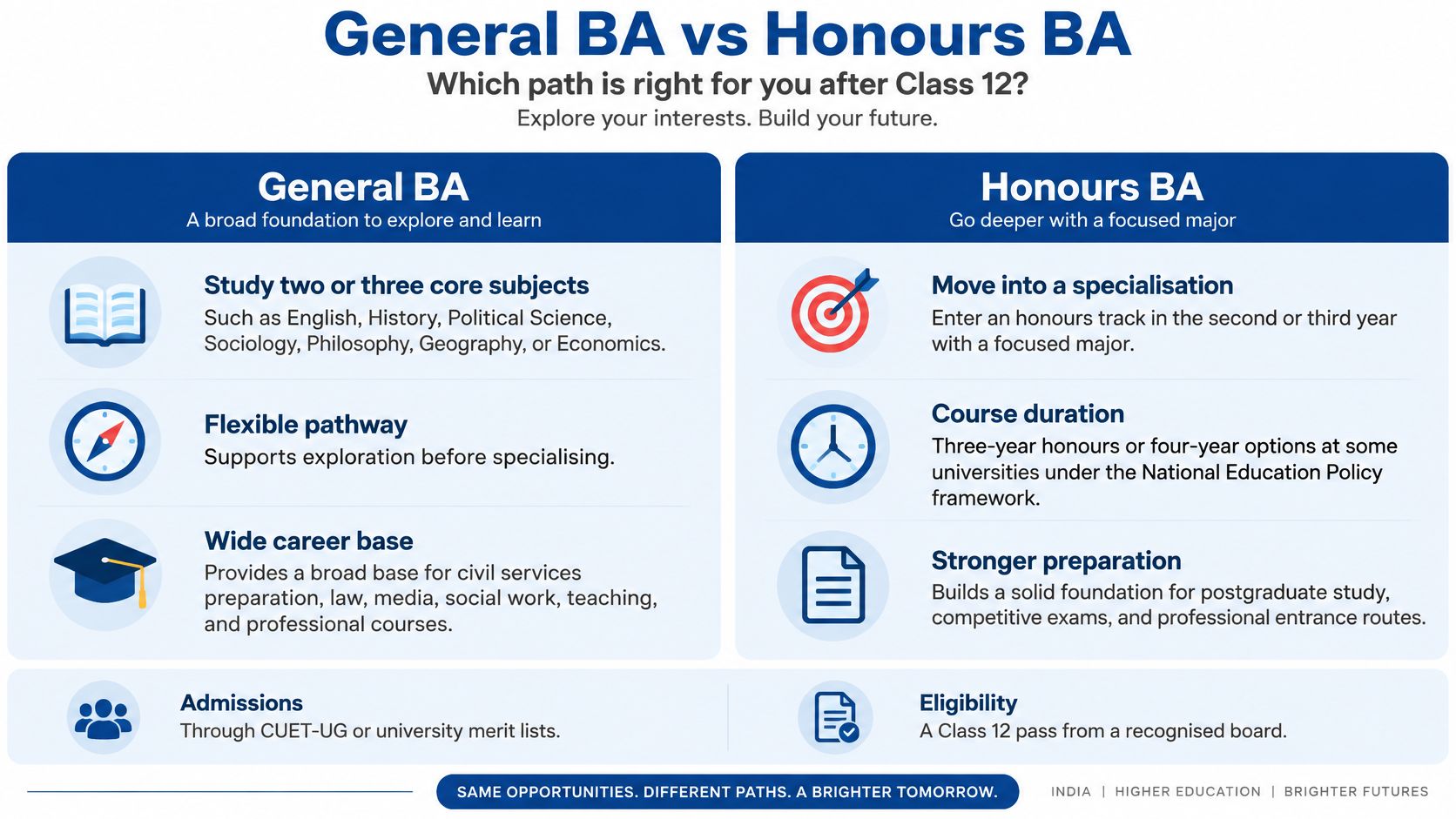
A BA suits students who enjoy reading, discussing ideas and developing arguments. English, History, Political Science, Sociology, Philosophy and Geography involve different methods, so choosing a subject matters more than choosing the BA label.
A broad BA allows exploration across subjects; an honours pathway usually involves greater concentration in a discipline. Students should verify the actual structure, duration, major-minor choices and research options in the university's current prospectus.
Connect subjects with a next step
A student interested in heritage could compare History programmes, then practise source evaluation through a local-history project. Someone considering journalism could combine literature or political study with reporting and editing work.
Lady Shri Ram College for Women, Delhi, and Presidency University, Kolkata, are useful institutions to investigate for subject-specific undergraduate options. Current programme names and admission conditions need confirmation on their official sites.
- Admission check: Verify school-subject requirements, minimum marks and the applicable entrance or merit route.
- Career direction: Consider publishing, research support, communications or further professional study, with additional training where needed.
- Shortlisting test: Complete a reading-based essay and assess whether interpreting evidence remains enjoyable after revision.
The humanities career options resource supports wider exploration, while an interest test offers a starting point for reflection rather than an admission decision.
2. Psychology (BA or BSc Honours in Psychology)
Empathy and observation are promising starting points for psychology, but they aren't enough. Students must also enjoy research, careful documentation and examining whether evidence supports an explanation.
Psychology degrees introduce behaviour, cognition, development, social processes, research methods and statistics. Students should compare the BA and BSc syllabuses directly rather than assuming that the degree title reveals the mathematical or scientific workload.

Separate studying psychology from practising professionally
An undergraduate degree isn't an automatic qualification to provide independent therapy. Before enrolling, students should verify the recognised training, supervised practice and registration requirements for the intended role with the relevant professional authority, including the Rehabilitation Council of India where applicable.
A student interested in workplace behaviour could investigate HR internships and research projects. A student aiming for clinical practice must plan for the relevant further qualifications, not assume immediate entry after graduation.
- Programme check: Verify duration, eligibility, entrance papers, laboratory work and supervised field exposure on official institutional sites.
- Shortlisting test: Read a psychology research summary and explain its method, findings and limitations.
A personality reflection tool can prompt useful questions, but it can't establish professional suitability. The guide to choosing a stream after Class 10 also helps families revisit the reasons behind earlier subject choices.
3. Law (Five-Year Integrated BA LLB, BBA LLB, and Other Law Pathways)
Law suits analytical thinkers who can read closely, distinguish evidence from assertion and construct a clear argument. Enjoying debates helps, but legal study also involves patient reading, drafting and revision.
The Consortium of National Law Universities' institutional brochure describes NLU Assam's integrated BA LL.B. as a five-year programme combining humanities and social-science subjects with legal education.
Compare the route, not just the college name
BA LLB and BBA LLB combine different undergraduate foundations with law. Students should compare their non-law subjects, internship support, assessment methods and total costs.
National Law School of India University, Bengaluru, and National Law University, Delhi, are relevant institutions to investigate. Applicants must verify each institution's current entrance route, including whether CLAT, AILET or another process applies, rather than treating all law admissions as identical.
Practical rule: Before paying an admission fee, verify the programme's Bar Council of India approval and the current requirements for entering legal practice.
A useful shortlisting exercise is to read a case summary, identify the legal issue and write arguments for both sides. Possible directions include litigation, corporate legal work, compliance and policy, subject to the qualifications and selection conditions of each role.
The explanation of professional courses helps distinguish occupational training from a general academic degree.
4. Journalism and Mass Communication (BJMC and Related Programmes)
A student who keeps asking why a local road floods, who approved a project or how a rumour spread has a useful starting instinct for journalism. Curiosity must be paired with accuracy, clear communication and the willingness to correct mistakes.
BJMC and related programmes cover reporting, editing, media ethics, audio-video production and digital publishing. Students should verify duration, entry requirements and whether admission uses CUET, an institutional examination, an interview or merit.

Test reporting before choosing the degree
A practical project could investigate accessibility around a railway station. The student would interview users, check official information, request a response from the responsible authority and produce a balanced article or video.
The Indian Institute of Mass Communication, New Delhi, is relevant when researching later journalism training. Applicants should distinguish its postgraduate offerings from courses available immediately after school.
- College check: Examine student publications, equipment access, internship arrangements and feedback on actual reporting.
- Career direction: Compare newsroom reporting, digital production, public relations and corporate communications.
- Shortlisting test: Produce an original report with attributable sources, then edit it after critical feedback.
Media work involves deadlines and repeated revisions. Enjoying social media alone isn't sufficient evidence of fit.
5. Design (Bachelor of Design and Related Creative Pathways)
Design is not just drawing well. It involves understanding a problem, studying users, producing alternatives, and improving a solution after criticism.
B.Des and related pathways include communication, product, textile, fashion and interaction design. Creative problem-solvers should compare studio demands, materials, software access and the balance between artistic expression and practical problem-solving.

Check eligibility before entrance preparation
National Institute of Design, Ahmedabad, and IIT Bombay are useful starting points for investigating undergraduate design. Students must verify current programme duration, subject eligibility and the applicable entrance process on official admissions pages.
Applicants comparing NID DAT, UCEED or other design examinations should check both examination eligibility and the admission rules of each participating institution. Eligibility to take an examination doesn't automatically establish eligibility for every programme.
A useful design portfolio explains the problem, rejected alternatives and revisions, not just the finished image.
For a practical test, a student could redesign a confusing school noticeboard. Interviews, sketches, a prototype and user feedback would reveal whether the student enjoys the process.
Career directions include visual communication, product development and interaction design. Entry depends on the relevant technical skills, portfolio quality and recruitment process, not the degree title alone.
6. Social Work (BSW and Community Development Pathways)
Social work deserves serious consideration from students who want practical, community-facing work. It suits empathetic students who can listen without judgement, maintain boundaries and remain dependable when situations become emotionally difficult.
BSW programmes address social policy, community development, research methods and field practice. Applicants should verify programme duration, entry conditions, delivery mode and fieldwork arrangements through official institutional information.
Fieldwork matters more than a persuasive brochure
IGNOU is an option to investigate for flexible BSW study. Tata Institute of Social Sciences is relevant to social-work education, but applicants must verify the current undergraduate qualification and campus rather than assuming that every campus offers a BSW.
A student could volunteer with a local organisation supporting school attendance. Documenting participation, speaking respectfully with families and following safeguarding procedures would provide a better test than enjoying charity events.
- Placement check: Look for structured supervision, named field partners and clear assessment of practical work.
- Career direction: Explore NGO programme support, community mobilisation and development-sector roles, with further study for specialised responsibilities.
- Shortlisting test: Reflect on whether regular field visits, documentation and difficult conversations remain motivating.
A values reflection exercise can help distinguish a sustained commitment to service from a general wish to help. Students should also consider travel, language skills and personal resilience.
7. Economics (BA or BSc Honours in Economics)
Economics is a strong option for students who enjoy both social questions and numerical reasoning. It isn't a route for avoiding mathematics.
Undergraduate study commonly includes microeconomics, macroeconomics, statistics, econometrics and development economics. Applicants should inspect the syllabus and verify duration, Mathematics requirements, minimum marks and entrance-paper combinations.
The official CUET syllabus page includes Economics/Business Economics, but students must match their examination choices to each university's programme requirements.
Try the analytical work
A student interested in food prices could compare household expenditure patterns, create a spreadsheet chart and explain competing causes of price changes. Enjoyment of that process is a stronger signal than an interest in stock-market headlines alone.
Presidency University, Kolkata, is worth investigating for undergraduate economics. Delhi School of Economics is relevant to longer-term economics study, but applicants should distinguish its offerings from undergraduate admissions across University of Delhi colleges.
- Skill priority: Strengthen algebra, statistics, spreadsheet analysis and clear interpretation of charts.
- Career direction: Investigate research assistance, banking-related recruitment, analytical support and policy study.
- Further-study check: Examine postgraduate prerequisites early, especially for research-intensive careers.
Economics graduates don't automatically become economists, investment bankers or policy advisers. Those directions involve different selection processes, technical skills and, frequently, further qualifications.
8. Foreign Languages (BA in French, German, Spanish, Japanese, and Other Languages)
Foreign-language study suits students who enjoy repeated practice, cultural exploration and communicating despite mistakes. Enthusiasm for films or travel helps, but daily listening, vocabulary revision and speaking practice determine progress.
Degree programmes can include literature, linguistics, culture and translation alongside language learning. Students should verify which languages an institution currently offers, whether prior proficiency is needed, the programme duration and its admission route.
Combine language with another capability
Jawaharlal Nehru University, New Delhi, is a useful institution to investigate for language programmes. Applicants must check the current prospectus for the precise qualification and available languages.
A student interested in Japanese and digital products could practise translating interface text, then study localisation principles. Another interested in French and tourism could develop guided explanations of local heritage.
- Career direction: Compare translation, interpretation, localisation, teaching and international customer-support roles.
- Professional check: Verify role-specific proficiency tests, certification and specialist knowledge.
- Shortlisting test: Sustain introductory learning and conversation practice before committing to a degree.
An exploratory resource to learn the Irish language illustrates how students can test language-learning habits beyond school subjects. It isn't a substitute for checking Indian degree eligibility.
Language proficiency can complement law, media or economics; it doesn't automatically provide entry into diplomacy or international organisations.
9. Teaching-Related Pathways (B.El.Ed and Integrated BA B.Ed)
Teaching suits students who enjoy explaining ideas, noticing misunderstandings and adapting an activity when children struggle. Patience matters, but so do preparation, subject knowledge and classroom judgement.
B.El.Ed and integrated BA B.Ed pathways combine educational study with practical preparation. Students should verify the exact qualification, duration, teaching-stage coverage and school-placement arrangements on official institutional sites.
Match the qualification to the intended classroom
Elementary teaching and secondary subject teaching aren't interchangeable career targets. Applicants should confirm current National Council for Teacher Education recognition and the recruitment requirements of the school system they hope to enter.
Where an institution offers an integrated teacher-education programme, applicants should verify whether NCET or another admission route applies. Teacher-eligibility tests and recruitment examinations must be checked separately from admission to the degree.
Fit check: Enjoying a subject isn't the same as enjoying the work of helping someone else understand it.
A practical test could involve tutoring a child in reading comprehension. The student should prepare an activity, observe mistakes and change the explanation rather than repeat it louder.
Career directions include school teaching, educational content and learning-support work, subject to role-specific qualifications. Parents should compare supervised teaching practice, language of instruction and local recruitment conditions before choosing a college.
10. Fine Arts and Performing Arts (BFA, BA in Music, Dance, Theatre, and Visual Arts)
Artistic commitment matters more than occasional inspiration. Fine arts and performing arts suit students willing to practise consistently, accept critique and continue working without immediate recognition.
BFA and specialised BA programmes combine practical training with history, theory and criticism. Students must verify duration, portfolio or audition requirements, prior-training expectations and the exact qualification awarded.
Compare training environments
The Faculty of Fine Arts at M.S. University of Baroda is relevant to visual-arts exploration. Kalakshetra Foundation, Chennai, is relevant to classical performance training, but applicants should verify the qualification rather than assuming every arts programme awards a degree.
A theatre applicant could prepare a performance reel and keep notes on rehearsals. A visual-arts applicant could develop a connected portfolio showing observation, experimentation and revision.
- Career direction: Consider artistic practice, production support, arts administration and teaching with the necessary additional qualifications.
- Shortlisting test: Use a skills reflection exercise alongside portfolio feedback and sustained practice.
- Comparison resource: Students considering overseas training can explore standout musical theater schools, while checking costs and recognition independently.
Performance material can prompt discussion about technique and presentation.
How the 10 humanities pathways compare at a glance
| Item | Typical duration | Main admission route | Best suited to |
|---|---|---|---|
| BA Specialisations (General and Honours) After Class 12 | 3 years; honours or 4-year options may be available | CUET-UG, merit lists, or institution-level tests | Students seeking a flexible humanities pathway |
| Psychology (BA or BSc Honours in Psychology) | 3 years; postgraduate study typically adds 2 years | CUET-UG, merit lists, or institution-specific tests | Empathetic, observant students interested in human behaviour |
| Law (Five-Year Integrated BA LLB, BBA LLB, and Other Law Pathways) | 5 years | CLAT, AILET, LSAT India, or institution-specific tests | Analytical students who enjoy reading and building arguments |
| Journalism and Mass Communication (BJMC and Related Programmes) | 3 years | University entrance tests, CUET-UG where applicable, or institution-specific tests | Curious, communicative students interested in news and media |
| Design (Bachelor of Design and Related Creative Pathways) | 4 years for B.Des | NID DAT, UCEED, NIFT Entrance Examination, or institution-specific tests | Creative problem-solvers interested in designing for users |
| Social Work (BSW and Community Development Pathways) | 3 years | Institution-specific tests, merit, or open and distance options | Empathetic, resilient students motivated by community service |
| Economics (BA or BSc Honours in Economics) | 3 years | CUET-UG, merit lists, or university-specific tests | Analytical students comfortable with numbers and policy questions |
| Foreign Languages (BA in French, German, Spanish, Japanese, and Other Languages) | 3 years | CUET-UG, institution-level tests, or merit lists | Students interested in languages, cultures, and cross-border communication |
| Teaching-Related Pathways (B.El.Ed and Integrated BA B.Ed) | 4 years | State-level tests, institution-specific tests, or merit | Students who enjoy working with children and planning learning activities |
| Fine Arts and Performing Arts (BFA, BA in Music, Dance, Theatre, and Visual Arts) | 3–4 years | Auditions, portfolio reviews, or entrance tests | Artistically committed students willing to practise consistently |
Shortlist Three Courses and Test Them Against Your Strengths
The best courses after 12th humanities aren't the same for every student. A useful shortlist contains courses that match both interests and willingness to do the everyday work: reading judgments, analysing survey results, revising designs or preparing lessons.
For each option, students should record eligibility, entrance dates, programme duration and introductory subjects from the official university or college website. They should then identify a realistic career direction and the additional qualifications or practical evidence it requires.
The National Testing Agency's CUET website explains the common admission mechanism, but applicants must confirm programme-specific subject combinations and conditions with each university. An examination registration isn't proof of eligibility.
Common mistakes to avoid
- Choosing by prestige alone: Compare teaching, fieldwork, facilities, affordability, hostel access and language of instruction.
- Ignoring skill gaps: Psychology involves research methods; economics involves quantitative work; journalism involves verification.
- Treating further study as automatic: Check postgraduate prerequisites and professional recognition before admission.
- Believing guaranteed-placement claims: Examine published placement information, role descriptions and the students covered by it.
Edvdo is a Student Understanding & Decision Intelligence platform that supports reflection on interests, strengths, motivation and decision-making patterns through assessments and mentor tools. Its insights should support course comparisons, not replace official admission information or practical experience.
Frequently Asked Questions
Which BA courses after 12th offer the most flexibility?
A broad BA can support exploration, while honours study provides deeper subject concentration. Actual flexibility depends on available combinations, prerequisites and institutional rules.
Which humanities courses have high salary potential?
Searches for humanities courses with high salary shouldn't substitute for comparing roles. Law, design, economics and communications contain different employment markets, and no course provides a dependable salary promise.
What are realistic salary expectations?
Students should expect differences between salaried employment, freelance work, internships and further training. Current job advertisements and official placement reports are better comparison tools than an unsupported stream-wide salary range; living costs and unpaid training also affect affordability.
Are professional courses after 12th arts better than academic degrees?
Professional courses provide more occupation-focused preparation, while academic degrees support broader subject exploration. The better choice depends on the student's intended work and commitment to the training involved.
Families seeking a human conversation can use Edvdo's free first career counselling session. Sharing academic background and aspirations helps make that discussion specific, while the final decision should remain grounded in verified requirements and the student's own evidence of fit.
Edvdo offers structured assessments, guided activities and the Vedu AI mentor to help students understand their strengths, motivations and learning patterns. Students comparing humanities pathways can visit Edvdo to connect self-reflection with course exploration and practical next steps.