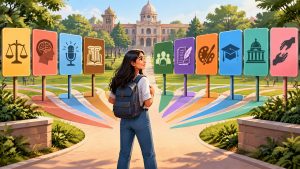

A Class 10 student enjoys discussions about why people behave differently and how societies change. At home, the parents expect Science because it feels like the safer choice. The school's subject-selection form turns that difference into an immediate decision.
Arts, also called Humanities, centres on people, societies, languages, ideas and creative expression. Choosing these subjects isn't just choosing an alternative to Science or Commerce. Students also choose the reading, writing, research and practical work they'll spend their senior-secondary years doing.
The arts subject list includes History, Political Science, Geography, Economics, Sociology, Psychology, Philosophy, languages, Fine Arts and Music. Schools may also offer subjects such as Physical Education, Home Science, Legal Studies, Fashion Studies or skill-based electives. No school should be assumed to offer the entire humanities subjects list.
The Ministry of Education's National Education Policy page explains the policy's rejection of rigid separation between arts and sciences or between academic and vocational streams. That supports exploring combinations beyond familiar stream labels, but it doesn't guarantee that a particular school can offer them.
A useful subject choice matches the student's curiosity with the work the subject actually requires, not just its name.
For a family comparing options, the starting point is straightforward: understand each subject, try a representative task and check the school's approved combinations. Future course eligibility matters too, especially when a degree requires a particular school subject.
Table of Contents
- 1. History
- 2. Political Science
- 3. Geography
- 4. Economics
- 5. Sociology
- 6. Psychology
- 7. Philosophy
- 8. Languages (English, Hindi, and Foreign Languages)
- 9. Fine Arts (Visual Arts and Painting)
- 10. Music (Hindustani, Carnatic, and Western)
- How the 10 Arts Subjects Compare at a Glance
- Turning the Arts Subject List Into a Confident Choice
1. History
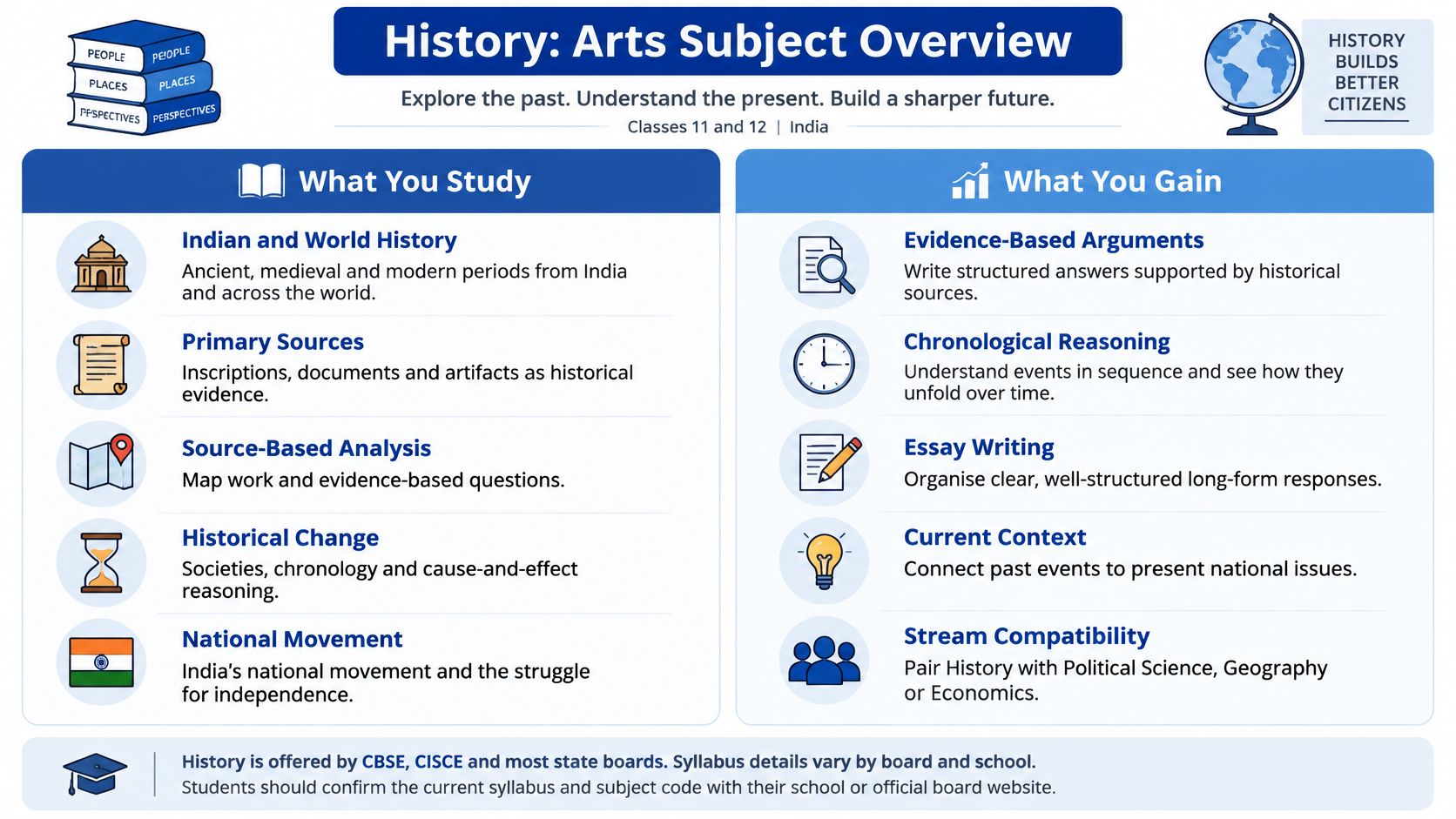
History asks how people lived, what changed and how historians know. Students work with evidence such as inscriptions, letters, buildings, photographs and accounts written by historians. The subject involves interpreting that evidence, not merely remembering events.
Depending on the board and syllabus, senior-secondary History may include selected themes from Indian and world history. Ancient societies, medieval institutions, modern developments and the Indian national movement may feature, but families shouldn't assume that every period appears in every course.
The infographic provides a visual starting point for understanding the subject.
The History Fit Check
History suits students who ask why events happened and can support an explanation with evidence. Day to day, they'll read closely, organise notes, compare interpretations and write structured answers. Enjoying historical films helps with interest, but it doesn't replace comfort with sustained reading.
Consider a textbook account of a protest alongside a newspaper report from that period. A student might compare whose views appear, what each account leaves out and why their descriptions differ.
- Useful pairings: Political Science adds institutions and ideas; Economics adds questions about livelihoods and resources.
- Study habit: Timelines and concept maps connect causes, events and consequences better than isolated date lists.
- Practice task: A source-based answer should separate what a document states from what the student infers.
English, History, Political Science, Economics and Psychology form an illustrative combination where the school permits it. History can support exploration of further study in History, Journalism or Public Administration, without guaranteeing admission.
For students still comparing streams, the guide to choosing a stream after 10th offers a broader decision-making starting point.
2. Political Science
Why does a government need limits on its power? Who protects citizens' rights? Political Science gives students concepts for examining these questions without treating every political discussion as a contest of personal opinions.
School courses commonly introduce political theory, the Indian Constitution, political institutions and international relations. Students learn to distinguish a legislature from an executive, explain constitutional principles and compare arguments about democracy, equality and justice.
From News Opinion to Reasoned Explanation
Consider a disagreement over a public policy. A Political Science student should identify the institutions involved, explain the competing rights or interests and examine the reasons behind each position. Agreeing with a political party isn't enough.
The subject suits students interested in public affairs who are willing to read carefully and define terms precisely. Debate and Model United Nations can strengthen engagement, but confident speaking doesn't automatically produce a well-supported written answer.
- Daily demand: Textbook reading, concept revision and organised short and extended responses.
- Natural pairings: History provides context; Sociology examines social groups; Economics explains policy trade-offs.
- Useful practice: Reading the Constitution's Preamble alongside textbook explanations helps connect abstract principles with actual wording.
A student interested in Law, Public Policy or International Relations might consider English, Political Science, History, Economics and Sociology, subject to school approval. None of those interests makes the combination a universal admission requirement.
The guide to further study and career options in Humanities can help families explore related pathways. University eligibility should still be checked separately, rather than inferred from a subject's apparent relevance.
3. Geography
A flooded street is a Geography question as well as a drainage problem. Students can examine rainfall, slope, land use, construction and the movement of people through the affected area. Geography connects physical environments with human decisions.
Senior-secondary courses often include physical geography, human geography and work with maps, diagrams or geographical information. Practical requirements depend on the board and subject specification, so families should check the actual assessment structure.
Map drawing illustrates the visual and spatial work students may encounter.

Who Usually Enjoys the Work
Geography suits students who notice patterns across places and enjoy connecting diagrams with written explanations. They should also be prepared to interpret data. It isn't a subject consisting only of map locations.
A useful trial task is to compare a neighbourhood map with observations of shops, housing and traffic. The student can explain why commercial activity clusters near a main road and what problems that creates for residents.
- Build spatial confidence: An atlas or Google Maps can help locate places mentioned in lessons.
- Practise explanation: Labelled diagrams should show processes, such as erosion or rainfall formation, rather than serve as decoration.
- Keep practical records: Completed exercises are easier to revise when maps, calculations and teacher feedback stay together.
Geography pairs well with Economics and Political Science for students curious about urban development, resources or regional inequality. English, Geography, Economics, Political Science and another approved elective form a possible combination.
Further study might include Geography, Environmental Studies or planning-related programmes. Some routes have additional subject requirements, so an interest in places alone doesn't establish eligibility.
4. Economics
A family deciding whether to save, spend or borrow is making an economic choice. Economics studies how households, businesses and governments use limited resources. Students examine both individual decisions and the wider economy.
Senior-secondary study commonly includes microeconomic ideas such as demand and supply, macroeconomic topics such as national income and banking, and statistical interpretation. Indian economic development may also form part of the course, depending on the syllabus.
The Important Question Is Comfort With Quantitative Work
Economics combines explanations, graphs and numerical reasoning. Students don't need to regard themselves as mathematical experts, but they should be willing to practise calculations and understand what a graph represents.
For example, a student can examine why tomato prices rise after heavy rain damages crops. A strong explanation separates a reduction in supply from a change in demand, then shows the difference on a graph.
Practical rule: Economics shouldn't be selected as an escape from numbers. Its quantitative demands deserve a trial before subject selection.
An illustrative combination for a student exploring Economics Honours is English, Economics, Mathematics, Political Science and History. Actual university requirements differ, and Mathematics or Applied Mathematics may be relevant to eligibility. Their acceptance shouldn't be assumed interchangeable.
- Study routinely: Numerical questions need repeated practice, not just reading.
- Explain graphs aloud: Students should be able to describe why a curve shifts.
- Use current examples: Union Budget and Economic Survey summaries can connect textbook ideas with public spending, employment and growth.
Economics also pairs with Geography for development questions or Sociology for inequality. It suits students who enjoy asking both what happened and what incentives or constraints helped cause it.
5. Sociology
Sociology begins with familiar situations and asks less familiar questions. Why are some household tasks assigned by gender? How does access to education differ between communities? What changes when a village becomes closely connected to a city?
The subject examines social relationships, institutions and social change. School courses may introduce socialisation, caste, class, gender, family, education and inequality, often through Indian examples.
Curiosity Needs Evidence
A student who enjoys discussing social issues may find Sociology engaging. The daily work, however, involves learning concepts, reading explanations and distinguishing a personal impression from a supported claim.
Consider a school project on access to public transport. A sociological approach would examine how location, income, gender or disability affects travel, rather than assuming that every student faces the same journey.
- Suitable strengths: Careful observation, reading comprehension and willingness to question assumptions.
- Useful pairings: Psychology examines individual behaviour; Sociology examines broader social patterns.
- Practice method: Defining a concept in plain language before applying it to an example makes longer answers clearer.
A possible combination is English, Sociology, Psychology, Political Science and History, where available. Sociology can relate to further study in Sociology, Social Work or Development Studies, but course prerequisites still need checking.
Availability can be limited, so a school's subject form matters more than a general online list. Teacher support and project expectations deserve attention too.
A student curious about unequal access to schooling might not initially recognise Sociology as a suitable option. A reflection exercise focused on recurring questions and reading interests can make that possibility clearer, without treating curiosity as proof of aptitude.
6. Psychology
Psychology examines behaviour, thinking and emotion through systematic study. It includes questions about learning, memory, motivation, development and personality. Depending on the course, students may also encounter mental health, research methods and practical work.
It isn't mind-reading, and studying it doesn't qualify a school student to diagnose classmates. Students need precise terminology, ethical awareness and evidence, as well as interest in people.
The illustration connects reflection with learning and emotion.

A Fit for Creative Problem-Solvers
Psychology deserves consideration from students who enjoy finding different explanations for behaviour. For example, a student struggling to revise may face distractions, unclear goals, anxiety or an ineffective study method. A thoughtful response examines these possibilities rather than labelling the student lazy.
Daily work includes reading, learning concepts, comparing explanations and writing careful applications. Any practical activities should follow the school's instructions and respect privacy.
- Helpful pairings: Sociology, English and Political Science offer related perspectives.
- Useful habit: A reflection journal can record study conditions and motivation without turning ordinary experiences into diagnoses.
- Trial task: Explaining a memory strategy in plain language tests understanding better than repeating its definition.
The personality reflection resource can support questions about personal preferences, but no personality label should decide a subject combination.
English, Psychology, Sociology, Political Science and Economics form a possible school-approved set. Psychology may also be offered alongside Science subjects in some schools, but timetable and board rules determine whether that arrangement is available.
Further study in Psychology has institution-specific requirements. Later professional practice involves additional qualifications, so school-level interest is an exploration stage, not a professional credential.
7. Philosophy
Can a statement be popular and still be wrong? Is an action fair because everyone follows the same rule? Philosophy asks students to examine the reasons behind their beliefs.
Senior-secondary courses may include logic, ethics and Indian or Western philosophical traditions. The exact content depends on the board and syllabus. Availability is limited in many schools, so Philosophy should never be assumed to appear on a local subject menu.
Enjoying Discussion Isn't the Only Fit Test
Philosophy suits students who can stay with an abstract question and revise an argument when it has a weakness. The work often involves dense reading, careful definitions and accurate summaries of different positions.
Consider a debate about whether school uniforms promote equality. A philosophical answer would define equality, identify the argument's assumptions and consider objections. Repeating a strong opinion wouldn't complete the task.
Students can test their interest through a short exercise:
- State a claim: Write a clear position on an everyday ethical question.
- Give reasons: Explain why the position should be accepted.
- Consider an objection: Present a serious challenge rather than an obviously weak opposing view.
- Revise carefully: Adjust the claim if the objection exposes a problem.
The student who enjoys changing a weak argument into a stronger one may find Philosophy more satisfying than the student who only enjoys winning debates.
Philosophy pairs naturally with Political Science, History and literature-based language courses. It can support exploration of Philosophy, Law or Public Policy, though those degrees don't necessarily require it at school.
Short introductory texts and discussion groups can help students test the fit before committing. The decisive question is whether the reasoning process itself remains interesting when the answer isn't obvious.
8. Languages (English, Hindi, and Foreign Languages)
Language subjects build the skills students use throughout Humanities: understanding a text, noticing tone, organising an explanation and expressing an idea clearly. Literature adds interpretation, while composition requires students to write for a purpose and audience.
English is compulsory in many schools, but families shouldn't treat that as a universal rule for every board. Hindi, regional languages, Sanskrit and foreign languages such as French, German or Spanish depend on the board's approved subjects and the school's provision.
Choosing Beyond Familiarity
Speaking a language comfortably doesn't automatically make its academic course easy. Literature, grammar, formal writing and examination expectations may demand skills that everyday conversation doesn't develop.
A student comparing English and Hindi electives could read a sample passage from each syllabus and write a short interpretation. The better fit may be the course whose texts and writing demands sustain interest, not merely the language spoken most often at home.
- Daily demand: Close reading, vocabulary development, drafting and revision.
- Useful pairings: Languages work well with History, Political Science, Sociology and creative subjects.
- Continuity check: A foreign-language option should be available through the final school year, with any prior-learning expectations made clear.
English Core, Hindi Elective, History, Political Science and Economics form an illustrative combination where approved. A second language can relate to further study in literature, languages, translation or journalism, but admission rules vary.
The subject exploration resource can provide a starting point for reflecting on subject comfort. Sample syllabus work remains important because a student needs to distinguish enjoying a language from enjoying its assessed course.
9. Fine Arts (Visual Arts and Painting)
A student who sketches constantly may welcome Fine Arts as an academic subject. The important next question is whether that student also enjoys practising technique, responding to feedback and completing work to a deadline.
Fine Arts offerings may include Painting, Sculpture or other visual disciplines. Students shouldn't assume that every school teaches all forms together. Depending on the course, study may combine practical work with art history, composition, colour and analysis of artworks.
From Enjoyment to Sustained Practice
A representative task is to arrange household objects, sketch their proportions and revise the drawing after feedback. This tests observation and patience more effectively than asking whether a student likes art.
Art-history content also needs checking. Indian miniature traditions or modern Indian art may appear, while Western art history shouldn't be assumed to feature in every board syllabus.
- Daily demand: Sketching, developing ideas, refining technique and maintaining practical work.
- Helpful pairings: History adds cultural context; English supports interpretation and written explanation.
- Application check: Fine Arts and Design programmes may have separate portfolio, entrance or practical requirements.
Students can use an interest reflection resource to consider whether visual expression is a lasting interest or an occasional hobby. Neither answer is a judgement of artistic worth.
English, Fine Arts, History, Psychology and another approved elective form a possible combination. Availability depends on teachers, facilities and the school's timetable.
A sketchbook can record experiments with drawing, painting, and collage. Gallery or museum visits can add context, but improvement still depends on regular practice. The subject isn't an effortless option just because students enjoy making things.
10. Music (Hindustani, Carnatic, and Western)
Music demands a different kind of study routine from a largely text-based subject. Students may need regular vocal practice or practice with instruments alongside theory, listening and written preparation. Interest in listening to music isn't the same as readiness for assessed performance.
The illustration shows creative practice in visual art; Music similarly requires consistent work, although its tasks and assessments differ.

Match the Course to Existing Training
Schools may offer particular Hindustani or Carnatic vocal or music subjects. Western Music depends on the relevant board and school. Families need the exact course name, not just an assurance that Music is available.
A student with classical vocal training might practise a prescribed composition, explain its rhythmic structure and prepare related theory. The fit depends on the student's training, willingness to practise and access to appropriate teaching.
- Check preparation: Prior training or an entry assessment may be expected.
- Plan practice: Rehearsal must fit alongside written subjects and other commitments.
- Explore pairings: English and History can complement interests in musical traditions and cultural studies.
This video provides an additional media resource alongside subject exploration.
A skills reflection resource can prompt students to separate current ability from willingness to improve. Teacher feedback and a realistic practice trial are more useful than assuming talent alone will carry the course.
Further study may include Music, cultural studies or arts administration. Performance-based programmes can set audition and other admission requirements independently of school subject selection.
How the 10 Arts Subjects Compare at a Glance
| Item | Core Focus | Practical Component | Typical Pairing | Best For |
|---|---|---|---|---|
| History | Indian and world events, societies, and change over time | Source analysis, map work, and evidence-based writing | Political Science, Geography, or Economics | Students interested in the past, current affairs, and structured argument |
| Political Science | Governance, constitutions, political ideas, and international relations | Current-affairs analysis, debate, and essay writing | History and Economics | Students interested in law, public policy, or public affairs |
| Geography | Physical environments, human settlements, and people-place relationships | Map work, diagrams, data interpretation, and possible projects | Economics and Political Science | Students interested in spatial thinking, environment, or urban planning |
| Economics | Choices about scarce resources, markets, and the wider economy | Graphs, data interpretation, and numerical practice | Mathematics, Political Science, or History | Students who enjoy combining social questions with analytical or quantitative thinking |
| Sociology | Society, social relationships, institutions, and social change | Observation and introductory surveys or interviews | Psychology and English | Students curious about communities, social issues, and human behaviour |
| Psychology | Behaviour, thought, emotion, learning, and personality | Research methods, simple experiments, and case studies | Sociology, Political Science, or English | Students interested in people, mental processes, or counselling and education |
| Philosophy | Knowledge, reality, ethics, logic, and reasoning | Argument analysis, discussion, and reflective writing | Political Science, History, or English | Students who enjoy abstract questions, debate, and critical reasoning |
| Languages (English, Hindi, and Foreign Languages) | Literature, grammar, comprehension, and communication | Reading, composition, and expressive writing | History, Political Science, or Economics | Students seeking strong communication skills or interested in literature and languages |
| Fine Arts (Visual Arts and Painting) | Visual expression, composition, design, and art history | Studio work and portfolio development | History and English | Students interested in creating art or pursuing design and fine arts |
| Music (Hindustani, Carnatic, and Western) | Musical performance, theory, rhythm, and traditions | Instrumental or vocal practice and practical examinations | English and History | Students with musical interest or training who enjoy regular practice and performance |
Turning the Arts Subject List Into a Confident Choice
A student can begin by shortlisting three subjects that match recurring interests. Each should then be tested against actual coursework, current strengths, preferred ways of learning and future eligibility. Interest matters, but the work must also be sustainable.
Families should confirm the exact subjects through the current CBSE, CISCE or relevant state-board curriculum and the school's approved offering. Official recognition and local availability are different questions. A school may not have the teacher, facilities or timetable space for an otherwise recognised subject.
Compulsory Subjects and Optional Choices
The subjects in Arts stream combinations aren't identical everywhere. Schools commonly specify a required language and offer electives within approved arrangements. Optional subjects in Humanities may also compete for the same timetable slot, making an otherwise attractive combination unavailable.
Arts subjects in Class 11 should be chosen with continuity in mind. Arts subjects in Class 12 shouldn't be treated as an entirely fresh selection. Families need the school's rules on continuation, changes and any additional subject before signing the form.
Check Future Study Without Predicting a Career
Subject relevance and admission eligibility aren't the same. History may help develop skills useful in Journalism, while a particular journalism programme may not require History. Economics-related degrees may have specific mathematical prerequisites.
The best Arts subjects after 10th therefore depend on the student and the intended route. Families should check university eligibility, entrance-test subject requirements and practical or portfolio expectations separately.
Avoid the Common Selection Traps
- Following friends: Shared interests don't guarantee shared learning strengths or study habits.
- Choosing an apparently easy subject: Psychology needs terminology, Geography can involve practical work, and Fine Arts requires sustained production.
- Starting with salary expectations: A subject doesn't guarantee an occupation, income or admission outcome.
- Confusing preference with a fixed learning style: Students can develop unfamiliar skills rather than avoiding every demanding task.
Frequently Asked Questions
Does every school offer the complete arts subject list?
No. The school's approved subjects, teachers, facilities and timetable determine the actual choices.
Can Humanities include Mathematics or creative electives?
Sometimes. Arts stream subject combinations depend on the board's rules and the school's arrangements, so permission must be confirmed locally.
Is Psychology compulsory for a Psychology degree?
Not universally. The relevant institution's current eligibility rules determine which school subjects are required.
Which combination is best?
There isn't a universally best combination. A suitable set combines manageable daily work, genuine interest and the prerequisites needed for the student's possible next steps.
Turn Reflection Into a Decision
Edvdo's approach follows Assess, Explore, Connect and Track. Students assess strengths and interests, explore academic and career pathways, connect with a counsellor when another perspective is needed, and track decisions as their understanding develops.
A useful final explanation is concrete: the student enjoys the questions, understands the workload and has checked the combination's availability and eligibility implications. That is a stronger basis than popularity or pressure. The decision should remain understandable to both the student and the parent.
Edvdo is a Student Understanding & Decision Intelligence platform that helps students explore their interests, strengths, motivation and decision-making patterns through guided activities and structured assessments. Families comparing Humanities subjects can visit Edvdo to connect self-understanding with a more considered subject shortlist.