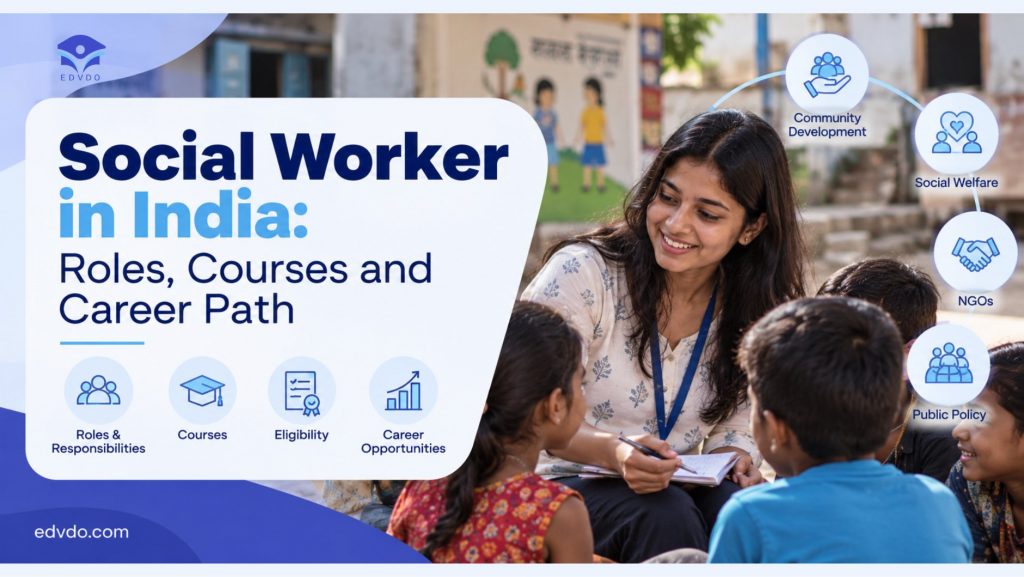
A Class 12 student enjoys helping at school events and wonders whether social work could become a career. A parent asks a different question: does that mean volunteering, working for an NGO, or getting a government job? Both need a clearer picture before choosing a course.
A social worker in India may help a child return to school, support a family navigating hospital services, or coordinate a community livelihood project. These are different working environments, not interchangeable jobs. A useful career decision starts with understanding the work, then comparing education routes, practical demands and actual vacancies.
Table of Contents
- What Social Workers Do Across India's Sectors
- Skills and Readiness to Test Before You Commit
- BSW and MSW Routes Compared
- What You Study in BSW and MSW Courses
- From Class 12 to First Assignment
- Salary Ranges and How the Career Grows
- Challenges Social Workers Face in India
- Frequently Asked Questions
What Social Workers Do Across India's Sectors
A social worker helps individuals, families and communities cope with problems and reach the services they're entitled to. The role resembles a connector at a busy junction, someone who understands which road leads where and helps people find their way through the journey.
Consider a hypothetical district child-protection officer receiving a report that a thirteen-year-old has stopped attending school. The officer visits the home, listens to the child and parents, speaks with the school and coordinates with the Child Welfare Committee where protection concerns require its involvement. The work involves assessment, records, referrals and follow-up, not just persuading the child to attend classes.
Different sectors mean different working days
Social work sectors, daily work and typical employers in India
| Sector | Typical daily work | Example employers |
|---|---|---|
| Child protection | Case assessment, child-safety follow-up, school re-enrolment, coordination with Child Welfare Committees | Child Welfare Committees and associated services, Childline services, district child-protection units, NGOs |
| Health and mental health | Linking patients to services, follow-up visits, family support and counselling within competence, psychiatric referrals | Government hospitals, district mental health programmes, NGOs |
| Disability support | Helping families navigate assessments and certificates, scheme benefits and independent-living support | NGOs, district disability offices, rehabilitation centres |
| Women and family support | Counselling referrals, shelter linkage, legal-aid and police coordination, safety planning | One Stop Centres, women's helplines, NGO-run shelters |
| Labour welfare | Worker welfare, grievance linkages, entitlement awareness, migrant-worker support | Labour departments, industrial welfare teams, NGOs |
| Education | Tracking dropout risk, family outreach, student welfare and counselling support | Schools, NGO education programmes, government education departments |
| Community development | Mobilising self-help groups, livelihood support, community health and awareness work | NGOs, rural livelihood missions, district administration |
These are employment settings to investigate, not a guarantee that every organisation recruits under the title social worker. Advertisements may use case worker, outreach worker, welfare officer or project assistant, with different qualification requirements.
Support is not the same as authority
A hospital social worker may spend the day helping families work through treatment-related services. A shelter worker may prioritise immediate safety, accommodation and coordinated support. Neither role automatically authorises someone to diagnose mental illness, prescribe treatment or make judicial decisions.
Disagreements also arise between families, institutions and service providers. Students interested in that aspect can compare social work with Eztrackr's guide to starting a career in dispute resolution, while recognising that mediation isn't appropriate in every safeguarding situation.
The table works best as a starting filter: a student can select a concern that already matters to them, then examine the employers and responsibilities attached to it.
Skills and Readiness to Test Before You Commit
Caring about people is not enough to practise safely. Empathy, communication, problem-solving and teamwork are core skills that aspiring social workers commonly need. They resemble tools in a briefcase: a difficult home visit may require several at once, and the mix changes between a hospital ward, a shelter and a school.
The toolkit illustration makes those complementary skills visible.

What the toolkit looks like in practice
- Empathy means listening without assuming that a family's choices reflect laziness or indifference.
- Communication includes explaining a referral in accessible language, checking understanding and writing accurate case notes.
- Problem-solving means identifying workable options when transport, documents or local services are missing.
- Teamwork requires sharing relevant information with colleagues while respecting confidentiality and professional boundaries.
Because the title social worker sits across many sectors, each skill takes a slightly different shape depending on the setting. Communication in a hospital may mean explaining treatment procedures to a worried family; in a school it may mean documenting a dropout-risk conversation for a head teacher. Students drawn to community work often already show patience, social awareness and concern for community wellbeing.
Those qualities are a starting point. They do not prove suitability on their own. Someone who enjoys organising a donation drive may feel differently about repeated follow-up visits, detailed paperwork or hearing a distressing disclosure.
Readiness includes boundaries
Emotionally heavy cases, field travel, detailed documentation and unpredictable caseloads can all be part of the job. A practitioner must remain respectful even when progress is slow or a service cannot provide immediate help.
India's SMART Mental Health Programme, examined in a community mental-health task-sharing article, showed why defined training, referral pathways, supervision and human oversight matter for community-facing work. Community health workers aren't interchangeable with qualified social workers, but the operational lesson holds: goodwill cannot replace competence.
Practical rule: A worker should recognise the limit of their competence before a client reaches the limit of their safety.
A useful self-check asks which situations would feel meaningful and which would be draining:
- Listening under pressure: Could the student hear an upsetting account without rushing to give advice?
- Following through: Would they tolerate phone calls, records and repeated coordination after the initial visit?
- Working with others: Could they accept supervision and disagree respectfully with a colleague?
An interest exploration exercise can help separate enthusiasm for a cause from interest in its daily work. Later, DashApply's tips for writing a resume skills section can help translate genuine experience into evidence rather than unsupported adjectives.
A weaker match on some items is useful information about the role or sector to explore next. It isn't a verdict on the entire profession.
BSW and MSW Routes Compared
A Class 12 student can meet two very different applicants in the same admission queue: one finishing school, one already holding a degree. Both may want the title social worker, yet the useful comparison is which door is open now, and what that door leads to after the first job.
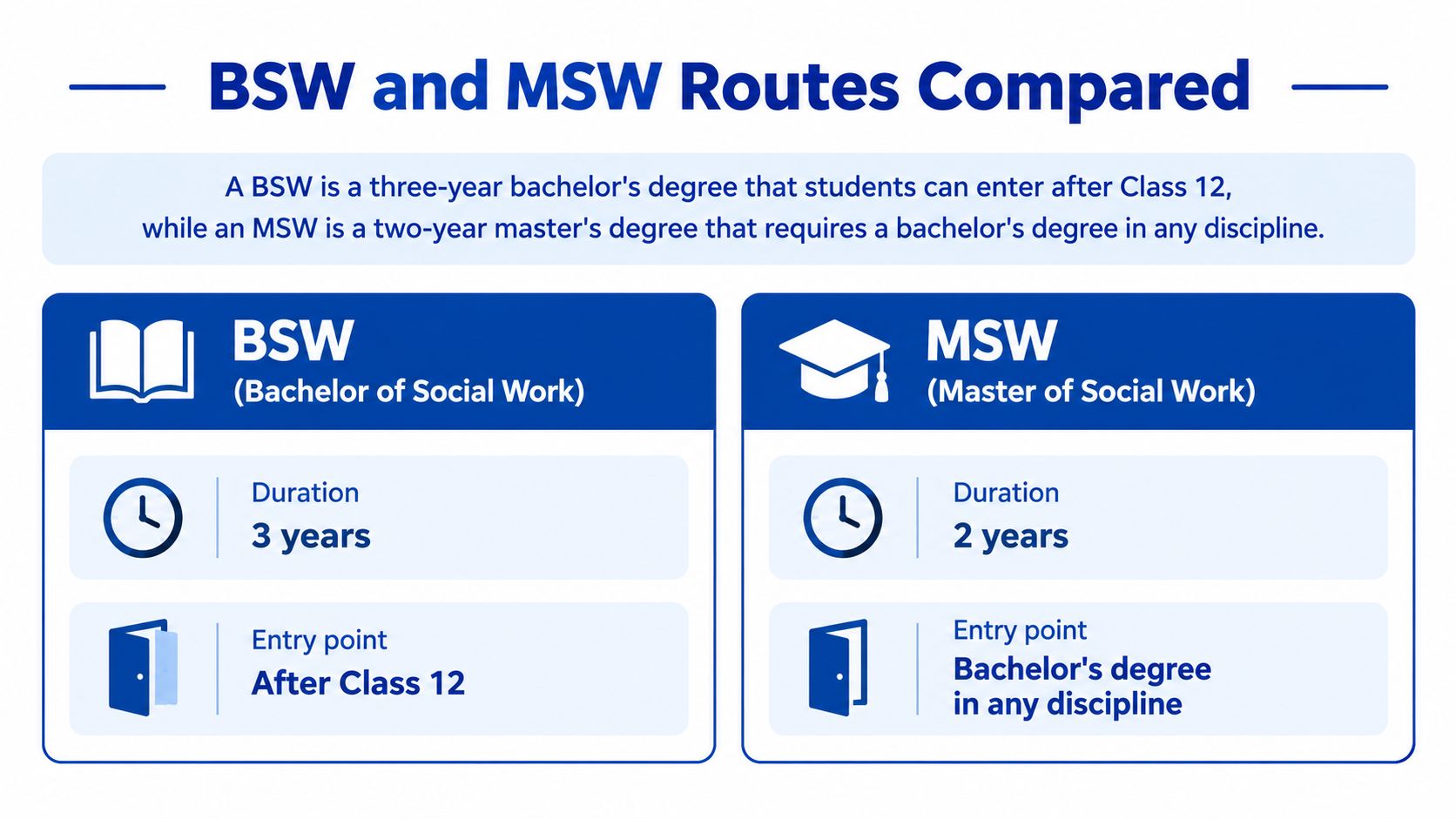
The UGC degree-entry framework specifies BSW as a three-year bachelor's degree after 10+2, and MSW as a two-year master's degree requiring a bachelor's degree.
Graduates from other disciplines can consider MSW, but MSW course eligibility must be checked university by university. An institution may accept all streams, specify related subjects, require an entrance test or use merit-based admission.
The visual comparison summarises the broad routes, rather than replacing a university's admission notice.
Compare eligibility before comparing college names
Across social-work courses, published totals can sit broadly between Rs 6,000 and Rs 2,00,000, but institution, mode and fieldwork costs change the actual bill. Treat that as a budgeting band, then verify the exact schedule.
BSW and MSW entry requirements, duration and fees
| Course | Minimum entry | Duration | Fee range | Best suited for |
|---|---|---|---|---|
| Bachelor of Social Work (BSW) | Recognised school-leaving qualification meeting university rules | Three years | Often within the Rs 6,000 to Rs 2,00,000 band; confirm tuition plus attendance and fieldwork costs | School-leavers wanting early exposure to social work |
| Master of Social Work (MSW) | Bachelor's degree, with subject and admission conditions checked individually | Two years | Often within the Rs 6,000 to Rs 2,00,000 band; check whether entrance or merit rules affect total cost | Graduates considering specialist practice or later supervisory responsibilities |
| Distance or part-time MSW | Bachelor's degree and programme-specific eligibility | Usually built around a two-year MSW, with the approved completion period set by the university | Frequently in the same broad band, but obtain the complete programme fee schedule before enrolling | Working graduates needing a flexible attendance arrangement |
| Diploma or certificate in social work | Provider's published entry requirements | Shorter than degree routes; provider sets the course length | Often lower than degree study, but verify tuition, assessment and other compulsory charges | Learners seeking an introduction rather than assuming degree equivalence |
A certificate can introduce a subject without qualifying its holder for a post requiring BSW or MSW. Similarly, a flexible programme shouldn't be chosen solely because it fits around employment. A lower fee can also be misleading if the credential does not match the eligibility wording of the target role.
Check the mode as carefully as the degree
For distance study, university recognition alone isn't enough. Applicants should confirm that the specific programme and mode are authorised for the relevant admission session, and establish how supervised fieldwork is delivered.
For part-time study, attendance requirements may still conflict with working hours. Written clarification is more useful than an admissions agent's verbal assurance.
The accompanying video provides another format for considering the education route.
BSW may suit a school-leaver who wants to begin professional study early. MSW may suit a graduate seeking focused preparation, but the degree itself doesn't guarantee a leadership appointment. Growth in welfare activity can create more tasks without automatically creating more professional posts, so compare each route against the eligibility wording of real vacancies rather than college names or headlines.
What You Study in BSW and MSW Courses
Social work courses in India teach ways of working with an individual, a group and a community. Casework resembles a focused consultation, group work resembles a team activity with shared goals, and community organisation resembles town planning, where several needs and interests must be considered together.
These analogies describe the scale of attention, not professional equivalence. A social-work student doesn't become a doctor through casework training or a planner through community practice.
Subjects connect personal problems with wider systems
The UGC Learning Outcomes-based Curriculum Framework for BSW identifies the following core subjects and includes field-work practice:
- Foundations and helping methods: Foundations of Social Work, Social Casework, Social Group Work, and Community Organization and Social Action.
- Understanding people and evidence: Psychology and Social Work, and Social Work Research.
- Rights and public systems: Human Rights and Social Justice, Social Legislation in India, and Social Policy, Planning and Development.
- Organisations and practice settings: Social Welfare Administration, and Areas of Social Work Practice.
The subjects answer different practical questions. Psychology helps a student consider behaviour without jumping to conclusions; research teaches how to gather and interpret evidence; administration explains how services operate.
Social legislation and policy matter because a client's difficulty may involve an entitlement, an institutional procedure or an exclusion from services. A practitioner needs more than a sympathetic conversation to work through those barriers.
Fieldwork turns concepts into supervised practice
Consider a hypothetical BSW student placed at a women's shelter. Under supervision, the student learns to write factual case notes, contribute to a safety plan with a resident and attend a case review with the shelter team. The supervisor should decide which tasks the student can undertake, observe performance and correct unsafe assumptions.
A strong placement teaches not only what action to take, but also when to pause and seek supervision.
An MSW applicant should examine the actual specialisation syllabus rather than assume every institution offers the same advanced preparation. Medical and psychiatric settings, community development and labour-related practice require different learning opportunities.
Before selecting a college, a family can request:
- Fieldwork arrangements: Scheduled hours, supervision methods and assessment criteria.
- Placement partners: Named organisations and the tasks students are permitted to perform.
- Practice choices: Opportunities to explore a preferred sector and alternatives.
A student uncertain about academic interests can use a subject exploration exercise alongside sample syllabi. Enjoying classroom psychology alone doesn't establish an interest in documentation, policy or community organisation.
From Class 12 to First Assignment
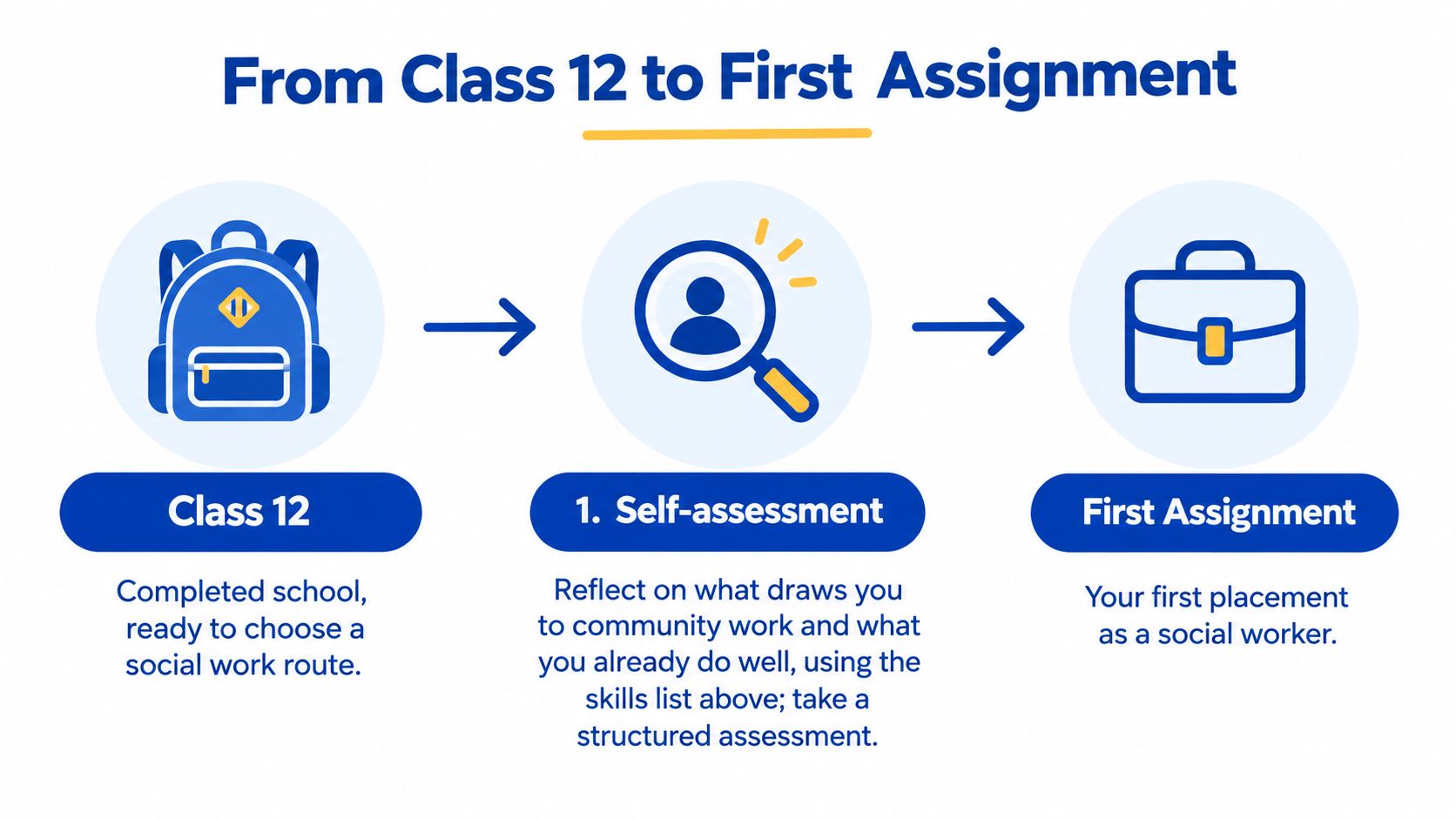
The typical journey is self-assessment → course and eligibility research → BSW/MSW admission → internship or fieldwork → first social work assignment. An NGO fellowship can sit alongside that journey as an alternative way to gain practical exposure, provided its responsibilities and supervision are clear.
The pathway illustration offers a simplified view of movement from school towards practice.
Turn exploration into concrete actions
Begin with self-assessment.
A student can record situations that felt meaningful during the past month, then identify whether the satisfaction came from listening, organising, explaining or solving a practical problem. A structured assessment can be an input, not a decision-maker. Students considering arts-related routes can also compare career options in humanities rather than treating social work as the only helping profession.Research courses and the full cost.
The Rajasthan career-guidance page drawing on the NCS pathway estimates social-work course fees at approximately Rs 6,000 to Rs 2,00,000, with actual fees differing by institution. That's a broad guidance estimate, not a current quote for a particular BSW or MSW. The practical action is to compare shortlisted syllabi alongside tuition, travel, accommodation and fieldwork costs.Apply through the appropriate admission route.
For social work after 12th, the student should examine BSW admission notices; a graduate considering MSW should check whether their existing degree meets the university's conditions. Application dates, required documents and selection procedures should be copied from the institution's current prospectus into a personal checklist.Use fieldwork to compare working environments.
A placement should help the student test everyday responsibilities, not merely collect a completion letter. Where possible, contrasting sectors can reveal whether hospital coordination, school outreach or community mobilisation feels more manageable. The action is to request placement partners, supervision arrangements and field-work hours before admission.Investigate an NGO fellowship.
Fellowships can offer hands-on community experience, practical learning and exposure to social challenges. Applicants should examine selection criteria, financial support, travel expectations, safeguarding procedures and whether the fellowship leads to any recognised qualification. It isn't automatically a substitute for a required degree.Prepare for a first assignment.
A community-worker, case-worker or project-assistant application should describe supervised tasks accurately. A fieldwork supervisor's reference can support the application, while ParakeetAI's online resume builder can help organise the profile without including confidential client information.
Keep the decision evidence visible
A career report can sit beside the student's course comparison and placement questions. Talking to practising social workers, visiting open days and reading prospectuses remain useful checks against an idealised picture.
Edvdo offers a free first career counselling session; for guidance suited to each person, users only need to provide their academic background and career aspirations. Its broader role is student understanding and informed decision-making, not deciding that social work must be the right fit.
Salary Ranges and How the Career Grows
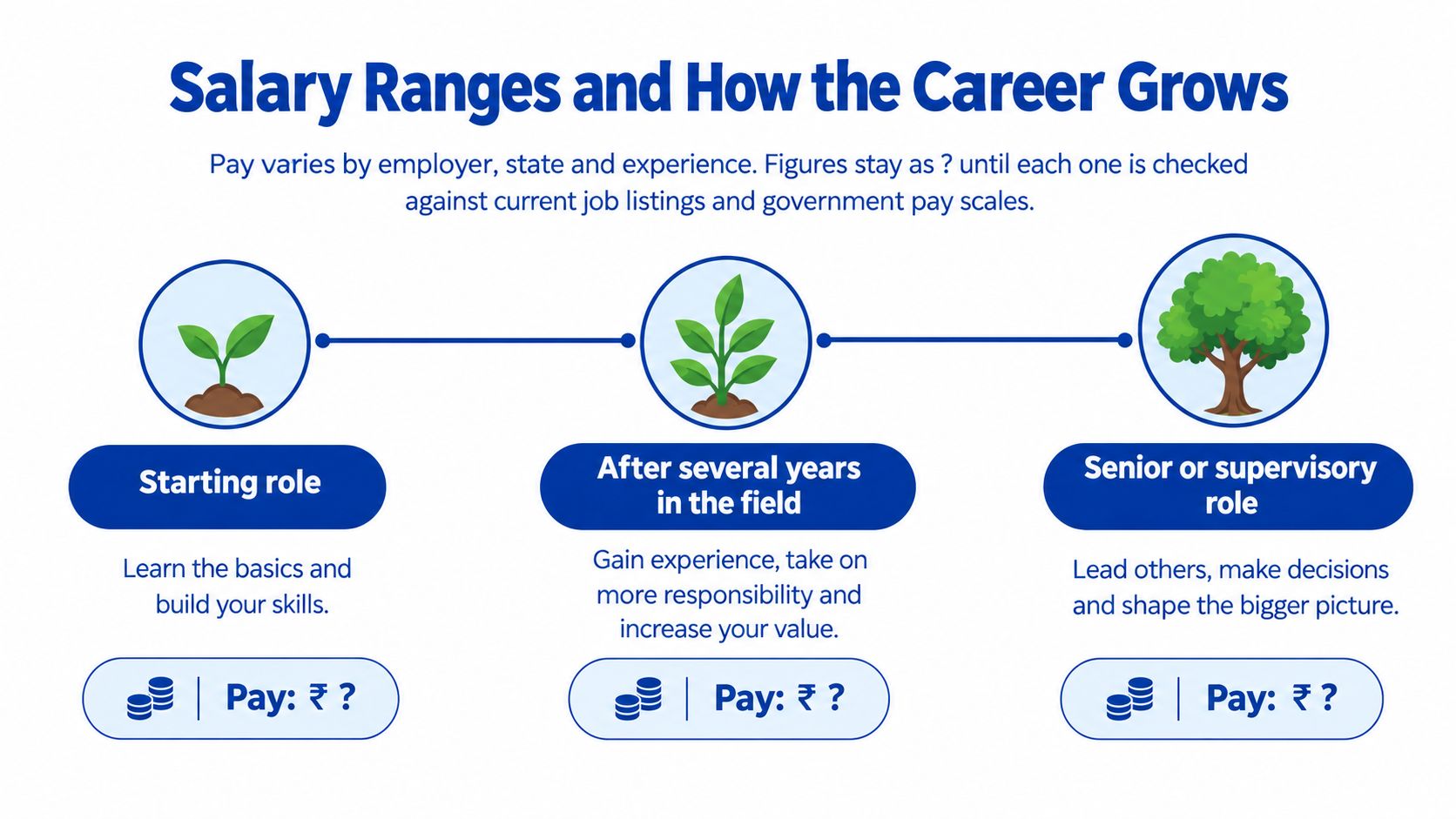
There isn't a verified, current numerical social worker salary in India range in the cited material. Giving a single monthly figure would hide differences between employers, locations, contracts and responsibilities.
The career-growth visual should therefore be read as a progression guide, not a salary quotation.
Compare roles before comparing pay
| Employer type | Typical entry role | What moves pay up |
|---|---|---|
| NGO field or community programme | Community worker or field worker | Local-language skills, relevant project experience, greater responsibility |
| NGO programme | Programme officer, with qualifications specified by the employer | Reporting, project management, fundraising support |
| Government schemes or district programmes | Social welfare or project post under the recruitment notice | Appointment category, applicable pay rules, qualifications and selection requirements |
| Hospitals and corporate CSR teams | Medical social-work or CSR role where eligibility is met | Relevant practice exposure, project scope and management responsibility |
| Senior leadership, NGOs or government | Not an entry-level destination; manager, director or trainer after relevant experience | Leadership record, policy work, research and role-specific advanced qualifications |
NGO field roles can have modest starting offers, while some hospital, government or CSR posts offer stronger compensation. Those labels alone don't establish a reliable ranking. A short-term, higher-paid contract may provide less security than a lower-paid continuing appointment.
Applicants should distinguish fixed salary from travel reimbursement, and examine benefits, working hours, renewal terms and field expenses. Government applicants should use the actual recruitment notification and applicable pay matrix rather than a salary aggregator's headline.
Progression follows responsibility, not a guaranteed timetable
A plausible path runs from field or case work to programme coordination, then project management and eventually leadership, training or research. Academic routes require checking current university recruitment and qualification rules; an advanced qualification alone doesn't guarantee entry.
In a hypothetical women's livelihood project, a BSW graduate might begin with community visits, later handle reporting and eventually supervise outreach staff. Progress would depend on vacancies, performance and organisational resources.
Welfare expansion measures service reach. It doesn't automatically measure demand for professionally qualified social workers.
The Press Information Bureau's labour and social-protection summary reports social-protection coverage rising from 19% in 2015 to 64.3% in 2025, but that isn't a count of social-work jobs. Students should compare scheme announcements with funded vacancies and browse current job openings alongside employer websites and official recruitment portals.
Challenges Social Workers Face in India
A difficult case rarely arrives neatly labelled. A family may need child protection, a mental-health referral, shelter, disability documentation and help accessing a digital service at the same time. The worker may understand the needs yet face unavailable appointments, transport barriers or services that don't coordinate.
Coordination has limits
Social workers assess, refer, document and follow up within their roles. Statutory decisions belong to the relevant authorities, including Child Welfare Committees and courts, while police handle matters within their legal remit. A worker shouldn't promise an outcome controlled by another institution.
Confidentiality also requires judgement. Records should contain necessary information, access should be restricted, and safeguarding concerns should follow organisational and legal procedures rather than informal messaging.
Stigma affects practical outcomes
A Karnataka study of 91 ASHAs found broadly unfavourable orientations towards mental illness. ASHAs are community health workers, not professionally qualified social workers, so the finding shouldn't be treated as a survey of the social-work profession.
It does illustrate why recognising distress, communicating without stigma and making appropriate referrals require training and supervision. Misreading symptoms can undermine trust and delay support.
Before committing to a role, a student should ask a practitioner about:
- Caseload pressure: How urgent cases are prioritised and reassigned.
- Supervision: Who reviews difficult decisions and supports staff after distressing incidents.
- Referral gaps: What happens when specialist services aren't accessible.
- Employment terms: Contract length, travel reimbursement and renewal conditions.
These questions reveal working conditions more clearly than a job title alone.
Frequently Asked Questions
Can someone become a social worker without a BSW?
Yes. A graduate from another discipline can apply for an MSW where the university's eligibility rules permit it. Admission and employment requirements still need separate checks.
Is a BSW enough to start working?
A BSW can meet the qualification requirement for some field and community roles. Specialist or supervisory advertisements may require an MSW, relevant experience or additional preparation.
Is social work always a government job?
No. Career opportunities in social work include NGOs, hospitals, schools, CSR teams and public programmes. A government-linked project shouldn't be assumed to offer permanent government employment.
Is a distance MSW acceptable?
Acceptance requires checking the programme's authorisation for the relevant session and mode, fieldwork arrangements and the intended employer's eligibility rules. A recognised university name alone doesn't settle every question.
Does a social worker need a particular personality?
There's no single required personality. A quieter student may communicate effectively in individual meetings, while an outgoing student may still need to develop careful listening and boundaries.
Where can current pay and openings be checked?
Employer vacancy pages, official recruitment notices and government pay matrices are the strongest starting points. Job-search platforms can help locate opportunities, but applicants should confirm the salary, contract and qualifications against the employer's advertisement.
Edvdo is a Student Understanding & Decision Intelligence platform that helps students examine their strengths, motivations and learning patterns before making academic and career choices. Students exploring social work can visit Edvdo to build self-understanding, compare possible routes and identify questions to investigate before applying.