A Class 11 student enjoys psychology, writes for the school magazine, and likes debating public issues. Law sounds respectable, design sounds creative, and relatives recommend teaching or civil services. By Class 12, the question isn't whether humanities offers possibilities. It's which possibility deserves a serious commitment.
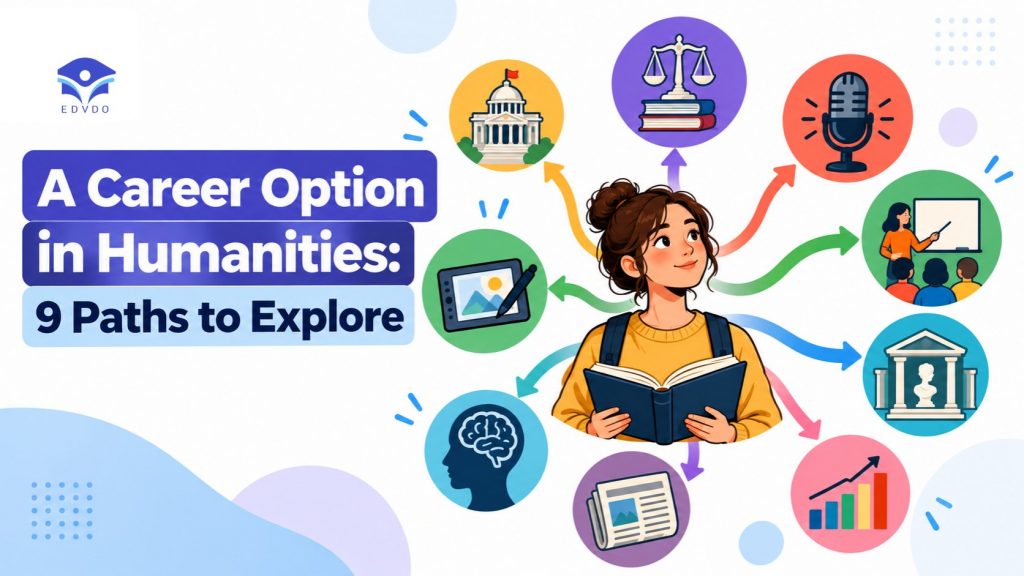
A humanities degree is a starting point, not a label. Psychology, law, journalism, design, education, social sciences, public administration, media, and creative work involve different responsibilities and working styles. Choosing a career option in humanities means comparing the actual work, the qualifications required, and the effort needed to become employable.
Humanities isn't a marginal academic choice. Arts accounted for 34.2% of undergraduate enrolment in AISHE 2021–22, according to this analysis of India's higher-education participation. That scale establishes its importance, not a guarantee of employment.
Three distinctions help students compare the paths below:
- Interest versus daily work: Enjoying a subject doesn't automatically mean enjoying its professional routines.
- A degree versus permission to practise: Clinical work, legal practice, and teaching require closer scrutiny of professional requirements.
- Exploration versus commitment: A supervised project or internship can test an interest before an expensive course decision.
Psychology, UX research, public policy, digital journalism, urban planning, behavioural research, and social impact deserve particular attention beyond familiar stereotypes. For every route, students should verify entrance criteria, subject requirements, recognised qualifications, and applicable registration rules against current official documents.
Table of Contents
- 1. Psychology
- 2. Law
- 3. Journalism and Digital Media
- 4. UX Research and User Experience Design
- 5. Education and Teaching
- 6. Public Policy and Public Administration
- 7. Urban Planning
- 8. Behavioural and Social Research
- 9. Social Impact and Development
- Career Paths in Humanities: 9-Option Comparison
- Choose the Next Step, Not the Entire Life
1. Psychology
Psychology suits students who want to understand behaviour and are willing to examine evidence rather than rely on intuition. Empathy and analytical thinking belong together: listening matters, but so do research methods, statistics, professional boundaries, and careful interpretation.
Possible directions include psychological research, organisational work, child development, education, counselling, and clinical work. These aren't interchangeable qualifications or responsibilities.

Separate interest from professional eligibility
A BA or BSc in Psychology is a potential starting point, subject to university eligibility. Students should inspect the syllabus for statistics, research projects, practical work, and supervised exposure, rather than choose by degree title alone.
A BA in Psychology alone doesn't qualify a graduate to practise therapy. Clinical practice requires the appropriate recognised professional training and registration. Students must verify the current Indian requirements for their intended role before enrolling; overseas requirements, such as those discussed in understanding AHPRA registration for psychologists, apply to a different jurisdiction.
- School subjects: Psychology can help students test their interest, while mathematics supports statistical learning. Neither should be assumed universally compulsory without checking admissions rules.
- Skills to build: Practise ethical interviewing, evidence-based writing, and introductory analysis using SPSS or R.
- A useful trial: Explore supervised NGO volunteering or non-clinical support work. Students shouldn't independently counsel vulnerable people.
An illustrative task might involve examining anonymised feedback about school wellbeing, not diagnosing classmates. An interest assessment can help students distinguish an attraction to helping people from an interest in systematic behavioural research.
2. Law
A student who enjoys debate should also test whether sustained reading, precise writing, and detailed document review feel satisfying. Law involves preparation as much as persuasion. Potential directions include litigation, corporate legal work, legal research, policy drafting, academia, and judicial services.
Consider the difference between reviewing a business contract and preparing an environmental petition. Both require legal reasoning, but their clients, working environments, and daily pressures differ considerably.
Compare the routes before choosing a course
Common Indian routes include an integrated law degree after Class 12 and an LLB after graduation. Many National Law Universities use CLAT, while other institutions follow different admission processes; applicants must check the current examination notice and each institution's eligibility rules.
Admission to a law course isn't the same as eligibility to practise. Students should verify programme recognition and the applicable enrolment and practice requirements before paying fees. Judicial-service aspirants must separately check the current recruitment notification, including qualification and experience conditions.
- School preparation: Languages, political science, history, and economics can support reading and contextual understanding. No subject combination should be treated as universally required.
- Skill alignment: Critical thinking, reasoning, research, and persuasive writing matter more than confidence in arguments alone.
- Practical exposure: A supervised legal-aid visit, lawyer-shadowing opportunity, or case-summary exercise can reveal whether the work suits the student.
Practical rule: A preference for courtroom drama isn't enough. Students should test their tolerance for reading lengthy documents, checking details, and revising arguments.
Legal careers can involve uncertain early earnings, demanding deadlines, or competitive recruitment. Course selection should account for these trade-offs, not prestige alone.
3. Journalism and Digital Media
A viral claim reaches a school group. A student journalist checks the original document, identifies missing context, interviews someone affected, and publishes a correction. That process captures journalism better than enjoying social media.
Journalism combines communication with research and verification. Digital work can include reporting, editing, podcasts, video, newsletters, fact-checking, and data-led explainers. Outlets such as The Wire, Scroll.in, and Newslaundry offer different examples of digital editorial work to examine, not guaranteed destinations.

Build a portfolio that demonstrates judgement
Journalism, mass communication, media studies, or a subject-focused degree can form part of a study plan. Students should compare reporting practice, editing feedback, internships, and production facilities, alongside institution-specific admission requirements.
Languages strengthen reporting and interviewing. Political science, history, economics, and sociology can provide useful subject knowledge, while spreadsheet skills help students interrogate public data.
- Portfolio project: Produce a school-transport story using interviews, an official document, and a clearly labelled explanation of limitations.
- Verification practice: Use reverse image search, trace quotations to their origin, and distinguish reporting from commentary.
- Creative alternatives: Explore documentary production, scriptwriting, audio editing, or content strategy if production feels more engaging than news reporting.
Students should compare staff employment with freelance work, including deadlines, editorial independence, payment terms, and income uncertainty. Digital media deserves exploration, but no verified Edvdo Career Hub search data establishes it as the fastest-growing humanities option.
4. UX Research and User Experience Design
Why does a banking-app user abandon a form? Why can't a learner find a recorded lesson? UX researchers investigate the difficulty; UX designers develop and test possible improvements. The roles overlap, but research isn't asking whether someone likes a screen.
A student interested in people, technology, and practical problem-solving should compare this route with psychology and social research. UX work requires turning observations into decisions that a product team can use.

Choose research depth or design practice
Psychology, sociology, design, and human-computer interaction are directions worth investigating. Specific programmes can require entrance tests, portfolios, or particular subjects, so humanities students shouldn't assume that every design or technology-related degree accepts their combination.
A useful trial project is to study a school-library booking process. With permission, a student can observe difficulties, conduct interviews, propose changes, and test whether participants understand the revised process.
- Research evidence: Include an interview guide, anonymised observations, analysis, and limitations.
- Design evidence: Show sketches or a Figma prototype, accessibility decisions, and revisions after usability testing.
- School preparation: Psychology and sociology support behavioural questions; art supports visual exploration; mathematics supports quantitative analysis.
An assessment of current skills can help identify whether interviewing, analysis, visual communication, or structured problem-solving needs attention. It shouldn't be treated as a hiring prediction.
A polished interface without documented reasoning is weak evidence of research ability. Students should also learn consent, privacy, inclusive design, and accessibility practices rather than treating participants as convenient sources of feedback.
5. Education and Teaching
Teaching is a strong option for students who enjoy explaining ideas, adapting explanations, and helping others make progress. Enjoying a school subject is useful, but teaching also demands planning, assessment, patience, and classroom management.
Education extends beyond classroom teaching into curriculum development, educational research, learning-content production, and administration. Counselling-related roles require their own qualification checks and shouldn't be treated as automatic extensions of teacher training.
Check the intended teaching role first
Teacher education in India is regulated by the National Council for Teacher Education, or NCTE. Routes include the BEd and integrated teacher-education programmes, but students must verify current programme recognition, entry rules, and suitability for the intended school level.
Recruitment can also involve teacher-eligibility tests and state-specific conditions. Completing a course doesn't automatically satisfy every employer's subject, training, or examination requirements.
For humanities students, school subject choices can influence later subject specialisation. A prospective history teacher should investigate the relevant degree and recruitment requirements rather than assume that any humanities qualification will suffice.
- Test the work: Volunteer as a tutor through a supervised community programme.
- Build evidence: Create a lesson plan, learning activity, assessment task, and reflection on what learners misunderstood.
- Explore adjacent roles: Compare classroom teaching with curriculum writing, instructional content, or education research.
An illustrative history lesson could use local archives and oral accounts, with students comparing conflicting evidence. The aspiring teacher should evaluate whether learners understood the method, not merely whether they enjoyed the activity.
Teaching aptitude is demonstrated by how effectively learners are supported, not by how confidently someone speaks.
6. Public Policy and Public Administration
Public policy asks what should be done about a public problem. Public administration focuses on implementation, coordination, and accountability. Neither should be reduced to UPSC preparation.
Possible directions include civil services, policy research, programme management, think tanks, and development organisations. Illustrative tasks include comparing transport proposals, examining a welfare programme's implementation, or coordinating education services.
Keep exam-dependent and research routes separate
Political science, economics, sociology, history, geography, and public administration are useful degrees to investigate. Postgraduate policy or administration programmes may support further specialisation, but applicants must check prerequisites and the programme's actual research and placement support.
The UPSC Civil Services Examination is a competitive route, not an employment guarantee attached to a humanities degree. Students choosing it should maintain a parallel skill and employment plan rather than postpone all practical experience.
- School subjects: Political science and history support institutional understanding; economics and mathematics can strengthen quantitative policy analysis.
- Applied skills: Practise reading budgets, interpreting spreadsheets, comparing evidence, and writing concise policy briefs.
- Portfolio task: Analyse a local public-service problem, identify affected groups, compare options, and explain implementation constraints.
Students can use career and job exploration to compare role descriptions and identify recurring requirements. A policy researcher's methodological skills may differ substantially from those of an examination candidate or programme coordinator.
Time-to-income matters. Students should establish a review point for competitive-examination preparation and compare its cost with internships, further study, and entry-level research opportunities. Public speaking activities can help, but they don't replace evidence analysis or disciplined writing.
7. Urban Planning
A student interested in geography may notice that a bus stop is difficult to reach, a neighbourhood lacks usable public space, or a redevelopment proposal overlooks residents' needs. Urban planning turns such questions into investigations of land use, housing, transport, infrastructure, and participation.
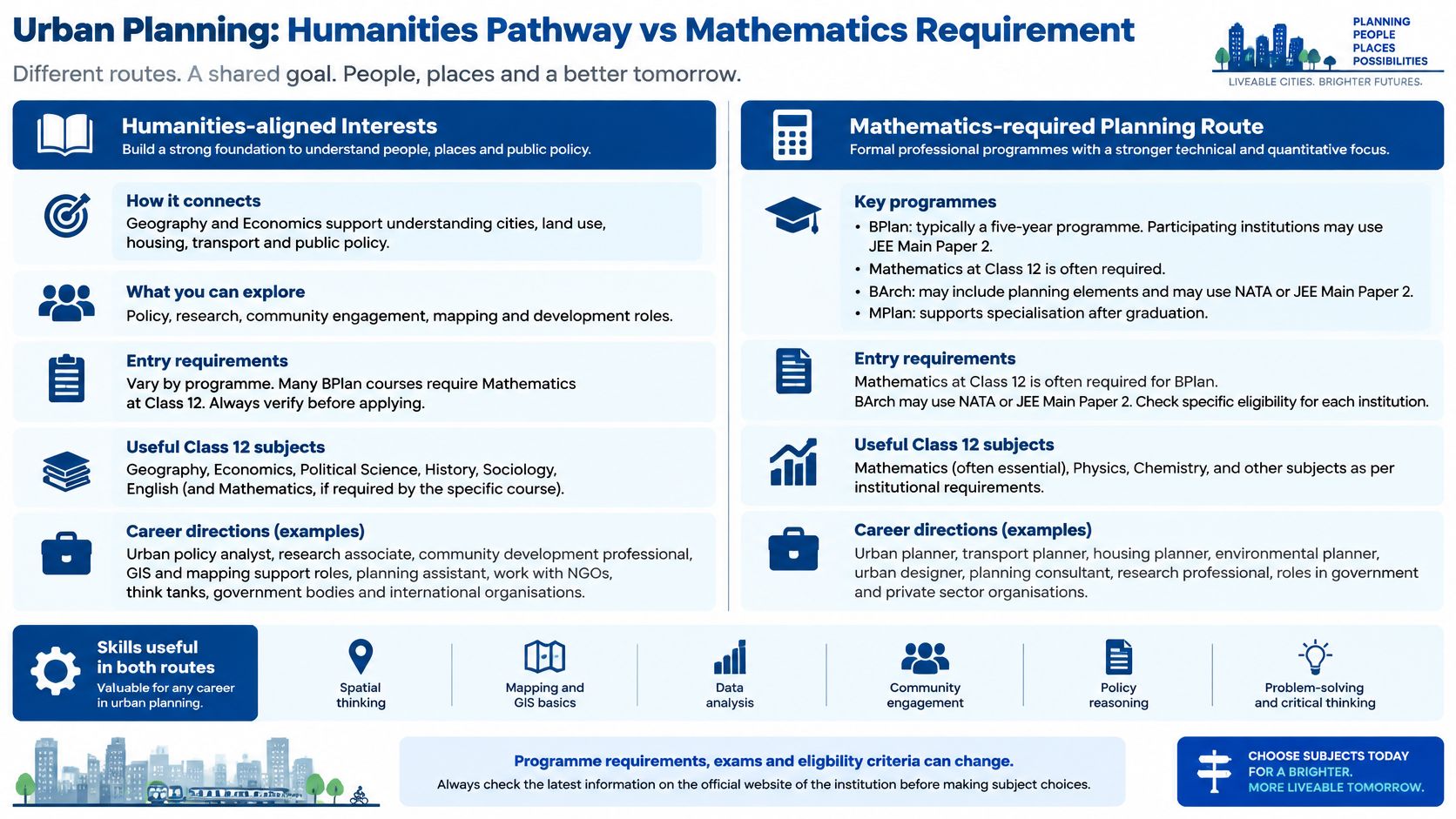
The key distinction is between professional planning qualifications and related urban-policy work. An interest in cities doesn't establish eligibility for every planning degree.
The comparison below can help frame the subject-choice questions.
Verify mathematics requirements early
Professional planning programmes can have specific mathematics, entrance, or prior-degree requirements. Humanities students should inspect current institutional documents before finalising Class 11 subjects or assuming eligibility for postgraduate planning.
Geography, economics, sociology, and public policy can also support exploration of urban research and community-development work. These routes shouldn't be presented as equivalent to a recognised professional planning qualification.
A practical project could map walking access to a neighbourhood park using QGIS, document barriers, and compare observations with a published development plan. Fieldwork should respect privacy and avoid making unsupported claims about residents.
- Investigate the workplace: Compare municipal bodies, development authorities, consultancies, and community organisations.
- Develop useful skills: Learn map interpretation, introductory GIS, report writing, and stakeholder interviewing.
- Check the trade-off: Consider whether technical spatial work, community engagement, or policy analysis is the strongest fit.
The video offers another starting point for career exploration; admissions decisions still require official verification.
8. Behavioural and Social Research
A public-health team wants to understand why people miss follow-up appointments. A researcher might examine inconvenient timings, unclear messages, transport problems, and mistrust before recommending reminders. Good behavioural research doesn't assume that every problem is a motivation problem.
This path suits students who enjoy asking precise questions, examining alternative explanations, and revising conclusions. Psychology, sociology, economics, anthropology, and related social-science degrees are study directions to compare.
Treat methods as a core skill
Courses should be assessed for qualitative methods, statistics, research ethics, fieldwork, and supervised projects. Academic research careers may require further qualifications; entry-level research-support roles must be checked against actual employer requirements.
Students who dislike mathematics shouldn't assume social research avoids quantitative work. Mathematics in school can support later analysis, while language skills help with interviews, field notes, and clear reporting.
- Qualitative practice: Develop an interview guide, obtain consent, anonymise responses, and explain how themes were identified.
- Quantitative practice: Learn spreadsheets and introductory R, Python, or SPSS. Distinguish a pattern in a small sample from a general conclusion.
- Portfolio exercise: Investigate how students interpret a school notice, documenting sampling limits and possible bias.
An illustrative student interested in human behaviour, communication, and research could compare psychology, UX research, and social research through these activities. This is an exploration scenario, not a verified Edvdo student success story.
Research safeguard: A survey result isn't automatically representative, and a change after an intervention doesn't automatically prove causation.
Emerging behavioural opportunities deserve attention, but students should evaluate methods, supervision, and role requirements rather than choose a course because its title sounds new.
9. Social Impact and Development
Social-impact work is suitable for students who want to address problems in education, livelihoods, health, inclusion, or gender equality. Commitment matters, but organisations also need reliable implementation, documentation, budgeting, and evaluation.
Possible directions include community development, NGO programme coordination, social enterprise, impact evaluation, and social work. For example, a programme team might organise skills training and follow up on participants' employment experiences, while an evaluator examines whether the programme's stated outcomes are supported by evidence.
Combine field experience with accountable practice
Social-science degrees can provide a foundation, while social work and development studies are further-study options to investigate. Students must verify admissions criteria and any specialist qualification required for the intended responsibility.
Field placements deserve close attention during course comparison. Applicants should ask about supervision, safeguarding, travel, accessibility, expenses, and how student work is assessed.
- School preparation: Sociology, economics, political science, geography, and languages can support contextual understanding and communication.
- Applied skills: Learn monitoring and evaluation, spreadsheet-based reporting, interview documentation, and basic project planning.
- First exposure: Volunteer with a supervised local programme and produce an anonymised reflection on responsibilities, constraints, and learning.
Students should distinguish community-facing work from desk-based research, fundraising, communications, and operations. Travel, field conditions, funding uncertainty, and emotionally demanding situations also belong in the comparison.
A personalised career report can help organise potential roles around assessed interests and strengths. The next step should still involve checking qualifications and speaking with practitioners, because enthusiasm for a cause doesn't establish readiness for every job within it.
Career Paths in Humanities: 9-Option Comparison
| Career Path | 🔄 Training / Entry Complexity | ⚡ Key Resources and Skills | 📊 Expected Outcomes | Ideal Use Cases | ⭐ Key Advantages |
|---|---|---|---|---|---|
| Psychology | BA/BA (Hons) typically takes 3 years; clinical practice requires postgraduate training and applicable RCI registration. | Research methods, statistics, active listening, empathy, ethical judgement; supervised experience for some roles. | Roles in counselling, research, education, HR, or clinical settings, depending on qualifications. | Mental health, child development, workplaces, schools, and research. | Skills apply across health, education, business, and policy; offers postgraduate specialisations. |
| Law | Five-year integrated degree after Class 12 or three-year LLB after graduation; advocate practice requires State Bar Council enrolment. | Extensive reading, legal research, reasoning, persuasive writing; entrance preparation may be needed. | Careers in advocacy, corporate law, policy, legal research, or judicial services. | Courts, companies, government, legal aid, and policy organisations. | Diverse practice areas; reasoning and writing skills transfer to other fields. |
| Journalism and Digital Media | BA/BJMC commonly takes 3 years after Class 12; a journalism degree is not always required. | Writing, interviewing, fact-checking, source evaluation, and digital or video tools; portfolio building helps. | Work in reporting, editing, data journalism, fact-checking, or multimedia production. | Newsrooms, digital publications, broadcast media, and independent platforms. | Combines communication and research across multiple formats and platforms. |
| UX Research and User Experience Design | Entry routes vary; design degrees, postgraduate study, or a related background can help. A portfolio is often important. | Interviewing, usability testing, research synthesis, accessibility awareness, and design or research tools. | Research or design roles improving digital products, services, and user experiences. | Technology, healthcare, education, and public-service products. | Connects human insight with product goals; skills transfer across sectors. |
| Education and Teaching | Routes include BEd, selected four-year integrated programmes, and eligibility tests for many government teaching roles; check current rules. | Subject knowledge, lesson planning, communication, classroom management, and assessment skills. | School teaching or pathways into curriculum, education research, counselling, and administration. | Schools, education NGOs, academic publishing, and curriculum development. | Established training routes; potential to contribute to learning and communities. |
| Public Policy and Public Administration | A bachelor's degree generally meets the basic UPSC degree requirement; policy research and senior roles may require postgraduate study. | Policy analysis, report writing, data interpretation, current-affairs knowledge, and ethical reasoning. | Careers in civil services, policy research, programme management, or think tanks. | Government, NGOs, development organisations, and research institutions. | Work can influence public services; skills are useful across research and administration. |
| Urban Planning | BPlan is typically a five-year programme; Mathematics is often required, and admissions may use JEE Main Paper 2. Verify course criteria. | Spatial thinking, mapping or GIS, data analysis, community engagement, and policy reasoning. | Planning roles in land use, housing, transport, public spaces, and infrastructure. | Municipal bodies, development authorities, consultancies, and NGOs. | Combines social, spatial, and technical work with visible effects on cities. |
| Behavioural and Social Research | Relevant bachelor's study can lead to the field; specialised or senior research roles may require postgraduate study or a PhD. | Statistics, research design, survey methods, data visualisation, and tools such as R, Python, or SPSS. | Research roles in market insights, public policy, health, education, or academia. | Studying decisions, attitudes, and responses to programmes or products. | Methods are applicable across business, government, and academic research. |
| Social Impact and Development | Entry often combines a relevant bachelor's degree with field experience; MSW or development studies can support specialisation. | Community engagement, project management, cultural sensitivity, evaluation, and report writing. | Roles in NGO programmes, social enterprises, community development, or impact evaluation. | Health, education, livelihoods, social inclusion, and development programmes. | Connects work with community needs; skills transfer across NGOs, government, and CSR. |
Choose the Next Step, Not the Entire Life
The strongest career decision connects interests with tested abilities, feasible qualifications, and acceptable trade-offs. Humanities students can explore business, design, media, government, education, and social-impact work, but prestige alone is a poor basis for choosing.
A degree also needs applied evidence. The Mercer | Mettl Graduate Skill Index 2025 reported overall graduate employability of 42.6%, reinforcing the need to build demonstrable skills rather than rely on a degree title.
Turn a shortlist into a practical comparison
- Identify energising problems: Compare explaining ideas, investigating behaviour, interpreting rules, improving services, and organising community work.
- Compare environments: Consider classrooms, offices, newsrooms, field sites, research teams, and independent creative work.
- Verify prerequisites: Record subjects, entrance tests, recognised qualifications, registration conditions, fees, and location constraints from current official documents.
- Compare study and skill routes: For each shortlisted option, identify a suitable degree and an applied project or supervised experience.
- Seek exposure: Arrange a practitioner conversation, workplace visit, volunteering placement, or realistic project before committing.
Subject planning needs particular care. The official CUET-UG information bulletin distinguishes examination participation from programme-specific eligibility, so students must check each university's conditions rather than assume CUET alone opens every course.
Frequently Asked Questions
Is humanities only suitable for students who dislike mathematics? No. Psychology, economics, policy, planning, and research can involve substantial quantitative work. Students should build numerical confidence and check subject requirements.
Does every humanities career require postgraduate study? No universal rule applies. Students should distinguish portfolio-based opportunities from regulated practice, specialist research, and roles requiring further qualifications.
Can humanities students enter creative industries and business? These are valid directions to investigate through design, content, communications, organisational work, and related roles. Course eligibility, work samples, and employer expectations still need checking.
Edvdo's assessments, career reports, Career Hub, and AI mentor Vedu can support comparison of interests, learning patterns, prerequisites, and possible roles. Recommendations should become a personalised shortlist, not a substitute for official eligibility checks or real-world exposure.
Students should retain evidence from projects and placements, including their contribution, feedback, and limitations. Resources such as GetTheCall's resume help can support presenting that work clearly when applications begin.
Edvdo offers structured assessments, personalised career reports, pathway exploration, and guidance through Vedu to help students compare humanities options. Students, families, and counsellors can visit Edvdo to build a shortlist and identify the subject checks, skill-building activities, and practical experiences needed next.