
A professional course is a structured programme that prepares students for a specific occupation through specialised knowledge, practical training and, where applicable, licensing or entrance examinations. Many Class 10 and 12 students hear the term from relatives, coaching centres and college advertisements, often with the suggestion that it's automatically the safest choice. The label alone doesn't prove that a course leads to suitable work, so families benefit from checking the destination, the regulator and the evidence behind each programme before committing time and money.
Table of Contents
- What a Professional Course Is, in Plain Terms
- Five Professional Course Categories and Their Programmes
- Entry Requirements Category by Category
- Career Outcomes and Licences in Each Field
- Four Checks That Make a Course Genuinely Professional
- Test the Label Against Fit and Evidence
What a Professional Course Is, in Plain Terms
A general degree can resemble a well-stocked library. Students explore a broad field, choose papers and decide later how the learning connects to work. A professional course works more like a guided route to one named destination, such as a clinic, a site office or a courtroom.

Students asking what are professional courses often expect a short list of prestigious degrees. In India, the term covers undergraduate, postgraduate, diploma, certificate, integrated and doctoral programmes across fields such as medicine, engineering, law, management, pharmacy, architecture, agriculture and applied technology. The level changes, but the occupational link stays central.
A familiar choice after Class 12
A Class 12 Science student might compare a four-year B.Tech with a three-year polytechnic diploma. Both routes are professional in structure, yet the degree usually targets graduate engineering roles while the diploma targets junior engineering and technician entry points. Treating either name as proof of quality would miss the core decision, which concerns the intended job and the training provided.
The route is mainstream rather than niche. Government higher education figures for India record approximately 4.50 crore higher education students in 2023-24, up from 3.42 crore in 2014-15, while the Gross Enrolment Ratio rose from 23.7% to 30% during the same period. Undergraduate, postgraduate and diploma enrolments all grew, showing that career-oriented study includes several qualification levels.
A course is professional in a meaningful sense when study connects to a defined occupation, stated eligibility, assessed practice and, where required, a licence.
That test gives Class 10 and 12 students a calmer starting point. Rather than asking whether a course sounds impressive, students can ask which occupation it serves and what proof shows that its training is recognised.
Five Professional Course Categories and Their Programmes
Readers comparing options should find the relevant row in the table, note the duration and then identify the body named in the final column. Those three details reveal more than a prospectus headline. They show how long preparation takes and who is responsible for recognising or approving the qualification.
| Category | Programmes | Typical duration | Regulator or awarding body |
|---|---|---|---|
| Medical and health | MBBS | 5.5 years including compulsory internship | National Medical Commission |
| Medical and health | B.Pharm | 4 years | Pharmacy Council of India |
| Medical and health | B.Sc Nursing | 4 years | Indian Nursing Council |
| Engineering and technology | B.Tech / B.E.; diploma in engineering | B.Tech 4 years; diploma 3 years | AICTE approval for eligible programmes; state technical boards for many polytechnics |
| Law | BA LLB (Hons), integrated; LLB after graduation | Integrated 5 years; LLB 3 years | Bar Council of India |
| Design | B.Des in communication, product, fashion or interaction design | 4 years | Institute and university recognition; NID and NIFT run their own programmes |
| Vocational and skill | ITI trades such as electrician, fitter and welder; NSQF-aligned certificate and diploma courses | About 6 months to 2 years | National Council for Vocational Training under DGT; state ITI boards |
Where duration surprises families
MBBS is the longest route in the table for most school leavers because the programme includes a one-year compulsory internship. A student entering straight after Class 12 therefore commits to a substantially longer preparation period than a nursing or pharmacy student, even though all three routes sit within health care.
Law creates a different timing issue. Integrated BA LLB (Hons) runs for five years straight after Class 12 and combines undergraduate study with legal training. A three-year LLB begins only after graduation, so total time from school to legal qualification is longer even though the LLB itself is shorter.
Engineering offers a staged alternative. A three-year diploma can prepare students for junior technical work and may later support lateral entry into the second year of a B.Tech, where rules allow it. That possibility helps students who prefer earlier practical exposure or need a lower-cost first step before deciding on a degree.
Labels that do not guarantee a degree
Design and vocational routes show why the word professional shouldn't be treated as a synonym for degree. B.Des programmes generally use institute or national design tests and applied selection rounds, while ITI trades are shorter workshop-based qualifications. A certificate or diploma can still be professional when it prepares students for a defined trade and is awarded through a recognised system.
The regulator check should happen before fees are paid. Students can match the programme's approval or awarding body with the field in the table and verify the details through the institution's current admission documents. A missing regulator, unclear awarding body or vague duration is a reason to pause, particularly when a provider relies heavily on placement claims. This comparison also prevents a common mistake, judging a two-year trade course against MBBS only by duration rather than by destination. Different occupations need different preparation, supervision and legal permission to practise.
Entry Requirements Category by Category
Admission gates fall into three broad types. Stream-locked courses require specified Class 12 subjects, so an early stream choice can keep a route open or close it. Entrance-gated courses depend on a competitive test, while portfolio-gated and merit-gated routes place greater weight on creative work, marks or trade-wise counselling.
Students who aren't sure whether present subjects and abilities fit a route can use a structured skill assessment for clearer course direction before narrowing the list. The next step is to compare the exact row requirements with the official brochure for the target institute and admission year.
| Course | Schooling requirement | Entry test or selection | Rule to check |
|---|---|---|---|
| MBBS | Class 12 with Physics, Chemistry and Biology | NEET-UG | Minimum age 17 by 31 December of the admission year |
| B.Pharm | Class 12 with Physics, Chemistry and Biology or Mathematics | State or institute tests | Varies by state and college |
| B.Sc Nursing | Class 12 with Physics, Chemistry and Biology | State or institute entrance tests | Varies by state and college |
| B.Tech / B.E. | Class 12 with Physics, Chemistry and Mathematics | JEE Main for NITs and many colleges; state CETs | Cut-offs and aggregate marks vary by institute |
| Engineering diploma | Class 10 with Mathematics and Science | State polytechnic entrance or merit | Lateral entry into second year of B.Tech is possible later |
| BA LLB (Hons), integrated | Class 12 in any stream | CLAT, AILET or state law entrance tests | Five-year course; test held once a year |
| LLB (3 years) | Graduation in any discipline | University or state entrance, or merit | Minimum marks set by each college |
| B.Des | Class 12 in any stream | UCEED, NID DAT or CEED, plus institute tests | Portfolio round carries major weight |
| ITI trades | Class 8 or Class 10 pass, depending on trade | Trade-wise merit and state counselling | Age and trade rules vary by state |
Three details students often miss
- Age rule for MBBS: Eligibility depends on reaching 17 by 31 December of the admission year, not simply completing Class 12.
- Stream flexibility in law and design: Integrated law and B.Des can accept students from any Class 12 stream, subject to each admission process.
- Changing level later: An engineering diploma may provide a later bridge into degree study, so a Class 10 decision doesn't always close the engineering degree route.
Aggregate cut-offs vary by state, category, institute and year. A general guide can identify the gate, but the official brochure controls the final rule.
Career Outcomes and Licences in Each Field
A licence can decide whether a graduate may practise at all. Doctors, nurses, pharmacists and advocates face registration requirements before independent professional work, while engineering, design and many trade roles rely more heavily on portfolios, supervised experience, trade tests and employer assessment.
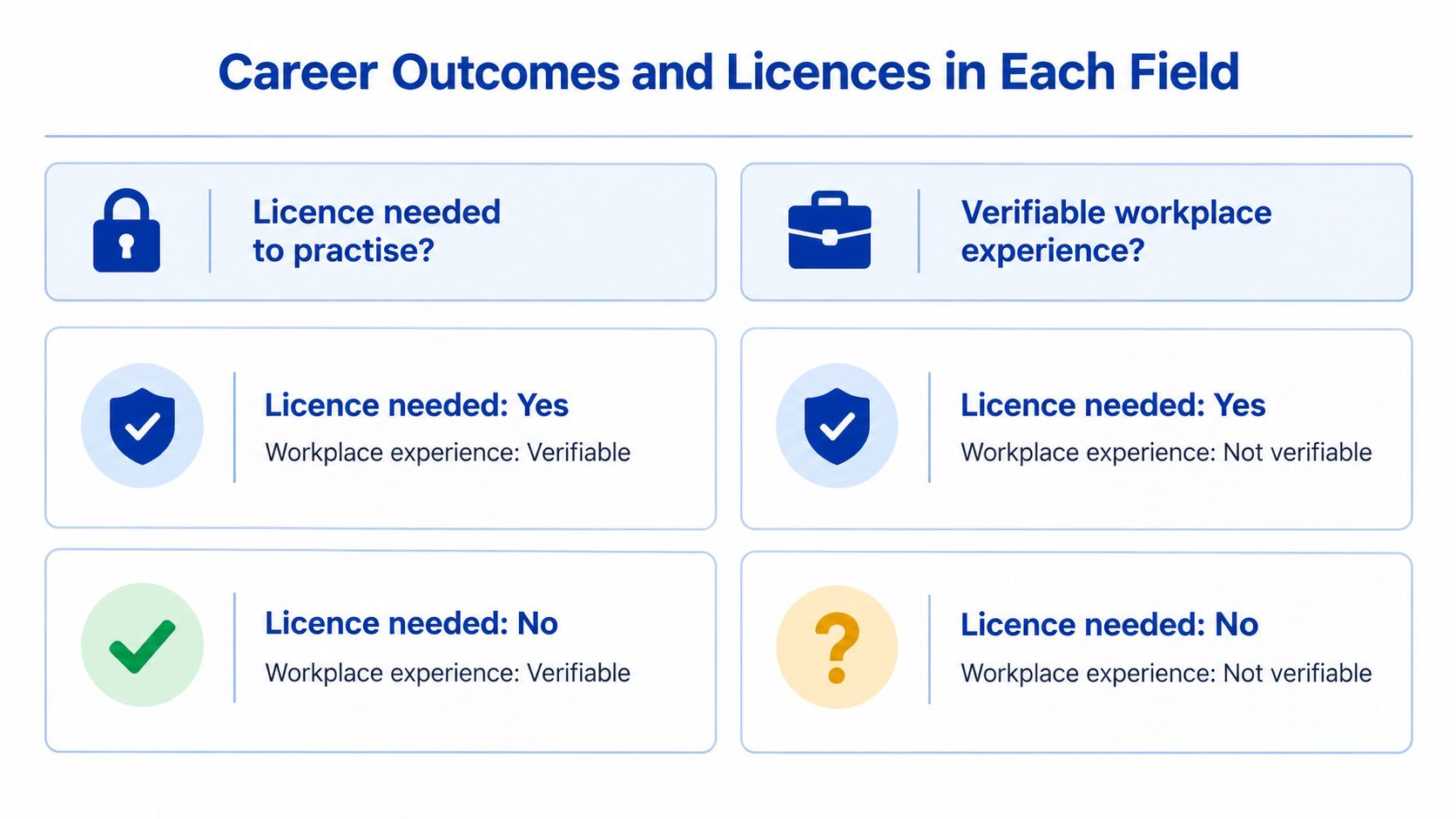
The distinction matters because similar job titles can hide different legal obligations. A pharmacist who dispenses medicine needs the relevant registration, whereas a graduate engineer normally presents project and internship evidence rather than a licence number. Students choosing fields should separate permission to practise from proof of competence. A personalised career report linking strengths to suitable routes can help connect that distinction with a student's preferred subjects and work settings.
| Course | Typical first roles | Licence or registration | What employers check |
|---|---|---|---|
| MBBS | Resident doctor, medical officer; specialisation later through NEET-PG | NMC and state medical council registration before practice | Registration number and internship completion |
| B.Sc Nursing | Staff nurse, ward or ICU nurse | State nursing council registration | Clinical placement record |
| B.Pharm | Retail or hospital pharmacist, quality assurance executive | State Pharmacy Council registration to dispense | Registration and practical training hours |
| B.Tech / B.E. | Graduate engineer trainee, software or core engineering roles | None for most jobs | Internship, projects and labs completed |
| Engineering diploma | Junior engineer, site supervisor, technician | None for most jobs | Field experience and trade skills |
| LLB | Junior advocate, legal associate, in-house counsel | Enrolment with the State Bar Council to appear in court | Moot court, drafting samples and internships |
| B.Des | UX and product designer, fashion or communication designer | None; portfolio drives hiring | Portfolio quality and project briefs |
| ITI trades | Electrician, fitter, welder, machinist | NCVT or NAC certificate; apprenticeship | Trade test result and apprenticeship record |
Why workplace evidence carries weight
Apprenticeship data offers a useful test of the transition from study to employment. A parliamentary record on apprenticeship and new-age skills states that the National Apprenticeship Training Scheme engaged more than 5.23 lakh apprentices in FY 2024-25, and a government-referenced third-party evaluation found that 74% of trainees obtained employment after apprenticeship. The same record reports more than 600 job roles developed across semiconductor, artificial intelligence, cybersecurity, renewable energy and mobility sectors, with over 4.3 lakh young people trained in new-age courses in 2025.
Those figures don't guarantee an outcome from any individual institute. They do show why applicants should ask for employer links, internship or apprenticeship hours, completion records, placement details, wage evidence and alumni outcomes. A named employer list covering recent cohorts is more useful than a broad promise of industry exposure.
Four Checks That Make a Course Genuinely Professional
A student aiming to become a civil engineer needs a course that leads toward that specific destination, not one chosen for a prestigious title. Before enrolling, ask the provider for evidence that can be checked: the relevant regulator, assessed practical work, internship arrangements and placement records.
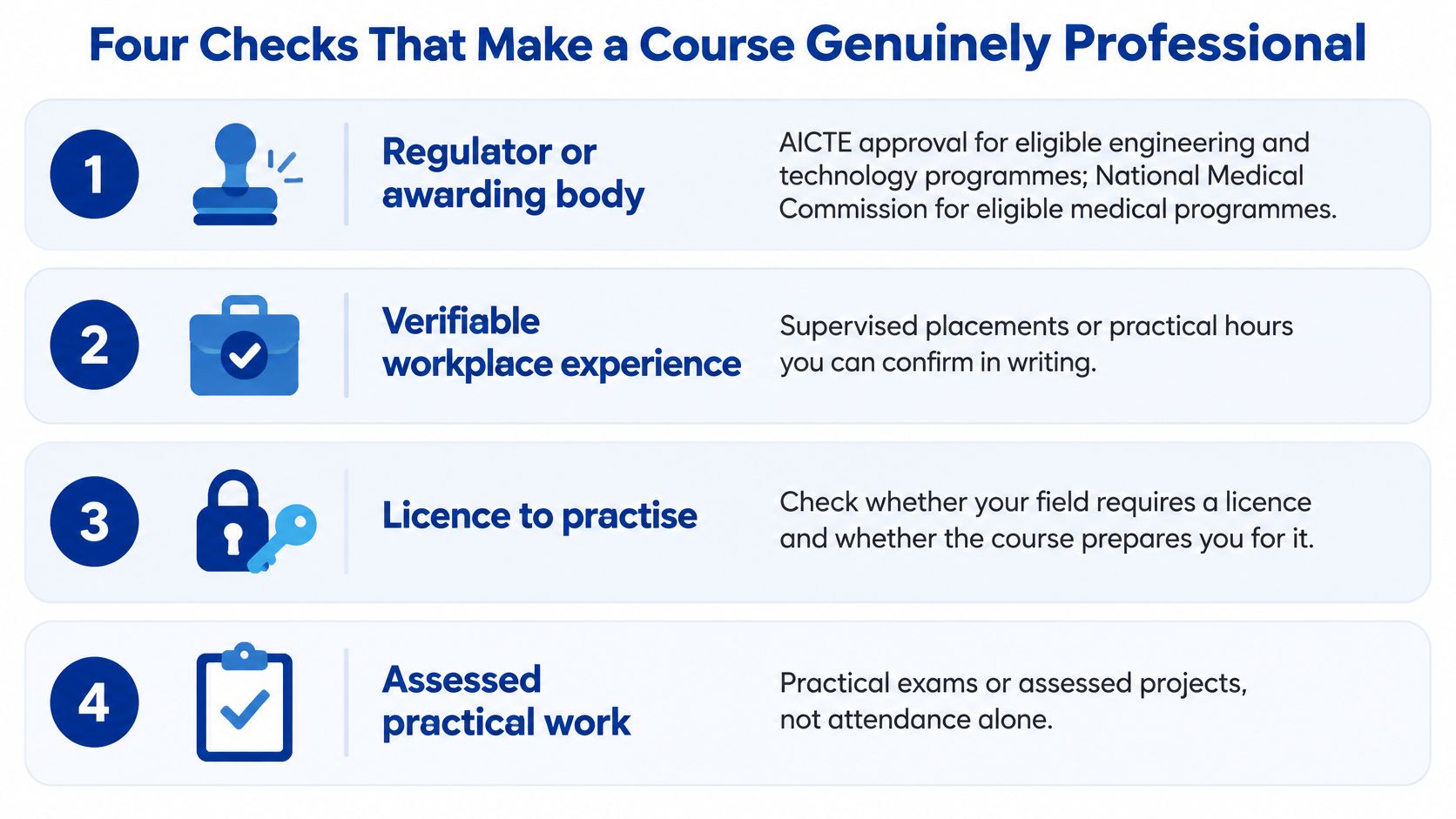
- Regulator or awarding body: Check that eligible engineering and technology programmes have the relevant AICTE approval. MBBS comes under the National Medical Commission, law under the Bar Council of India, and ITI trades under NCVT arrangements. Ask which body applies to the exact programme.
- Assessed practical work: Labs, clinical rotations, studio projects, workshops and field tasks should have assessment marks. If practical work is listed only as attendance, ask how students demonstrate their skills.
- Internships or apprenticeships: Request the duration, supervision arrangements, assessment method and written confirmation. A general promise of industry exposure is not proof that a placement is arranged.
- Current syllabus: Ask for unit details and revision dates. Check whether the content and tools relate to the work you hope to do.
How to judge syllabus currency
Ministry of Education information on technical curriculum revision explains that AICTE periodically revises model curricula with academia, industry, professional bodies and institutions. Topics include artificial intelligence, data science, machine learning, cybersecurity, robotics and quantum computing. The information also describes internships as an integral part of technical education and notes that the National Credit Framework allows up to 50% of the credits required for a qualification to be accumulated through skill-based courses.
Alignment with the National Skills Qualification Framework can provide another useful signal, particularly for certificates and skill-based programmes. Students can use Edvdo's career database to explore roles and compare their tasks with course units. This helps test whether the syllabus teaches skills linked to the intended destination.
Document request: Ask the provider for the syllabus, practical hours, written details of internship or apprenticeship arrangements, and placement records naming employers and years.
A course that passes these checks offers clearer evidence of occupational preparation. If one item is missing, ask why and request supporting documentation before enrolling.
Test the Label Against Fit and Evidence
The most common misconception is simple: professional means better. The word describes a course structure and occupational focus. It doesn't certify teaching quality, campus facilities, internship access or employment results, and a well-run diploma may provide a clearer route to work than a weakly delivered degree.
Employment evidence supports that caution. Reporting on graduate employability and employment outcomes in India puts the national graduate employability rate at 54.81% in 2025, based on testing of 6.5 lakh candidates across 28 states and 8 Union Territories. It also reports worker-population ratios of 57.5% for graduates and 62.2% for postgraduates in 2023-24, showing that educational attainment and employment are related but not identical.
Three assumptions worth testing
A degree always beats a diploma or ITI. That claim fails when the destination is a trade. A student aiming for electrical work may reach paid employment sooner through an ITI route combined with supervised apprenticeship than through a longer course that doesn't match the intended work. Earlier entry doesn't make the route universally superior, since later progression, earnings and occupational scope still need comparison.
A certificate equals a job. A certificate can prove completion of defined learning, but it doesn't by itself prove workplace competence. Assessment tasks, practical hours, employer involvement and alumni outcomes determine whether the document carries weight beyond attendance. New course names involving artificial intelligence or cybersecurity deserve the same scrutiny as older programmes.
A shorter route can replace every long qualification. Medicine and law provide the counter-case because registration rules make the recognised route mandatory for practice. A short health-related certificate can't substitute for MBBS and medical registration, and legal training that doesn't lead toward recognised enrolment can't authorise court practice. Fit therefore matters, but legal eligibility sets boundaries that preference can't override.
A five-step selection sequence
- Shortlist two or three tracks: Match each track with Class 10 or 12 subjects, interests and the kind of daily work involved, using an interest test to clarify preferences where choices feel unclear.
- Apply the four checks: Record the regulator, assessed practical share, internship or apprenticeship arrangements and syllabus currency for every option.
- Confirm the entry calendar: Check test dates, application windows, age rules, subject combinations and likely state or institute cut-offs from official notices.
- Request outcome evidence: Ask each provider for recent placement records with named employers, available wage information, completion details and examples of alumni progression.
- Weigh the whole fit: Compare cost, location, duration, travel, preferred work style and the likelihood of completing the programme successfully.
Families who want structured help with that sequence can consider guidance based on a student's academic background and career aspirations. Edvdo provides personalised career guidance for students from class 8 to 12 using scientific assessments, expert counselling and AI-driven insights, and its first career counselling session is free. Used carefully, external guidance should sharpen the evidence comparison rather than replace direct checks with universities, councils and employers.
The strongest choice isn't necessarily the course with the most famous title. It's the recognised route that leads to a named occupation, teaches through supervised practice, fits the student's subjects and resources, and leaves a sensible next step after the first qualification.
Students comparing professional courses can use Edvdo to connect academic background and career aspirations with personalised guidance, structured assessments and expert counselling for classes 8 to 12. The free first career counselling session gives families a practical place to test shortlisted routes against interests, eligibility and evidence before applications begin.