

Popular advice tells students to follow a fascination with crime straight into a degree. That advice skips the harder question. A student can binge-watch crime thrillers, predict a twist, and still dislike the slow reading, statistics, legal procedure, and policy debate that fill real Criminology courses in India.
Crime shows reward speed. Academic criminology rewards patience. One asks who did it. The other asks what counts as evidence, how institutions respond, why patterns differ across places, and what happens to victims, accused persons, and communities after an offence is recorded. Those are very different kinds of curiosity.
The seven options that follow aren't treated as a ranking. Each one is framed as a test of fit, by the question its curriculum answers and the kind of thinking it demands. A forensic laboratory programme, a liberal arts degree, and a short online introduction can all carry the word criminology while training students for different daily work.
Before comparing fees or campuses, students benefit from checking what kind of learning they enjoy. Tools that clarify aptitude and learning patterns, such as the overview of different aptitude test types, can help distinguish analytical patience from simple excitement about a dramatic story. That distinction matters more than a college name.
Table of Contents
- 1. National Forensic Sciences University (NFSU), Pune, Integrated B.Sc.-M.Sc. Criminology and Forensic Science
- 2. O.P. Jindal Global University, B.A. Criminology and Criminal Justice
- 3. Dr. B. R. Ambedkar University Delhi, M.A. Criminology
- 4. University of Madras, M.Sc. Criminology and Criminal Justice Science
- 5. Karunya Institute of Technology and Sciences, B.A. Criminology
- 6. Cochin University of Science and Technology (CUSAT), Online Criminology, Penology and Victimology
- 7. Sardar Patel University of Police, Security and Criminal Justice, M.A./M.Sc. Criminology
- How the seven criminology programs differ on level, entry requirements and published costs
- Test Your Curiosity Before You Enroll
1. National Forensic Sciences University (NFSU), Pune, Integrated B.Sc.-M.Sc. Criminology and Forensic Science
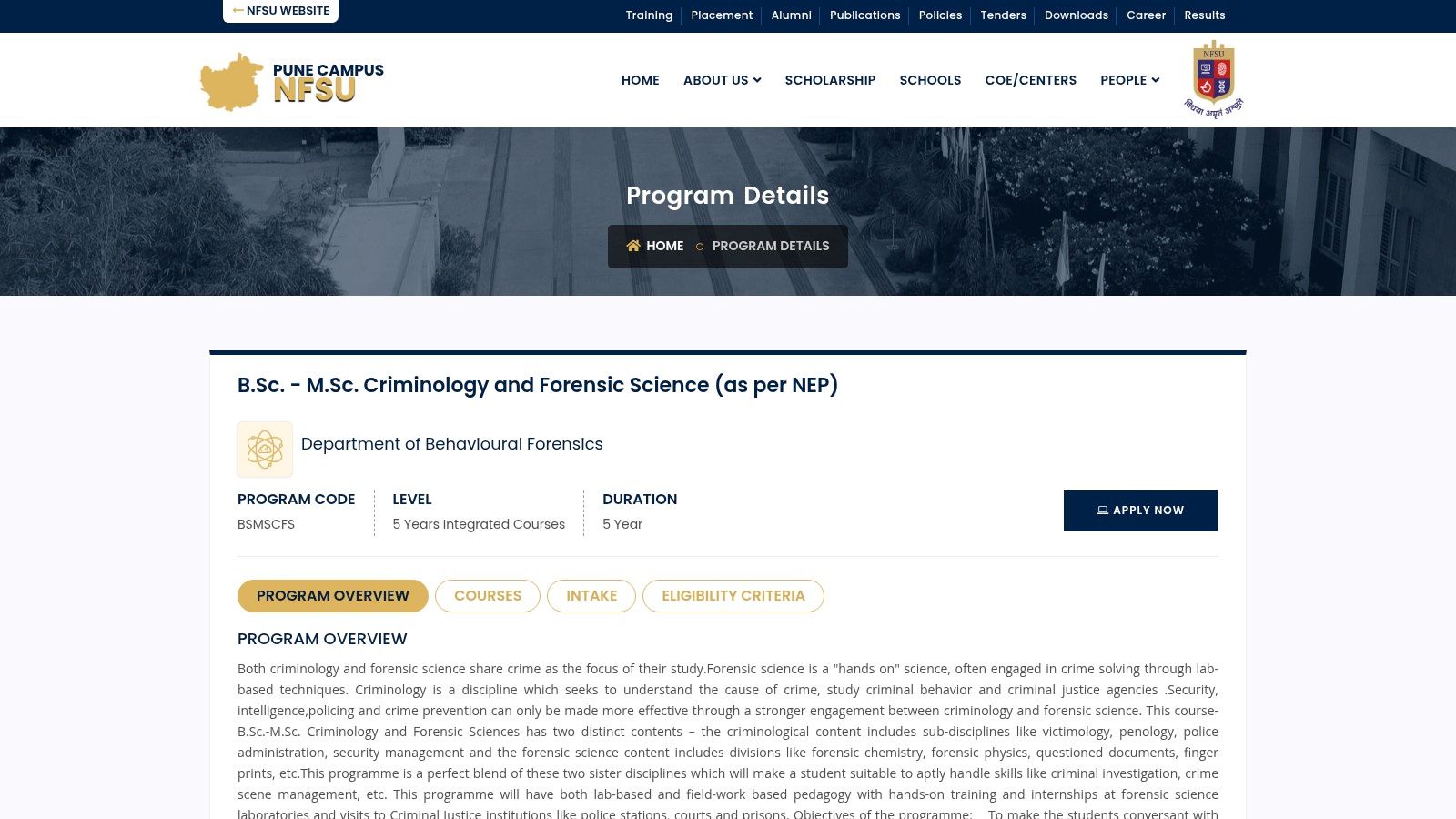
This route suits a science student who wants criminology tied closely to physical evidence. The NFSU Pune programme page lists a five-year integrated degree, an intake of 30, and published tuition of ₹65,000 per semester. Eligibility requires 10+2 in science with Physics, Chemistry, Biology, or Mathematics.
A related NFSU listing shows the sharper science gate for this combined route, including at least 60% for general-category applicants alongside laboratory work, fieldwork, internships, and criminal justice visits, according to the NFSU programme information page. That's the first fit test. Students who dislike laboratory precision may prefer a social science pathway even if both use the same subject name.
What the work actually feels like
- Forensic breadth: Chemistry, physics, questioned documents, and fingerprints sit beside criminology and criminal justice.
- Practical training: Lab-based and field-based learning, internships, and institutional visits are built into the description.
- Evidence discipline: Progress depends on careful handling, documentation, and repeatable method, not dramatic deduction.
Fit check: Enjoyment of crime scenes on screen counts for little if careful measurement, contamination control, and delayed results feel tedious.
Strengths include combining criminology and forensic science in one pathway and giving practical exposure a central place. Limits are equally clear. Science eligibility excludes many Arts and Commerce students, five years is a long specialised commitment, and current charges need confirmation before application.
Reflection on working style can sharpen that decision, and a structured personality test gives students language for preferences such as detail, routine, and independent analysis. The degree rewards methodical habits first, dramatic intuition last.
2. O.P. Jindal Global University, B.A. Criminology and Criminal Justice
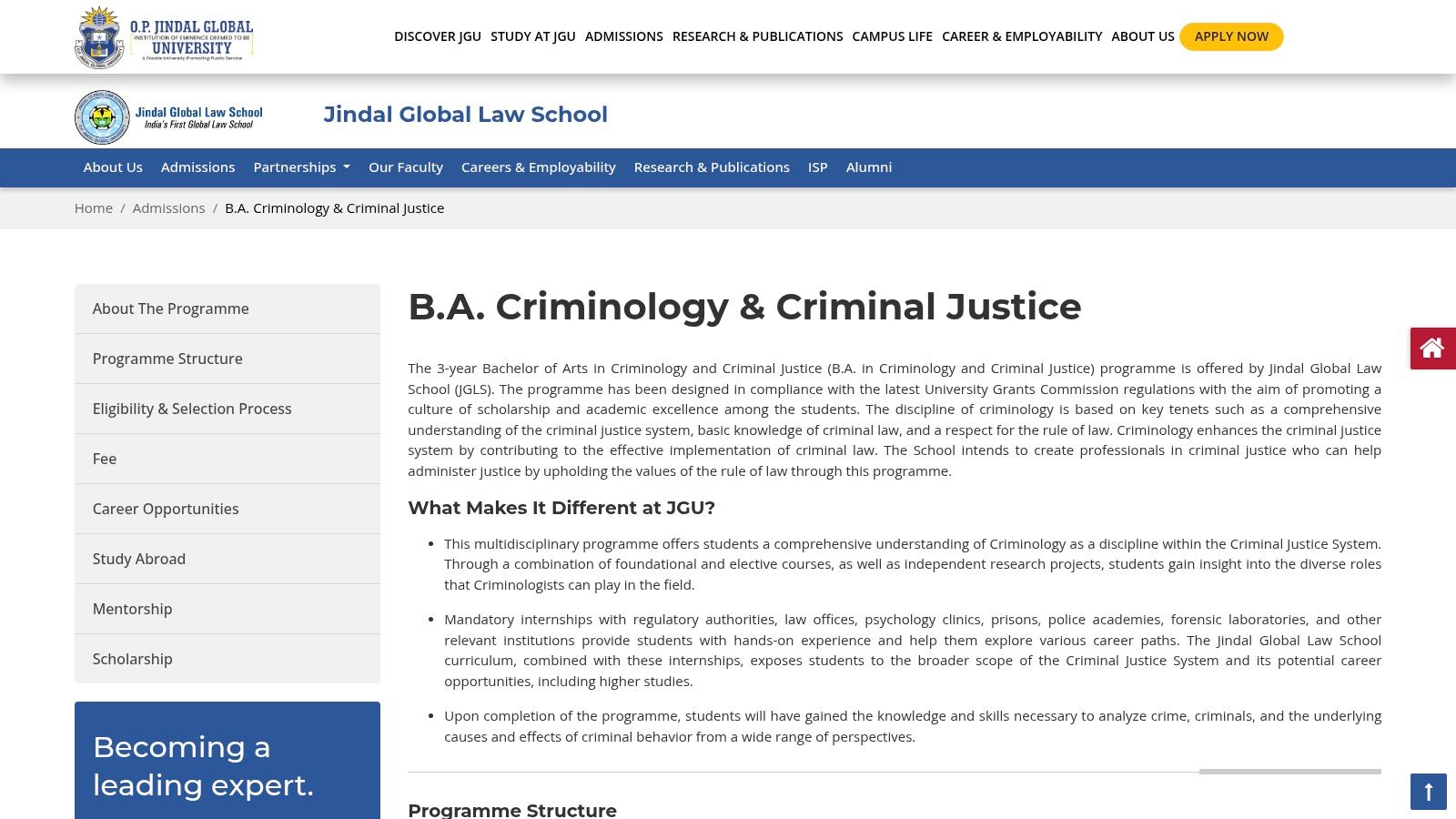
A student from Arts, Commerce, or Science who wants a direct undergraduate entry after Class 12 faces a different question here. Does the appeal lie in law, psychology, policing, and social explanation rather than laboratory science? The Jindal Global Law School admissions page lists tuition at ₹5 lakh per year, with additional accommodation and allied-service charges for residential students.
The curriculum spans theories of crime, victimology, penology, criminal psychology, cybercrime, and policing. A required internship adds exposure through settings such as prisons, police academies, forensic laboratories, and law offices. Admissions information lists national-level entrance exams, so current criteria need checking for the relevant intake.
Broader Indian provision shows why that breadth matters. Programmes operate across undergraduate, postgraduate, M.Phil., and PhD levels, with reported work settings including prisons, police departments, NGOs, juvenile homes, rehabilitation centres, corporate roles, and research organisations, according to EducationWorld. A degree title alone doesn't assign a graduate to any one of those settings.
Strengths and trade-offs
- Interdisciplinary base: Students can test legal, psychological, and sociological explanations side by side.
- Internship exposure: Required placements connect classroom debate with institutional routines.
- Cost barrier: Private university and residential costs may be significant for many families.
- No guaranteed role: Completion doesn't guarantee a government post or a specific occupation.
An interest test can help students separate lasting interest in justice institutions from short-term enthusiasm for crime stories. The strongest fit is a reader who enjoys argument, field observation, and writing about contested evidence, then accepts that careers still require further choices, applications, and often competitive entry routes.
3. Dr. B. R. Ambedkar University Delhi, M.A. Criminology
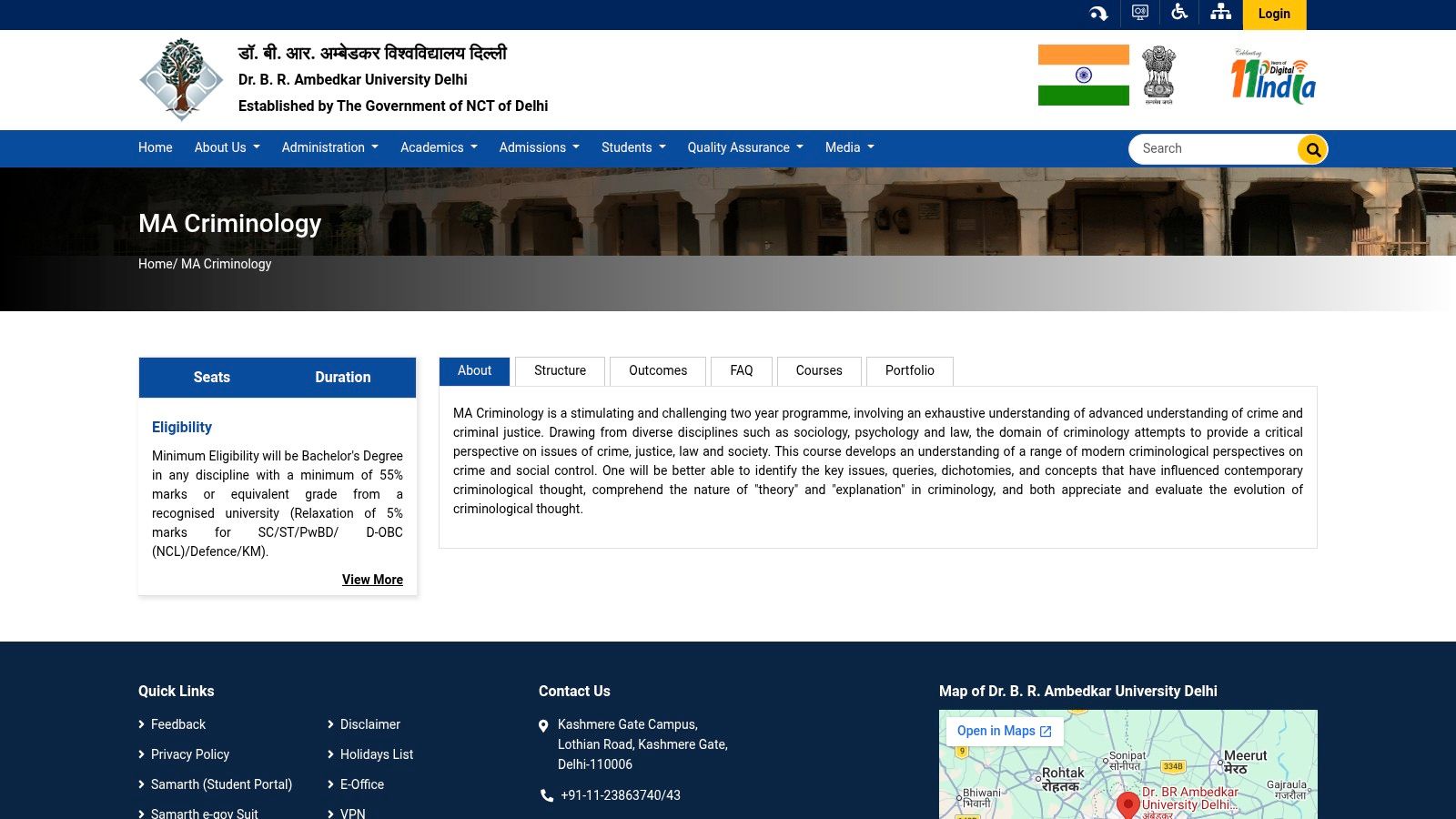
For a graduate considering a move into criminology, the key question is whether the programme's methods fit the way they want to study. The Ambedkar University Delhi programme page describes a four-semester, 80-credit M.A. open to applicants with a bachelor's degree in any discipline, subject to minimum marks and category-based relaxations. Coursework is paired with field visits, an internship, and a dissertation.
The curriculum includes cyber criminology, psychology of crime, victimology, juvenile justice, penology, and criminal procedure. That combination may appeal to graduates in sociology, psychology, law, political science, or other fields who want to examine crime through several lenses. Since this is a postgraduate degree, it is not an immediate option after Class 12.
Consider a fictional case: a student researches an online financial scam and asks how institutions respond, how victims experience the process, and how law defines the offence. Those questions call for careful reading and evidence-based analysis, not just interest in technology or crime stories. NCRB data reported by the Press Information Bureau show registered cybercrime cases rising from 86,420 in 2023 to 101,928 in 2024, according to the Press Information Bureau release. The figures give context to the subject, but do not establish that the course teaches digital investigation or that graduates automatically enter technical roles.
Questions to ask before applying
- Cyber depth: Does the teaching examine digital evidence and data analysis, or focus mainly on legal and social questions?
- Research fit: Would you enjoy developing a dissertation question, working with evidence, and revising your conclusions?
- Field experience: How are visits and internships arranged, supervised, and assessed?
Delhi's proximity to criminal justice institutions may be relevant when considering field exposure, while admission remains competitive and current seat and selection details should be checked. Current fee figures aren't listed here, so check the university's admissions page before budgeting. To compare course language with real-world role descriptions, explore the jobs list.
4. University of Madras, M.Sc. Criminology and Criminal Justice Science
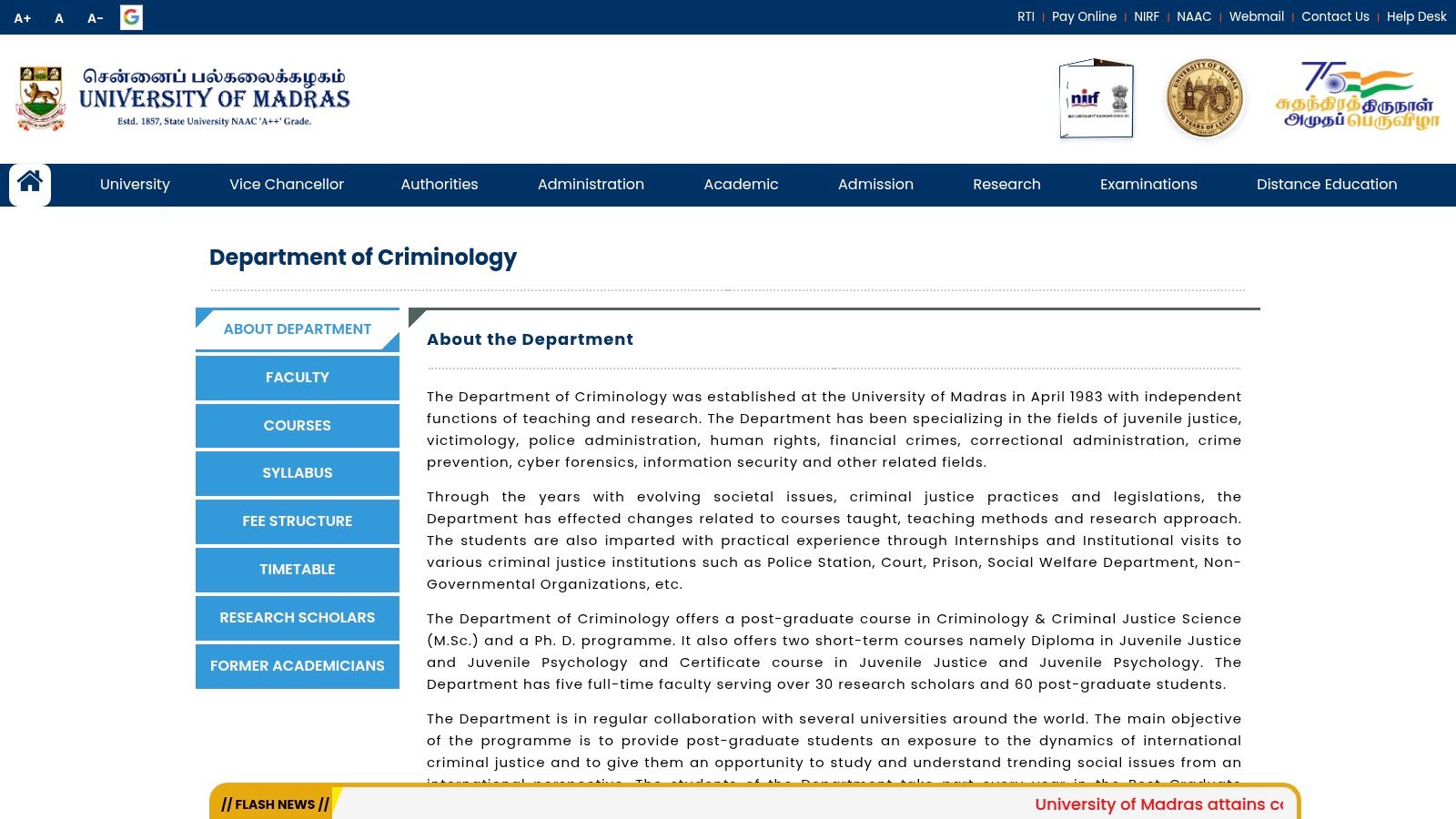
A criminology degree is a test of how you like to think. At the University of Madras, the M.Sc. asks students to examine justice institutions and social responses to crime through subjects such as victimology, juvenile justice, police administration, human rights, financial crimes, and cyber forensics. The Department of Criminology page dates the department to 1983 and lists the M.Sc. in Criminology and Criminal Justice Science.
The department describes internships, visits to criminal justice institutions, and research and training collaborations with public bodies and criminal justice agencies. That setting may suit graduates who want to connect academic questions with institutional practice, especially in areas such as victim support or juvenile justice.
Consider a fictional case: a student is studying why young people in a district leave school before coming into contact with the justice system. The criminological task is to examine records, interview practices, and institutional responses carefully, while distinguishing evidence from assumption. Would that kind of patient inquiry hold your interest?
A specialised department can offer depth, but depth is useful only if you want sustained study of criminal justice. The M.Sc. requires a bachelor's degree. The department page does not publish current fees, so applicants should confirm them directly with the university along with intake details and whether particular specialised offerings run in the relevant academic year.
The AISHE-directory aggregation for criminology reports 9 institutes and 382 seats in the related Criminology and Police Administration category, all in Tamil Nadu. These figures describe approved capacity, not actual enrolment or demand.
For a fit check, ask yourself: Do you enjoy examining how institutions respond to social problems? Are you willing to work with research and field-based learning? Does victimology or juvenile justice interest you more than a programme centred mainly on forensic methods? Your answers can help clarify whether this course's approach suits you.
5. Karunya Institute of Technology and Sciences, B.A. Criminology
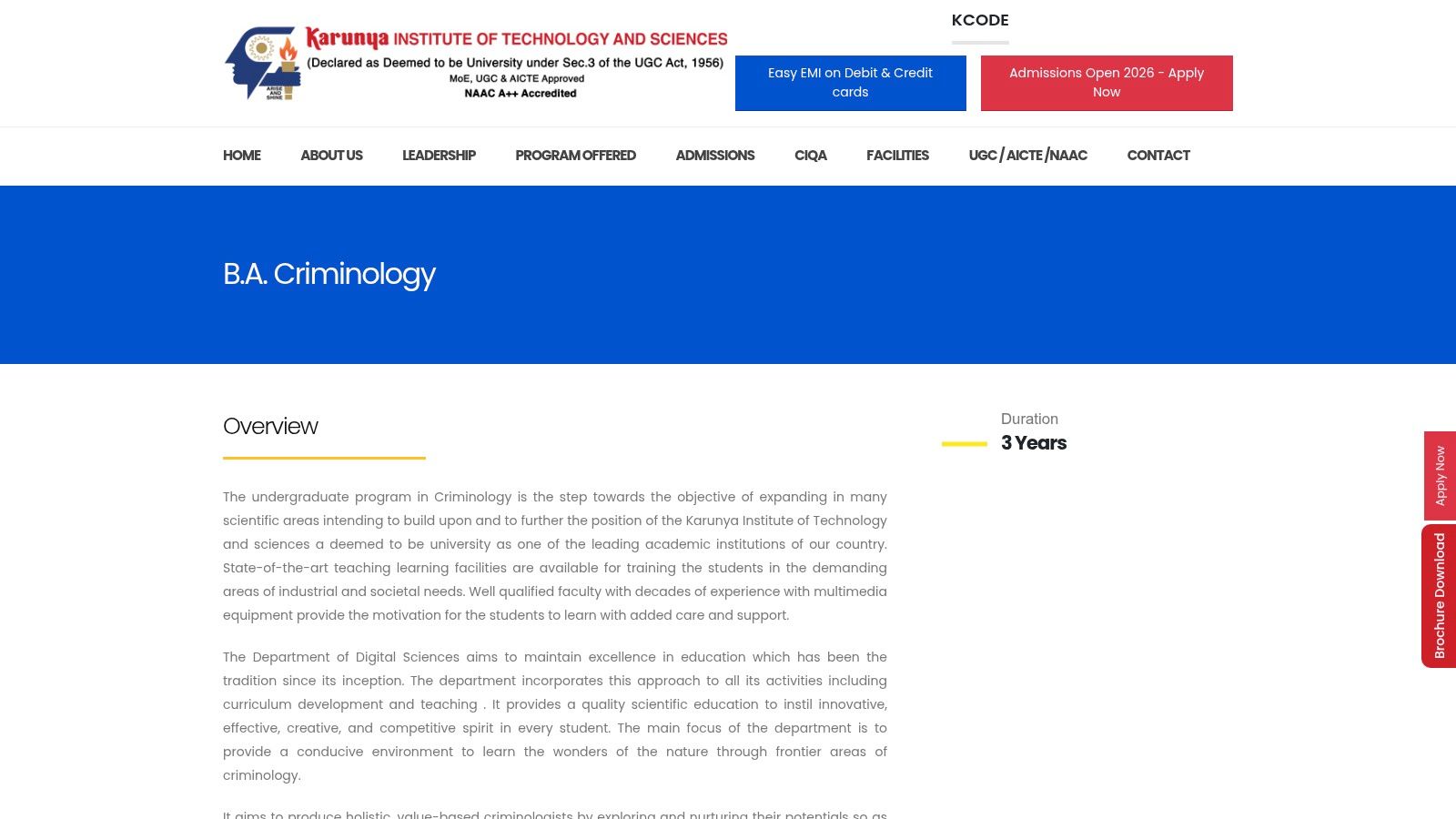
Electives reveal the thinking a degree asks for. The Karunya B.A. Criminology course page lists a three-year curriculum covering criminology, forensic science, police administration, research methods, and victimology, plus field visits and summer internships. The institution says the curriculum is designed with UGC norms and exam preparation in mind.
The elective range is unusually instructive. Cybercrime tests comfort with digital harm and evidence. Restorative justice asks how harm can be repaired and what victims need beyond punishment. GIS crime mapping requires spatial patterns and data handling, while abnormal psychology demands careful reading without reducing people to labels.
A small self-test from the elective list
Say theft reports rise near one market in a fictional Indian town. A weak response names a suspect profile immediately. A criminological response separates reporting changes, lighting, crowd flow, police recording, seasonal trade, and repeat victimisation, then asks which explanation evidence can support. Students who enjoy that slow separation may enjoy the subject.
- Specialised electives: Several applied choices sit inside an undergraduate degree.
- Practical exposure: Field visits and summer internships appear in the published curriculum.
- Delivery uncertainty: The page sits with the Centre for Distance and Online Education, so delivery and attendance requirements need direct confirmation.
- Fee gap: The reviewed page didn't show a current fee figure.
A skill test can help students check strengths in observation, reasoning, and data handling before treating electives as attractive labels. Applicants should also ask how visits and internships are arranged in practice, since published curriculum and lived timetable can differ.
6. Cochin University of Science and Technology (CUSAT), Online Criminology, Penology and Victimology
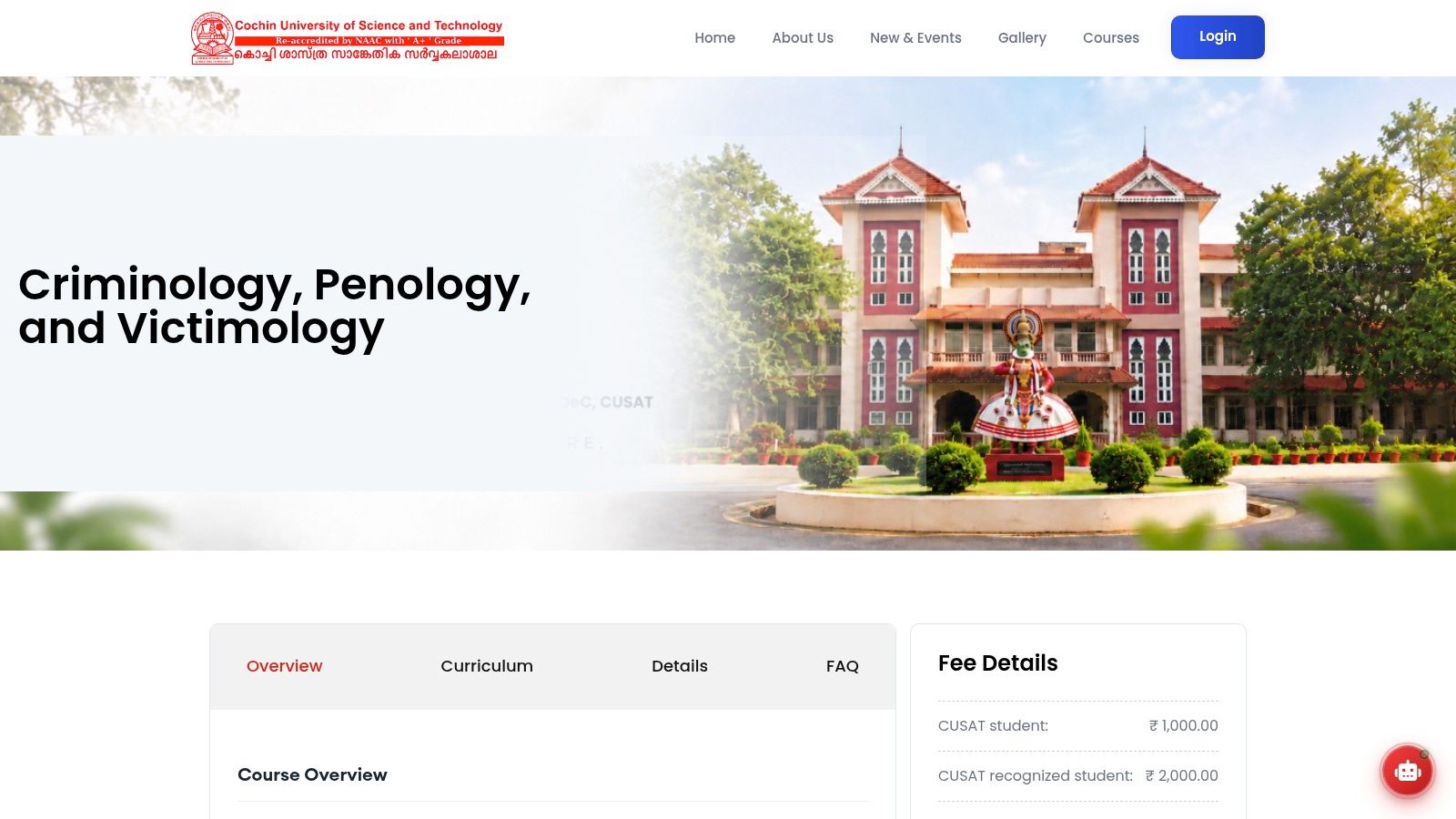
A short course can test whether criminology's way of thinking suits you. The CUSAT online course listing describes a nine-week, three-credit course covering criminological perspectives, punishment, prison issues, and victims' rights, including Indian perspectives.
The listing gives fees of ₹1,000 for CUSAT students, ₹2,000 for recognised students, and ₹3,000 for other learners. It also identifies an instructor whose stated areas include criminal law, human rights law, and criminology. For a student in Classes 11 or 12, or an undergraduate studying another subject, the course may offer a focused introduction before committing to a degree.
The course's three themes ask different questions. Criminology examines how societies explain crime; penology studies punishment and prisons; victimology considers victims' experiences and rights. Together, they shift attention from the image of a crime scene to the institutions and people affected by criminal justice.
Consider a fictional case in which a person reports a stolen phone in Kochi. A criminological approach asks what records and evidence can establish; a penological one examines how punishment is chosen; a victimological one asks whether the reporting and court process address the person's needs. Each question calls for a different kind of evidence and care.
Indian procedure also places boundaries around evidence collection. The India Code record for the Bharatiya Nagarik Suraksha Sanhita, 2023 defines investigation as proceedings for collecting evidence conducted by a police officer or another person authorised by a Magistrate. For students, this points to a central habit of criminological thinking: distinguish suspicion from evidence, and consider who has authority to act.
Try a fit check: Would you enjoy comparing explanations, reading about institutional rules, and weighing victims' rights alongside questions of punishment? If the method interests you as much as the subject, a short course may be a useful test. If you mainly want practical exposure to crime scenes, this syllabus may not answer that interest.
The course is a short academic introduction, not a substitute for a bachelor's or master's qualification. Its availability is batch-based, so check the listing for current enrolment and certificate details before applying.
7. Sardar Patel University of Police, Security and Criminal Justice, M.A./M.Sc. Criminology
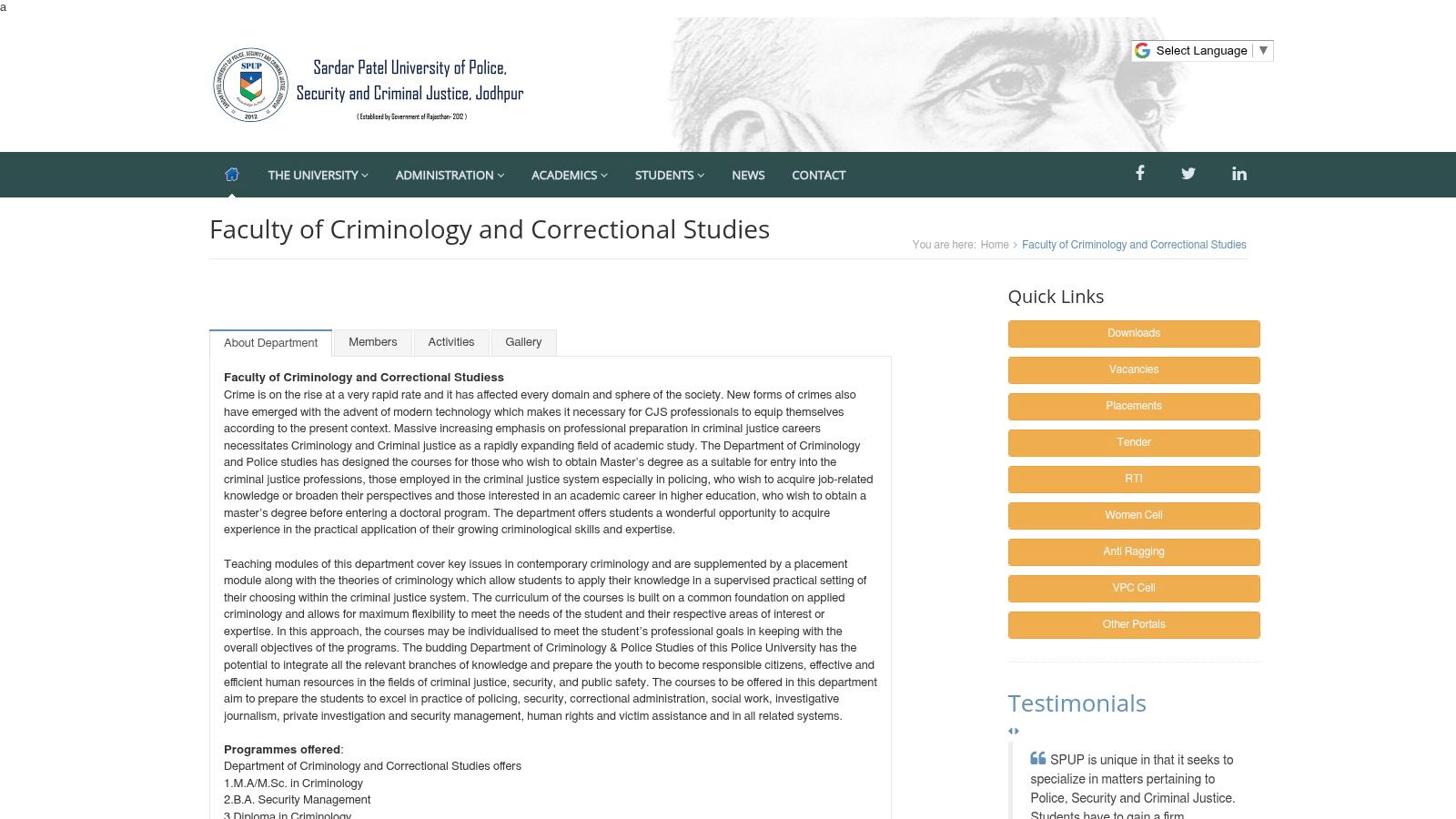
Institutional setting shapes daily questions. The Sardar Patel University department page lists an M.A./M.Sc. in Criminology and a Diploma in Criminology through the Department of Criminology and Correctional Studies. The description emphasises applied coursework and a supervised placement module.
Stated career-related areas include policing, corrections, security, victim assistance, and private investigation. The department also lists research in criminology, criminal justice, and police administration. That police-university environment may suit students drawn to operational institutions more than broad social theory.
Scale gives another correction to screen expectations. NCRB-linked reporting for 2023 recorded 6,241,569 cognizable cases, a 7.2% increase over 2022, according to ThePrint reporting on the NCRB report. A system handling millions of cases needs records, procedure, triage, and court capacity, not only individual profiling of dramatic crimes.
Who should pause
- Theory-first students: A primarily theoretical or wider social science programme may fit better elsewhere.
- Detail seekers: Current fees, intake, and a full curriculum aren't provided on the department page.
- Career literalists: Listed areas such as policing or corrections still involve separate recruitment and eligibility routes.
Strengths include specialist focus, placement-based learning, and both postgraduate and diploma routes. Applicants should confirm which programmes are open for the current academic year and how placements are supervised. Lesser-known specialisations such as cybercriminology, victimology, and penology can be explored against the curriculum, but labels shouldn't substitute for paper-level detail.
Fit here turns on comfort with hierarchy, field discipline, correctional settings, and the ethical strain of working close to state power. Interest in uniforms or investigation alone isn't enough.
How the seven criminology programs differ on level, entry requirements and published costs
| Item | Level and Duration | Eligibility | Published Fee or Cost |
|---|---|---|---|
| National Forensic Sciences University (NFSU), Pune, Integrated B.Sc.–M.Sc. Criminology and Forensic Science | Integrated undergraduate and postgraduate degree; 5 years | Class 12 science with Physics, Chemistry, Biology, or Mathematics | ₹65,000 per semester |
| O.P. Jindal Global University, B.A. Criminology and Criminal Justice | Undergraduate degree; 3 years | Class 12 graduates from any stream | ₹5 lakh per year; additional accommodation and allied-service charges may apply |
| Dr. B. R. Ambedkar University Delhi, M.A. Criminology | Postgraduate degree; 2 years | Bachelor's degree in any discipline; minimum marks and category-based rules apply | Current fee not provided |
| University of Madras, M.Sc. Criminology and Criminal Justice Science | Postgraduate degree; duration not stated | Bachelor's degree required | Current fee not provided |
| Karunya Institute of Technology and Sciences, B.A. Criminology | Undergraduate degree; 3 years | Undergraduate route for Class 12 graduates; confirm current entry criteria | Current fee not provided |
| Cochin University of Science and Technology (CUSAT), Online Criminology, Penology and Victimology | Online short course; 9 weeks, 3 credits | Specific eligibility not stated | ₹1,000 for CUSAT students; ₹2,000 for recognized students; ₹3,000 for other learners |
| Sardar Patel University of Police, Security and Criminal Justice, M.A./M.Sc. Criminology | Postgraduate degree; duration not stated; diploma also listed | Current eligibility not stated | Current fee not provided |
Test Your Curiosity Before You Enroll
A fascination with crime is not the same as enjoying criminology. The better test is whether you like the work behind the subject: comparing explanations, evaluating evidence, reading legal material, interpreting numbers, and considering people's experiences fairly.
Try a short introductory reading, a course unit, or a fictional case. For example, suppose a phone is reported missing from a college library in Pune. A criminologist might ask what records or accounts could help establish when it disappeared, how different explanations should be assessed, and what the incident suggests about prevention. The task is not to guess who did it. It is to ask careful questions and distinguish evidence from assumption.
Afterward, write down what interested you about the topic and what you enjoyed about the method. That distinction can help you judge fit. Criminology courses in India may approach the field through law, research methods, statistics, psychology, forensic science, policing, corrections, or victim studies. A program's curriculum matters because each route asks for a different kind of attention.
Keep a few distinctions clear. Profiling is not mind reading, and a charge sheet is not a conviction. Criminal psychology is one perspective within a wider field. Forensic science and social science criminology overlap in some questions but use different methods. A degree, by itself, does not guarantee a government job.
Cost can also shape a decision. Published M.A. tuition figures in the linked comparison range from ₹77,000 at Rashtriya Raksha University to ₹2.4 lakh to ₹6 lakh for comparable NFSU M.A. tuition, according to Shiksha's published fee figures. Check each university's current fee information before applying.
Reflection can help clarify interests, but it is one input among several. Edvdo helps students understand their strengths, motivations, and learning patterns through AI career assessments, guided activities, and an AI mentor named Vedu. Its personalized insights and recommendations can support academic and career decisions alongside advice from teachers and family, course documents, and questions to universities.
Three questions can help you test your interest: Did you stay engaged after the mystery gave way to evidence and analysis? Did uncertainty feel like a question to investigate, or a frustration to escape? Could you consider fairness for victims, accused people, and communities without relying on stereotypes? Your answers can point toward further study in criminology or related subjects such as law, psychology, sociology, and forensic science.
Student life skills resources can help you practise study habits, note-making, and decision routines while exploring a subject. An optional psychometric test for career counselling offers another structured reflection tool. Treat its results as a prompt for questions, not a verdict on which program you should choose.
Students considering criminology can use Edvdo to reflect on their strengths, motivations, and learning patterns while comparing forensic, social science, and short-course options. Guided activities and structured insights can help turn a general interest into specific questions about evidence, research, ethics, and study methods.