
A Class 10 student can score well in every exam and still panic when asked to introduce herself in English, choose a stream, or explain why a homework plan fell apart. That gap is why student life skills matter so much in Indian schools. Marks show what a student remembers, but life skills shape what a student can do when the timetable changes, the pressure rises, or the next decision is bigger than a test paper.
Table of Contents
- Why Student Life Skills Matter More Than Marks Alone
- The Seven Core Life Skills Every Student Needs
- Building Time Management and Decision-Making Habits That Stick
- Emotional Awareness and Resilience for Real-Life Pressure
- Making Career Choices That Are Financially Realistic
- How Parents and Teachers Can Practise These Skills Together
- Your 30-Day Student Life Skills Growth Plan
Why Student Life Skills Matter More Than Marks Alone
A boy in Class 11 can finish tuition, school, and dinner with barely enough energy left to think clearly about commerce, science, or arts. A girl in Class 9 can know the lesson perfectly and still freeze during a group presentation because she is unsure how to speak, listen, and recover from a mistake. These moments are where communication, critical thinking, emotional awareness, and decision-making begin to matter more than marks.
India has a clear reason to treat adolescence as a serious skill-building window. UNICEF's India framework notes that only 5% of young people were not enrolled in formal education at age 14, but that figure rose to 30% by age 18, with 32% of females and 28% of males not enrolled at 18, and 42% of rural adolescents aged 14–18 also doing unpaid work (UNICEF India life-skills framework). School is not continuous for everyone, so a student who learns only content often has a fragile path after adolescence.
Practical rule: if a skill helps a student explain, choose, recover, or organise, it belongs in life skills work.
The OECD survey on Delhi's 15-year-olds adds a useful local lens. It found that 91% reported social and emotional education integrated across subjects, higher than the international average of 83%, and students who felt stronger belonging and received more teacher feedback generally reported stronger skills across the board (OECD India site note). That is the key point. Marks open doors, but student life skills decide which doors a young person can walk through with confidence.
The Seven Core Life Skills Every Student Needs
A student may be bright in class and still stumble in daily life if one core habit is missing. One child can speak well but miss deadlines. Another can stay calm during a test but struggle to work with a group. These skills work together like the supports under a school roof, and each one needs practice in real school life.
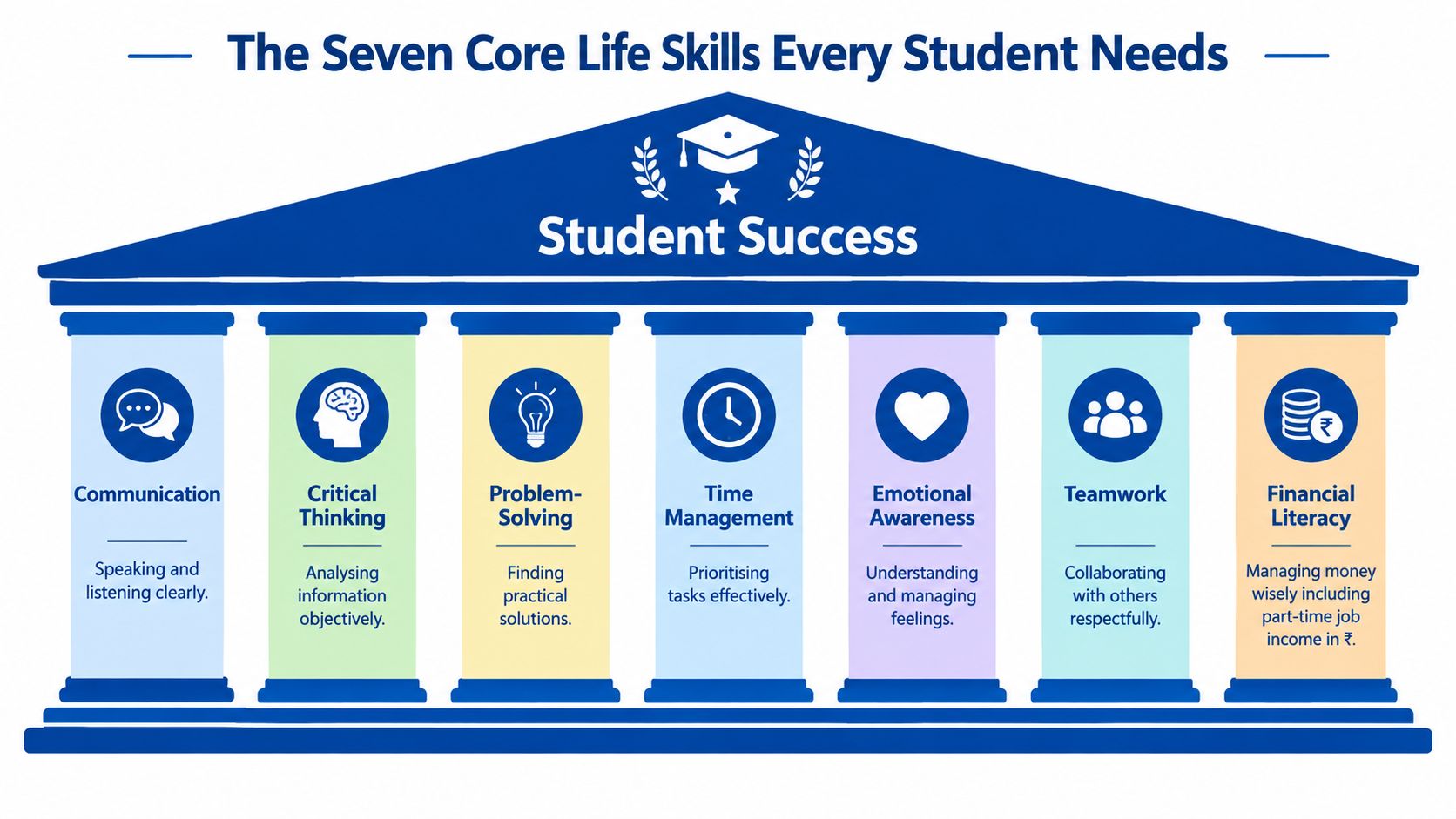
Communication, critical thinking, and problem-solving
Communication grows when a student makes ideas clear enough for someone else to act on. A good practice this week is simple, ask a child to explain one lesson from school to a parent at dinner in three plain sentences. If the parent can repeat it back, the message was clear.
Critical thinking starts when a student asks, “Why does this work?” instead of copying the first answer found. In an Indian classroom, that might mean checking why a maths shortcut works, or comparing two answers before submitting homework. A teacher can use a five-minute exit question, asking students to defend one choice from the lesson.
Problem-solving becomes stronger when a large task is broken into smaller parts. A science project, for example, can move from topic choice to research, then to rough draft, then to presentation. That is also the spirit of NEP 2020, which supports inquiry, discussion, analysis, and hands-on learning.
Time, emotions, teamwork, and adaptability
Time management is the habit of giving each task a place before the day runs away. A student preparing for exams can write homework, revision, family time, and sleep on one page, then choose what must happen first.
Emotional awareness begins when a student names the feeling plainly. “I am stressed,” “I am embarrassed,” or “I am angry” gives adults and teachers something real to respond to, instead of guessing. A parent can ask that question after school, before advice starts.
Teamwork shows up when students share roles instead of one child doing all the work. In a group activity, one student can gather notes, another can present, and a third can check the final answer. That keeps group work fair and teaches students how to contribute without taking over.
Adaptability is the skill of adjusting without panic when the plan changes. A bus delay, a surprise test, or a cancelled class becomes easier to handle when the student knows how to reset and continue.
For a quick self-check, a dedicated life skills test can help students compare strengths across these areas and see where daily practice should begin.
Small action beats vague intention. A student who practises one skill for 10 minutes a day usually gets further than a student who keeps a perfect list and never starts.
Building Time Management and Decision-Making Habits That Stick
A student who keeps saying, “There isn't enough time”, usually needs a system, not more motivation. Last-minute cramming, tab-hopping, and trying to finish everything at once make decisions worse because the mind is already overloaded.
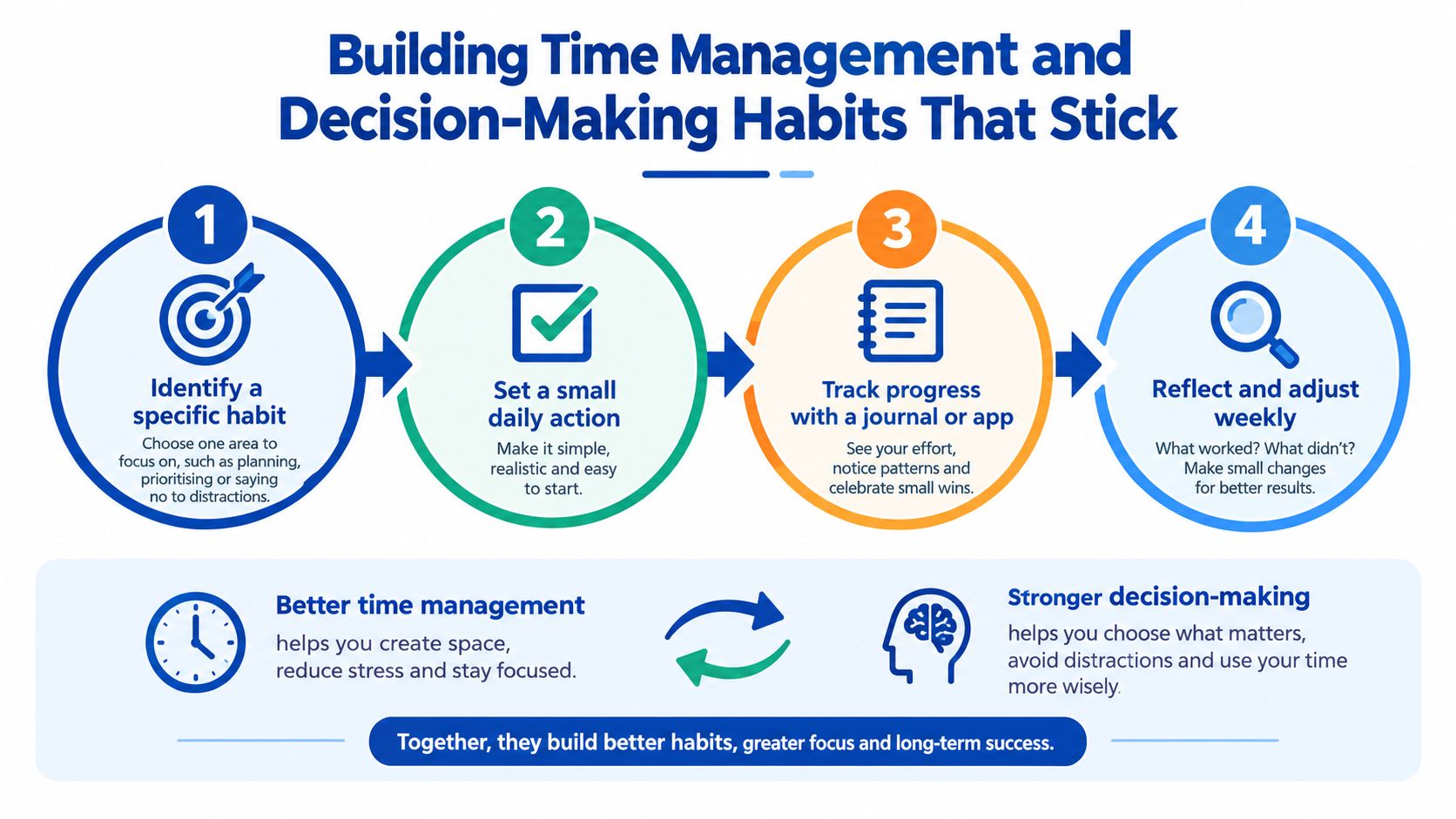
A four-step routine for everyday use
- List the day's tasks. A board student might write revision, homework, family time, and sleep on paper before opening a book.
- Pick the three most important ones. A student preparing for boards may choose maths practice, English writing, and an early night instead of seven half-finished jobs.
- Assign realistic time slots. A 30-minute revision block is honest. A two-hour promise that depends on perfect focus is usually fantasy.
- Review the day in the evening. A short end-of-day check shows what got done, what slipped, and what needs a better slot tomorrow.
That structure works because time management and decision-making reinforce each other. Once the day is ordered, the student has fewer reasons to say yes to every distraction. A teacher who wants a printable planning rhythm can adapt the same logic with Teacher Planner planbook and then echo it in class routines.
Choosing with a cost-versus-effort lens
Decision-making also gets easier when students ask two simple questions. What will this choice cost in time, money, and energy? What effort will it need before the first result appears?
A homework choice, a stream choice, or a club commitment becomes less confusing when seen through that lens. Edvdo's activity check-in can fit this style of practice, because students can review whether a habit was followed instead of guessing how well they managed the week.
Emotional Awareness and Resilience for Real-Life Pressure
A student can walk into school prepared and still feel shaky by lunch. Homework pressure, exam fear, family expectations, and peer comparison often arrive together, and the Ministry of Education and NCERT survey, which included 379,842 students from Classes 6 to 12, found that satisfaction with personal life and school life fell as students moved into secondary school, while mood swings and study-related anxiety rose and were reported more often by girls (PIB report).
A simple check-in that fits before class
A two-minute check-in can stop a bad mood from spilling into the whole day. A student can ask, “What am I feeling right now?”, “What set it off?”, and “Who should I speak to if this gets heavier?” One line in a weekly journal helps too, especially if it ends with one coping step, such as a short walk, a quiet conversation, or a reset after study.
The same survey noted that students used yoga and meditation, reframing their thoughts, journaling, and self-reflection to cope. Those habits work because they are low-cost and repeatable. Consistency matters more than doing them perfectly once and forgetting them the next week.
Parents should listen first. If a child shares stress, the first response should be to hear the problem clearly, not to minimise it or rush into advice.
A small class-room routine can make this practical. A teacher might begin the day with a one-minute “weather report” where students name their mood in one word, or use a quick reflection card after a tough test. The point is not to force sharing. It is to make feelings easier to name before they turn into behaviour.
Bullying changes how safe school feels. A school safety report on student experience in Delhi found that some students were both bullied and bullying others, which shows that the same child may need support and accountability at the same time. A class teacher can respond by separating the behaviour from the student, checking in privately, and watching for repeat patterns rather than waiting for the next fight. That kind of response protects attention, relationships, and learning. In an Edvdo personality test setting, a useful prompt is simple, “What helped calm the last difficult moment, and what made it worse?”
Making Career Choices That Are Financially Realistic
Many families still treat career choice as if it begins and ends with interest. That sounds neat, but Indian students have to live with costs, entrance requirements, time to employability, and the chance that the first plan may not work out.
A UN-supported survey of 21,239 students across 14 Indian districts found that only 10.4% had received professional career guidance, only 10% knew course costs, and just 22% had a fallback career plan, while 41% of private-school and 35% of government-school students were undecided about their post-school course choice (ETV Bharat report). That means a lot of students are choosing without the full picture.
Career Decision Worksheet
| Question to Answer | Why It Matters | Example Prompt |
|---|---|---|
| What does the course cost in total? | Families need a full picture, not a guess. | “What will tuition, books, transport, and exam fees look like?” |
| What entrance route is needed? | Some choices need long preparation. | “Which exam, stream, or marks are required?” |
| How long until employability? | Time matters when resources are limited. | “Will this lead to work quickly, or after more study?” |
| What cheaper or local routes exist? | Good plans do not have to be the most expensive. | “Is there a diploma, bridge course, or nearby college?” |
| What scholarships, loans, or support exist? | Cost should be checked before panic or hope. | “Which support options can reduce the burden?” |
| What salary range is realistic later? | Students should compare outcomes with effort. | “What kind of pay is common after training?” |
| What is the Plan B? | Resilience improves when the first choice fails. | “If this path closes, what is the next workable option?” |
The career report page can help a student connect strengths to streams and roles before the worksheet is filled in. That matters because self-knowledge only becomes useful when it meets practical constraints. A child who understands both fit and cost is far less likely to choose blindly.
How Parents and Teachers Can Practise These Skills Together
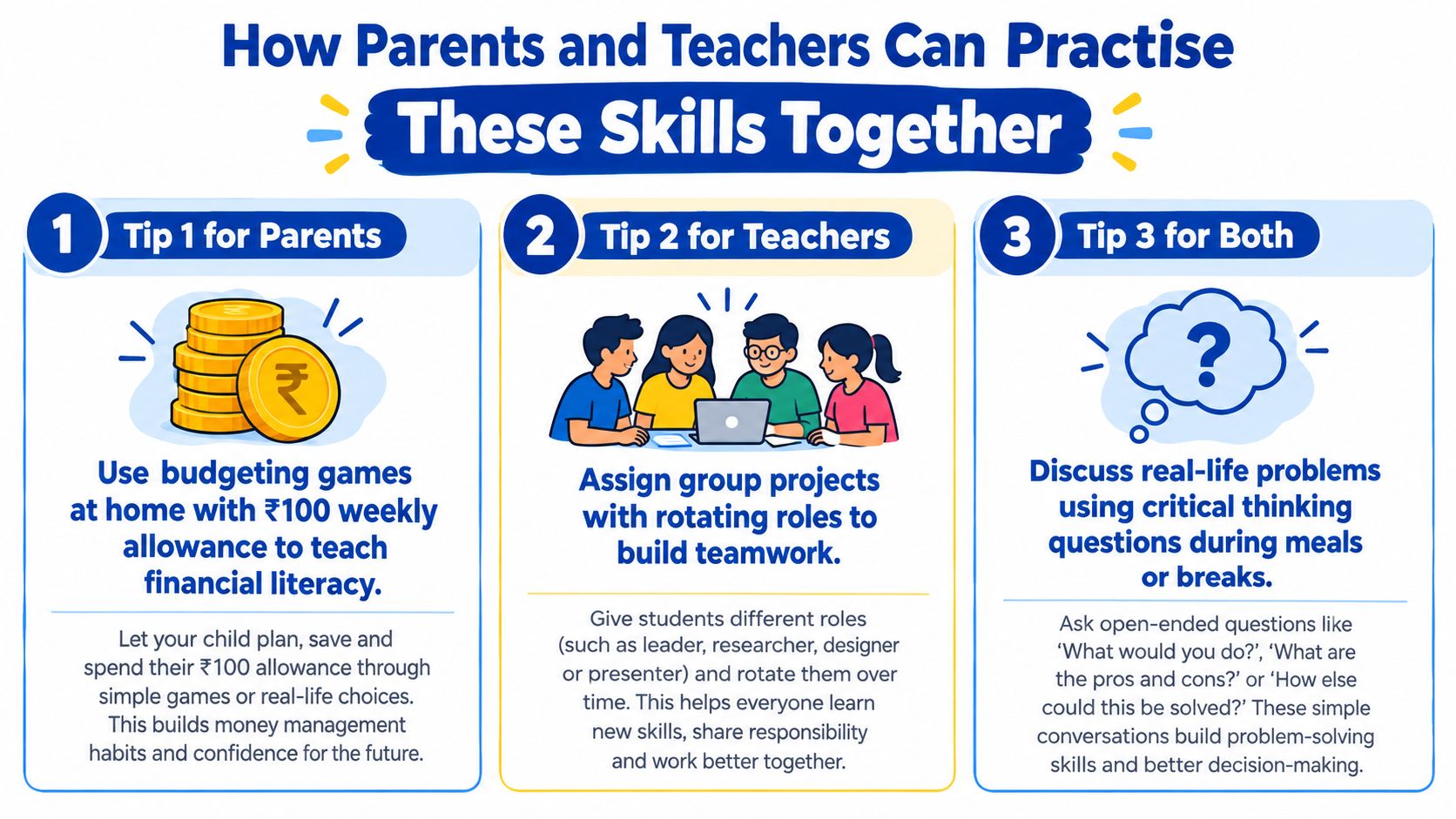
Children do not build life skills only by hearing advice. They build them by seeing adults handle mistakes, explain choices, and recover from plans that did not work. A parent who calmly says, “That plan failed, now what is the next step?” teaches more than a lecture ever will.
Home habits that feel natural
Parents can ask, “How did you reach that answer?” before correcting a mistake. They can also give small responsibilities at home, such as managing a weekly shopping list or tracking one household expense, because that builds responsibility and decision-making. A family check-in once a week works better than a long lecture after every exam result.
Classroom moves that do not need a syllabus overhaul
Teachers can build the same muscles through group investigations, peer teaching, short debates, and reflection journals. Rotating roles in a project helps students practise teamwork without turning one confident child into the permanent leader.
A useful external resource on collaborative support is the Guiding Growth research summary, which can help adults think more carefully about shared responsibility between home and school. The big idea is simple. When adults model thinking, listening, and recovery, students copy the behaviour that helps them grow.
Your 30-Day Student Life Skills Growth Plan
A student does not need to fix every weakness at once. Four focused weeks can change how schoolwork, stress, and everyday choices feel.
A simple month that builds momentum
Week 1, time management. Each day, list tasks, pick the three most important ones, assign time slots, and review the day at night. A student who feels buried under assignments can start here and quickly reduce the “everything at once” feeling.
Week 2, communication. Explain one topic out loud each day to a sibling, parent, or friend. The goal is clarity, not polish. A student who can explain a concept in plain language usually understands it better too.
Week 3, emotional awareness. Keep a short reflection journal. Write the feeling, the trigger, and one action that helped. If stress or sadness keeps repeating, tell a trusted adult without delay.
Week 4, career decisions. Fill in the career worksheet with one realistic option and one fallback. Students can compare route, cost, and effort instead of choosing by instinct alone.
Track the change, not just the mood. A better week often shows up as fewer rushed decisions, calmer evenings, and cleaner follow-through.
If a student, parent, or teacher wants a more organised way to turn self-knowledge into action, Edvdo offers assessment-led guidance, reflection tools, and practical next steps for Indian students who want more than marks alone. Start with the Week 1 task list tomorrow morning, write one line each evening, and bring the completed week to your next conversation with a parent or teacher before moving to Week 2.