

A parent settles into the chair in the counsellor's room in the second week of the new session with a plastic folder. Inside are eleven certificates: an inter-house quiz, a drawing competition, a yoga-day participation card, two sports medals and a rangoli prize. Then comes the question. "She's done so much. Does any of it count?"
The certificates count for very little. What counts is what the student can now do that she couldn't do a year ago. Stand up in a hall and finish an argument. Read a waste-segregation chart and explain what it means. Hold a team together when the plan falls apart two days before annual day.
That is how this guide treats every activity: as evidence of a skill and a prompt for reflection, not as a line on a certificate. Co curricular activities examples turn up in every corner of an Indian school, but most lists stop at naming them. A parent and a student need the next step, which is knowing what each one builds and how to tell whether it's working.
Table of Contents
- Co-Curricular Activity Examples Across School Life
- What Separates Co-Curricular from Extracurricular Activities
- How Debates, Quizzes and Science Exhibitions Build Skills
- How Sports, Arts and Cultural Programmes Build Skills
- Clubs, Community Service and Leadership Roles
- How to Find an Activity That Fits Your Strengths
- Choose Your First Activity This Term
Co-Curricular Activity Examples Across School Life
Co-curricular activities are the ones a school organises alongside classroom teaching, ties to a subject or a skill, and reviews with a learning outcome in mind. They sit inside school life rather than beside it, which is why the list runs well past sport. Ten categories cover most of what an Indian school offers.
How those categories get sorted matters more than the length of the list. The NEP implementation material published by the Press Information Bureau groups co-curricular learning by the competencies it develops, including communication, collaboration, problem-solving, creativity, leadership, physical well-being and practical skills. The same material describes hands-on exposure to gardening, pottery, carpentry, electrical work and metalwork in Grades 6 to 8, a useful correction to the assumption that only debate and sport count.
| Category | Examples | Skill built | Where it happens |
|---|---|---|---|
| Debate and public speaking | Inter-house debates, Model United Nations | Communication and reasoning | Classroom and inter-school events, from Class 7 |
| Quizzes | Subject quizzes, group quizzes | Recall, quick thinking and teamwork | Classroom and inter-house rounds, from Class 7 |
| Science | Science exhibitions, working models, inquiry projects | Analytical thinking and experimentation | Science department and district fairs, from Class 7 |
| Sports | Athletics, kabaddi, yoga, badminton | Discipline, teamwork and resilience | Games period and sports club, from Class 7 |
| Visual and craft arts | Painting, pottery, rangoli and craft displays | Creativity and observation | Art room and art club, from Class 7 |
| Music and dance | School choir, classical or folk dance group | Expression, rhythm and confidence | Cultural rehearsals, from Class 7 |
| Cultural programmes | Annual day skits, regional festival presentations | Planning, language and performance | Annual function, from Class 7 |
| School clubs | Eco club, reading circle, robotics club | Collaboration and problem-solving | After school and vacations, from Class 8 |
| Community service | Waste drives, peer tutoring, tree planting | Empathy and planning | Local community, from Class 9 |
| Leadership | Class monitor, house captain, student council | Decision-making and responsibility | Whole school, from Class 9 |
How to read the table
Start with the row where the student's interest already sits, then read across to the skill column. That column is the reason the activity deserves a term of anyone's time. A student who lives for the annual day skit is practising planning, language and performance, even if nobody remembers the skit by March.
The last column answers a different worry. It says where the activity happens and the class where it usually begins, which tells a Class 9 student who has never debated that she isn't late, and a Class 11 student that a robotics club meeting after school is still open to him.
Every row leads to a skill. None of them leads to a certificate, unless the student stops at the certificate.
What Separates Co-Curricular from Extracurricular Activities
The question arrives in almost every counselling conversation, usually attached to an example. Is the school music club the same thing as practising guitar at home in the evening? It isn't, and the gap is worth naming because parents and students use the two terms as if they were interchangeable.
| Type | Who runs it | Indian school example | Link to classroom learning |
|---|---|---|---|
| Co-curricular | The school | Inter-school debate team, school science club | Direct link to subject skills |
| Extracurricular | Outside the school or optional | Weekend football academy, private coding class | Loose link or none |
| Personal hobby | The student alone | Practising guitar at home | None |
A hobby isn't a lesser thing. Independent guitar practice can bring a student years of pleasure and real technique. It's invisible to a teacher who has to assess something, and it produces no shared evidence that a parent, a teacher and a student can look at together.
Where the policy has moved
The National Credit Framework document sets out NEP 2020's position that the rigid separation between curricular, co-curricular and extracurricular activities should give way, along with the hard boundaries between arts and sciences and between vocational and academic streams. The distinction therefore helps with planning. It doesn't rank one kind of learning above another.
One project that runs across four activities
Take a Class 8 student working on water conservation. She researches the topic for a science project, presents the findings in a debate, designs posters through the art club and leads an awareness drive in her neighbourhood. Four rows of the table, one topic, one term.
Rule of thumb: if the school organises it, connects it to something being taught and sets an outcome a teacher can observe, treat it as co-curricular.
How Debates, Quizzes and Science Exhibitions Build Skills
Marks record what a student can produce in ninety minutes under supervision. A debate, a quiz and a science exhibition record something different, which is how a student thinks when another person pushes back.
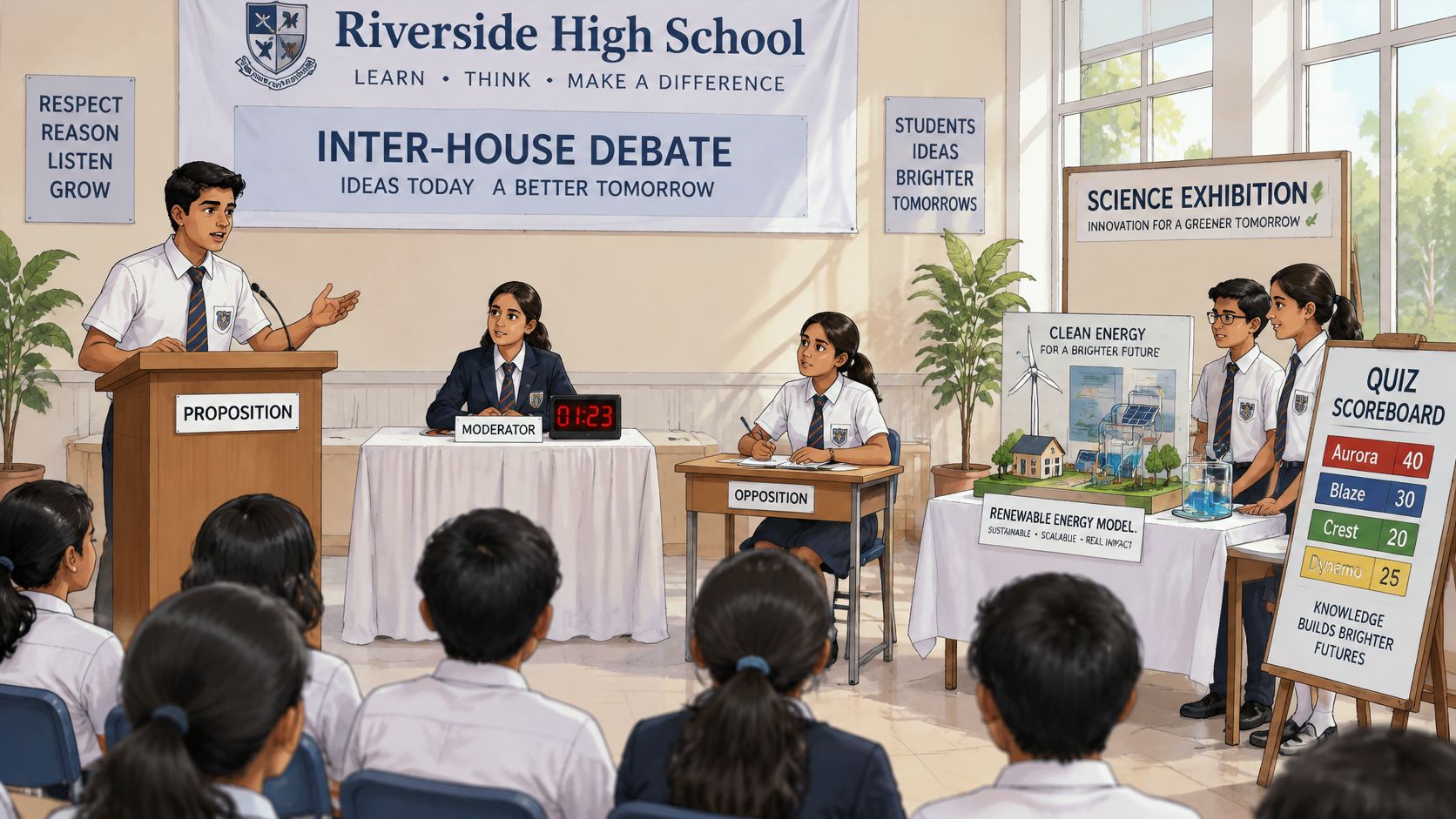
What each format actually tests
A debate tests argument structure, use of evidence, listening, rebuttal and clarity of speech. Teams lose most often because they prepared a speech and stopped listening to the other side, which is the exact habit a classroom discussion rarely punishes.
A quiz tests recall under time pressure, and a group quiz adds the small negotiations that make a team work: who takes which round, when to risk an answer, how to recover after a wrong one. Quick thinking is trainable, and a weekly quiz trains it.
A science exhibition tests inquiry. The student needs a question, a hypothesis, a working model and an explanation that survives a judge's probing. The model is a prop. The explanation is the assessment.
What the participation numbers say
A 2018 Cambridge-related survey reported by Business Standard found that 72% of Indian students said they took part in co-curricular activities, and that debating was the most popular option at 36%, followed by science clubs at 28% and art at 25%. Participation is spread across communication, inquiry and creative work rather than concentrated in one type.
That spread is useful for a counsellor. Engagement in debate, science, design or reading often reveals capabilities that subject marks leave out.
Consider a student who joined the debate society in Class 9 mainly because a friend was joining. Within two months she was the one building the case structure and hunting for counter-arguments. Her interest moved towards subjects that lean on public speaking and critical thinking, and her Class 11 choices followed that thread rather than a mark sheet.
The test that matters: an activity earns its place when it produces evidence of a skill, not when it produces a certificate.
What a parent can ask at home
Three questions do more than any certificate review. What did you have to research? How did you handle the part that went wrong? What would you change next time? A student who can answer all three has learned something a teacher can also see.
Where a student has no starting point, a skill test that names current strengths gives the conversation a vocabulary before the first meeting is over.
How Sports, Arts and Cultural Programmes Build Skills
The policy floor for sport is concrete. The Samagra Shiksha sports guidelines ask schools to provide at least 30 minutes of daily physical-training activity for all students and to reserve at least one games period, preferably daily, for post-primary students. The same guidance describes a general sports club with a minimum of 10 students, formed around student interest or by nomination from the physical-education teacher or the school sports committee.
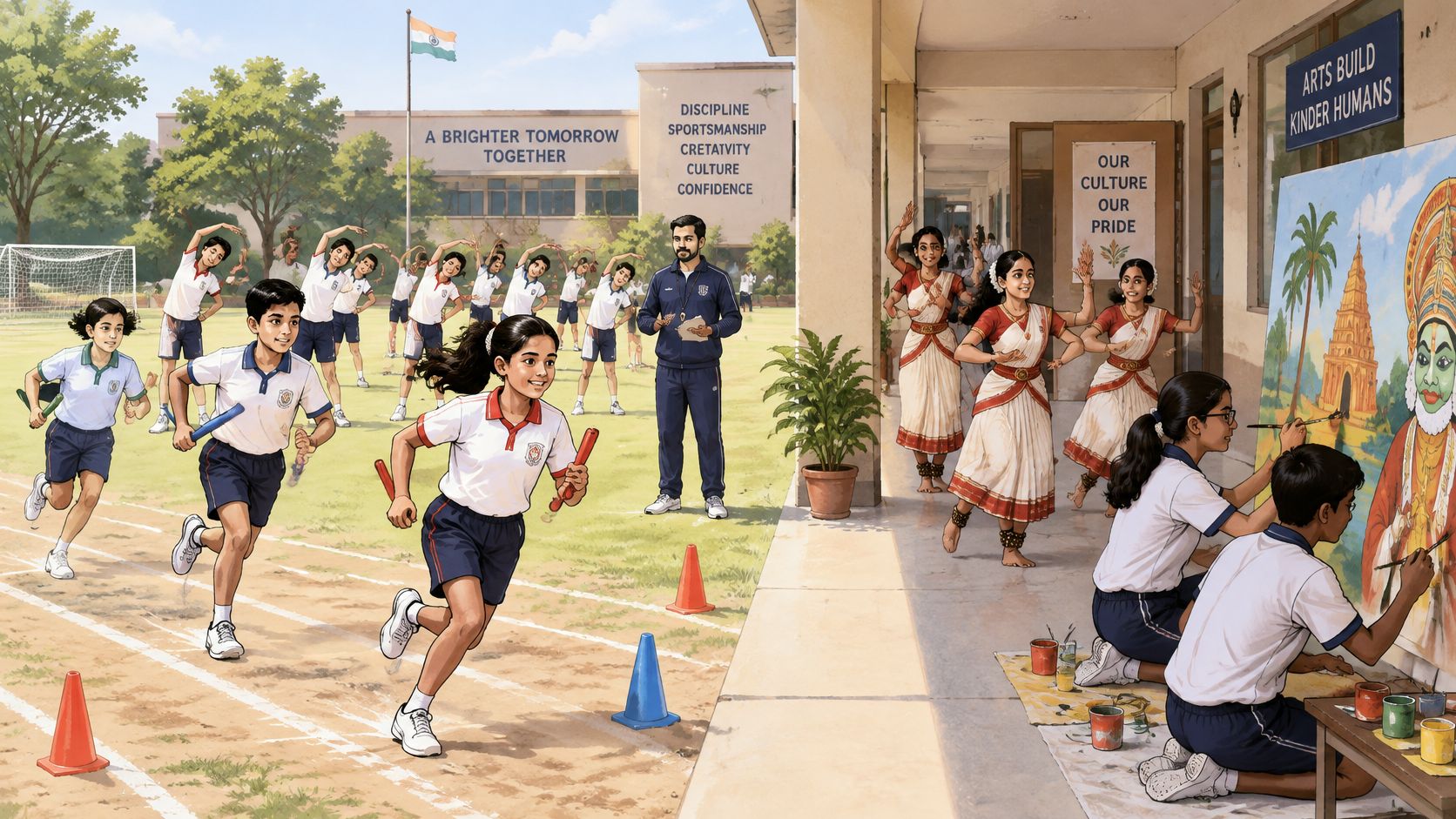
What a ten-student club looks like in practice
Ten interested students are enough to start. A basketball, athletics, yoga, kabaddi or badminton group begins there, elects its own roles, practises during the allocated games period and takes responsibility for an inter-house competition or sports day.
The learning sits inside the ordinary sessions. Players call out during drills, adjust positions when a teammate is injured, absorb a loss without blaming the referee and rework a plan at half time. None of that appears on a report card, and all of it transfers to a group project two weeks later.
Why non-athletes still belong
A student who will never make the starting five can still hold a real role in the club. That matters in a country where 99% of children said they wanted to play sports and 96% wanted school-team participation, even as one in four physical-education classes was cancelled, according to a 2025 national sports survey reported by Sportz Village.
- Referee assistant or scorekeeper: learns the rules well enough to apply them under protest.
- Commentator or photographer: practises live description and visual storytelling.
- Event planner: handles draws, timing, announcements and the endless small logistics of a match day.
- Equipment coordinator: keeps a register, checks condition and reports what needs replacing.
For a staff discussion on how a games period can be organised so that every student has a role, the short film below is a workable starting point.
Arts, craft and cultural programmes
The Vidyanjali programme guidelines list visual and performing arts, local or state crafts, dance, songs, festivals and drama among the activities a school can support, and they encourage students to choose sports according to locality and personal preference.
That gives a Kerala school room to build a cultural presentation around local dance and music, and a Rajasthan school a reason to place regional craft at the centre of an art exhibition. Both are stronger than a generic talent show because the student is researching something close enough to interview a grandparent about. What gets recorded is attendance, effort, teamwork and a short reflection, not only medals.
Clubs, Community Service and Leadership Roles
A single event tests a student once. A club tests them every week. NCERT guidance asks schools to constitute Youth and Eco Clubs where students can take part in debates, music, arts, sports, reading and physical activities after school hours and during vacations, using school resources such as playing fields, equipment and libraries.
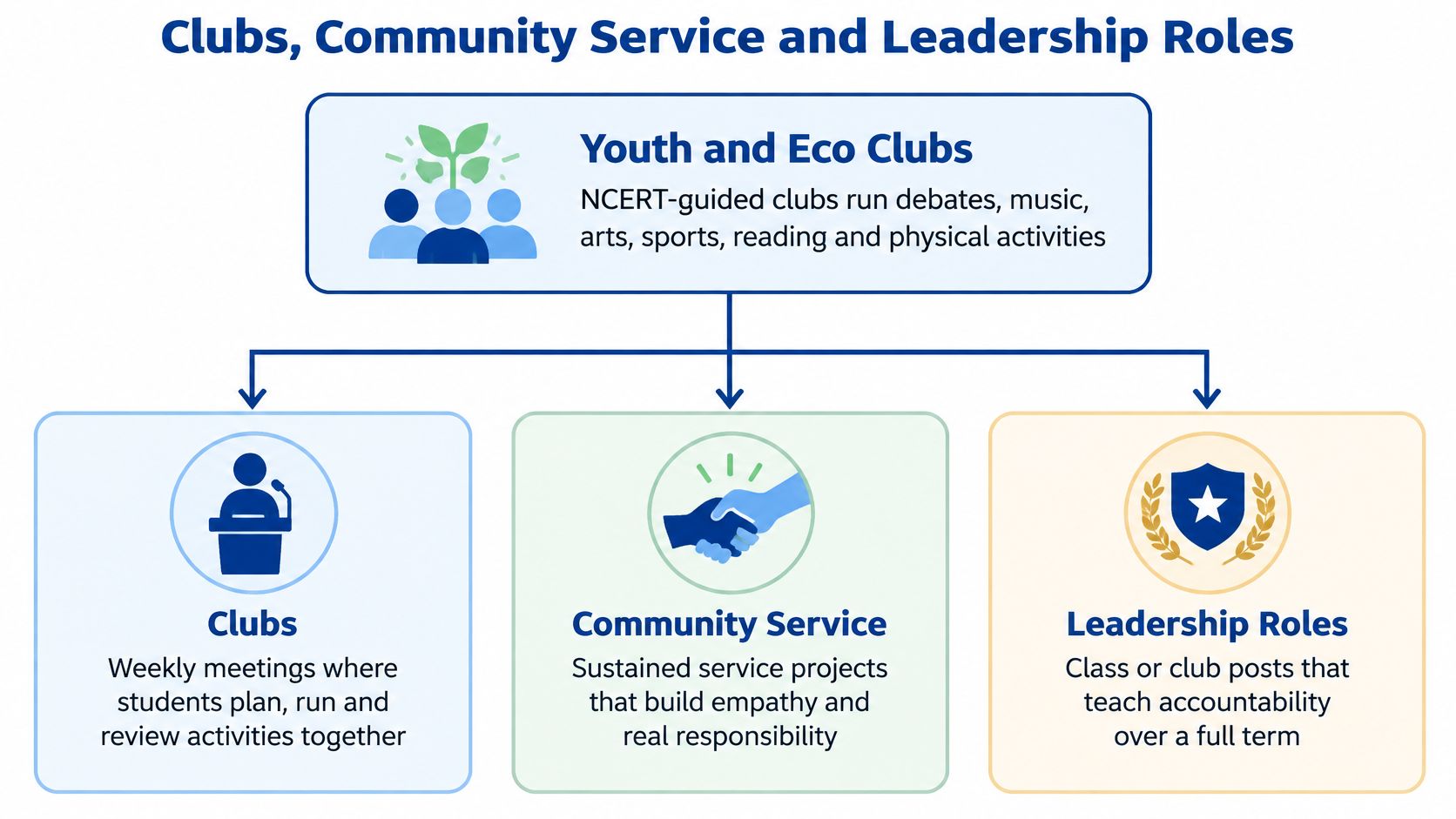
The NEP 2020 document frames this participation as experiential learning and suggests designing activities around outcomes a teacher can measure.
Three club models a school can run this term
The Eco Club. Students audit classroom electricity use, run a campus waste-segregation drive and present the results to the assembly. A structured version asks them to collect local waste data, calculate recycling rates, present findings and propose one intervention. The numbers do the arguing.
The Reading and Debate Club. Members pick a monthly issue, research opposing viewpoints across two weeks, then hold a moderated discussion with assigned speakers and a timekeeper. Reading without argument stays passive. Argument without reading becomes noise.
The Arts and Cultural Club. Students document local songs, crafts, festivals or stories, then present them to the school community. The output might be an exhibition, a recorded interview or a performance.
Clubs that meet weekly need a register, a roster and a record of subscriptions, which is the unglamorous side of student leadership. Where the club is a sports club, Vanta Sports offers a way to manage your sports club, from member lists to session schedules.
Service that fits a school timetable
Two service projects fit inside a school day. A Class 11 group can tutor younger students in mathematics during a free period, which forces the tutors to explain a method rather than just apply it. A neighbourhood tree-planting drive across one monsoon week, or a monthly visit to a nearby old-age home, teaches planning and reliability without needing transport budgets.
Leadership roles and what they demand
A class monitor handles conflict and reports accurately. A house captain plans across weeks and delegates without dropping the task. A student council member speaks for others rather than about them. A club secretary keeps the record that makes all of this visible later.
A student who runs the waste-segregation drive for a full term has practised more planning than a student who watched a documentary about waste.
The certificate trap is simple to avoid. Ask what the student decided, what they delivered and who else it affected. Keep that record of achievements as it happens instead of reconstructing it in the final week of term.
How to Find an Activity That Fits Your Strengths
Choosing well takes a shortlist and a review date, not a personality overhaul. The four moves in the graphic below cover the decision. The six steps after it add the detail a student needs.
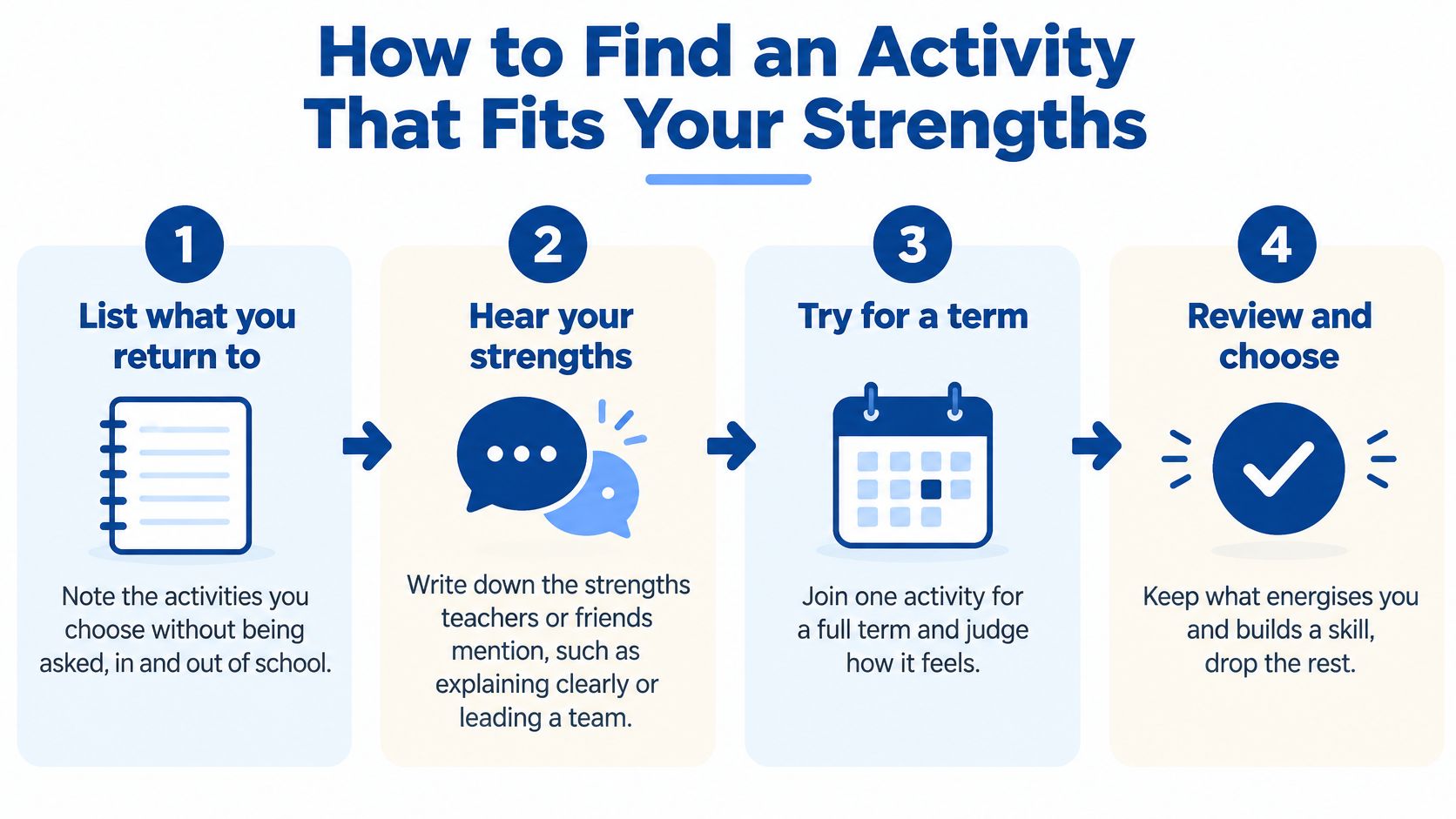
- List what you return to without being asked. Include things outside school, not only clubs. A student who reorganises the family bookshelf every few months is showing something.
- Write down the strengths other people mention. Explain things clearly, stay patient with a slow learner, spot a pattern before anyone else. An interest test that names what a student is drawn to can speed this up when the student insists they have no interests.
- Name the skill you want to practise next. Speaking up in a group, running a team, handling a budget or finishing something unaided. Pick one, not four.
- Match that skill to a row in the earlier table. Debate for speaking, a science exhibition for analysis, community service for empathy, a house captaincy for accountability.
- Try one activity for one term. Volunteer for a school activity even if it seems small, then reflect on three things: what you enjoyed, what came naturally and what kept you going.
- Compare with a second option before committing. One term of two activities tells a student more about fit than a year of guessing.
Filters that decide whether a student can join at all
Time, transport, cost, facilities and safety decide participation well before interest does. A survey of Indian children found that 99% wanted to play sports and 96% wanted school-team participation, yet one in four physical-education classes was cancelled, and a 13% gender gap persisted in sports such as cricket and football, as reported in the national sports survey coverage. Wanting to join was never the bottleneck.
Schools without equipment or late buses can still offer peer tutoring, local biodiversity mapping, community interviews, reading circles, digital storytelling, household budgeting projects and accessible fitness routines. Girls, students with disabilities, rural learners and students who can't stay after school need adaptations planned in advance, not an apology afterwards.
Protecting study time in Classes 10 and 12
Board years don't require quitting. Cut to one session a week and keep the log running so the thread stays visible. Schools help most when clubs sit inside the games period or run in the weeks after exams, so the two parts of a student's life support each other instead of competing for the same evening.
The simplest test of fit is curiosity. The right activity leaves a student wondering what happens at the next session, not only pleased with the last certificate.
Choose Your First Activity This Term
A student returning from debate club may remember the result of a round, but a useful review asks what they did to prepare, respond and improve. Choose one activity, then set a date to review the experience about eight weeks later. One decision, one term, one honest look can replace guesswork with evidence.
The CBSE assessment guidance describes a practical loop: name a quality to develop, choose observable indicators, collect evidence, record and analyse it, then make a judgement. In debate, indicators might include structuring an argument, using evidence, listening, rebutting and speaking clearly. In robotics, they could be defining a problem, revising a prototype, testing carefully and documenting decisions.
Build a one page log
Keep a simple record in a notebook or spreadsheet. Include the date, the role taken, two skill indicators, a concrete example and a short reflection. For example: “Opening speaker. Evidence quality. I handled a difficult question without repeating myself. Next time, I would cut one statistic.”
Attendance alone says little about learning. The useful evidence is a specific choice or action: a student changed an argument, adjusted a design, organised a drill or explained a concept to a classmate.
Practical rule: each entry should name a decision the student made and what happened next.
A simple activity log for recording what you tried and learned can help keep those observations together.
Where Edvdo fits
Edvdo is a student-focused platform that helps students understand their strengths, motivations and learning patterns as they make academic and career decisions. Its assessment can help students notice habits that slow progress, how they learn most effectively, their confidence in key decisions, what drives success and where goals and actions do not match. The personal insights report covers strengths, how students act and learn, what they like, how they decide and study, and what motivates them.
A log captures what happened in an activity; assessment insights can add context about the patterns behind a student's choices. Parents can read about the Edvdo assessment to understand its role. For a counselling session, students provide their academic background and career aspirations for personalized guidance.
A term later, the certificates may look much the same. The evidence of growth is in what the student can explain: the argument they rebuilt, the drill they organised or the classmate they tutored. Edvdo connects personality, interests and abilities to real-world career opportunities. Students and parents can explore the Edvdo assessment as one way to consider strengths and future academic or career choices.