

Just 56% of graduating design students in India entered industry, while 10% moved into academia, according to a British Council study of design education and industry. A design qualification on its own doesn't settle a career, and the gap between the two outcomes is usually set long before the first job application.
That's why this roadmap starts with the decision most advice skips. Tools take weeks to learn. A route chosen badly can cost years and several lakhs, and most students make that choice with almost no cost information.
The path below is written for an Indian student or graduate who can't tell a B.Des from a design diploma, and doesn't know whether a portfolio needs a degree behind it. It covers the job itself, an estimated timeline, five entry routes with their trade-offs, the order to learn skills, the case studies hiring teams read, and the first application you can send this month.
Table of Contents
- What a Product Designer Does in India
- The Full Roadmap and How Long It Takes
- Choosing Your Entry Route in India
- Core Skills to Learn in the Right Order
- Build Case Studies and Fix Portfolio Problems
- Start Your First Application This Month
What a Product Designer Does in India
A product designer owns a problem from the moment a user's need shows up to the day the fix ships. In an Indian product company, that looks like a week spent interviewing people who use a payments or education app, mapping the flow with a product manager, sketching three directions, testing a clickable prototype with five or six users, then sitting with engineers to decide what gets cut before release.
The distinction from a visual or UI designer matters when you're picking a course. A UI designer usually produces screens from a brief someone else framed. A product designer is judged on whether those screens solved the right problem and moved something measurable, such as task completion, drop-off at step three, support tickets or repeat use.
The question that decides interviews: what did you change, and how do you know it worked?
Job postings show the mix. India listings for product design roles name qualitative analysis, market research, product development, requirements analysis and design thinking alongside design-tool skills, according to Glassdoor's India product designer listings. Craft gets a résumé shortlisted. Judgement gets a candidate hired.
Employers come in three shapes: product companies and startups with in-house teams, service firms whose designers work across client projects, and design agencies. Pace, pay and learning differ sharply between them, and the first two generally ask for more evidence of shipped work.
Ask yourself one question before reading further. Do you enjoy digging into why people struggle with something and then deciding what to change? If the honest answer is that you mainly enjoy making things look good, a UI or visual design route will fit better, and the routes below still apply.
The Full Roadmap and How Long It Takes
The whole path fits in one table. Timings are estimates for someone working alongside study or a job, and a student on a four-year degree can spread the same phases across semesters.
| Phase | Typical timing | What you produce | Proof to show |
|---|---|---|---|
| Foundations | 2-3 months | Exercises on interaction design, layout and usability | Critiqued exercises with notes |
| First project | 1-2 months | One flow for a local problem, researched and prototyped | Interview notes and a tested prototype |
| Case studies | 3-4 months | Three to five documented case studies with trade-offs | Public portfolio link |
| Applications and interviews | 2-6 months | Tailored applications and interview practice | Interview invitations and feedback log |
The order matters more than the speed. Foundations before projects, projects before case studies, case studies before applications. Each phase produces something a stranger can review, which is why "finished" means a file, a note or a link rather than a feeling.
What each phase asks of you
Foundations are two to three months of interaction design basics, layout and usability principles, with every exercise critiqued by someone who designs for a living. A senior student, a working designer who reviews portfolios for a fee, or a community critique thread will do. Feedback from people who share your taste is nearly worthless.
The first project takes one to two months and should sit on a problem you can observe directly: a college admissions form, a local transport app, a bill-payment flow your family uses. Pick something you can watch five people struggle with this week.
Case studies take three to four months, because turning two or three projects into documented work is slower than making new screens. Many underestimate this phase and start applying before it's done.
Students still weighing design against engineering should compare the entry routes into coding careers side by side, since both paths run on portfolio evidence but lead to different first jobs. A career report built from a strengths assessment can also narrow the choice before fees are committed.
Readiness check: you can explain one project's trade-offs for five minutes without notes, and your portfolio holds at least three case studies that show research and outcomes. If either is missing, the next phase isn't applications.
Choosing Your Entry Route in India
The decision most guides skip comes before any training: which route to take. It's also a decision Indian students make with very little information. Only 10.4% of students across Classes 9 to 12 reported receiving professional career guidance, while 41% of private-school students and 35% of government-school students remained unsure about course selection, according to the Bharat Career Aspirations Report 2025. Only 10% knew course costs, and just 22% had a backup career plan.
Those numbers explain why so many families choose a programme on reputation rather than fit. Compare the five routes on the things that decide the outcome: years, fees, entrance effort, and how much portfolio work each one forces you to do alone.
| Route | Typical duration | Suits | Main trade-off |
|---|---|---|---|
| B.Des after Class 12 | 4 years | Students who want design training from the start | Entrance tests and fees vary by institute |
| B.Tech or engineering with an HCI or design elective | 4 years | Students strong in maths and coding | Less studio practice, so more portfolio work is needed |
| Visual communication or design diploma | 2-3 years | Students who want shorter, practical training | Fewer product and research modules |
| Non-design degree plus self-study | 3 years plus 6-12 months | Students from commerce, arts or psychology who can self-direct | Evidence must come from projects and short courses |
| Short certificate or bootcamp after graduation | 3-9 months | Graduates changing career | Outcome depends on the portfolio and the programme quality |
Route by route, and who each one fits
B.Des after Class 12 is the most direct route and the most competitive. Four years, entrance tests sat in the Class 12 year through national and institute-level design exams, and fees that swing widely between government-funded and private institutes. It suits a student who is ready to commit at eighteen.
B.Tech with an HCI or design elective rewards maths and coding strength. Four years with less studio time, so the portfolio has to be built outside coursework through electives, internships and self-set projects. Graduates of this route often interview well on technical constraints and poorly on visual craft unless they work at it.
The remaining three options each solve a different constraint:
- Visual communication or design diploma (2-3 years). Shorter and cheaper, with strong craft teaching, but fewer product and research modules, so case-study discipline is yours to add.
- Non-design degree plus self-study (3 years plus 6-12 months). Suits commerce, arts or psychology students who can self-direct. Psychology helps with research, economics helps with product metrics, and the missing design degree only hurts if the portfolio shows the gap.
- Short certificate or bootcamp after graduation (3-9 months). Fastest for a graduate changing track. Ask who teaches, whether work is critiqued live, and how many alumni can show shipped projects before paying.
If the first target role doesn't materialise, four adjacent roles use much the same evidence: UX research, UI design, design operations and front-end design. A route that builds research, systems thinking and craft isn't wasted when the first title differs from the one you wanted.
The rule is simple. Pick the route that fits the subjects you already have and the budget you can defend, then set a first-year portfolio milestone so evidence starts in year one. Students stuck between design, engineering and research can narrow it with a short interest test before comparing fees.
Core Skills to Learn in the Right Order
Many first portfolios stall because the student becomes faster at drawing screens before learning how to find out whether those screens work. The order below starts with decisions that can be seen in an interface, then builds the research evidence and judgement hiring teams probe in interviews. The bottleneck is choosing the first weak skill to fix, not finding more tutorials.
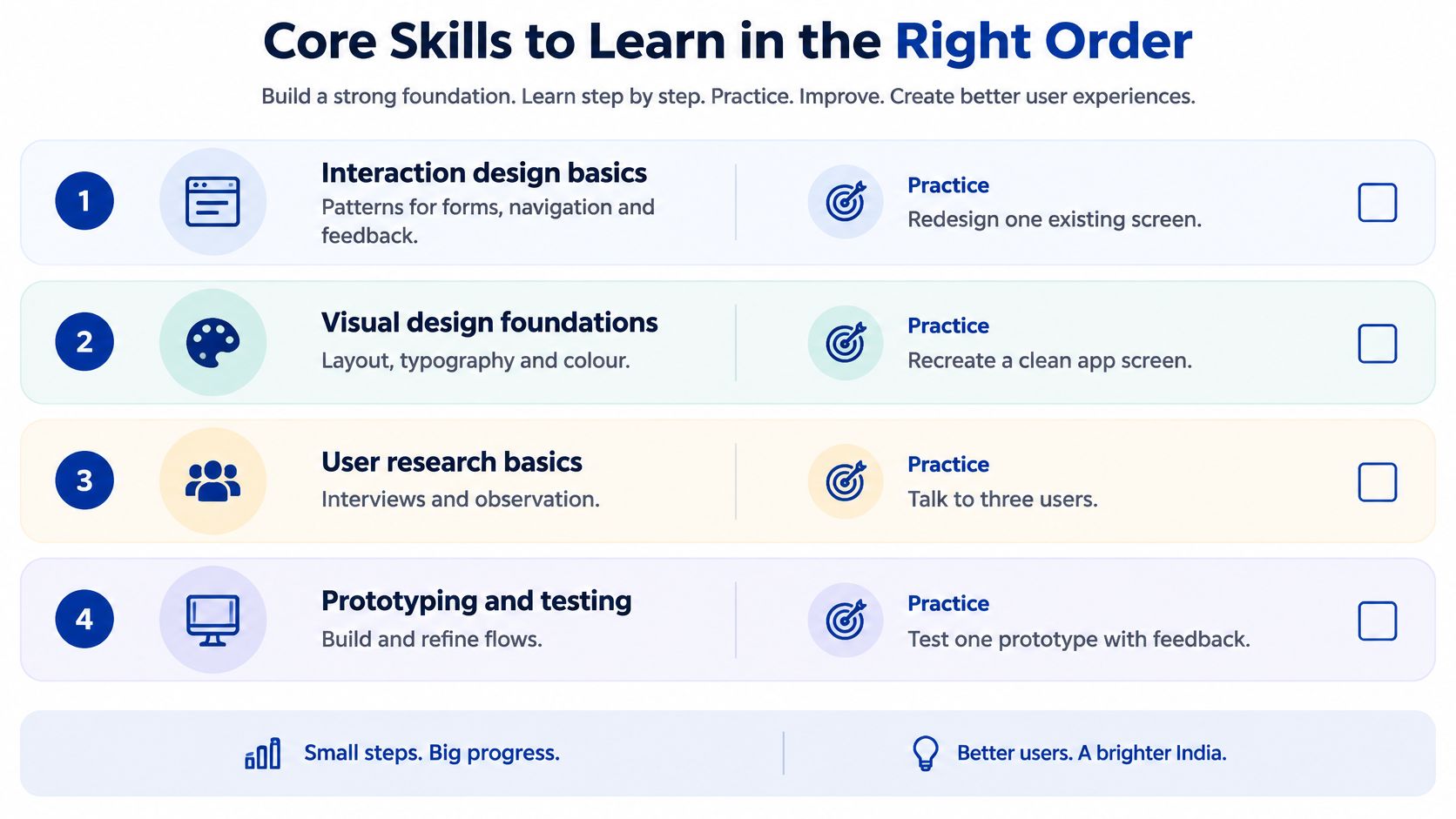
- Interaction design basics. Learn the patterns for forms, navigation, feedback, loading and errors. Redesign one existing screen and write down why each change helps a user complete the task.
- Information architecture. Sort content into categories a real user would recognise, then test the structure with a card sort of ten to fifteen items among five people.
- Visual hierarchy and layout. Use spacing, type and colour to show what matters first, second and last. Check each screen against a plain-language brief rather than your own taste.
- Prototyping in Figma. Build a clickable flow for one task, with real content rather than placeholder text. The prototype should make the structure and interaction choices easy to inspect.
- Accessibility. Check contrast, labels and keyboard navigation against WCAG basics. Treat these as part of the design, since a screen that excludes users has failed before research begins.
- User research. Run five or six interviews from a script that avoids leading questions, and write up the notes the same day while memory is fresh.
- Usability testing. Watch someone complete a task and record where they stall, without rescuing them the moment they hesitate.
- Product judgement. For every decision, write the problem statement, the success measure and the trade-off you accepted.
The sequence gives each skill a job. Interaction patterns and information architecture produce a defensible structure. Figma turns that structure into something testable. Research and usability testing show what users do, and judgement connects the evidence to the next design decision.
Where research and judgement decide the hire
Indian UX job listings show why the second half of the sequence matters. Glassdoor's India UX designer listings repeatedly name information architecture, interaction design, user-centred design, user research, usability testing, A/B testing, rapid prototyping, heuristic analysis and accessibility. Use that list as a map, rather than trying to learn every item at the same depth at once.
On coding, the honest answer is a middle one. Learn enough HTML and CSS to read a component, understand why a layout breaks on small screens, and talk to engineers without a translator. Production code is outside the role for most beginners. Asking a sensible question about state, loading or error handling is part of it.
Self-check: can you run one usability test end to end and explain the findings without guessing at what participants meant?
Before starting step one, score yourself on each of the eight skills and begin with the lowest score that blocks the others. Edvdo's career assessment can also surface habits slowing your progress, how you learn most effectively, confidence in key decisions, what drives success and gaps between goals and actions.
Build Case Studies and Fix Portfolio Problems
A case study is a record of decisions, not a gallery. Reviewers read for what you noticed, what you rejected and what changed after testing. The nine steps below keep every one of those visible in the write-up.
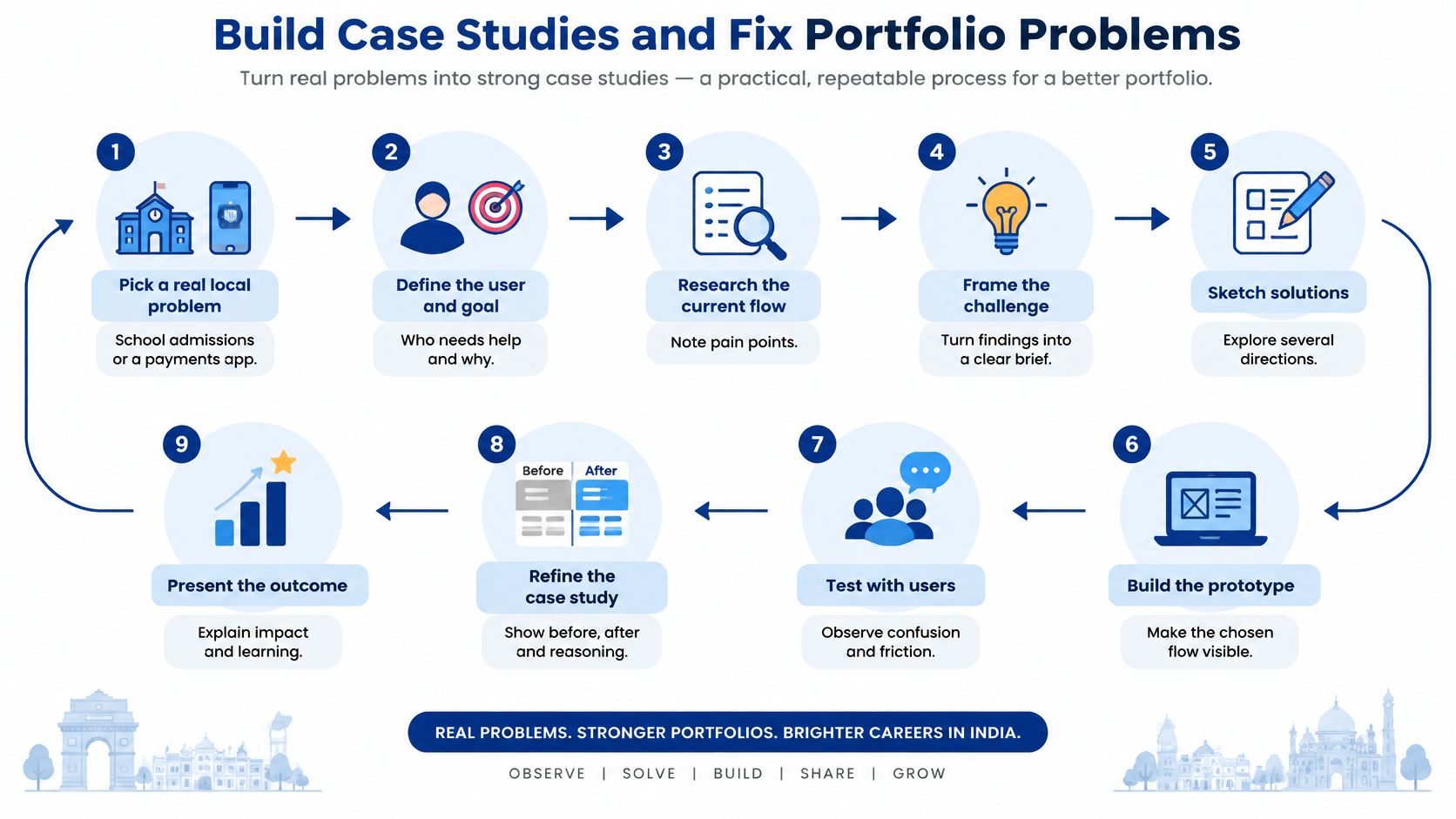
- Pick a real local problem. School admissions, a payments app, a bus timetable, a local-language service. A redesign of a famous app reads as copying, because the hard part of the problem was already solved for you.
- Interview five to eight people who match the target group. Ask what they did last time, not what they'd like. Past behaviour is evidence; preferences are noise.
- Synthesise observations into themes. Then compress them into a one-sentence problem statement you can defend.
- Map user flows and list constraints. Connectivity, language, device, literacy and cost shape more Indian product decisions than visual style does, so name them.
- Sketch low-fidelity wireframes before high-fidelity screens. Layout arguments are cheaper on paper, and the sketch is proof you explored more than one structure.
- Prototype the single critical journey. One task, done well, beats five half-built screens.
- Test with representative users. Record where they hesitate, what they misread and what they gave up on. Write down the questions you asked, because reviewers read those too.
- Iterate on what you observed. Not on what you liked, and not on what a mentor liked. Each change should trace back to a specific moment in a test.
- Document three to five case studies. Each one shows the original problem, the research protocol, the participant profile, the alternatives rejected, test findings, iteration rationale, and outcomes or proxy measures. A proxy measure such as time to complete a task or number of errors is legitimate when you label it clearly.
The reviewer's test
The single pitfall is presenting polished screens without demonstrating decision quality. A portfolio that opens with beautiful mock-ups and closes with "users liked it" tells a reviewer that you can make interfaces and can't yet make arguments.
Show the original problem, the alternatives you rejected, and the change you made after testing. That sequence is the whole interview.
Indian product teams connect user needs, business goals and engineering constraints, and a case study is where you prove you can hold all three at once. Claims should separate what you observed from what you assumed. Write "three of six participants missed the fee field" rather than "users found fees confusing", and the difference between evidence and opinion becomes obvious.
| Portfolio problem | Why reviewers reject it | Fix |
|---|---|---|
| Only polished screens | No evidence of decisions made | Show the original problem, alternatives rejected and iterations |
| No user research | Assumptions read as facts | Label observed evidence separately from assumptions |
| Redesign of a famous app | Looks like copying | Use a local problem such as admissions, transport or payments |
| No outcomes | No proof the work mattered | Add a proxy measure such as task completion time |
| Too many shallow projects | Depth is missing | Keep three to five strong case studies |
Fix order for a weak portfolio
Audit your strongest project first. It should name the problem, the participants, one alternative you rejected and one change you made after testing. Whichever of those four is missing, fix that one before starting anything new.
Then stop adding projects. Finish the single case study you'd want to walk an interviewer through, and put it on a live page. When the write-up is ready, a no-code portfolio built with own.page gets it online in an afternoon without a developer, which matters more than a perfect domain name.
Start Your First Application This Month
Thirty days is enough to move from reading to applying, provided the month runs on a fixed sequence. None of it depends on finishing a degree first.
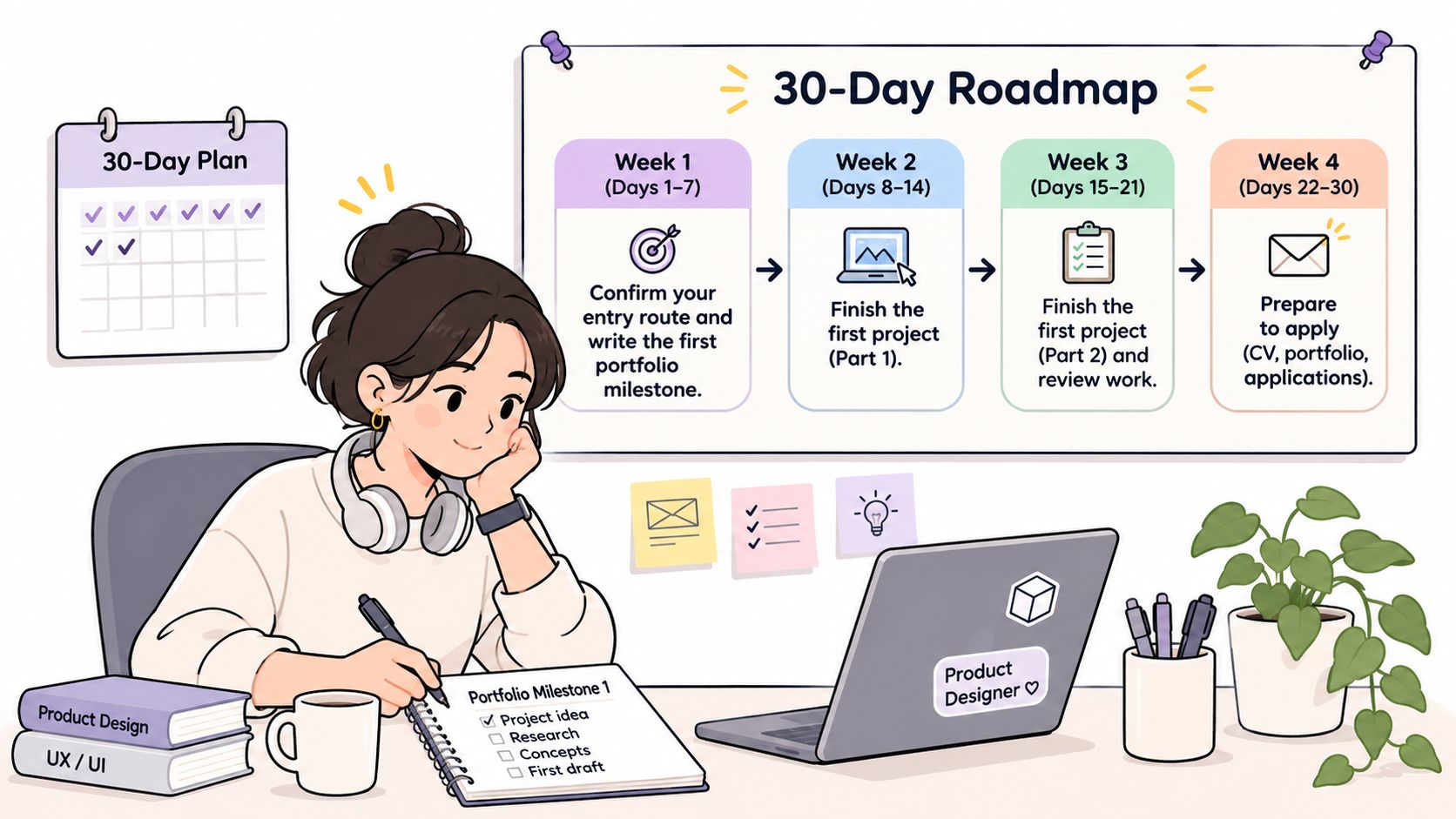
Week one settles the route. Confirm which of the five entry paths fits your subjects and budget, then write one portfolio milestone with a date attached to it. Vague intentions produce vague progress.
Weeks two to four go to the first case study. Finish it, publish it, and tailor it to the roles you're chasing rather than sending a generic link.
Where to apply, and with what
Target product companies and startups, service firms with in-house design teams, and design agencies. Tailor each application by matching two or three case studies to the skills named in the job posting, and write one line per case study on the problem it solved. Apply to five to ten roles a week, keep a simple log of responses, and ask for feedback after every rejection. A hiring manager's two-sentence reply is the cheapest improvement available.
The market justifies the effort. India's digital economy employed 14.67 million workers in 2022-23, 2.55% of the total workforce, according to the Press Information Bureau. Formal design education is expanding alongside that growth, with more approved undergraduate design institutes and rising student intake in recent years. Structured entry routes keep multiplying, and the technology ecosystem behind them needs product and experience skills.
Here's how a typical portfolio walkthrough looks in practice.
If a product design role stays out of reach after six to eight weeks of applying, apply sideways to UX research, UI design, design operations or front-end roles. Those titles draw on the same portfolio evidence and often lead back into product work within two years. A searchable jobs list shows which of those titles are hiring near you faster than guessing at company names.
One action this week. Write your entry route and your first portfolio milestone on a single page, then open the empty document for your first case study. An opened draft moves you closer to the job than any course enrolment does.
Edvdo helps students settle the route question before they spend money on a programme. A free first career counseling session needs only your academic background and career aspirations for individual guidance, and the four-step process runs through Assess, Explore, Connect and Track so progress stays visible. Start at Edvdo.