

India's higher-secondary Gross Enrolment Ratio was only 58.4% in 2024–25, according to the UDISE+ analysis published by Education for All in India. That measure compares enrolment with the population in the official age group. Entering higher secondary is not an automatic next step, and students who continue face an important choice about what they'll study.
Choosing Class 11 subjects requires more than a marksheet and a preferred stream name. A useful combination preserves realistic future options while matching the student's interests, strengths and capacity for sustained work, within the rules of the board and the subjects the school offers.
Table of Contents
- Why Class 11 Subject Selection Feels So Hard
- Class 11 Subject Combinations That Stay Valid
- Learning Preferences Behind a Good Fit
- Build the Mix Around Strengths and Electives
- Workload Before You Commit for Two Years
- Future Courses and Two Student Paths
- Confirm the Combination Before You Submit
- Frequently Asked Questions About Class 11 Subjects
Why Class 11 Subject Selection Feels So Hard
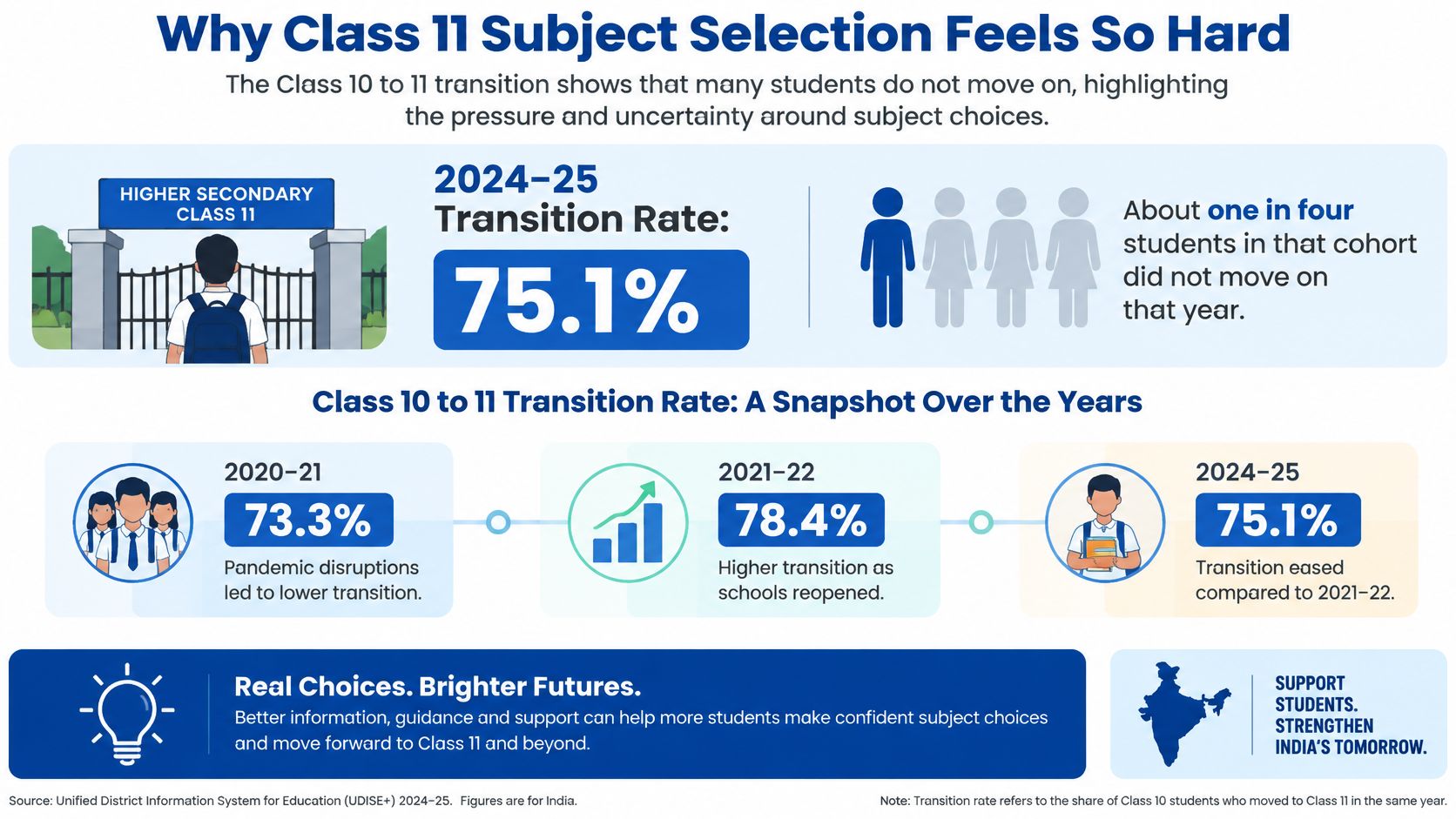
The Class 10-to-11 transition rate was 75.1% in 2024–25, meaning about one in four students in the relevant cohort didn't move into higher secondary that year, according to the UDISE+ transition analysis. The same series recorded 73.3% in 2020–21, 78.4% in 2021–22, 71.3% in 2022–23 and 71.5% in 2023–24.
Those figures describe participation, not the reasons individual students leave school. For students entering Class 11, however, they underline that this is a consequential transition rather than merely another promotion.
Marks don't describe the whole student
Consider a student who performs well in Class 10 Science after careful revision but dislikes solving unfamiliar numerical problems. The family sees the mark and recommends Physics, Chemistry and Mathematics. The student sees friends choosing the same combination and agrees, without examining the daily work.
The difficulty isn't that the student lacks ability. The decision relied on evidence of past examination performance without checking interest in the next syllabus.
Class 10 marks remain useful. They can reveal gaps in algebra, written expression or conceptual understanding, but they don't establish whether a student enjoys laboratory work, extended reading or repeated calculation.
Three weak reasons that sound convincing
- A high Science percentage: Strong marks justify investigating Science subjects, not automatically selecting them.
- A friend's combination: Shared classes may feel reassuring, but friends can have different strengths and undergraduate plans.
- A supposedly safer stream: No stream preserves every option, and an unsuitable workload can make an apparently safe choice difficult to sustain.
Practical rule: A subject deserves a place because its work and future use make sense for the student, not because its label sounds impressive.
Families still comparing broad routes can use the guide to choosing a stream after Class 10. Subject selection after 10th then becomes more specific: which combination fits the student, satisfies likely course requirements and exists on the school timetable?
The personal starting points are genuine interests, natural strengths and learning preferences. Family expectations deserve discussion, but they shouldn't replace these.
Class 11 Subject Combinations That Stay Valid
Class 11 combinations, open doors and hard limits
| Combination | Typical subjects | Doors it usually keeps open | Hard constraint |
|---|---|---|---|
| PCM | Physics, Chemistry, Mathematics, English, another elective; optional sixth | Engineering and other maths-based degrees | Mathematics 041 cannot accompany Applied Mathematics 241 |
| PCB | Physics, Chemistry, Biology, English, another elective; optional sixth | Medicine, dentistry, nursing and life sciences, subject to programme rules | Biology 044 cannot accompany Biotechnology 045 |
| Commerce with Maths | Accountancy, Business Studies, Economics, Mathematics, English | CA, BCom, economics and finance routes requiring maths | Business Studies 054 cannot accompany Business Administration 833 |
| Commerce without Maths | Accountancy, Business Studies, Economics, English, another elective | BCom and many business degrees; maths-heavy professional papers still require preparation | Adding Applied Mathematics makes this a maths-containing combination; it cannot accompany Mathematics 041 |
| Humanities core | History, Political Science, English, other electives | BA routes and law pathways without stream prerequisites | The school must run the chosen elective pair |
| Psychology with Sociology | Psychology, Sociology, English, other subjects | Psychology, social work and related degrees where admission rules match | Some programmes require science or maths preparation |
| Mathematics with Economics | Mathematics, Economics, English, other subjects | Economics honours and quantitative commerce or data-related routes | Several economics programmes expect Mathematics in Class 12 |
| Physics with Computer Science | Physics, Computer Science, Mathematics, Chemistry or another approved elective, plus language | Engineering and computing where the complete prerequisite set matches | Computer Science excludes Informatics Practices and Information Technology |
| Skill-led set | Skill electives alongside required languages and academic subjects | Vocational study, diplomas or entrepreneurship; some routes need bridge preparation | School provision and college recognition must be checked |
These are planning examples, not admission guarantees. Stream labels alone don't establish eligibility, and a table entry isn't a complete school-approved registration form.
Remove incompatible pairs first
The CBSE senior-secondary scheme explained by CBSE Portal lists these exclusions: Mathematics 041 with Applied Mathematics 241; Biology 044 with Biotechnology 045; and Business Studies 054 with Business Administration 833. It also permits only one among Informatics Practices 065, Computer Science 083 and Information Technology 802.
The CBSE senior-secondary curriculum also identifies exclusions involving Physics with Applied Physics, Chemistry with Applied Chemistry, and Informatics Practices with Information Technology or Web Applications. Subject codes matter because similar names don't mean subjects are interchangeable.
Permitted elective patterns include three academic electives, two academic and one skill elective, one academic and two skill electives, or three skill electives, within the applicable scheme and language requirements. The school should confirm the current rules before registration.
Flexibility still has boundaries
The CBSE skill-education webpage includes subjects such as Retail, Information Technology, Web Applications, Financial Markets Management, Tourism, Agriculture, Food Production, and Beauty and Wellness. A school may offer only a small selection.
Skill subjects aren't automatically recognised for every degree. Families should examine practical facilities, assessment arrangements and progression requirements rather than treating vocational study as either a shortcut or a dead end.
For closer comparison, the guides to Class 11 Commerce subjects and the Arts subject list explain relevant electives. State-board groups and school arrangements can differ, so this CBSE planning map shouldn't be transferred unchanged to another board.
Learning Preferences Behind a Good Fit
After invalid combinations have been removed, the next question concerns how the student engages with work. Learning preferences are useful observations, not permanent learning-style labels. A student can enjoy discussion and still need written practice, diagrams and independent reading.
The National Education Policy 2020 rejects rigid separation between arts and sciences and between vocational and academic study, and calls for vocational exposure from Grade 6, including internships. That supports broader exploration, but it doesn't guarantee that every school can staff every combination.
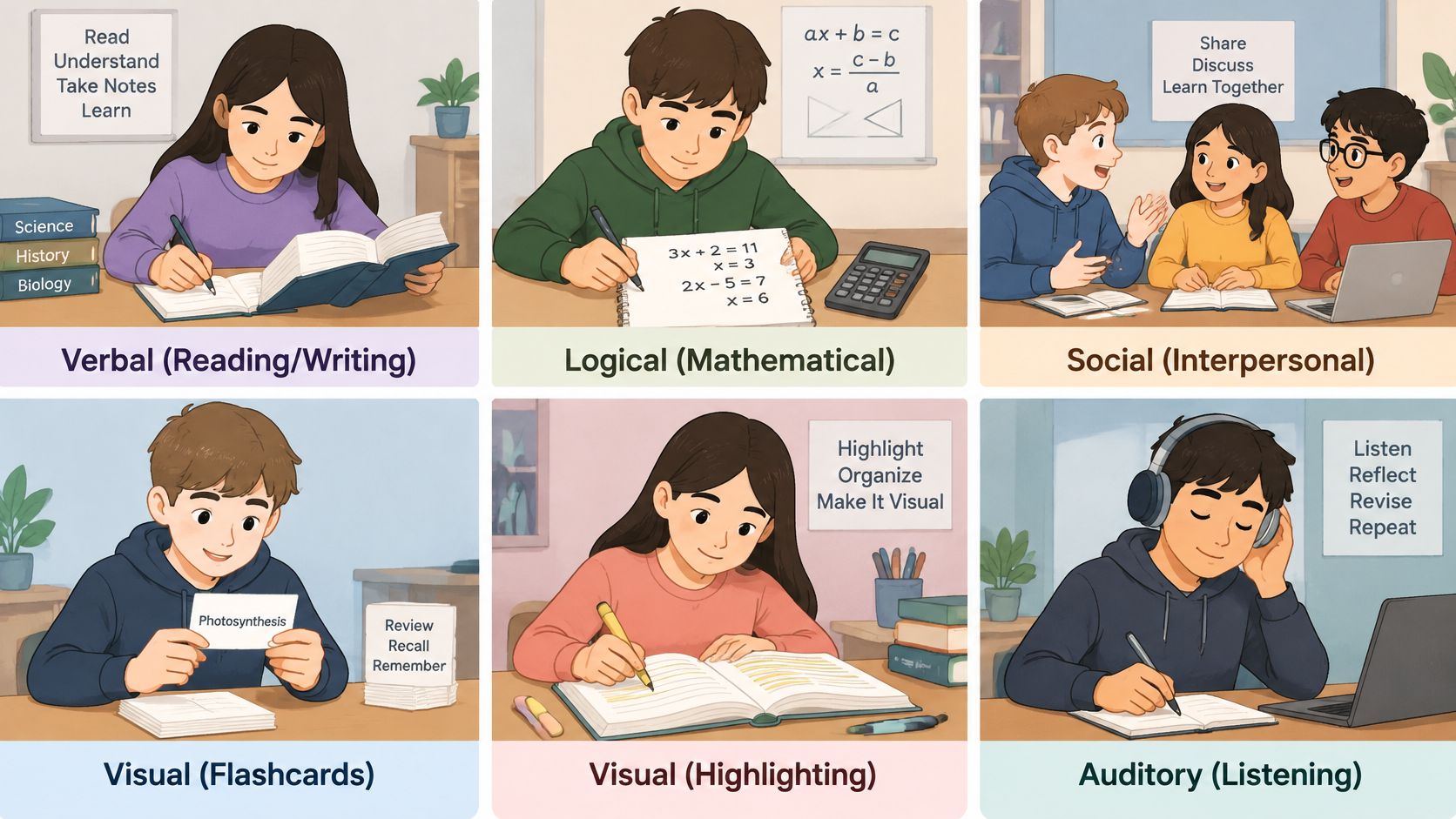
Compare behaviours rather than stream reputations
| Preferred activity | Subject work worth sampling |
|---|---|
| Understanding a theory and explaining it clearly | Concept explanations in Psychology, Sociology or Biology |
| Repeating problems until a method becomes reliable | Mathematics exercises or introductory Accountancy problems |
| Testing an idea through practical work | Physics experiments, Chemistry practicals or applied skill tasks |
| Reading widely and developing an argument | History, Political Science or Economics answers |
| Making, designing or building something | Computer Science programs, design tasks or Food Production activities |
| Comparing evidence before reaching a conclusion | Source interpretation, case analysis or data-based questions |
Average marks don't automatically rule out numerical subjects. A student who willingly corrects mistakes and repeats problems may respond well to Mathematics or Accountancy, provided foundational gaps receive attention.
Likewise, remembering ideas through cases may make Psychology, Sociology or Business Studies worth exploring. Enjoying practical work can justify investigating Computer Science or a skill elective, but practical doesn't mean light: preparation, troubleshooting and documentation still take effort.
Test interest against an actual task
A structured interest exploration exercise can give students vocabulary for describing what attracts their attention. The result should then be tested against a textbook extract, a sample problem or an introductory practical.
- For reading-heavy subjects: Notice whether the student can explain an argument after reading, rather than recognising familiar words.
- For numerical subjects: Observe persistence when the first method fails.
- For applied subjects: Check willingness to complete the record or explanation after the enjoyable activity.
Friends calling a subject scoring doesn't establish fit. A useful starting exercise is to identify two tasks from Classes 9 and 10 that the student would willingly repeat, then look for combinations containing that kind of work.
Build the Mix Around Strengths and Electives
The CBSE senior-secondary framework treats Classes XI and XII as a composite course. Under the CBSE curriculum scheme, students should choose subjects intended for continuation into Class XII, normally study at least five subjects, retain Hindi or English within the prescribed language arrangement, and may take an optional sixth subject comprising another language, academic elective or skill elective.
That makes Class 11 optional subjects genuine commitments, not spare labels on an admission form. The subject should have a clear purpose and a manageable place in the student's week.
Build the combination in a deliberate order
- Fix the language requirement. Confirm the school's permitted language arrangement rather than assuming English sits outside the subject count.
- Select the strongest working subjects. Look for subjects whose tasks the student can practise without persistent avoidance.
- Protect a realistic prerequisite. Include a subject required by a course the student might pursue.
- Use the remaining space for interest. An elective can add breadth without being selected merely for prestige.
- Consider the additional subject last. Extra coverage helps only when the student can sustain the work and continue the subject.
Evidence of strength should come from homework, corrections and independent practice, not just an overall percentage. A student who carefully completes introductory ledger problems but repeatedly avoids Physics numericals has different evidence to consider from a student who enjoys deriving relationships and testing them.
A skills reflection exercise can support that comparison. It shouldn't replace a teacher's review of actual subject work.
Leave room for an unexpected strength
Students sometimes discover an interest in Psychology, Economics, Mathematics or Political Science after moving beyond their initial assumptions. Sampling unfamiliar material is more useful than deciding that a subject is unsuitable because nobody in the family studied it.
Mathematics with Economics, Psychology with Sociology, and Physics with Computer Science can be promising pairings when their work matches the student's interests and goals. They aren't predictions of strong performance.
An elective should add a reason to study, not merely another examination to manage.
Health and Physical Education and General Studies belong to CBSE's internal requirements for regular candidates; they shouldn't be mistaken for unrestricted elective spaces. Before submission, the student should write the complete proposed subject set and flag anything already intended for an early exit.
Workload Before You Commit for Two Years
A subject name can sound attractive while its weekly demands remain unclear. The important test is whether the student can sustain reading, practice, practical records and revision during an ordinary school term, including travel and tuition.
The CBSE Class XI Chemistry syllabus assigns 70 theory marks across nine units, including 11 marks for Organic Chemistry and 9 each for Structure of Atom and Chemical Thermodynamics, with practical assessment separate. Preparation therefore requires attention across several conceptual areas, not reliance on a favourite chapter.
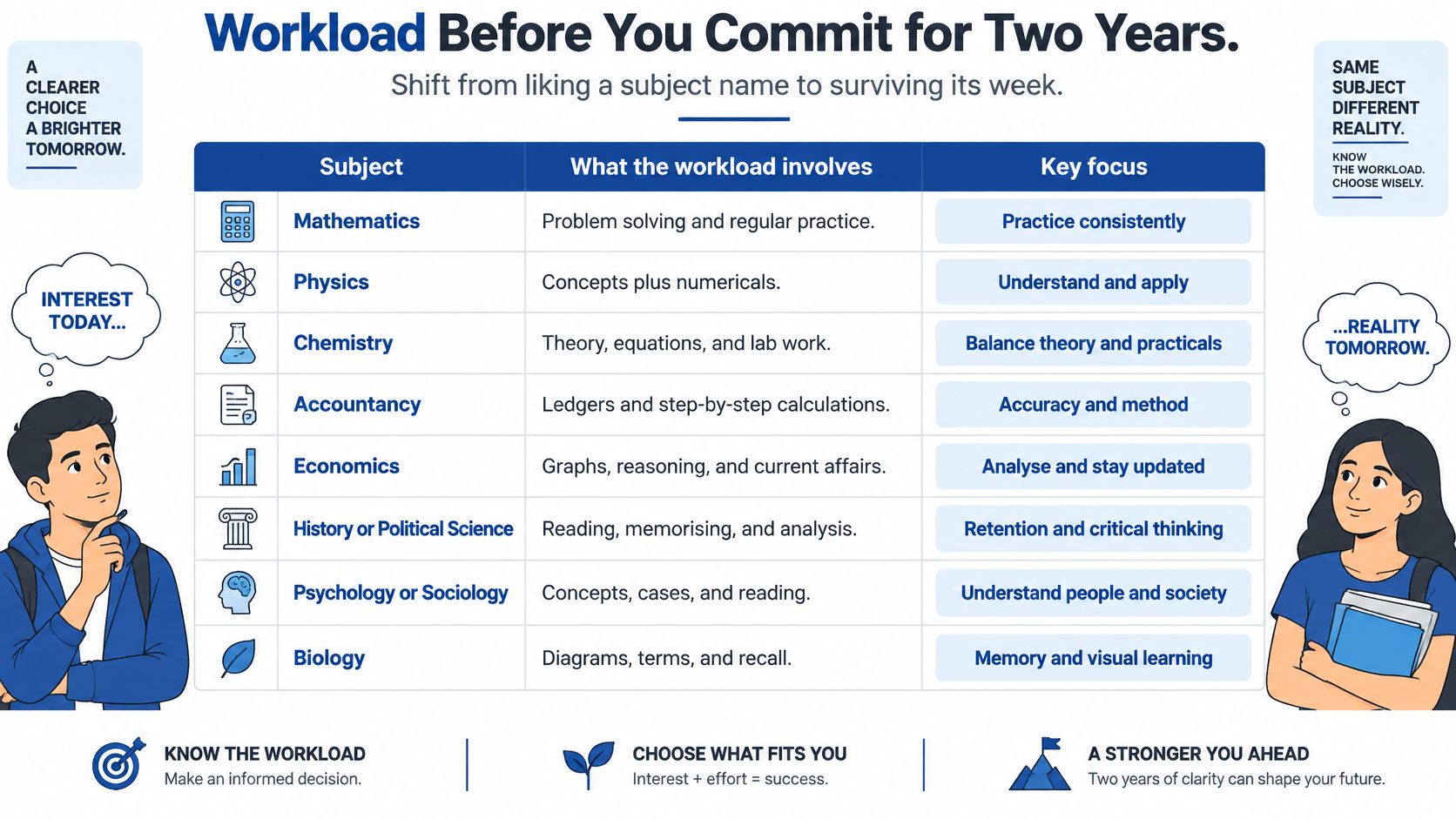
Weekly load by Class 11 subject family
The habits below are illustrative planning suggestions, not prescribed study hours or universal assessment specifications.
| Subject family | Main time sink | Assessment shape | Sustainable habit |
|---|---|---|---|
| Mathematics | Regular problem practice | Predominantly written work | A sample routine could allow 45 to 60 minutes on most days |
| Physics | Numericals and conceptual explanation | Theory and practical work | Revise formula use and keep laboratory records current |
| Chemistry | Multiple theory units and laboratory work | Theory with separate practical assessment | Maintain unit notes and practise equations alongside concepts |
| Accountancy | Ledgers, adjustments and statements | Written problem-solving | A sample week could include three timed practice sessions |
| Economics | Graphs and written reasoning | Written answers and assigned project work | Prepare a chapter explanation with labelled graphs |
| History or Political Science | Reading and answer structure | Theory and project requirements | Keep source notes, not only summaries |
| Psychology or Sociology | Concepts, cases and terminology | Theory and project or practical requirements | Write a short application note after each chapter |
| Computer Science | Programs, debugging and theory | Theory and practical work | A sample weekly target could be one fully debugged program |
| Skill elective | Applied tasks and portfolio completion | Practical emphasis under the subject scheme | Reserve the portfolio time scheduled by the school |
Humanities students may spend considerable time reading and structuring answers. Skill-subject students can face practical submissions that bunch together, while computing students may need repeated attempts to locate a programming error.
Test a normal school week
A hypothetical PCB routine might include:
- Monday to Friday: Separate 45-minute blocks for Physics, Chemistry and Biology after school.
- Saturday: A 90-minute laboratory-record or diagram session and a timed English answer.
- Sunday: A two-hour review across the heavy subjects, with an evening protected for rest.
This is a trial timetable, not a target every student must meet. It should be tested against school hours, commuting, meals and existing commitments.
If several subjects require frequent practice, the student should check whether those sessions fit. Calling an additional subject optional doesn't remove its workload once selected.
Sustainability check: A combination that fits only when sleep disappears doesn't fit the student's current week.
Projects and practical files need scheduled attention throughout the term. They aren't marks that can safely be remembered only near an examination.
Future Courses and Two Student Paths
The best subject combination for Class 11 preserves relevant options, not every imaginable option. Students need a short list of plausible courses and the actual eligibility conditions attached to them.
Engineering routes usually call for Physics, Chemistry and Mathematics, while medicine and many allied-health routes usually involve Physics, Chemistry and Biology. These are starting assumptions for investigation, not substitutes for the current entrance-examination and programme admission documents.
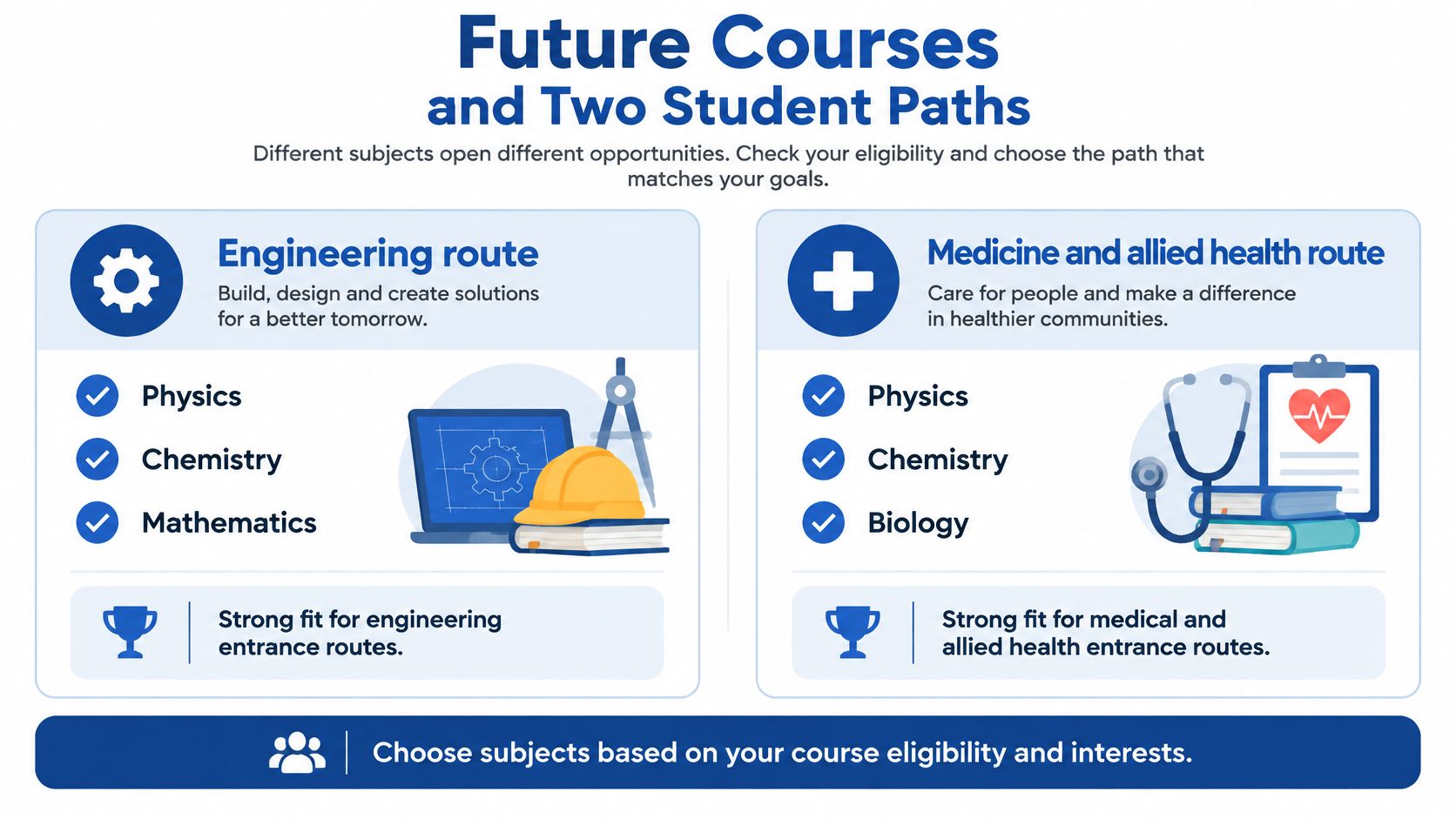
Check subjects, not just degree names
Several economics honours programmes expect Mathematics in Class 12. A student can enjoy school Economics and still miss a preferred university's prerequisite after dropping Mathematics.
CA and other professional commerce pathways can be approached through more than one school combination, but Accountancy preparation and mathematical confidence remain relevant to the work. Law entrance routes such as CLAT don't require a particular stream, so Humanities isn't a barrier merely because it isn't Science.
Design, media and psychology admissions require programme-level checking. Some institutions emphasise an entrance test, portfolio or particular prerequisite; the stream name alone won't settle eligibility.
An additional subject helps only if the admitting institution accepts it in the required way. It shouldn't be assumed to repair a missing prerequisite or an unsuitable main combination.
Five questions before finalising
- Interest: Which subjects would still attract the student if marks were hidden?
- Strength: Which subject resembles work the student already completes carefully and independently?
- Routine: Can the student maintain its practice and revision during a normal school week?
- Eligibility: Which subject is required for a course the student might realistically apply to?
- Availability: Does the school offer the complete set without a timetable clash?
A structured course-direction report can serve as a discussion prompt. Final decisions still need to be checked against the relevant admission conditions.
Riya in Nagpur and Arjun in Kochi
Consider a hypothetical student, Riya in Nagpur, who scores 92% in Class 10 and faces pressure to choose PCM. She prefers essays, current affairs and discussing human behaviour, so she samples Political Science, Psychology and Economics before choosing.
Riya keeps Mathematics only if it serves a plausible course requirement and she's willing to continue its practice. Her decision isn't a rejection of ability in Science; it's a more precise use of evidence about her interests and working habits.
In another hypothetical situation, Arjun in Kochi wants to pursue economics honours. He retains Mathematics with Economics rather than dropping it because Commerce is described as easier, and chooses Accountancy only after trying ledger-based exercises.
Both students then verify the school's subject list. Neither treats a promising pairing as proof that admission or strong results will follow automatically.
Confirm the Combination Before You Submit
A suitable subject choice must fit both the student's goals and the school's rules. Before submitting the final set, check each subject against registration requirements, available combinations, and the time needed to study it.
Complete the final checks
- Write the full set: List languages and any additional subject, not just labels such as PCM, PCB or Commerce.
- Check registration rules: Confirm that the subjects are compatible and meet the applicable language requirements.
- Match a likely course: Use the current admission document to record any prerequisite subjects.
- Review the week: Make room for practice, projects, practical records and rest.
- Obtain school confirmation: Ask for the offered-subject sheet and written confirmation that the timetable works.
A change after classes begin may be possible, but the principal should confirm the board procedure and deadline. An early change is not automatic, and a later replacement may affect preparation or eligibility.
A cousin's state-board combination does not establish that the same set is valid under CBSE. Mixed-stream choices need approval under the applicable rules and a workable arrangement at the school.
Use self-understanding to choose among valid options
Edvdo is a student-focused platform that helps students understand their strengths, motivations and learning patterns to support academic and career decisions. Its assessment can help students identify habits that slow progress, how they learn most effectively, their confidence in key decisions, what drives success, and where goals and actions do not align.
A values reflection exercise can help families discuss whether a subject choice reflects the student's priorities or outside pressure. Use that reflection to compare options, while treating the school's approved list, board rules and admission requirements as the boundaries for the final decision.
Frequently Asked Questions About Class 11 Subjects
Can students mix Science and Commerce subjects?
Yes, where the board permits the complete combination and the school can timetable it. Mathematics with Economics is a useful example, but every proposed pair still needs checking.
Can a subject change after Class 11 starts?
A change may be possible through the school, subject to the board's procedure, registration window and available places. The replacement must preserve a valid subject set and allow the student to catch up.
Is an additional subject compulsory?
No. Under the CBSE arrangement described above, it's optional and can be a language, academic elective or skill elective. It should serve a clear purpose rather than increase the subject count.
Do state boards use the same subjects as CBSE?
Not necessarily. Boards publish their own groups, codes and combination rules, while individual schools decide which approved subjects they can offer.
Are skill subjects a genuine option for college?
They can be, but recognition isn't automatic across programmes. Families should check the intended institution's accepted subjects, eligibility conditions and any bridge preparation before committing.
Edvdo offers structured assessments and personalised insights to help students understand their interests, strengths, motivation and learning patterns. Families comparing Class 11 subjects can visit Edvdo, use those insights to build a shortlist, and take that shortlist to the school for a final rules and availability check.