
A Class 10 student often reaches this point with mixed advice from every direction. A parent says Commerce is the safer choice, a friend says it is manageable, and a cousin insists that without Mathematics there will be regrets later. At the same time, the word Accountancy can sound intimidating even when the student enjoys solving problems.
That confusion is normal, because commerce subject for 11th class is not just a stream label. Under CBSE, it works as a two-year commitment, so the subjects chosen now affect Class 12 continuity, school workload, and later options. A smart choice is not about picking what sounds easy, it is about picking a combination that fits the student's strengths and keeps useful doors open.
Parents, students, and school counsellors all need the same thing here, a clear way to compare subjects before forms are submitted. The pages below break the decision into plain language, starting with the core subjects, then the electives, then the future impact of the combination. For a quick self-check on interests before reading further, a short interest test can help frame the discussion at home.
Table of Contents
- Where You Stand Before Choosing Commerce Subjects
- The Core Commerce Subjects Explained Simply
- Optional Electives and What Each One Actually Feels Like
- How Subject Choices Shape Your Future Courses and Careers
- A Practical Framework for Choosing Your Combination
- Common Myths About Commerce Subjects Students Should Question
- Common Mistakes When Picking Commerce Combinations
- Quick Subject Snapshot and Your Next Step This Week
Where You Stand Before Choosing Commerce Subjects
A Class 10 student usually reaches Commerce after hearing two kinds of advice. One relative says, “Commerce is easier than Science,” while another warns that skipping Mathematics will close doors later. Both comments are only half-useful, because the actual question is not whether Commerce is easy, it is whether the chosen combination suits the student's learning style and future plans.
CBSE treats Classes XI and XII as a composite two-year course, so subject choice in Class 11 is not casual. Students generally need to continue the same subjects into Class 12, and they must take at least five subjects under the senior-secondary framework. That is why a hasty choice in Class 11 can create avoidable stress later, especially when school rules, board requirements, and college preferences all start intersecting.
Practical rule: choose the combination that a student can realistically sustain for two full years, not the one that sounds impressive for two weeks.
This guide is meant for students who are curious, parents who want a grounded view, and counsellors who need a clean way to explain the trade-offs. The focus stays on what each subject feels like in school, how optional subjects change the workload, and how continuity matters more than trends. A student who understands that framework can talk to the family and school with much more clarity.
The Core Commerce Subjects Explained Simply
A good way to understand Commerce is to follow one small business. Think of Annu's Shop, a neighbourhood kirana store that sells rice, soap, biscuits, and notebooks. Every subject in Commerce looks at that shop from a different angle.
Accountancy keeps the money trail visible
Accountancy asks a simple question, what happened to the money? When Annu sells two packets of rice, the sale must be recorded properly, first in the journal, then in the ledger, and eventually in the trial balance and financial statements. CBSE Class XI Accountancy builds this accounting cycle through journal entries, ledgers, depreciation, error correction, and sole-proprietorship statements, with 80 marks for theory and 20 marks for project work in the usual pattern (CBSE Accountancy syllabus).
A student often struggles here when the format looks mechanical. The subject starts to click once the learner sees that every entry is just a business event written in a standard language. A practical notebook, regular practice, and neat working steps matter more than memorising blind formats.
Business Studies explains how the shop is run
Business Studies looks at why Annu runs the store as a sole proprietorship today, or why she might later bring in a partner. It studies business organisation, finance, trade, services, ethics, and social responsibility, which means the student learns how firms are formed, managed, funded, and governed (CBSE Class 11 syllabus overview). In a family-business setting, this subject feels familiar because it connects with suppliers, customers, ownership, and daily decisions.
A student who understands how local businesses function usually finds Business Studies more memorable than abstract.
Economics connects the shop to the market
Economics asks why rice becomes costlier, why demand changes, and how supply affects price. In Class XI, CBSE combines Statistics for Economics with Introductory Microeconomics, so students work with data, graphs, averages, correlation, demand, supply, consumer equilibrium, and market forms (CBSE economics structure). For Annu's Shop, that means noticing which products move faster in monsoon, or why customers shift when prices rise in the local market.
English turns Commerce into communication
English often gets treated like a support subject, but in Commerce it matters a lot. Students write answers, reports, project work, and business-like responses with clarity, which later helps in interviews, presentations, and client communication. A student who can explain an idea cleanly usually handles Commerce questions with more confidence because the subject depends on structure, precision, and language control.
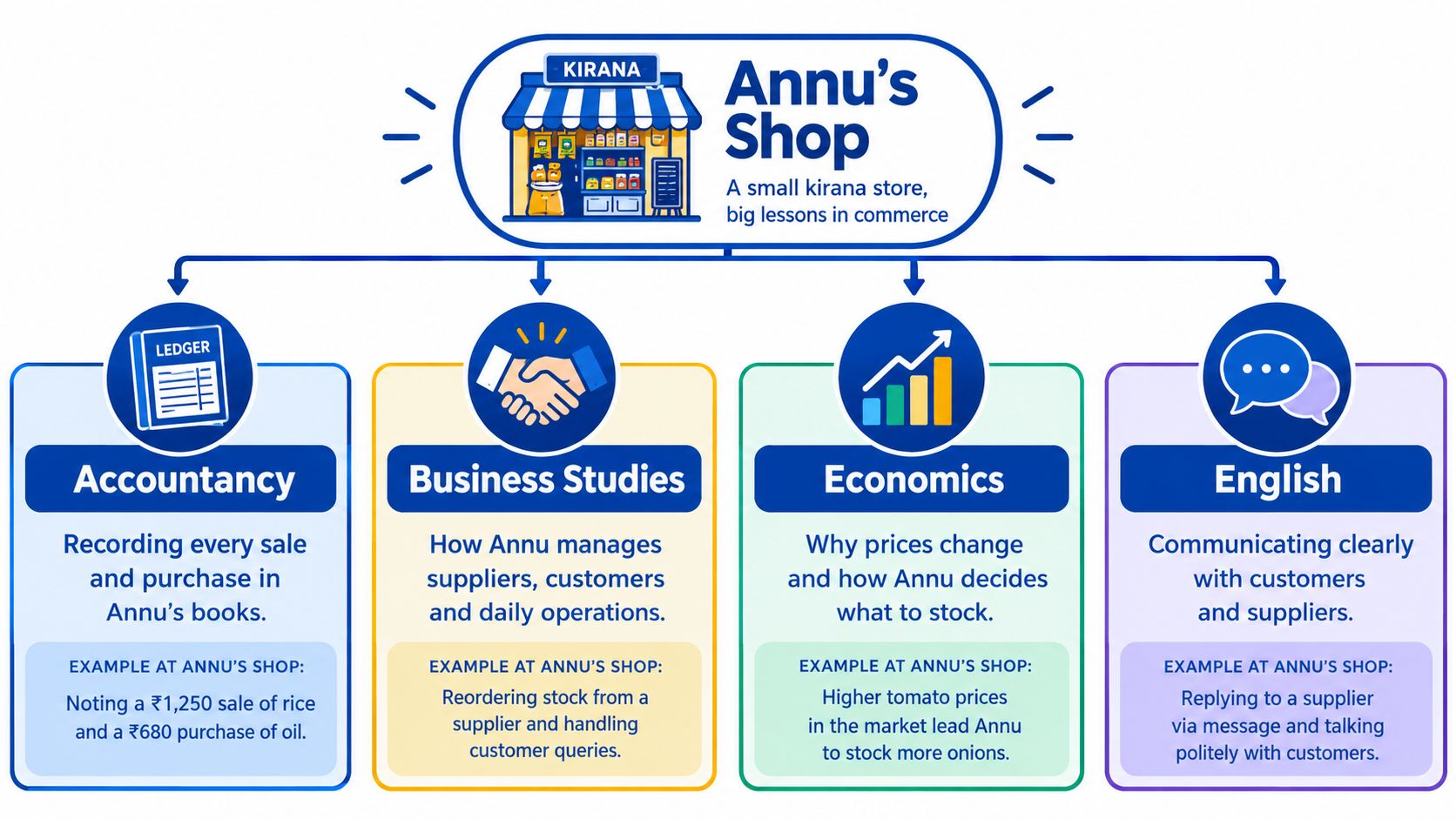
A useful habit is to link every chapter back to a shop, a family business, or a local market. That makes the syllabus feel real instead of remote. For a quick subject-fit check, a subject test can help students compare where they feel confident and where they feel strained.
Optional Electives and What Each One Actually Feels Like
Optional subjects change the everyday experience of Commerce more than many families expect. Two students can both say they took Commerce, yet one may be balancing numerical work, another may be handling coding-style tasks, and a third may be keeping the timetable lighter with a practical subject. Availability depends on the school and board, so the first rule is always to verify the prospectus, not assume every school offers every option.
Mathematics and Applied Mathematics
Mathematics suits a student who likes abstract problem-solving, neat logic, and regular practice. It feels rewarding when concepts connect, but frustrating when a gap in basics slows the next chapter. Applied Mathematics is more classroom-friendly for many Commerce students because it leans towards practical use, which is why some families see it as a middle path.
Informatics Practices, Entrepreneurship, and Physical Education
Informatics Practices feels right for a student who is comfortable with digital work, data handling, and computer-based tasks. Entrepreneurship suits students who enjoy ideas, initiative, and business creation, not just textbook answers. Physical Education can be a sensible load-balancing choice for someone who wants a subject that supports routine without adding the same kind of numerical pressure.
| Class 11 Commerce Electives at a Glance | Best Suited For | Workload Signal | Connects To |
|---|---|---|---|
| Mathematics | Students who like abstract problem-solving | High practice and continuity | Quantitative degrees and exam pathways |
| Applied Mathematics | Students who want maths with a practical edge | Moderate to high, but more applied | Commerce calculations and analytics |
| Informatics Practices | Students who enjoy digital tools and data work | Steady practical work | Commerce technology and data roles |
| Entrepreneurship | Students who like business ideas and start-up thinking | Conceptual and project-friendly | Small business, venture thinking |
| Physical Education | Students who need a balanced timetable | Usually easier to sustain for many learners | Health, sports, and overall load management |
A family should treat the elective as part of the core plan, not as a decorative extra. What looks like a “simple” subject now can become a pressure point in Class 12 if the student never liked the style of learning. A counsellor's job is to match subject style with the student, not just the student with the stream.
How Subject Choices Shape Your Future Courses and Careers
A subject combination in Class 11 is a two-year decision, and it can affect both college eligibility and how comfortable the student feels later. CBSE's Class XI and XII structure makes continuity matter. A student who chooses Mathematics or Applied Mathematics keeps access to several quantitative routes, while a student who skips Maths still has many Commerce-friendly options, including B.Com, CA Foundation, CS, CMA, BA, hotel management, and design pathways. The question is less about which stream is better and more about which route keeps the right doors open.
Mathematics often works as a gatekeeper for programmes that depend on quantitative thinking, such as economics honours, statistics, and data-oriented paths. Some institutes also expect it for certain business and management programmes, especially where the curriculum is numerically heavy. The common advice to “keep Maths for flexibility” makes sense only if the student can carry that load for two years without losing grip on other subjects.
Informatics Practices points to a different kind of fit. It suits students who want to stay close to commerce, analytics, and digital work without moving into a full Maths-heavy route. For many learners, it feels closer to spreadsheets, computing, and business-tech work than to abstract calculation.
Once the combination is locked, a structured career report can show how those subjects connect to courses and roles. That kind of mapping helps families see the long-term effect clearly, before Class 12 pressures begin.
A Practical Framework for Choosing Your Combination
A solid choice needs a process, not a guess. Families often start with the final answer, but the better route is to sort preferences, strengths, and future plans first, then check what the school offers. That keeps the discussion honest and reduces last-minute panic.
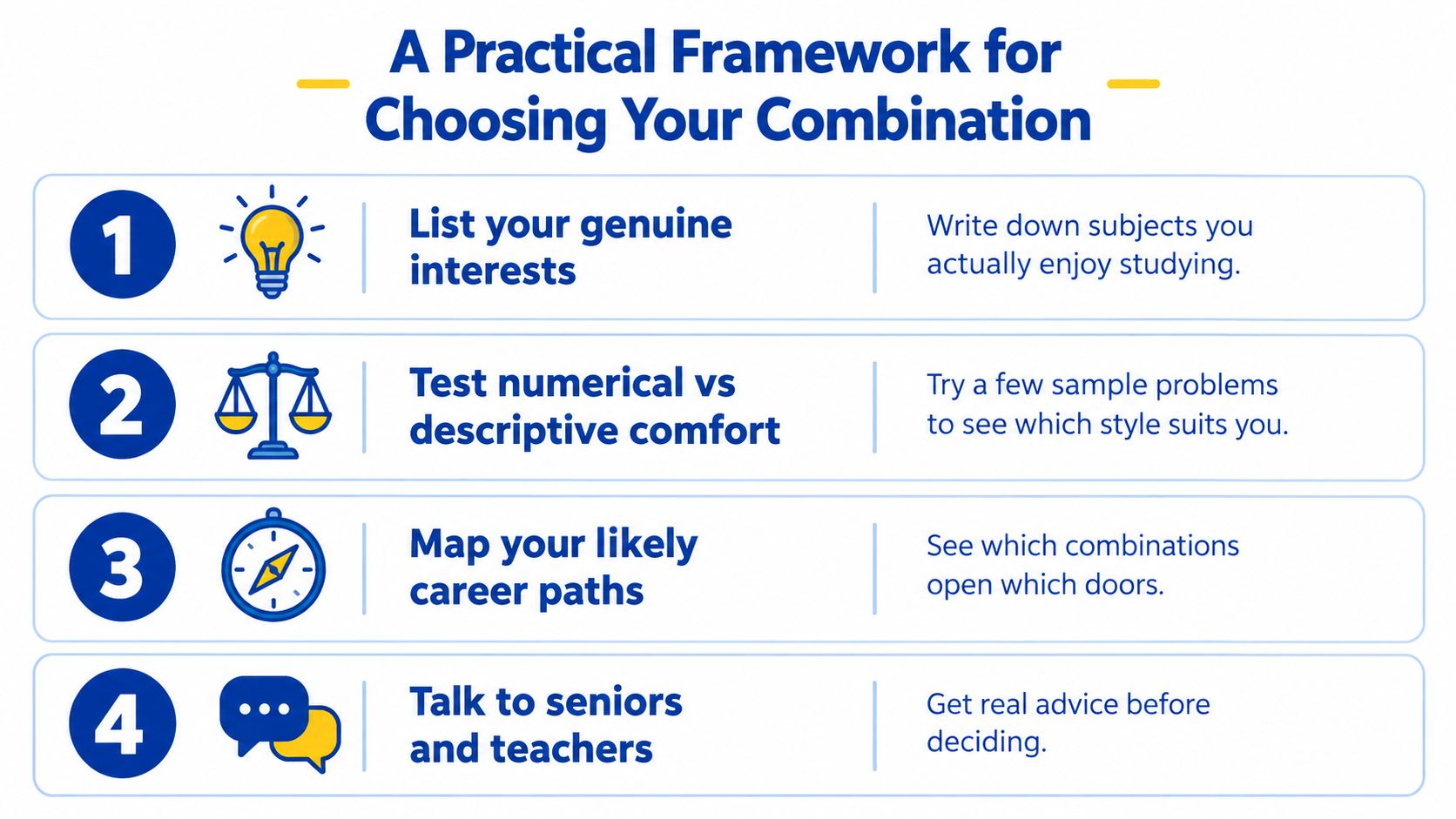
A simple self-check works better than guesswork
- List genuine interests. Write down the subjects the student likes, not the ones that sound socially impressive.
- Test numerical comfort. Try a few sample problems and see whether the student enjoys the process or starts resisting it.
- Map likely career directions. Shortlist college routes and entrance goals before locking in a subject mix.
- Verify school availability. Check the prospectus and confirm which electives the school offers in Class 11 and continues in Class 12.
The strongest signal is often the student's response to sustained effort. If a learner likes numbers but dislikes long derivations, that may point towards Applied Mathematics or Informatics Practices rather than pure Mathematics. If the student likes explanation, discussion, and examples, Commerce subjects with stronger conceptual flow may suit better than a highly calculation-heavy setup.
Useful question: which combination can the student study steadily for two years without feeling trapped by the timetable?
For a more structured conversation at home, Edvdo's skill test can help the family compare strengths before making a final choice. That does not decide the stream on its own, but it can make the next discussion far more focused and less emotional.
Common Myths About Commerce Subjects Students Should Question
A lot of poor subject decisions begin with a neat-sounding myth. The problem is that these ideas spread easily because they sound practical, even when they ignore how CBSE and college planning really work.
Myth versus reality
- “Commerce is the easy stream.” Reality, Commerce is different, not easy. Accountancy, Economics, and Business Studies each demand regular reading, practice, and conceptual clarity.
- “Mathematics is compulsory for every Commerce student.” Reality, CBSE does not make Mathematics universally compulsory for Commerce. Schools may have their own rules, so availability must be checked locally.
- “Pick whatever your friend is taking.” Reality, the friend's strengths may be completely different. A combination that works for one student can create avoidable stress for another.
- “Accountancy is just memorising formats.” Reality, the subject is about recording business events correctly and understanding the accounting process.
- “Entrepreneurship sounds modern, so it must be the best elective.” Reality, the name does not matter if the student dislikes project-based, idea-driven work.
The most dangerous myths are the ones that sound obvious at home. A student who repeats advice without checking the actual combination rules often ends up with a subject mix that looks good on paper but feels wrong by mid-year.
Common Mistakes When Picking Commerce Combinations
One common mistake is choosing Mathematics because a relative did well with it. That story can be encouraging, but it says little about the student's own pace, patience, or habit of regular practice. A better check is simple: try a few Maths chapters early, then see whether the work feels steady or strained.
Another mistake is waiting too long to confirm subject availability. Some families assume a subject will be offered because it is familiar, then discover later that the school does not run it in that batch. The safer move is to read the school prospectus carefully and ask which electives are carried into Class 12.
A different error is underestimating the work attached to Accountancy in Class 12. The subject is not only about classroom notes. It also asks for consistent practice and space for project-related work, so a student who already has a packed timetable may feel the pressure quickly.
Physical Education is often brushed aside too quickly. For some students, it is the most practical way to keep the workload balanced while still meeting their academic goals.
Quick fixes students can apply now
- Check the timetable load. See whether the mix still leaves room for Accountancy and Economics practice.
- Ask about continuity. Confirm that the elective chosen in Class 11 can be taken forward in Class 12.
- Match the subject to the learner. If the student prefers theory, practical tools, or calculations, choose with that fit in mind.
- Review college requirements. Some future courses care more about subject continuity than about a popular combination.
Before signing the form, ask which subject the student would still willingly open on a tired Wednesday evening in Class 12. That question is plain, but it catches problems early and protects marks, confidence, and future choices at the same time.
Quick Subject Snapshot and Your Next Step This Week
| Core and Optional Commerce Subjects, One-Line Snapshot | What It Builds | Best Direction Signal |
|---|---|---|
| Accountancy | Recording, accuracy, and financial thinking | Comfort with structured numerical work |
| Business Studies | How businesses are organised and managed | Interest in firms, decisions, and cases |
| Economics | Data reading and market understanding | Curiosity about prices, demand, and supply |
| English | Communication and clear expression | Students who need strong written and spoken clarity |
| Mathematics | Abstract problem-solving | Students keeping quantitative options open |
| Applied Mathematics | Practical numerical thinking | Students who want applied work over pure theory |
| Informatics Practices | Digital and data handling | Students leaning towards commerce-tech work |
| Entrepreneurship | Business initiative and project thinking | Students interested in creating or running ventures |
| Physical Education | Balanced workload and practical routine | Students needing a steadier timetable |
For a Class 11 student, this table is not just a subject list. It is a two-year choice that can shape which Class 12 combinations stay open, which college routes remain available, and how heavy the weekly workload feels at home. A subject that looks attractive on paper can become tiring later if the student dislikes calculation, writing, or project work.
A simple way to use the snapshot is to read it like a match chart. If the student enjoys structure, Accountancy may feel manageable. If they like current affairs, prices, and everyday business questions, Economics may feel more natural. If they want flexibility for later courses, Mathematics or Applied Mathematics can keep more doors open. Parents should also check whether the school offers the same subject forward in Class 12, because a choice made now needs continuity later.
This is also the right time to write a shortlist on paper. Keep it small, then ask one practical question for each option, “Would the student still be willing to study this on a tired weeknight?”
A family that wants support for written applications can compare AI rewriters for students as a light editing aid after the shortlist is fixed.
This week, do three things. First, write two or three possible Commerce combinations. Second, check them against school availability and future course requirements. Third, sit together for a short conversation and choose the mix the student can carry for two full years without constant regret.