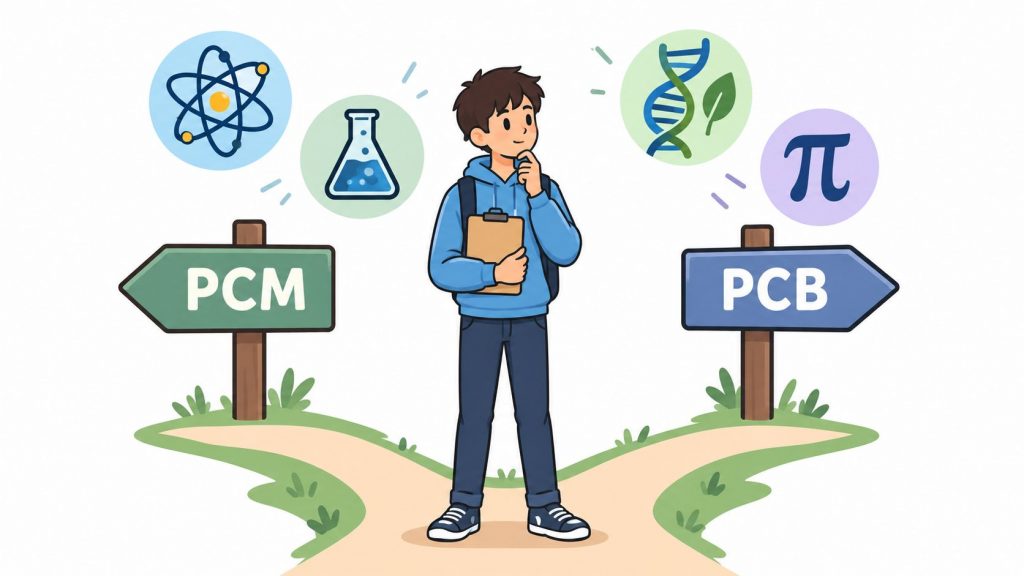
Class 11 science is built around Physics and Chemistry with Mathematics, Biology, or both, alongside English and one optional subject, so the familiar combinations are PCM, PCB, and PCMB. That single choice changes both the kind of work a student will do every week and the paths available after Class 12.
A student holding the stream form after Class 10 results often sees three neat abbreviations and feels the pressure rise. Those letters are not just labels, they decide whether the year will lean more towards experiments, numerical practice, or both, and they shape the next stage of study in a very practical way.
Table of Contents
- Why Class 11 Subject Choices Matter So Much
- Core Science Subjects You Will Study
- PCM vs PCB vs PCMB Compared
- Marks Pattern and Assessment Structure
- Elective and Optional Subject Choices
- Career Paths After Each Combination
- Choosing the Right Fit and Final Checklist
Why Class 11 Subject Choices Matter So Much
A Class 10 student can finish a board result day with good marks and still feel stuck at the stream form. PCM, PCB, and PCMB look simple on paper, but each one changes the rhythm of the next two years, the type of homework, and the doors that stay open later. The choice is really not about prestige, it is about matching a subject structure to a student's strengths and target route.
Class 11 is where general science stops being broad and starts becoming specialised. Physics, Chemistry, Mathematics, and Biology move from integrated school science into full senior-secondary versions, which means the work gets deeper, faster, and more demanding. A student who chooses science stream subjects in 11th is not just picking topics, the student is choosing a training pattern for the next stage of study.
Practical rule: subject choice should follow eligibility and workload reality first, not peer pressure.
A useful way to start is to ask three plain questions. Which subjects feel manageable on a normal school week, which entrance exams or courses might follow after Class 12, and which combination does the school offer?
For students comparing stream options after Class 10, a clear starting point is this guide on subject combination in 10th, because the habits built there often show up again in Class 11.
The safest decision is usually the one that matches both ability and interest. Panic-driven choices based on what friends select, or what sounds most impressive, often create avoidable stress later.
Core Science Subjects You Will Study
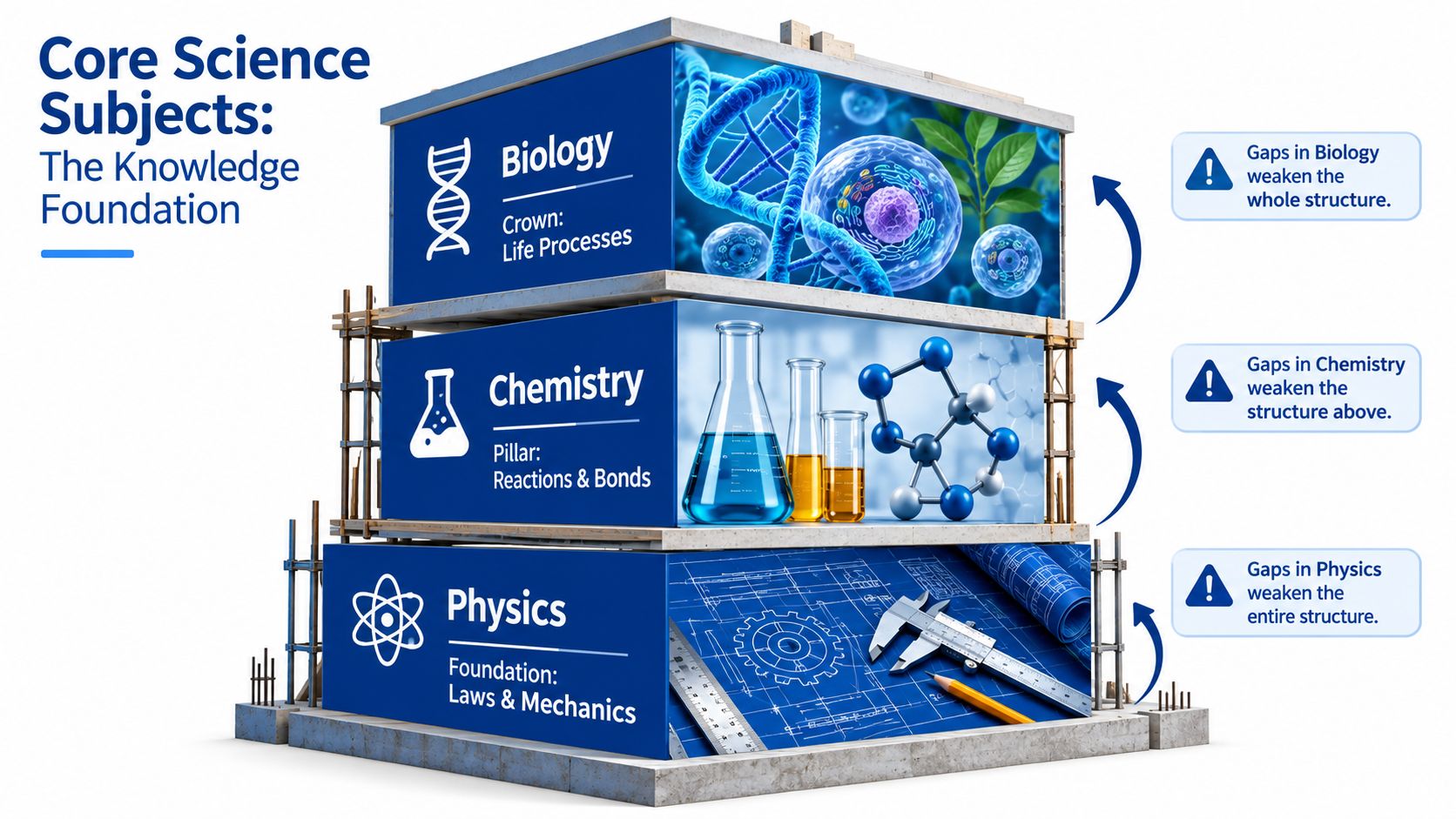
The easiest way to understand the science stream is to think of it as a building under construction. The lower floors carry the weight, and if those floors are weak, everything above feels harder. Physics and Chemistry form the base for most science students, while Biology or Mathematics changes the direction of the structure.
Physics and Chemistry as the base
Physics in Class 11 usually starts with measurement and kinematics, then moves into Newtonian mechanics, work and energy, rotational motion, gravitation, thermal physics, kinetic theory, oscillations, and waves. Each topic leans on the one before it, so a student who struggles with units or graphs early on can feel that difficulty spread later. That is why measurement, estimation, and algebra matter from the first month itself.
Chemistry follows a similarly layered route. The subject begins with quantitative foundations, then moves through atomic structure, periodicity, bonding, thermodynamics, equilibrium, redox chemistry, and introductory organic chemistry. Mole calculations, reaction reasoning, and structure-based thinking are not side tasks here, they are the core of daily progress.
Biology and Mathematics as different study habits
Biology suits students who enjoy observation, memory with meaning, and careful reading of processes in living systems. The workload feels different from Physics or Chemistry because diagrams, terminology, and lab-based understanding matter throughout the year. Students who like watching patterns in living organisms often find Biology more natural than abstract numerical work.
Mathematics is the extended problem-solving track. It rewards stamina, repeated practice, and comfort with working through steps until the final answer is clear. Many students enjoy it because there is less memorisation than in Biology and less experimental record-keeping than in the practical sciences, but the mental effort is steady.
A student does not need to love every topic to do well. The real question is whether the subject's daily routine feels tolerable enough to sustain for a full year.
The day-to-day difference matters more than many families expect. Physics, Chemistry, and Biology bring lab records, observation work, and graphing, while Mathematics brings long numerical practice and written solution sets. A student should picture the weekly workload clearly before choosing the subject mix.
PCM vs PCB vs PCMB Compared
The key question is not which combination has a better name on paper. It is which one matches the route a student genuinely wants to keep open, and which one fits the way they study day to day. PCM, PCB, and PCMB all share the same science base, but they place different demands on the student. That is where confusion usually starts.
What each combination is really for
PCM, or Physics, Chemistry, Mathematics, suits students aiming toward engineering, computing, and physical sciences. PCB, or Physics, Chemistry, Biology, suits students who are aiming at medicine, life sciences, and allied health routes. PCMB keeps both directions open, but it asks for a much heavier week because the student must maintain Mathematics practice and Biology study along with the practical sciences.
| Combination | Core Subjects | Best Suited For | Workload |
|---|---|---|---|
| PCM | Physics, Chemistry, Mathematics | Engineering, computing, physical sciences | Heavy, especially in problem-solving |
| PCB | Physics, Chemistry, Biology | Medicine, life sciences, allied health | Heavy, especially in practical and memorisation work |
| PCMB | Physics, Chemistry, Mathematics, Biology | Students who want to keep both medical and engineering-type options open | Heaviest, because both tracks must be maintained |
Why PCMB is not automatically the safest choice
PCMB looks appealing because it seems to preserve options. In practice, it can pull attention in two demanding directions, and that split often makes steady performance harder to hold in both.
The same idea applies to weaker areas. A student who dislikes numerical work may struggle in PCM no matter how popular that combination appears, while a student who dislikes lab-style and biology-based learning may feel drained in PCB. The better question is not what sounds broadest, but what can be sustained with discipline.
A student who is already strong in one route often does better by committing to it fully. For families weighing route fit, career paths are covered in detail later in this guide.
Marks Pattern and Assessment Structure
A student can choose science and still face very different weekly demands. The difference is not the stream label, it is the assessment pattern behind each subject. One subject may ask for steady lab records and oral readiness, while another depends almost entirely on written problem-solving.
What the marks split means in practice
Physics, Chemistry, and Biology are commonly structured around 70 marks of theory and 30 marks of practical or internal assessment, so practical work carries 30% of the subject total (CBSE Class 11 syllabus overview). Mathematics is generally assessed through a 100-mark written examination without the same laboratory component (CBSE subject list and structure). That changes the study rhythm from the first week itself.
| Subject Type | Assessment Pattern | Weekly Demand |
|---|---|---|
| Physics, Chemistry, Biology | 70 theory, 30 practical/internal assessment | Lab records, observation, viva-style preparation, theory revision |
| Mathematics | 100-mark written examination | Continuous problem-solving and timed practice |
A practical subject behaves like a running file. Experiments, records, and observations build over time, so last-minute effort rarely fixes weak preparation. Mathematics works more like repeated training sessions, because the pressure comes from accuracy, speed, and regular practice.
Students often miss the transition gap between Class 10 and Class 11. Algebra, ratios, scientific notation, and basic chemical equations should feel familiar before the year begins, since later chapters assume that foundation is already in place. If those basics are shaky, the new content feels heavier than it really is.
Simple rule: delaying practice for weeks hurts science scores more than many students expect.
That is why the marks pattern deserves attention before subject selection settles. It shows the kind of work each subject asks for all year, not just the chapter names in the textbook.
Elective and Optional Subject Choices
The core four rarely stand alone. Most schools expect a fifth subject, and some offer an additional subject too, so the timetable matters more than many families first realise. Subject codes help here because they show whether a student is taking standard Mathematics, Applied Mathematics, or Biology as the formally recognised option.
Choosing the right add-ons
CBSE's science pathway includes Mathematics 041, Applied Mathematics 214, and Biology 044, along with options such as Computer Science, Informatics Practices, Physical Education, Psychology, and Biotechnology. The official CBSE senior secondary curriculum and subject-code list on cbse.gov.in is the cleanest place to verify what a school is offering. The right elective depends less on what sounds impressive and more on the skill it builds.
- Computer Science and Informatics Practices: These suit students who want computing routes and stronger comfort with logic, digital systems, and data handling.
- Psychology: This fits students interested in behaviour, cognition, and human development, especially when reading and reflection come naturally.
- Biotechnology: This aligns with bio-based study routes and supports students who like the applied side of life sciences.
- Physical Education: This can help balance a heavy academic timetable with one subject that is more activity-based.
What schools can and cannot offer
Not every school offers every combination. A student may want PCMB with a particular elective and then find that the timetable does not support it. That is why families should check the school's actual subject basket before assuming the preferred mix is available.
Subject availability is a practical constraint, not a minor detail. The best combination on paper is useless if the school cannot timetable it.
The best way to shortlist electives is to connect them with the next stage of study. A computing-oriented student should favour subjects that strengthen logic and digital fluency, while a biology-focused student may gain more from electives that support laboratory or health-related interests. The goal is fit, not collection.
Career Paths After Each Combination
Engineering and technology routes depend on Mathematics; medicine and most life-science programmes depend on Biology. Subject choice at this stage decides whether a student can meet the eligibility rules later, because school science is the base for engineering, medicine, computing, physical sciences, biological sciences, and related technical fields.

Eligibility follows subject logic
The first mistake many students make is assuming that “science” covers every route. It does not. Biology does not substitute for Mathematics in programmes that require mathematical preparation, and Mathematics does not substitute for Biology in biology-based medical prerequisites (CBSE subject compatibility guidance).
So the core question is simple: which undergraduate doors does the student want to keep open? PCM suits students who are comfortable with numeracy and technical problem-solving. PCB suits students who can handle detailed life-science study and practical work. PCMB only makes sense when both directions are actually on the table, because it carries the weight of both tracks.
The real decision is compatibility, not prestige
A combination chosen for status often creates avoidable pressure later. A combination chosen for eligibility, interest, and workload fit usually feels steadier through Class 11 and Class 12.
For families mapping possible routes, the broader career opportunities in science resource helps connect subject choice with real pathways instead of vague ambition. The best mix is the one that still works after the first term, not only on paper.
Choosing the Right Fit and Final Checklist
A Class 10 student may enter the stream-selection meeting thinking, “Science keeps every door open.” By the first term of Class 11, that idea can feel very different if the subjects do not match the student's preparation, pace, or interests. Science is not one universal route. It is a set of prerequisites, assessment patterns, and workload choices.
Eligibility follows subject logic
Biology does not substitute for Mathematics in programmes that require mathematical preparation, and Mathematics does not substitute for Biology in biology-based medical prerequisites (CBSE subject compatibility guidance). Subject selection works like choosing the correct key for a door. A strong mark in the wrong subject may still leave a route unavailable.
PCM generally fits students comfortable with numeracy, abstraction, and technical problem-solving. PCB suits students prepared for detailed life-science learning, recall, and laboratory work. PCMB keeps both directions available, but it also combines both workloads. Choose it only when both pathways are genuine possibilities, not merely because it sounds safer.
Compatibility matters more than prestige
The secondary-to-higher-secondary transition is a bottleneck for many learners. Government-linked data for 2021–22 recorded 1,03,97,393 students in higher secondary education, including 56,78,265 boys and 47,19,128 girls (parliamentary STEM pipeline data). UDISE+ analysis reports a gross enrolment ratio of 78.7% at secondary level and 58.4% at higher-secondary level (UDISE+ 2024-25 analysis). These figures do not show that science causes students to leave school. They do show why the Class 11 transition deserves careful planning.
Start with an honest weekly check. Can the student sustain focused study? Does Mathematics feel workable? Are practical sessions manageable? Can motivation survive a difficult month? Marks patterns matter too: a student comfortable with practical assessment may experience the science subjects differently from a student who prefers a fully written paper.
The choice can change. Students sometimes move from science towards computing, design, health sciences, vocational education, or humanities after learning more about their strengths. That is course correction, not failure.
Parents can also compare this long-term approach with these A Level subject selection tips for parents. A useful subject assessment guide for students choosing strengths can help replace guesses with evidence. For broader career mapping, career opportunities in science and Edvdo offer further guidance.
Final checklist: confirm prerequisite compatibility, elective availability, assessment comfort, weekly workload, and realistic career options before submitting the form.