

A hotel management diploma after Class 10 typically takes 3 years, or approximately 3,600 hours, under NCVET guidelines, and can prepare students for operational roles in food production, front office, housekeeping, and food and beverage service. It can be a practical entry into India's growing tourism sector, but the right choice depends on the student's interests, strengths, and preferred way of learning.
A Class 10 student and a parent may be comparing higher secondary school, technical education, and early vocational training. The decision can feel difficult because course titles often sound similar while their eligibility rules, recognition, practical exposure, and progression options may differ. A diploma can suit a student who enjoys learning by doing, working with people, and handling practical responsibilities, but it shouldn't be chosen only because hospitality sounds exciting.
Table of Contents
- Understanding Hotel Management Diploma After 10th
- Course Structure and What You Will Study
- Is Hotel Management Right for You
- Choosing the Right Program and Provider
- Career Outcomes and Industry Opportunities
- Common Misconceptions About Hotel Management Diplomas
- Next Steps and Making Your Decision
Understanding Hotel Management Diploma After 10th
A student who enjoys preparing food, organising a school event, welcoming visitors, or solving problems in a team may find hospitality more engaging than a heavily theoretical course. A student who prefers quiet, individual work may need to examine the course more carefully, because hotel operations involve coordination, service standards, and changing workplace demands.
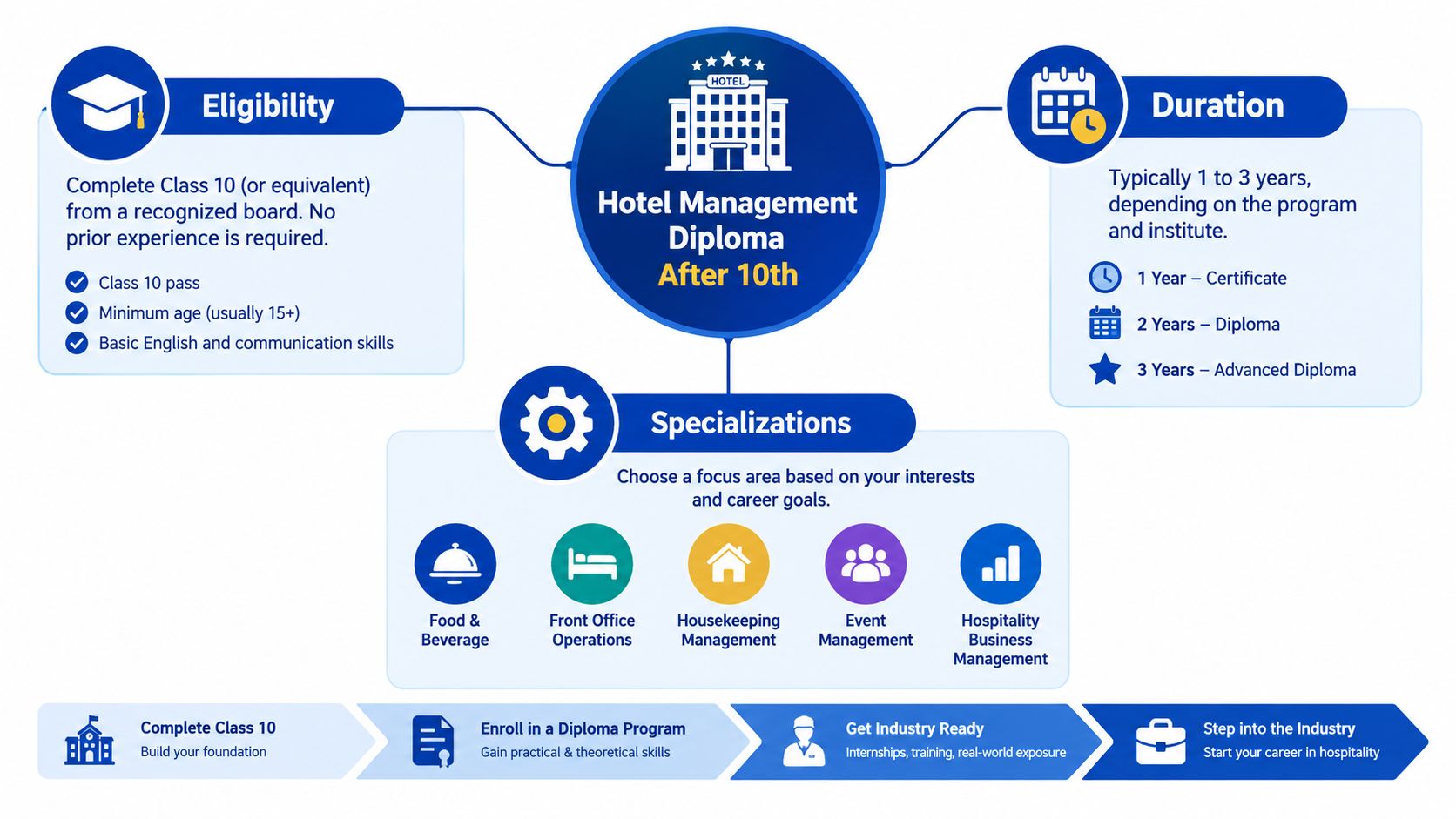
In India, a diploma entered after Class 10 is generally structured as a vocational qualification lasting approximately 3 years or 3,600 hours under the NCVET diploma guidelines. The framework normally places a Diploma after Class 10 at 3 years, while a Diploma (Advanced) generally takes 2 years after Class 12. Learners may have up to 7 years from admission or enrolment to complete the qualification, subject to the applicable rules.
What the pathway usually includes
The course may introduce food production, food and beverage service, housekeeping, front office operations, hygiene, communication, and hospitality management. Students learn how departments work together, rather than studying hotel operations as a single job.
However, “hotel management diploma” isn't a single nationally uniform qualification. Some programmes accept Class 10 graduates, while particular hotel-management routes may require Class 12. Families should check the awarding body, recognition, duration, practical requirements, and progression route before paying an application fee.
A student may also compare this pathway with other hospitality industry careers before deciding. Event venues, catering businesses, restaurants, resorts, and visitor services can all use related skills. Resources such as venue event planning guides can also help students understand the wider service and events environment.
Course Structure and What You Will Study
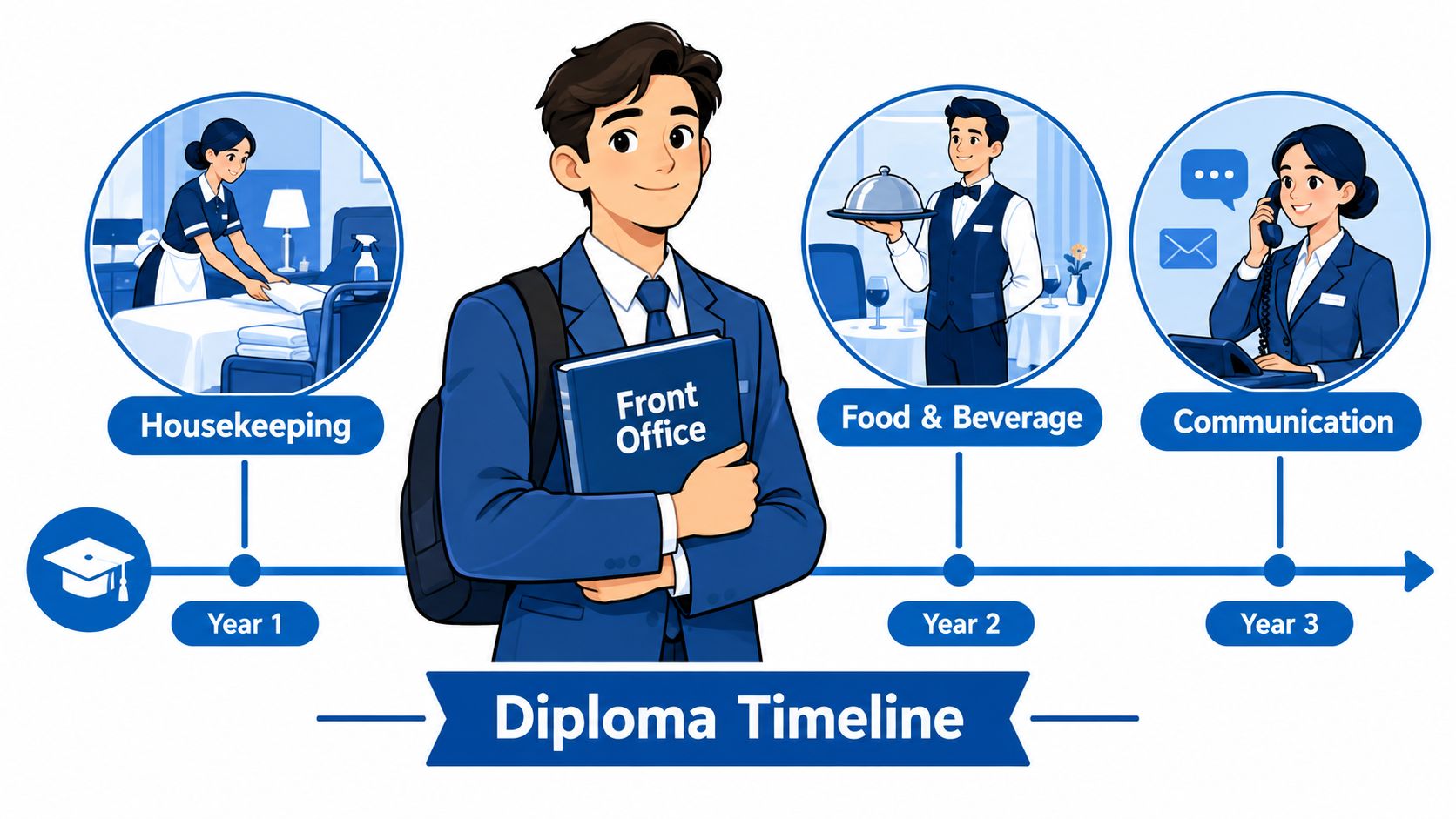
A well-designed diploma combines classroom concepts with repeated practice. Students might learn food hygiene before entering a training kitchen, study guest communication before practising a front-office interaction, or learn inventory principles before planning ingredient use.
The main learning areas
- Food production: Students practise basic preparation, kitchen safety, cleanliness, portion control, and organised work. The emphasis isn't only on cooking skill. It also includes following standard procedures and working reliably during busy service.
- Food and beverage service: This covers table preparation, order handling, service sequence, guest interaction, and coordination with the kitchen. Students who want to understand food and beverage career skills can connect these lessons with restaurant, café, banquet, and catering work.
- Front office operations: Learners may study reservations, guest reception, basic billing, complaint handling, telephone etiquette, and hotel software. Clear communication matters because front-office staff often become the first point of contact.
- Housekeeping: The subject includes room preparation, cleanliness standards, linen handling, supplies, safety, and coordination with maintenance or reception. It requires attention to detail and consistent routines.
- Hospitality operations: Students learn how departments coordinate staffing, service quality, guest needs, and daily procedures. Hygiene, workplace discipline, professional conduct, and basic cost control may support these operational lessons.
How admission should be checked
A student should first confirm whether the programme accepts Class 10 graduates and whether the qualification is issued by a recognised or affiliated body. The admission process may involve an application, document verification, an eligibility check, and an institute-specific interaction or selection step, so the provider's current prospectus should be treated as the final authority.
Practical learning deserves close attention. A course that only displays equipment during an orientation visit may not provide meaningful training. Families should ask whether students regularly use kitchens, mock front offices, housekeeping practice areas, service rooms, and digital systems, and whether industrial training is supervised and assessed.
Is Hotel Management Right for You
A suitable candidate isn't defined by one personality type. A student can be quiet and still succeed in kitchen production, housekeeping coordination, bakery work, inventory control, or back-office operations. The more useful question is whether the student can learn practical procedures, cooperate with others, respond to changing needs, and accept responsibility for service quality.
Assessment insights commonly associated with hospitality fit include communication, adaptability, teamwork, confidence, responsibility, and practical problem-solving. These traits can be developed, but students should be honest about their current preferences. A learner who dislikes every form of customer interaction may still find a suitable department, while someone who enjoys people but avoids routine and accountability may struggle.
Practical rule: Interest in hotels is a starting point. Suitability depends on the student's preferred tasks, working conditions, and willingness to practise workplace habits.
A useful student profile
A student who thrives in this pathway may enjoy practical demonstrations more than long lectures, contribute actively during group tasks, and stay calm when a plan changes. Such a learner might notice that a guest needs help, divide work fairly during a kitchen exercise, or find a solution when an ingredient or room item is unavailable.
The industry also needs more than friendliness. Employers identified problem-solving, communication, literacy, and team-management capabilities as important, while only about one-third reportedly provided training facilities, according to the Tourism and Hospitality Skill Council study. The study projected incremental demand of approximately 3 million workers during 2025–2028 and estimated that 5.7 million young people could be trained to help meet that demand. These are sector-level projections, not a promise of employment for every diploma holder.
Before selecting a course, a student can use a structured career path decision guide and ask:
- Does the student prefer practical work, theory, or a mixture?
- Can the student communicate respectfully with unfamiliar people?
- Is standing, routine, teamwork, and occasional pressure acceptable?
- Which area feels more attractive, food production, guest service, housekeeping, or coordination?
- Is the student prepared to continue learning after the first qualification?
Choosing the Right Program and Provider
Families shouldn't choose a provider solely because its brochure uses words such as “professional”, “international”, or “placement-focused”. A careful comparison should examine what students practise, who awards the certificate, how attendance is handled, and what support exists when a learner struggles.
| What to compare | A stronger programme usually shows | Warning signs |
|---|---|---|
| Recognition | Clear affiliation, awarding body, and certificate details | Staff can't explain who issues the qualification |
| Practical training | Regular access to kitchens, service areas, front-office systems, and housekeeping facilities | Practical work is mentioned but not scheduled |
| Industrial exposure | Written information about supervised training, assessment, and attendance | Internship promises have no terms or named responsibilities |
| Curriculum | Food production, food and beverage service, front office, housekeeping, hygiene, and cost control | The syllabus is broad but lacks operational detail |
| Student support | Guidance, feedback, safety procedures, and transparent communication | Families receive vague answers about complaints or academic help |
| Progression | Clear options for higher hospitality study after Class 12 | The provider implies that the diploma automatically leads to a degree |
Fees need a complete calculation
Published examples show why the headline tuition figure can be misleading. Arunachal University lists a three-year, six-semester Diploma in Hotel Management with Rs. 35,000 tuition per year and an additional listed charge of Rs. 4,000 per year, totalling Rs. 117,000 across three years before other expenses, according to its published course fee details.
That amount isn't a national average. Families should request a written breakup covering examination charges, uniforms, equipment, transport, accommodation, meals, laboratory use, industrial training, and any placement-related cost. They should also ask about refunds, attendance requirements, practical schedules, and whether students must purchase their own tools.
A broader explanation of how families assess nationally recognised vocational courses can help them think beyond the cheapest advertised option. A lower fee may offer poor value if students rarely use the facilities needed to build confidence.
Career Outcomes and Industry Opportunities
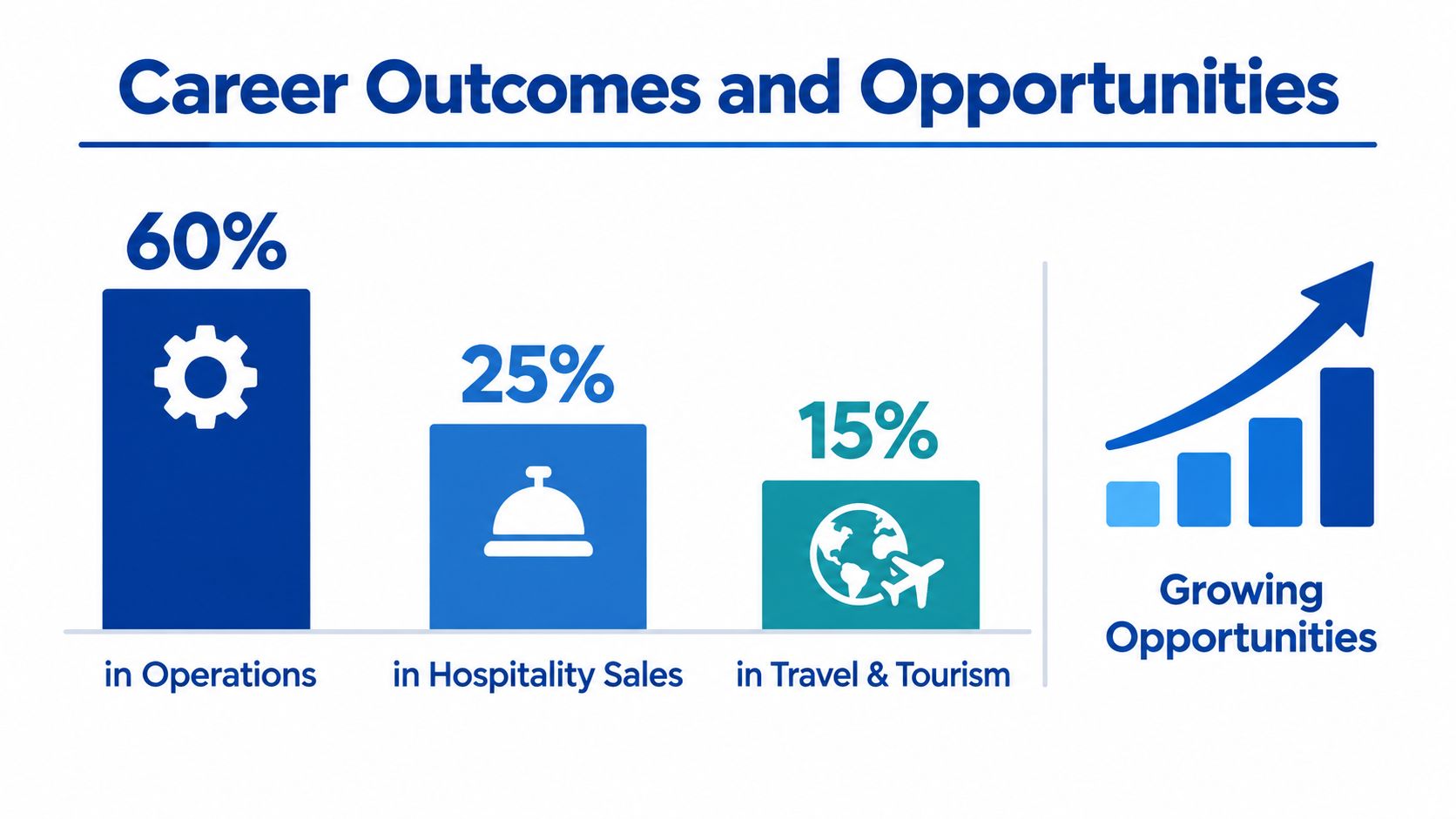
The diploma's value becomes clearer when each module is connected to a workplace. Food production can support entry-level kitchen roles. Food and beverage service can lead towards restaurant, café, banquet, or catering operations. Front-office training relates to reception, reservations, and guest support, while housekeeping prepares students for room operations, supplies, and cleanliness standards.
The wider economy provides context, but it shouldn't be confused with an individual job guarantee. Government estimates state that travel and tourism generated 84.63 million direct and indirect jobs in India during 2023–24, representing 13.34% of national employment. Tourism's contribution to GDP reached 5.22% in 2023–24, according to the Ministry of Tourism's official estimate.
Where skills can lead
The Ministry identifies hotel departments such as housekeeping, food and beverage, kitchen, front office, and support services as employment areas created by hotel-infrastructure expansion. Related work may exist in resorts, restaurants, catering businesses, event venues, travel services, and other visitor-facing organisations.
Students should also consider working conditions before enrolment. Hospitality can involve standing, shift schedules, weekends, busy periods, uniforms, strict hygiene procedures, and frequent teamwork. Some roles are highly customer-facing, while others focus more on preparation, maintenance, stock, or coordination.
A first role is usually a starting point, not a final destination. Progression depends on reliable performance, communication, technical improvement, workplace feedback, and further training. Students preparing applications can review hospitality resume formatting tips so that practical training, assessed skills, and relevant experience are presented clearly.
For a realistic view of career growth in hotel management, students should ask providers which roles graduates pursue and how the course supports development beyond the first placement.
Common Misconceptions About Hotel Management Diplomas

Misconception 1: Any diploma guarantees a hotel job.
A certificate alone doesn't demonstrate workplace readiness. Employers may look for communication, practical competence, problem-solving, teamwork, hygiene awareness, and the ability to follow procedures. A programme with limited supervised practice can leave a graduate less prepared, even if its title sounds impressive.
Misconception 2: Every hotel-management diploma accepts Class 10 students.
Entry rules vary by awarding body and programme. The NCHMCT eligibility document lists its Diploma in Food Production as a 1.5-year programme requiring 10+2 Senior Secondary completion with English as a subject. That route isn't generally direct-after-10th.
Institution-level diplomas may accept Class 10 graduates, but students must verify the exact eligibility instead of assuming that similar names indicate equivalent qualifications. The same check applies to duration, industrial training, assessment standards, and progression.
Misconception 3: Diploma holders can only remain in one entry-level role.
A diploma can provide an operational foundation, but progression isn't automatic. Students may build towards supervisory or specialised responsibilities through dependable work, additional learning, stronger communication, and qualifications that match their goals. Students who want a government Institute of Hotel Management degree should remember that the NCHMCT B.Sc. Hospitality and Hotel Administration route requires 10+2 with English, so completing Class 12 remains strategically important.
Misconception 4: The course is only for students who want to become chefs.
Food production is one pathway, not the entire field. Front office, housekeeping, food and beverage service, support operations, event services, and guest coordination involve different strengths. A student who prefers organisation and routine may be better suited to housekeeping or operations than to a kitchen role.
Next Steps and Making Your Decision
A sensible decision begins with self-assessment, not an application form. The student should identify preferred learning methods, comfort with teamwork, communication habits, stamina for practical work, and interest in particular departments.
The family can then follow a short decision process:
- Compare Class 12 with a vocational diploma in terms of long-term goals.
- Shortlist programmes that clearly accept Class 10 graduates.
- Verify the awarding body, syllabus, facilities, practical hours, industrial training, and progression route.
- Request the complete fee schedule and written admission conditions.
- Speak with current students or recent graduates where possible.
- Choose only after the student's interests and strengths match the daily reality of hospitality work.
No provider is automatically suitable for every student. The strongest option is the one that offers credible training and fits the learner's goals, budget, temperament, and preferred route after Class 12.
Edvdo helps students understand their strengths, motivations, and learning patterns through structured assessments, guided activities, personalised reports, and its AI mentor, Vedu. Students considering a hotel management diploma after 10th can use those insights to compare hospitality with other pathways and take the next step through Edvdo.