

Humanities increased from 30.9 lakh students in 2012 to 40 lakh in 2022, while Science rose from 30.7 lakh to 42 lakh and Commerce moved from 13.7 lakh to 14.4 lakh. Subject combination in 10th is therefore a strategic filter for Grade 11 stream eligibility and future career pathways, not merely a timetable decision for the current school year.
A student may be choosing between Mathematics, a language, Computer Applications, Information Technology, Artificial Intelligence, Commerce, Painting, Music, or Home Science without knowing which doors each choice keeps open. Parents may focus on marks, classmates may recommend Science, and relatives may describe one stream as more respectable than another. Yet the practical question is different: which combination supports the student's likely next step without creating an academic load that becomes difficult to sustain?
The right choice doesn't need to predict an entire career. It needs to connect present strengths with future eligibility, school rules, and a manageable workload. That means looking beyond subject names and asking what each combination makes easier in Grades 11 and 12, which entrance requirements it may support, and whether the student can study the subjects thoroughly enough to perform well.
Table of Contents
- Why Subject Selection in Grade Ten Matters More Than You Think
- How Curriculum Structure Shapes Your Options After Class 10
- Popular Subject Combinations and What They Unlock
- The Real Trade-Off Between Choice and Academic Load
- How CBSE Rules Influence Your Available Paths
- Matching Subject Choices to Personal Strengths and Interests
- Taking the Next Step with Confidence After Grade 10
Why Subject Selection in Grade Ten Matters More Than You Think
Riya sits with her parents after school and opens the subject-selection form. The list looks harmless. There are compulsory subjects, optional subjects, and several combinations that appear interchangeable. Her friend has chosen an additional computing subject, her cousin insists that Science is the safest route, and her parents are considering Commerce because they believe it will be less demanding.
Riya hasn't yet asked the most useful question: what does each option allow her to study next?
A subject combination in 10th works like a set of doors in a corridor. Some doors lead towards Physics, Chemistry, Biology, or Mathematics in senior secondary school. Others support business, economics, law, languages, social sciences, design, or creative study. A student can change interests later, but changing direction may require catching up on subjects that weren't studied earlier or finding a school that offers a different combination.
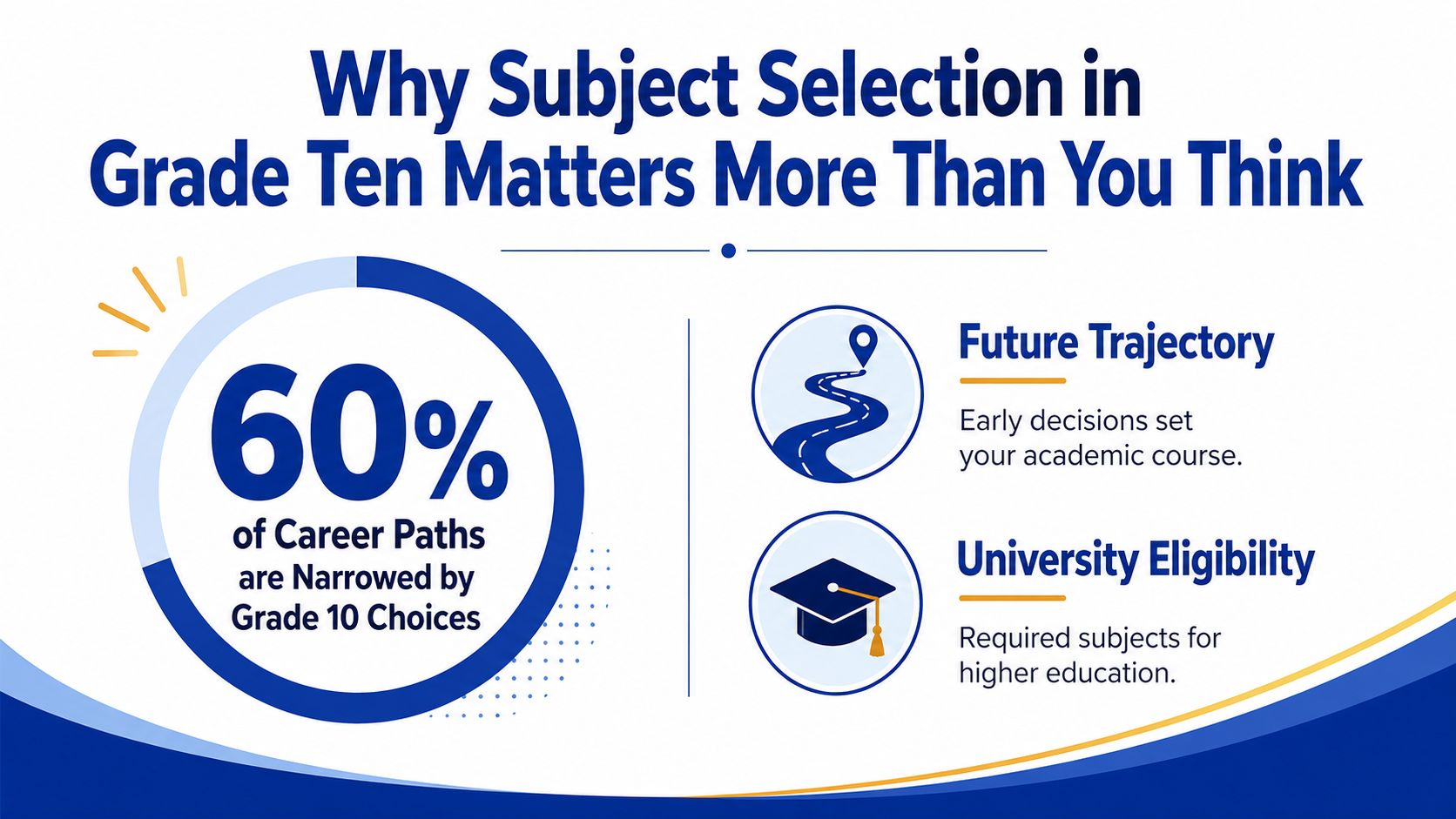
The choice is about access, not prestige
Science can be appropriate for a student who enjoys scientific reasoning and wants to explore medicine, engineering, computing, or related areas. Humanities can suit a student drawn to reading, writing, society, history, law, communication, or public policy. Commerce can provide a useful base for business, accounting, economics, and finance-related study.
None of these pathways is automatically superior. The strongest choice is the one that matches future requirements and present evidence. A student who selects a demanding combination for status but struggles to maintain depth may have fewer practical options than a student who chooses a better-fitting route and performs consistently.
A simple planning sheet can help. The family can record the student's strongest subjects, preferred activities, two possible career directions, required senior-secondary subjects, and the combinations available at the intended school. Students who need help organising these details can use a create your success plan template as a starting point, then adapt it to their school's rules.
Practical rule: A good Grade 10 choice should preserve the right doors while keeping the daily workload realistic.
How Curriculum Structure Shapes Your Options After Class 10
Subject selection becomes clearer once students understand that the Grade 10 curriculum isn't a completely free menu. The National Curriculum Framework for School Education 2023 recommends that learners in Grades 9 and 10 study 10 subjects across at least two domain groups, including languages and a mix of social science or humanities, science, mathematics, computational thinking, arts, physical education, and vocational areas. The framework is designed to provide breadth while helping students build relevant depth for later study. The National Curriculum Framework 2023 explains the structure behind this broader approach.
This creates a direct cause-and-effect relationship. Broader exposure helps a student compare different ways of learning, but the mathematics level and elective pairing can still influence alignment with Grade 11 streams. A student considering Physics-heavy study needs to examine mathematics preparation. A student interested in economics should consider whether the combination supports quantitative confidence. A student leaning towards law, media, or social sciences may need to protect language, reading, writing, and humanities strength.
National trends provide context, not a personal prescription
The Ministry of Education reporting covered by The New Indian Express shows how preferences changed across India between 2012 and 2022. Science and Humanities each moved from about 31% of students in 2012 to above 40% in 2022, while Commerce stayed near 14%. In absolute terms, Humanities rose from 30.9 lakh to 40 lakh students, Science from 30.7 lakh to 42 lakh, and Commerce from 13.7 lakh to 14.4 lakh over the same period.
Those figures show that Science and Humanities remain major post-Class 10 pathways, but they don't prove that either is right for every student. State-level patterns also differ. Science uptake was particularly high in Andhra Pradesh, Telangana, and Tamil Nadu, while Commerce had relatively stronger uptake in Karnataka. Local school provision and regional expectations can influence what students see as a normal choice.
Families should therefore use national patterns as background, then check the actual subjects, mathematics levels, and senior-secondary admissions rules at the student's school. Resources built around standards-aligned lesson subjects can also help educators map classroom learning to the broader domains that students may encounter later.
Popular Subject Combinations and What They Unlock
A useful way to compare combinations is to start with the next academic destination rather than the subject label. The question is not just whether a student likes Science or Commerce. It is whether the selected subjects provide enough preparation for the stream, course, or entrance route being considered.
The following table offers a practical starting point. It describes typical direction rather than a universal eligibility rule, because schools, boards, institutions, and later admissions requirements can differ.
| Subject Track | Typical Combination | Primary Stream Access | Key Consideration |
|---|---|---|---|
| Science and mathematics | Mathematics with science and a suitable computing or technical elective | Science-oriented Grade 11 routes, engineering, computing, and quantitative study | Strong mathematical reasoning and consistent practice matter |
| Biology-oriented science | Biology and science subjects with the required mathematics pathway where available | Medicine-related and other life-science directions | Biology interest must be genuine because content depth increases later |
| Commerce-aligned | Commerce or business-related study with Mathematics or another suitable elective | Commerce, accounting, business, economics, and finance-related routes | Mathematics can support later quantitative work, but the level must be manageable |
| Humanities and social science | Languages, social science, humanities, or related electives | Humanities, law, communication, social science, teaching, and public-policy directions | Reading, writing, interpretation, and argument become central |
| Creative and applied | Art, Music, Home Science, vocational, or skill-oriented subjects alongside the core | Creative, applied, design, performance, and vocational pathways | The school must offer meaningful teaching and assessment in the chosen area |
| Computing-oriented | One permitted computing subject paired with the core and suitable mathematics preparation | Computing, digital study, and technology-related exploration | Students should distinguish interest in using technology from interest in computational problem-solving |
Start with the doors that must stay open
A student interested in engineering should examine whether Mathematics and Physics preparation can continue after Class 10. A student considering medicine should check the later need for Biology and Chemistry. Someone exploring economics or business should decide whether keeping Mathematics is realistic and useful.
Computing also needs careful interpretation. A student may enjoy apps and online tools but dislike logic, problem-solving, or sustained technical practice. Another may enjoy building systems and analysing patterns without wanting a biology-heavy route. Students considering this direction can explore career options in AI and data science while comparing the mathematics and computing preparation expected by later courses.
The safest combination isn't always the one with the greatest number of subjects. It's the one that protects the student's most important future options without weakening performance in every subject.
The Real Trade-Off Between Choice and Academic Load
A family may reason that more subjects must mean more opportunity. Sometimes that is true. A wider combination can expose a student to different fields and preserve more possible directions. But every additional subject also takes time, attention, revision, and examination energy.
PCMB illustrates the tension clearly. By combining Physics, Chemistry, Mathematics, and Biology, a student may aim to keep both medicine-related and engineering-related routes available. That breadth can be useful for a genuinely undecided student with strong performance across the relevant subjects. It can also become an exhausting schedule when the student has limited time or finds one of the subjects difficult.
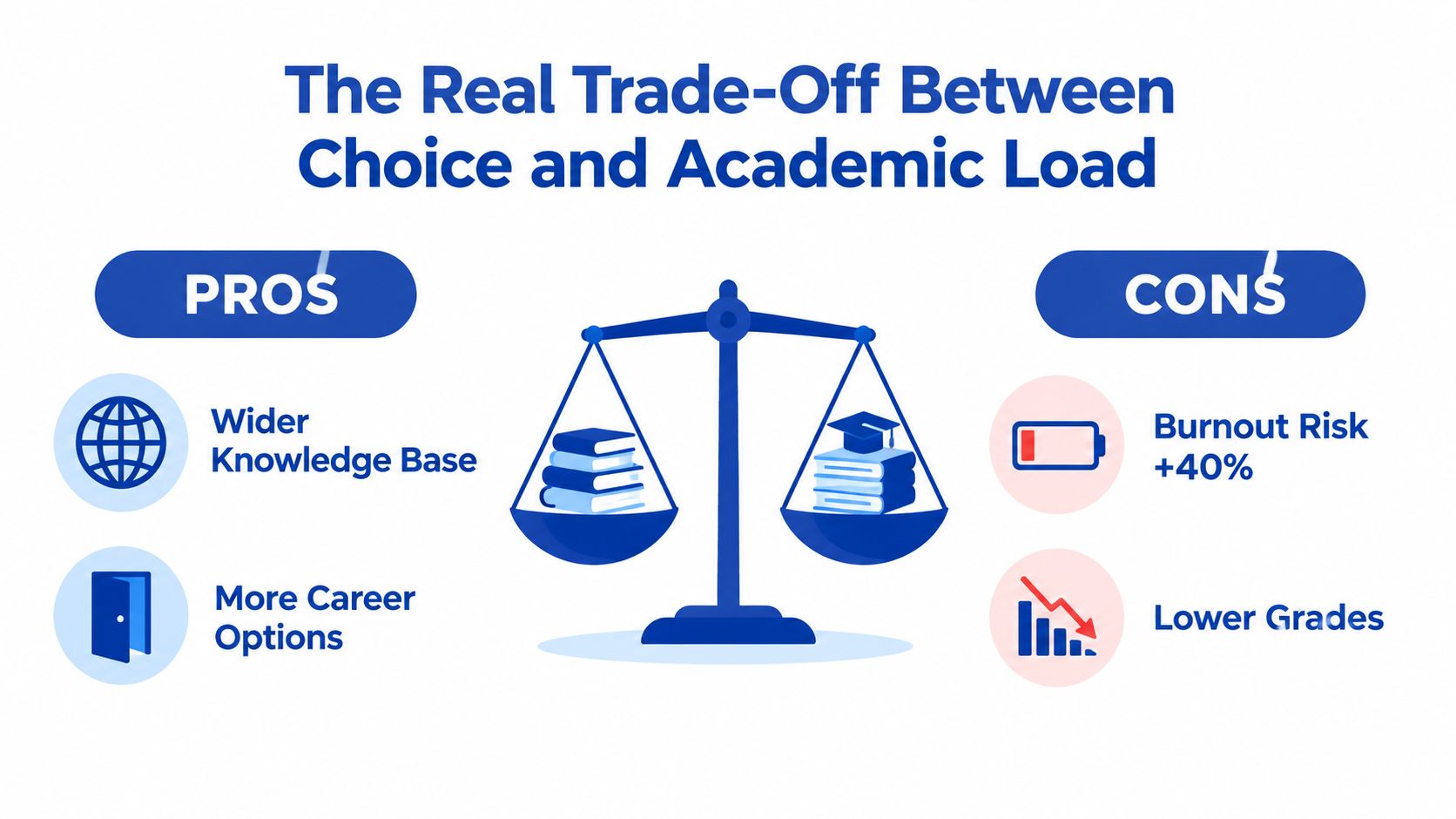
Optionality has a cost
Education guidance discussing PCMB often presents it as a way to retain both medicine and engineering possibilities, while also recognising its heavy workload. The same guidance notes that school-level admission rules and cut-offs vary, with some schools requiring 70% to 85% or more for Science admissions in particular cases. Families can review the discussion of CBSE compulsory subjects and stream decisions while treating each school's current policy as the final reference.
The decision should be based on sustainable performance rather than fear of closing a door.
| Priority | A broader combination may help when | A narrower combination may be wiser when |
|---|---|---|
| Future access | The student has several closely related interests and strong evidence in the required subjects | The student already has a clear direction and needs depth in specific subjects |
| Workload | The timetable, support, and study habits can accommodate the added content | Existing schoolwork already causes fatigue or inconsistent preparation |
| Performance | The student can practise each subject regularly without sacrificing core subjects | Extra subjects would reduce marks and understanding across the whole schedule |
| Decision confidence | The student is exploring responsibly rather than following pressure | The student is choosing additional subjects only because others call them safer |
A student who enjoys both Biology and Mathematics may still need to ask whether both can receive enough attention. A student who dislikes Biology but chooses PCMB because relatives consider medicine prestigious may be creating a problem rather than preserving a real option.
For learners and schools working on attention, planning, and study pressure, cognitive load management in schools offers a useful lens. The central question remains simple: does the extra option justify the extra academic demand?
More choice is valuable only when the student can use that choice without losing depth, health, or confidence.
How CBSE Rules Influence Your Available Paths
CBSE students can't construct any combination they want. The board requires compulsory core subjects and allows specified additional subjects, so the first step is checking what the school and curriculum permit. The CBSE curriculum guidance for secondary classes states that students may offer one additional subject, such as a language other than the two compulsory languages, Commerce, Painting, Music, or Home Science.
A subject that appears attractive on a general list may not fit a student's existing language choices or school timetable. Some language pairs can't be taken together. Similarly, students can't freely select all three of Computer Applications, Information Technology, and Artificial Intelligence. More recent CBSE guidance identifies these subjects as a related optional trio in which only one can be selected.
The menu has expanded, but it remains regulated
CBSE's 2025 Parents Handbook describes more than 9 broad options and more than 27 combination options after Class 10 under the implementation of NEP 2020. That expansion gives families more routes than older, more rigid patterns, but it doesn't remove the need to check eligibility and availability.
A student should ask the school four practical questions before submitting a preference:
- Which subjects are compulsory? The answer establishes the foundation before any elective is considered.
- Which optional subjects are available? A board-approved subject may not be available at every school.
- Which subjects can be paired? Language restrictions and related optional groups can rule out an otherwise attractive plan.
- What mathematics level is available? CBSE distinguishes Mathematics Standard and Mathematics Basic, and this distinction can affect preparation for later study.
The same rule applies to ambitious combinations such as PCMB. A student may want maximum flexibility, but the school may not timetable the required subjects together, or its admission policy may apply additional conditions. Families should obtain the school's current written subject list and speak with the academic coordinator before making a decision based on a general online guide.
Matching Subject Choices to Personal Strengths and Interests
A student's report cards often reveal more than a single high mark. They show whether performance is consistent, whether improvement follows practice, and whether the student can manage reading-heavy, numerical, practical, or project-based work. Those patterns are more useful than a choice based only on a friend's plan or a parent's preferred profession.

Evidence should lead the conversation
A counsellor can ask the student to compare three things:
- Demonstrated strengths: Which subjects have produced reliable results across more than one term?
- Sustained interest: Which topics does the student return to without repeated pressure?
- Learning behaviour: Does the student prefer calculations, experiments, discussion, writing, design, memorisation, or building things?
A student who earns good marks in Mathematics but dislikes every form of problem-solving may need further exploration before choosing a mathematics-intensive route. Another student with average current marks may have strong interest and improving study habits, making a support plan more appropriate than an immediate rejection. The decision should consider both current evidence and realistic capacity for growth.
A structured subject assessment guide for students choosing strengths can support this reflection, but no assessment should replace conversations with teachers, parents, and the student.
The family can then build a short comparison:
| Question | Science direction | Commerce direction | Humanities direction |
|---|---|---|---|
| What feels engaging? | Experiments, systems, numbers, natural phenomena | Business, money, organisation, markets | People, society, language, history, ideas |
| What needs checking? | Mathematics and science workload | Quantitative comfort and business interest | Reading, writing, analysis, and communication |
| What pressure should be avoided? | Choosing it only for status | Assuming it is automatically easy | Treating it as a fallback rather than a deliberate route |
A short video can help students begin a broader reflection before discussing the final choice with a teacher.
The best combination sits where ability, interest, eligibility, and workload overlap. If one factor is missing, the family should investigate rather than rush.
Taking the Next Step with Confidence After Grade 10
A sound decision can be made through a short, evidence-based process. The student doesn't need a perfectly fixed career plan, but the family should know which future doors matter most and what each door requires.
A practical selection check
- List the available combinations: Use the school's current subject list, not a generic online list.
- Mark the essential subjects: Identify the subjects needed for the student's likely Grade 11 stream or target course.
- Review academic evidence: Compare report-card performance, teacher feedback, study habits, and genuine interest.
- Test the workload: Ask whether the student can practise and revise every selected subject consistently.
- Keep a realistic alternative: Choose a second route that still fits the student's strengths if the preferred combination isn't offered.
- Confirm the mathematics level: Check whether Mathematics Standard or Mathematics Basic aligns with later ambitions.
- Ask about transition rules: Find out whether the school permits changes and what catch-up work would be required.
A student who is undecided can preserve useful breadth without selecting every available subject. For example, the student may retain a strong language, one quantitative or scientific subject, and one social science, business, creative, or vocational option where the school permits it. The precise combination should follow CBSE rules and the student's intended next step.
Parents can make the conversation calmer by replacing “Which stream is best?” with “Which subjects fit the student, which doors should remain open, and what workload can be sustained?” Teachers can add another important perspective by explaining classroom performance, not only examination marks.
The final decision doesn't need to be dramatic. It needs to be informed, permitted by the school, aligned with future requirements, and manageable enough for the student to learn thoroughly. A sustainable choice usually serves the student better than an impressive combination that creates constant overload.
Edvdo helps students explore strengths, motivations, learning patterns, subject choices, and career directions through assessments, guided activities, personalised reports, an AI mentor called Vedu, and a career database. Students and families can use Edvdo to turn subject-selection questions into a clearer plan for the next academic stage.
Built with Outrank