
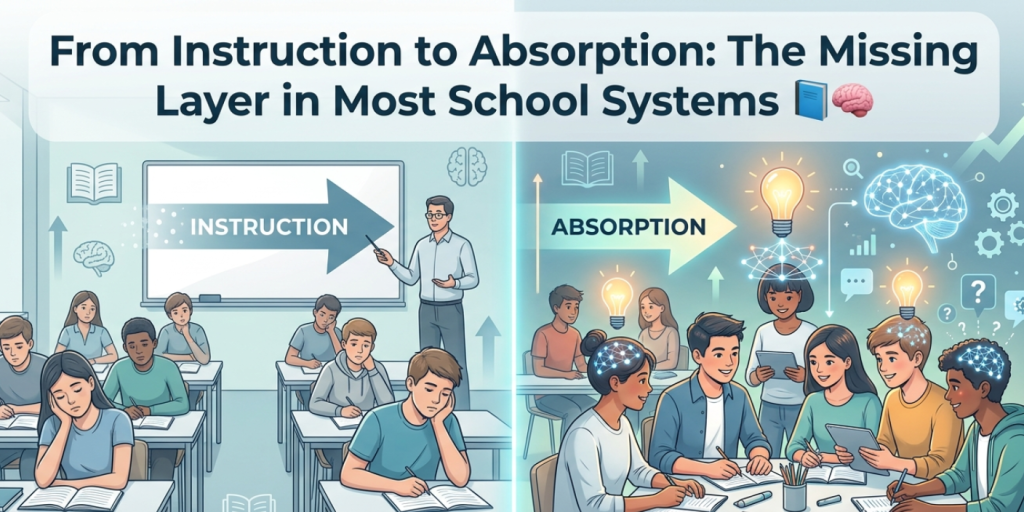
From Instruction to Absorption The Missing Layer in Most School Systems
In many Indian classrooms learning looks active on the surface. Teachers explain concepts students take notes and tests are conducted regularly. Yet a deeper question remains unanswered Are students truly understanding what they are learning or are they just memorizing information for exams
This gap between teaching and real understanding is where the idea of absorption in learning becomes important. While instruction focuses on delivering content absorption focuses on how deeply students process and retain that knowledge. This missing layer is one of the biggest reasons why many students in Classes Eight to Ten struggle with confidence clarity and long term academic growth.
What Is the Difference Between Instruction and Absorption
Instruction is what happens when a teacher explains a concept. Absorption is what happens when a student truly understands and connects that concept with real life.
For example a student may learn a science formula in class but absorption happens only when they can apply it in a real situation or explain it in their own words. Without absorption learning remains incomplete.
- Instruction is teacher focused
- Absorption is student focused
- Instruction is short term
- Absorption is long term
Most school systems focus heavily on instruction because it is easier to measure through tests. Absorption is harder to track but far more important.
Why Absorption Is Missing in Many Schools
The Indian education system is highly structured around syllabus completion and exam performance. Teachers often have limited time to slow down and ensure every student understands the concept deeply.
This creates a situation where students move from one topic to another without fully absorbing the previous one. Over time this leads to confusion and lack of confidence.
Another major reason is the pressure to perform. Parents and schools often focus on marks rather than understanding. This shifts student attention from learning to scoring.
According to research shared by OECD education insights students who focus on conceptual understanding perform better in the long run compared to those who rely on memorization. This shows why absorption must become a priority.
Signs That Students Are Not Absorbing Learning
Parents and teachers can identify the lack of absorption through simple observations. These signs are common among students in Classes Eight to Ten
- Forgetting concepts soon after exams
- Difficulty applying knowledge in new situations
- Dependence on rote learning
- Low confidence in answering questions
- Lack of curiosity or interest in subjects
These patterns are not due to lack of intelligence. They are a result of a system that prioritizes instruction over absorption.
Why Absorption Matters for Career Readiness
Students in Classes Eight to Ten are at a stage where they begin thinking about their future. Without proper absorption they struggle to understand their strengths and interests.
Career decisions require clarity not confusion. When students truly absorb learning they can connect subjects to real world careers.
For example a student who absorbs mathematics concepts may explore careers in data science engineering or finance. Without absorption the same subject may feel difficult and uninteresting.
Platforms like student assessment tools help identify strengths beyond marks and guide students towards suitable career paths.
The Emotional Impact of Lack of Absorption
When students do not understand what they are learning they often feel frustrated and anxious. This emotional stress affects their overall attitude towards education.
Parents may notice their child avoiding studies or losing interest. Teachers may see reduced participation in class. These are not signs of laziness but signals of deeper learning gaps.
Related insights can be explored in this detailed explanation on passive learning risks which highlights how surface level engagement hides deeper problems.

How Schools Can Build a Culture of Absorption
Improving absorption does not require major changes in infrastructure. It requires a shift in teaching approach and mindset.
Encourage Active Learning
- Ask students to explain concepts in their own words
- Use real life examples in teaching
- Promote group discussions and problem solving
Use Technology Smartly
Technology can support absorption by providing personalized learning experiences. Tools like AI driven insights help teachers understand where students are struggling and adjust teaching methods accordingly.
Interactive platforms such as learning chat support allow students to ask questions freely without fear of judgment.
Focus on Understanding Over Marks
Schools and parents need to shift their focus from marks to mastery. When students feel safe to make mistakes they learn better.
What Parents Can Do at Home
Parents play a crucial role in supporting absorption. Small changes at home can make a big difference.
- Ask your child to explain what they learned instead of asking for marks
- Encourage curiosity by connecting lessons to real life
- Avoid comparing with other students
- Support consistent learning habits instead of last minute studying
These steps build confidence and deeper understanding.
Role of Career Counsellors in Strengthening Absorption
Career counsellors can bridge the gap between subjects and future opportunities. When students see the purpose of learning they are more likely to absorb knowledge.
Access to career experts helps students connect their interests with real career paths. Exploring different options through career libraries also increases motivation to learn deeply.
From Passive Learning to Meaningful Growth
The shift from instruction to absorption is essential for building confident and capable students. It ensures that learning is not limited to exams but becomes a lifelong skill.
When schools parents and counsellors work together to prioritize understanding students feel more engaged and motivated. They begin to see education as a tool for growth rather than pressure.
Absorption transforms classrooms from information delivery spaces into environments of curiosity and discovery. This is the foundation of a strong education system.
What changes can you bring to help students move from instruction to true absorption Share this with your school community and explore more insights to create meaningful learning experiences.