
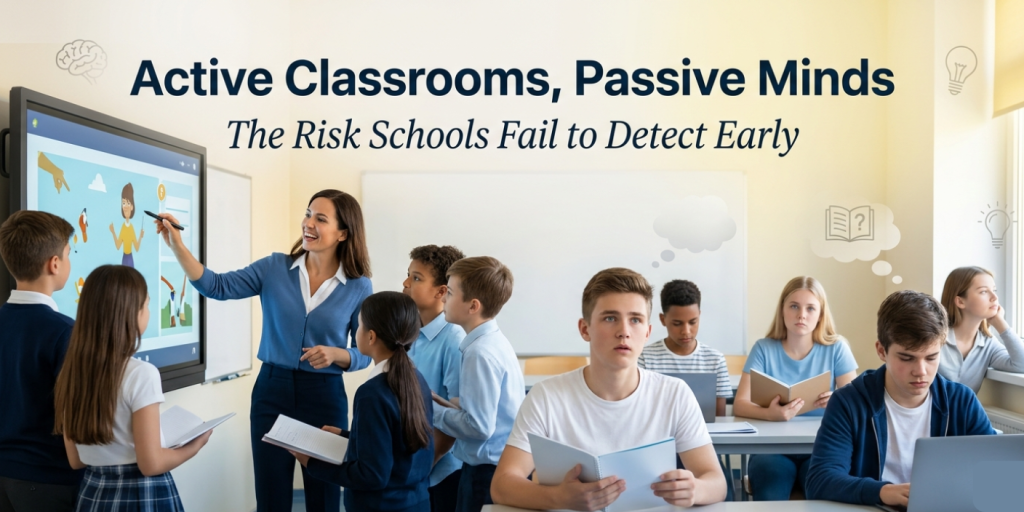
Active Classrooms Passive Minds The Risk Schools Fail to Detect Early
Walk into many classrooms today and you will see activity everywhere. Students are raising hands teachers are explaining concepts smart boards are running and discussions are happening. On the surface everything looks perfect. But beneath this visible activity there is a silent concern growing in schools across India. Many students are physically present and participating yet mentally disconnected. This is the hidden gap between active classrooms and passive minds.
For parents principals teachers and career counsellors this is not just a classroom issue. It directly affects how students in Classes Eight to Ten understand concepts build confidence and make future career choices. This article explores why this problem exists how to identify it early and what can be done to create truly engaged learning environments.
What Do We Mean by Active Classrooms and Passive Minds
An active classroom is one where students appear busy. They answer questions complete assignments and follow instructions. A passive mind however means the student is not deeply thinking questioning or connecting ideas.
This means a student can look engaged without actually learning in a meaningful way. They may memorize answers repeat what the teacher says and complete tasks without understanding the concept fully.
- Students answer quickly but struggle to explain why
- They follow steps but cannot apply knowledge in new situations
- They rely heavily on teacher guidance
- They feel confident until faced with unfamiliar problems
This gap is difficult to detect because activity creates an illusion of learning.
Why This Risk Often Goes Unnoticed
Schools often measure success through visible participation and exam scores. If students are quiet disciplined and scoring reasonably well it is assumed that learning is happening effectively. But this approach misses deeper understanding.
Parents also see homework completion and classroom activity as signs of progress. In reality these are only surface indicators. True learning involves curiosity critical thinking and the ability to connect ideas.
Research from global education platforms like OECD Education highlights that student engagement is not about activity but about cognitive involvement. Students must think reflect and question to truly learn.
Early Signs of Passive Learning in Active Classrooms
Detecting passive minds early can prevent long term academic struggles. Here are some signals that parents and teachers should watch for
- Students say they understand but cannot explain concepts clearly
- They hesitate when questions are slightly changed
- They depend on memorization instead of reasoning
- They lose interest when asked to think independently
You can explore a deeper understanding of this behaviour in this detailed explanation of false understanding.
Why Students Become Passive Thinkers
The issue is not about student capability. Most students are naturally curious. The problem lies in how learning experiences are designed.
Focus on Completing Syllabus
Teachers often face pressure to finish the syllabus quickly. This leaves little time for discussion exploration or reflection. Students learn to focus on completing tasks rather than understanding ideas.
Fear of Making Mistakes
In many classrooms mistakes are seen as failure. Students avoid asking questions or sharing thoughts because they fear being judged. This reduces active thinking.
One Way Teaching Methods
When teaching becomes one directional students become receivers instead of thinkers. They follow instructions but do not engage deeply.
Over Dependence on Exams
Exams often test memory more than understanding. Students adapt by memorizing answers instead of developing critical thinking skills.
The Impact on Students in Classes Eight to Ten
This stage is crucial because students begin to think about their future careers. If they develop passive learning habits they struggle to make informed decisions.
They may choose streams based on marks rather than interest or understanding. This leads to confusion stress and lack of direction later.
Parents often see their child scoring well but feeling unsure about future goals. This is a direct result of passive learning patterns.

Why Parents Should Look Beyond Marks
Marks provide only a partial picture. A student scoring high marks may still lack conceptual clarity. Parents should focus on how their child learns not just what they score.
- Ask children to explain concepts in their own words
- Encourage questions and discussions at home
- Focus on effort and thinking process
- Observe how they handle new problems
These small steps help identify whether the mind is active or passive.
How Schools Can Build Truly Engaged Classrooms
Creating active minds requires intentional changes in teaching approach. Schools do not need complex systems but thoughtful strategies.
Encourage Thinking Based Questions
Instead of asking what is the answer teachers can ask why and how questions. This encourages deeper thinking.
Create Safe Spaces for Mistakes
When students feel safe to make mistakes they participate more actively. This builds confidence and curiosity.
Use Real Life Examples
Connecting lessons to real life makes learning meaningful. Students understand concepts better when they see practical relevance.
Balance Teaching and Reflection
Giving students time to think reflect and discuss improves understanding.
Role of Technology in Activating Student Minds
Technology can play a powerful role when used correctly. Tools that provide insights into student thinking help teachers identify gaps early.
Platforms like student assessment tools and AI driven insights go beyond marks and highlight how students think and learn.
Interactive systems such as AI based learning support allow students to ask questions without fear which increases engagement.
Guidance from career experts helps students connect their learning with future goals making education more meaningful.
Connecting Learning with Career Awareness
When students understand how subjects relate to careers they become more interested. This shifts them from passive learners to active thinkers.
Access to structured career information such as career exploration platforms helps students see purpose in their studies.
For example a student learning mathematics becomes more engaged when they understand its role in engineering data science or finance.
What Principals and Educators Must Prioritize
School leadership plays a key role in shaping learning culture. When principals encourage thinking based learning teachers feel supported to move beyond traditional methods.
- Focus on understanding rather than only results
- Provide training for interactive teaching methods
- Encourage collaboration among teachers
- Use data to track student thinking patterns
These changes create classrooms where activity reflects true engagement.
The Long Term Risk of Ignoring Passive Minds
If this issue is ignored students may perform well in school but struggle in higher education and careers. They may lack problem solving skills confidence and independent thinking ability.
In a rapidly changing world these skills are essential. Passive learning creates short term success but long term challenges.
A Shift from Activity to Awareness
Active classrooms should not be the final goal. The real goal is active thinking. Schools parents and counsellors must work together to create environments where students question explore and understand.
When we shift focus from visible activity to real understanding we prepare students not just for exams but for life.
Have you noticed signs of passive learning in your child or classroom Share your thoughts and experiences with your school community and explore more insights to build truly engaged learning environments.