

A Class 9 student's marks have slipped. At the parent meeting, the conversation turns to effort, tuition and screen time. Yet the student may be struggling with a different question: whether the subjects being studied now will lead towards a future that feels right.
For a principal or parent, the first decision isn't always which career to recommend. It's what the student needs help with. Career counselling for students belongs within that wider conversation, alongside understanding motivation, engagement, wellbeing and the reasons behind everyday choices.
Table of Contents
- Why Career Counselling for Students Starts Earlier Than Expected
- When Career Counselling for Students Should Begin
- Assessment and Mentoring Methods That Support Decisions
- Counselling Versus Understanding Students Before Choosing Support
- Reading Marks, Attendance and Behaviour as Early Signals
- Designing a School Programme That Measures Impact
- Taking the Next Step with Edvdo and Student Understanding
Why Career Counselling for Students Starts Earlier Than Expected
Waiting until Class 11 to discuss careers assumes that students haven't already formed expectations about their future. A school should test that assumption rather than build its support programme around it.
Consider the student whose marks have dipped. Before recommending additional tuition, a teacher might ask whether the student understands the purpose of the subjects being studied. Perhaps the student wants a particular stream but believes it's out of reach. Perhaps a family preference has become an expectation the student doesn't know how to discuss. These are illustrative possibilities, not conclusions that marks alone can establish.
The gap between advice and structured guidance
The 2024 Bharat Career Aspiration Report, based on 4,968 students in Classes 9–12 across 25 Indian states, found that only 9.36% had previously received career guidance services and knew about them; families influenced 30% of students' career decisions, while teachers influenced 13% (Bharat Career Aspiration Report findings).
Family and teacher advice deserves a place in the conversation. However, familiarity with a student doesn't automatically provide a systematic understanding of interests, strengths, pathway requirements or personal concerns.
Career counselling is a structured process for exploring those connections. It helps students examine possible streams, courses and occupations, understand requirements, and decide what further information or experience they need. It doesn't promise a perfect career match or guarantee admission, employment or lifelong satisfaction.
Practical rule: A falling mark is a reason to ask a better question, not enough evidence to prescribe a career.
Where Edvdo's perspective begins
Edvdo was created to help students understand themselves earlier so they can make better decisions about their learning and career. Its perspective begins before a career recommendation: understanding the learner whose decision is being discussed.
For school leaders, that means separating several questions:
- Timing: What decision is approaching, and how much preparation is needed?
- Understanding: Is the difficulty about options, confidence, engagement or wellbeing?
- Response: Would assessment, mentoring, academic help or family involvement be appropriate?
- Evidence: What change would show that the support is useful?
The priority is not earlier commitment. It's earlier understanding.
When Career Counselling for Students Should Begin
The right starting point depends on the decision stage, not the student's age. A younger learner may need permission to explore. A student approaching stream selection needs to understand consequences and prerequisites. A school-leaver needs a workable plan.
In the 2021 IC3 Institute survey, conducted with Shiv Nadar University among more than 6,600 students in Grades 9–12 from approximately 2,000 schools across India and South Asia, 71% had begun thinking about future employment and 82% considered career counselling imperative (IC3 Institute survey findings). Those findings support making space for career conversations before college applications become urgent.
The timeline below distinguishes exploration from decisions requiring greater commitment.
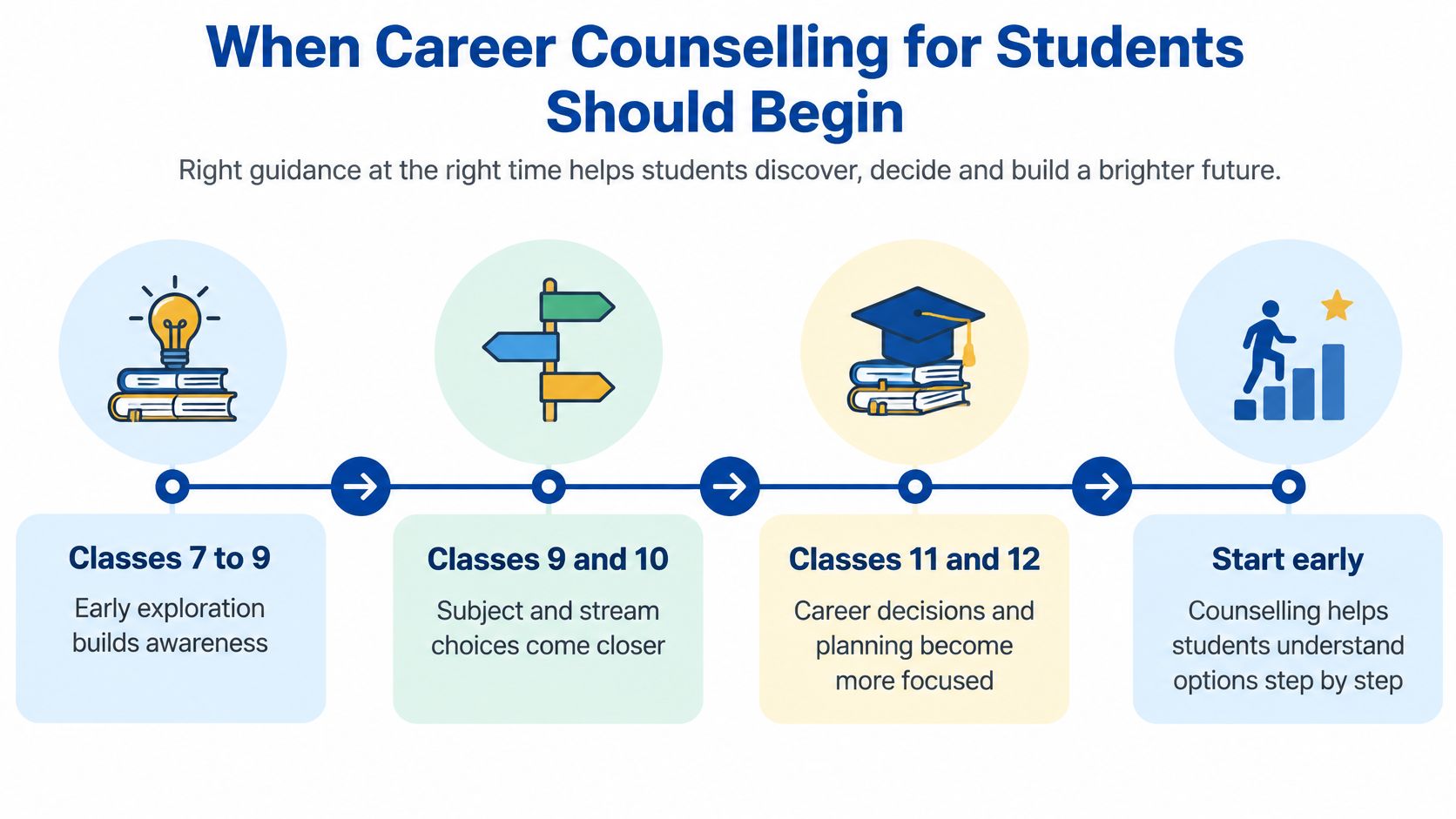
Classes 7 to 9 build awareness
At this stage, schools can invite students to notice what interests them and why. A learner who enjoys organising a school exhibition might explore planning, communication and design, without being assigned a future occupation.
An interest test can provide a starting point for that discussion. The useful follow-up is whether the result resembles the student's experience, what seems unfamiliar, and what activity could help clarify it.
Edvdo's focus across Classes 7–12 is on helping schools understand motivation, engagement, wellbeing and decision-making. Early support should leave room for preferences to change.
Classes 9 and 10 bring choices closer
Schools should connect subject preferences with actual requirements. A student may enjoy the idea of a profession while knowing little about its daily work or the study involved.
Useful conversations distinguish:
- Interest: Does the student enjoy the underlying activities?
- Readiness: Which subjects or skills need development?
- Feasibility: What do available subject combinations, costs and local opportunities allow?
Career counselling after 10th should build on this preparation rather than introduce the entire conversation at the admission deadline.
Classes 11 and 12 require focused planning
Older students need to compare courses, entrance requirements and alternative routes. A student reluctant to attend college deserves a conversation about the reason, rather than an immediate judgement about ambition.
For an aviation-curious teenager, CFII's resource on aviation careers for college reluctant teens offers a focused reading prompt. A counsellor should still help the student verify relevant training, eligibility and financial requirements.
The sequence should remain flexible: explore, investigate, test assumptions and then commit. A single annual session can't substitute for conversations matched to the decision at hand.
Assessment and Mentoring Methods That Support Decisions
Assessment provides material for a conversation; mentoring helps a student interpret and use it. Treating either as sufficient on its own can leave important questions unanswered.
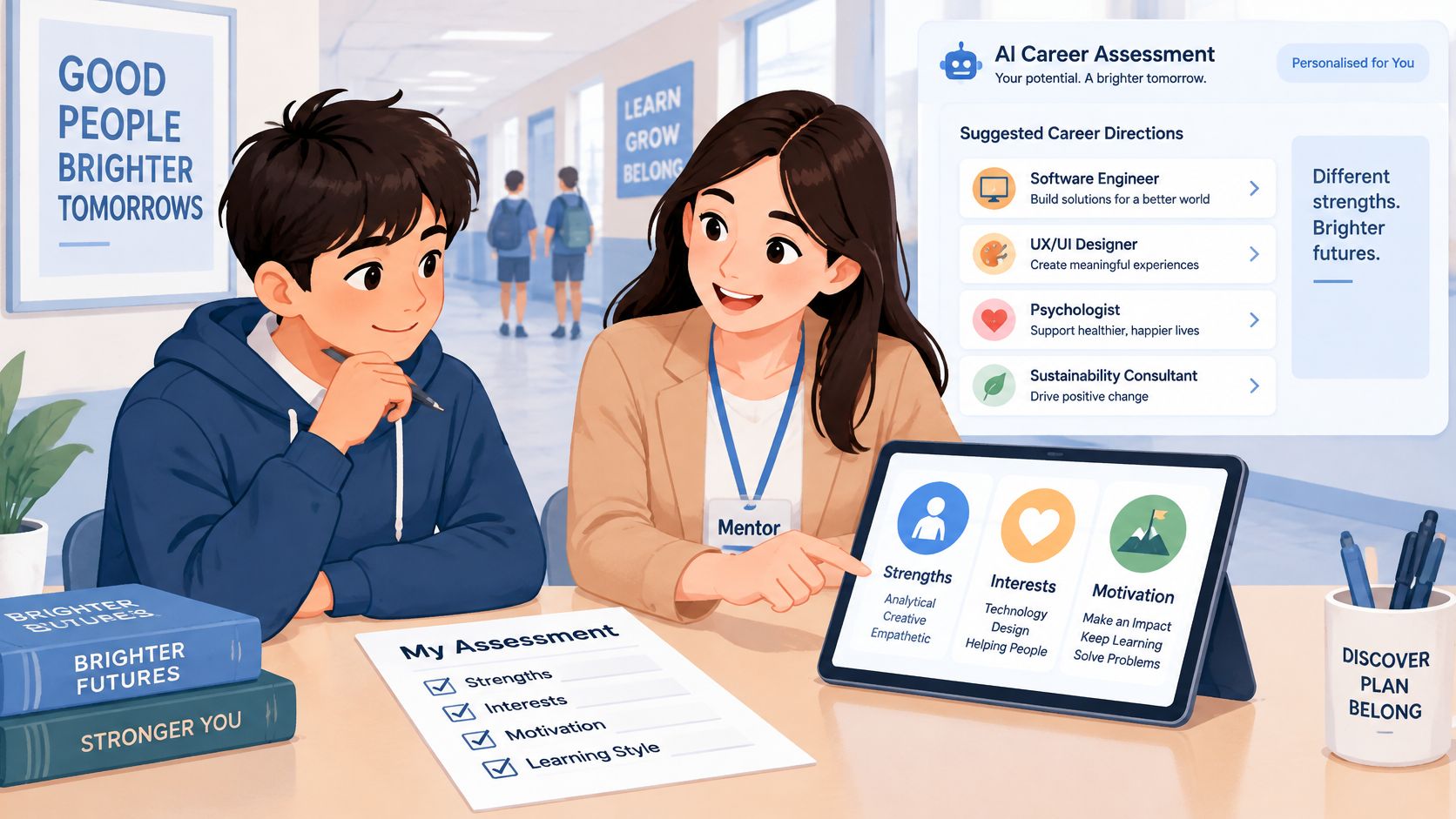
The illustration below represents an assessment discussion, where the student participates rather than passively receives a result.
Begin with patterns, not labels
Structured student assessment can examine strengths, interests, motivation and learning patterns. Edvdo's AI Career Assessment produces an individualised profile that can be reviewed alongside a school counsellor.
A profile should be treated as a starting map, not a verdict. It can suggest areas to investigate, but it can't establish that a student must enter a particular profession or cannot develop a new capability.
For example, a student may show interest in visual work but have little experience of design tasks. A mentor could suggest creating a poster, documenting the decisions involved and discussing which parts were satisfying or frustrating. That produces something more useful than agreement with a career label.
A skill test can also prompt discussion about present capability and development needs. Schools should distinguish what a student can demonstrate now from what the student may learn with suitable teaching and practice.
Use mentoring to examine real choices
Mentoring connects a profile with subject combinations, prerequisites and alternative routes. It also creates room for disagreement: a student should be able to say that a recommendation doesn't feel relevant and explain why.
Edvdo provides one-on-one guidance from dedicated career counsellors at every step. Human discussion remains important when results conflict with classroom evidence, family circumstances or the student's own account.
For supplementary reading between conversations, schools can use the 24hourEDU career planning articles as discussion prompts, rather than substitutes for individual guidance.
The accompanying video provides another resource for a guided conversation.
A practical selection checklist
Schools needn't choose assessment instead of mentoring. They should decide how the methods will work together.
- Explain the purpose: Students should understand what is being explored and what results cannot establish.
- Allow questions: A useful discussion makes space for uncertainty and disagreement.
- Check context: Recommendations should account for available subjects, resources and family circumstances.
- Agree on an action: A project, conversation or pathway comparison gives the student something concrete to investigate.
- Review the evidence: The next discussion should consider what the student learned, not merely repeat the original recommendation.
The method is useful when it improves the quality of the next decision, not when it produces the most confident-sounding label.
Counselling Versus Understanding Students Before Choosing Support
A student asking about engineering may need career information. Another student asking the same question may be seeking reassurance that declining science would not disappoint the family. The topic sounds identical; the support required may differ.
Career counselling explores career options. Student understanding helps establish what kind of support is needed before, or alongside, that exploration. Edvdo's wider perspective is Student Understanding & Decision Intelligence, not just matching a learner with an occupation.
Career Counselling and Student Understanding Compared
| Focus | Career counselling | Student understanding |
|---|---|---|
| Main question | Which streams, courses and careers merit exploration? | What is influencing the student's learning and decisions? |
| Main attention | Interests, abilities, requirements and pathways | Engagement, motivation, wellbeing and context |
| Typical output | Options to investigate and a pathway plan | A clearer support priority and questions to pursue |
| Action difficulty | What steps does the pathway require? | Why isn't the student taking an intended step? |
| What remains uncertain | Whether non-career concerns need separate support | Which career route is suitable without further exploration |
The distinction matters because student decision-making is not determined by aptitude alone. A mixed-methods study of 320 students in Koraput and Jeypore found that parenting style was the strongest predictor of career decision-making, while career counselling had a positive, emerging influence (study of parenting, counselling and career decision-making). That local finding shouldn't be treated as a universal explanation, but it gives schools a reason to examine context.
Clarify the difficulty before choosing an intervention
An intent-action gap occurs when a student expresses a goal but doesn't take the steps needed to pursue it. Decision drift describes movement away from a considered choice without deliberate review, perhaps through avoidance, pressure or repeated postponement.
Neither automatically means that the student lacks ambition. A learner may need a manageable plan, a conversation about family expectations or support for distress.
Two students with similar marks may need different support. Similar performance doesn't establish similar motivation, circumstances or concerns.
A personality test may contribute reflective material, but it shouldn't settle the explanation. Schools should consider the student's account alongside teacher observations and relevant family information.
Career exploration is appropriate when options are unclear. Academic help fits a demonstrated learning difficulty. Wellbeing concerns require suitable support, while conflicting expectations may call for a carefully facilitated family conversation.
Reading Marks, Attendance and Behaviour as Early Signals
Consider an illustrative Class 10 student who begins missing school and stops submitting homework. A teacher sees incomplete work; parents see avoidance. Neither observation explains why the change has occurred.
The student might be frightened of examinations, worried about being judged or unsure about the next admission. Another possibility is a practical barrier unrelated to career choice. The school's task is to investigate, not choose the most convenient explanation.
The image below illustrates reviewing school information, but the student's own account must remain part of that review.
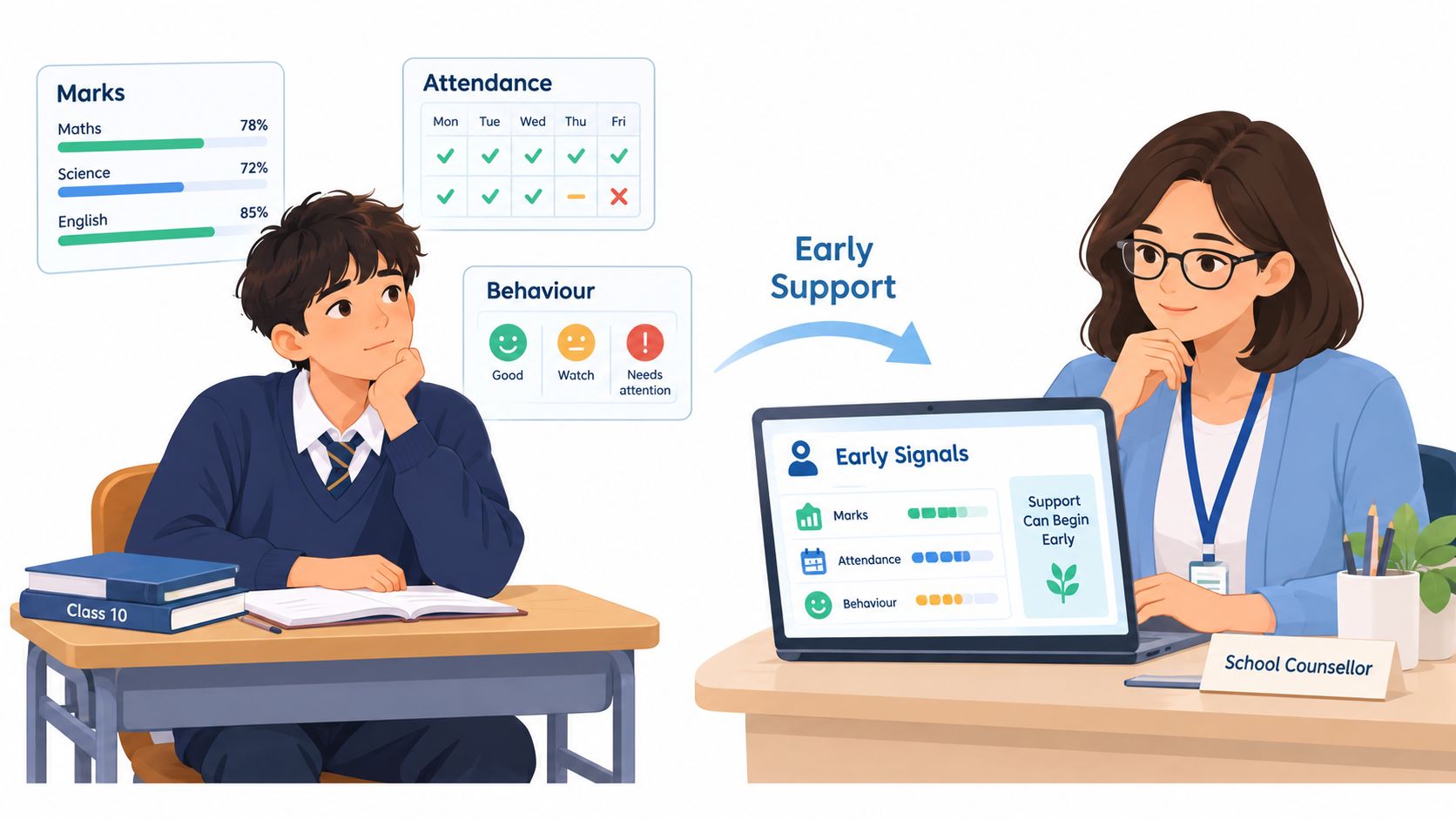
Ask what changed before asking for more effort
The NCERT Manodarpan survey, conducted from January to March 2022 among more than 3.79 lakh students across all 36 States and Union Territories, found that 81% identified studies, examinations and results as major sources of anxiety (NCERT survey findings on academic anxiety).
That finding doesn't diagnose the illustrative student. It shows why an academic explanation alone is insufficient.
Edvdo helps schools focus on early signs of disengagement, motivation loss, wellbeing concerns and decision drift. Its contribution is to student understanding, not an assumption that attendance or marks reveal a hidden cause automatically.
A private, non-judgemental conversation can begin with questions such as:
- Recent changes: What became harder around the time attendance changed?
- Experience of lessons: Which classes feel manageable, confusing or uncomfortable?
- Decision pressure: Is an upcoming subject, stream or admission choice causing concern?
- Practical barriers: Are health, travel or home responsibilities affecting participation?
- Available support: Which adult would the student feel comfortable approaching?
Match the response to the explanation
If the difficulty is an unclear topic, the school can arrange targeted teaching. If the student understands the work but fears humiliation, extra worksheets may miss the concern entirely.
Where a learner has a goal but cannot organise the next action, mentoring can break the task into manageable steps. Where distress is significant, an appropriate wellbeing referral should take priority over another career recommendation.
Before acting: Record the observation separately from the explanation. “Homework submissions have stopped” is observable; “the student doesn't care” is an interpretation.
This is the value of Student Understanding & Decision Intelligence: helping adults choose a proportionate response before a visible difficulty becomes a fixed judgement about the learner.
Designing a School Programme That Measures Impact
A school shouldn't judge a programme only by how many students attended a session. Attendance establishes exposure, not whether students understood their options or could act on the advice.
The Bharat Career Aspirations Report 2025 found that only 10.4% of students had received professional career guidance, including 9% in government schools and 12% in private schools (professional career guidance access findings). Access therefore belongs among programme measures, but it shouldn't be the only one.
Build a continuous workflow
A manageable school pilot can begin with an assessment of strengths, interests, motivation and learning patterns. Staff can then help students identify several plausible streams or career families rather than immediately recommending a single route.
Next, students need evidence-building activities. They might compare subject prerequisites, speak to a professional, complete a relevant project or examine alternative training routes. Each activity should answer a question the student has.
A motorsport enthusiast, for example, could use Trackside Careers motorsport jobs as a starting point for investigating roles. The school could ask the student to examine actual requirements and distinguish an interest in watching the sport from an interest in the work involved. Relevant Indian routes would still need separate verification.
Commitment should follow investigation, with a review point after the choice.
Collect evidence that changes the next conversation
| Programme measure | Evidence a school could collect |
|---|---|
| Guidance exposure | Whether the student accessed structured support |
| Completion | Whether agreed assessment and exploration activities were completed |
| Confidence change | Comparable reflections before and after support |
| Pathway knowledge | The student's explanation of requirements and alternatives |
| Post-choice persistence | Whether the student continues the pathway and why |
| Appropriate support | Whether identified concerns received a suitable response |
Confidence requires careful interpretation. A student who becomes less certain after discovering unfamiliar requirements may be thinking more realistically, not benefiting less.
Schools should establish their own baselines and agree what each measure means before starting. They should also record reasons for changed choices rather than treating every change as failure.
Specific six-month tracking methods depend on Edvdo's verified measurement process. No standardised impact method or outcome should be assumed without that confirmation.
A useful pilot leaves staff able to explain what was offered, what students learned, which concerns remained unresolved and what support should happen next.
Taking the Next Step with Edvdo and Student Understanding
For school leaders, the practical choice is not between career counselling and student understanding. It's how to connect them without asking either to do work it cannot do alone.
The guiding sequence is straightforward: understand the student, select appropriate support, and review what changes. Assessment and mentoring serve different purposes, while confidence and persistence need interpretation alongside the student's circumstances.
Follow a process without rushing the outcome
Edvdo's process has four steps:
- Assess: Take a detailed assessment to evaluate strengths, interests and goals.
- Explore: Discover personalised career options and academic pathways.
- Connect: Schedule a session with an expert career counsellor.
- Track: Set career goals and monitor progress with tools and resources.
A school can begin from the Student Assessment page and plan how results will enter a counsellor-led discussion. The career report resource can sit within that discussion, rather than become a final instruction handed to the student.
Edvdo offers a free first career counselling session, providing a low-commitment starting point. For a session, users only need to provide their academic background and career aspirations for personalized guidance.
Common questions from principals and parents
Is counselling only for Class 12? No. Exploration and student-understanding work can begin across Classes 7–12, with the depth of guidance matched to the decision involved.
Does Edvdo replace school counsellors? No. It is designed to support their work, with one-on-one guidance available rather than leaving students to interpret results alone.
For staff reviewing what their school currently notices, The Gap Between What Students Feel and What Schools Measure offers relevant reading. The Hidden Timeline of Student Failure Before Marks Drop complements conversations about earlier support, while How to Choose a Stream After 10th provides a focused resource for families approaching that decision.
A sensible starting point is a clearly defined student group, a named counsellor and an agreed review process. The aim is not to produce earlier certainty, but to make decisions more informed and support more appropriate.
Edvdo offers structured assessment, personalised insights and access to expert guidance to help schools understand students before deciding what support they need. School leaders and parents can visit Edvdo to explore the assessment platform or connect about a first counselling session.