
Career counselling is a structured, guided process that helps a student understand their interests, strengths and options so they can choose subjects, streams, courses and careers with confidence. For students in Classes 7–12, it means learning how to make an informed choice, rather than waiting for someone else to name the right career.
At a family discussion about stream selection, a student may hear that Science is the safest choice while wanting to explore design. A useful conversation makes room for both the student's curiosity and the parent's concerns about qualifications, costs and future opportunities.
Table of Contents
- Why Career Decisions Feel So Overwhelming
- What Career Counselling Actually Means
- How the Career Counselling Process Works
- Career Counselling vs Career Guidance and Where Edvdo Fits
- Making Subject and Course Choices After Class 10 and 12
- Knowing the Limits and Choosing Your Next Step
- Common Questions About Career Counselling
Why Career Decisions Feel So Overwhelming
A Class 10 student enjoys sketching everyday objects and finding ways to improve them. A relative recommends engineering, a friend has chosen Commerce, and a parent worries that design sounds uncertain. This is an illustrative situation, not a reported student case.
Nobody necessarily has bad intentions. The parent wants security; the relative knows a familiar route; the student wants permission to explore. Yet the conversation can become a contest between opinions before anyone checks what the student enjoys doing or what different courses require.
The immediate problem isn't always a lack of ambition. It may be a lack of a shared way to compare choices.
When a subject choice feels like a life sentence
Students may treat stream selection as a promise about their entire working life. Parents may see hesitation as carelessness, while teachers may focus on marks because those are the clearest evidence available.
A calmer discussion separates the questions:
- Interest: Which activities hold the student's attention beyond examination preparation?
- Readiness: Which subjects feel manageable, and where is support needed?
- Practicality: Which routes fit the family's budget, location and circumstances?
For families concerned about the emotional side of uncertainty, Uptown Psychology's resource on overcoming early-career uncertainty offers a related perspective. Its young-adult focus should be kept separate from Indian school eligibility and admissions advice.
Students don't need to settle their entire future at the dining table. They need a sound next decision, supported by evidence and room to reconsider. Indian examples involving streams, course requirements and family constraints make that task more manageable than abstract advice about following a passion.
What Career Counselling Actually Means
The answer to what is career counselling becomes clearer when the emphasis moves from naming a job to understanding a student. A counsellor explores what the student likes, what they can currently do, what matters to them and which possibilities deserve investigation.
These aren't interchangeable questions. Enjoying biology doesn't automatically settle whether a student would enjoy patient care, laboratory work, environmental study or teaching.
Connecting self-understanding with real options
Interests describe activities a student enjoys. Aptitude concerns abilities and readiness to learn particular kinds of tasks. Values concern what matters, such as creativity, stability, service or independence, while personality describes patterns in how someone approaches situations.
These components work together rather than producing a single answer.
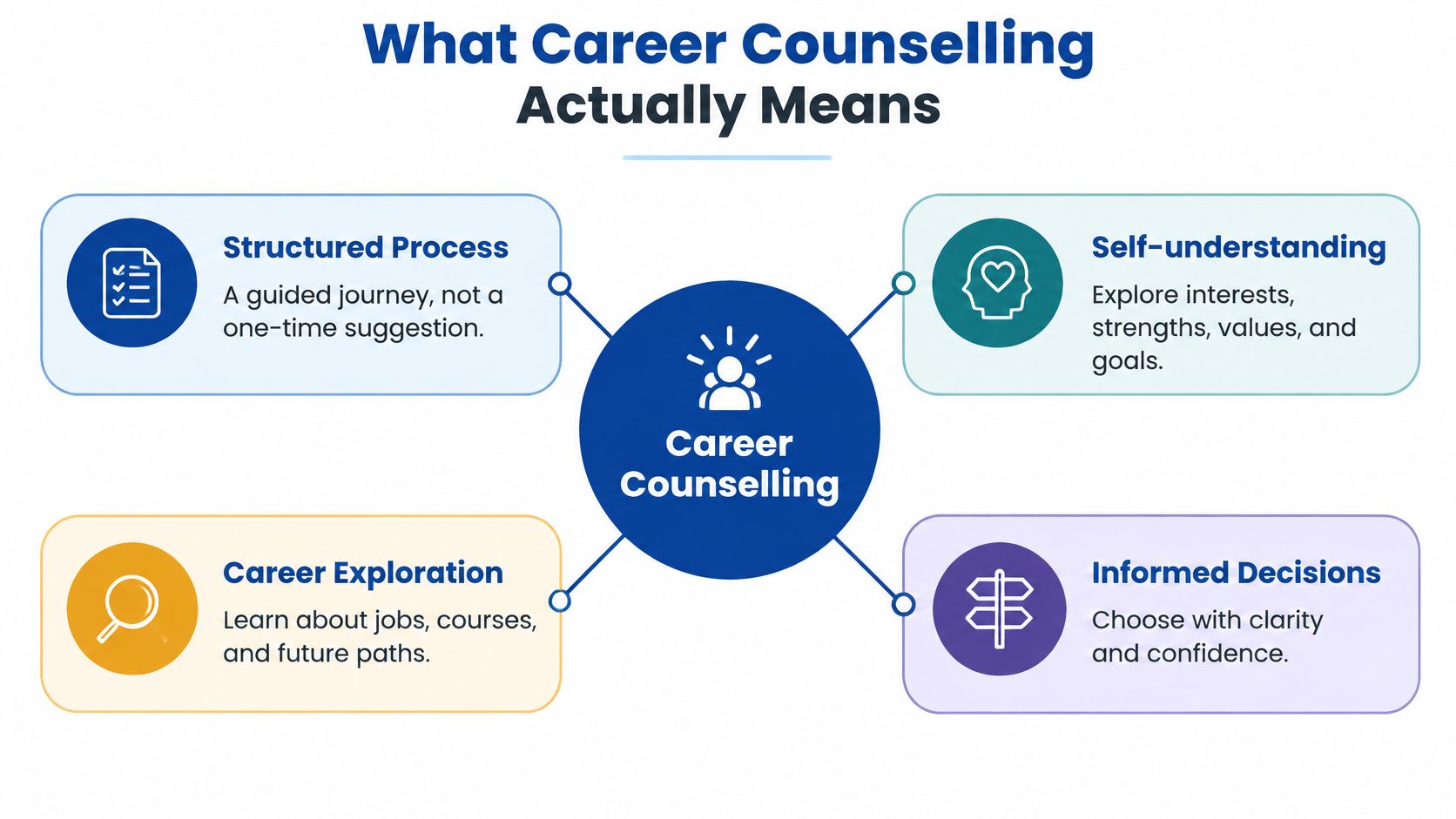
A counsellor works like a travel guide who helps a traveller read a map. The guide explains possible routes and obstacles, but doesn't choose the destination on the traveller's behalf.
A resource such as a personality assessment can provide prompts for reflection. Its results should start a conversation, not become a permanent label or a reason to exclude unfamiliar subjects.
Practical rule: An assessment result is a clue to investigate, not an instruction to obey.
Support for ordinary decisions, not just crises
India's National Education Policy 2020 places professional academic and career counselling within wider student support, alongside physical, psychological and emotional wellbeing. That framing matters: students shouldn't have to reach a crisis before seeking help with educational choices.
The intended gains are practical:
- Self-awareness: A clearer account of interests, abilities and priorities.
- Wider awareness: Knowledge of possibilities beyond familiar occupations.
- Decision skills: A way to compare evidence and trade-offs.
- A workable direction: A plan that respects the student's circumstances.
Admissions counselling is a related but narrower area. For a separate explanation of that role, Mrs. College Counselor explains admissions counseling; families should still verify Indian application requirements with the relevant institutions.
Casual advice from relatives or social media may introduce an option. Career counselling goes further by asking whether that option fits this student, why it might fit and what evidence still needs checking.
How the Career Counselling Process Works
A useful counselling process leaves something the student can act on. A conversation that ends only with a list of suitable jobs hasn't yet answered how the student can investigate or reach them.
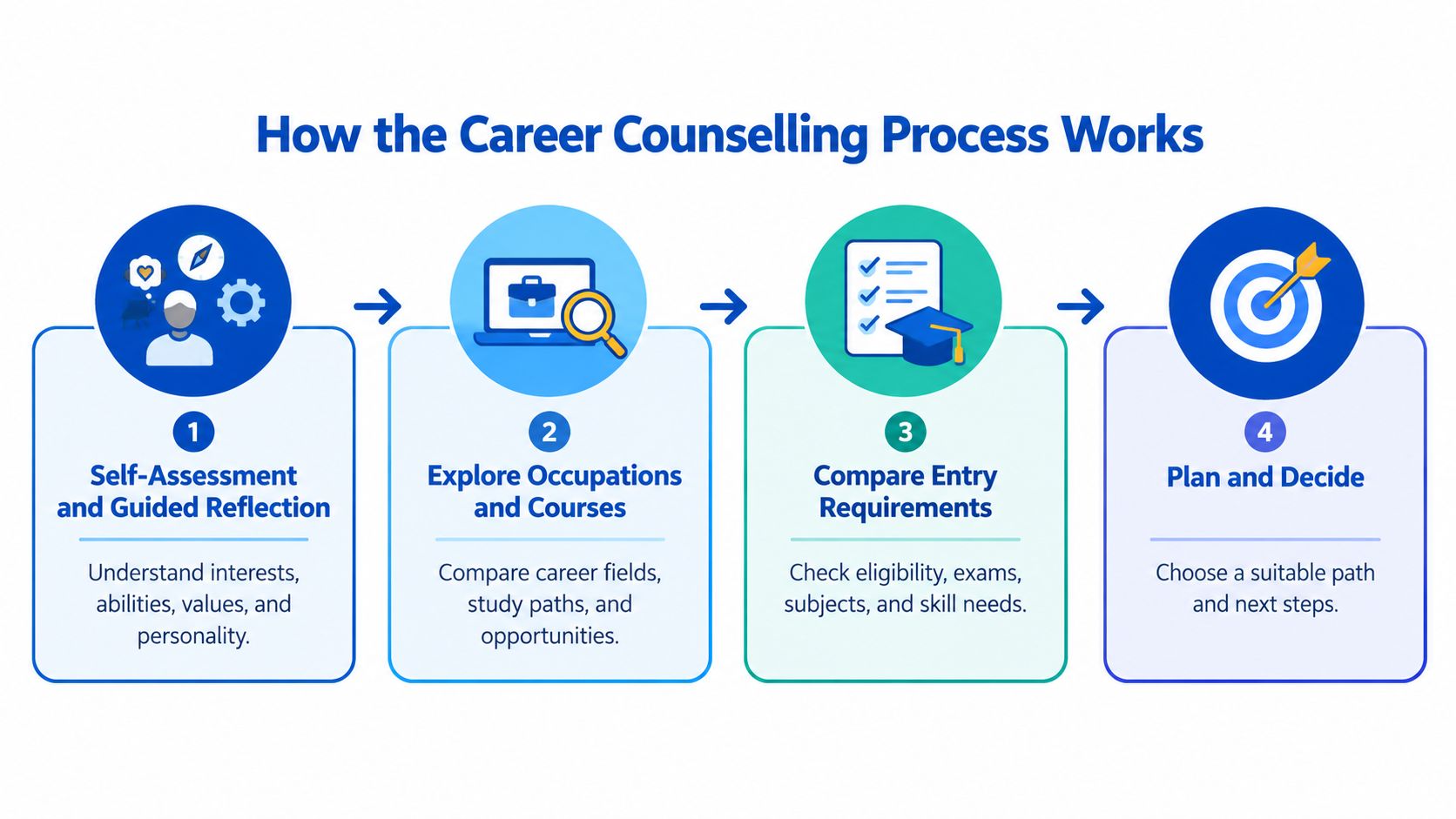
NCERT's school career-development guidance connects self-understanding, educational and career information, planning and decision-making. In practice, those activities should form a connected journey rather than isolated tests.
The process can be understood through these linked stages.
From reflection to investigation
The student begins by discussing schoolwork, activities, achievements, frustrations and responsibilities. A counsellor may use assessments, but should also ask for examples: enjoying a subject and consistently engaging with its actual tasks aren't always the same thing.
An interest exploration assessment can help organise those starting observations. The discussion should also leave space for uncertainty or disagreement with a result.
Consider a hypothetical student who enjoys making models and understanding machines. Mechanical engineering and industrial design could both become options to investigate, without assuming that either is already the right answer.
The next task is to compare the actual work and study routes. The family would need to check current subject requirements, admission processes, course content, fees, financial support and institution-specific conditions.
Turning discussion into a usable record
A practical counselling record should contain:
- A student profile: Interests, strengths, priorities and relevant constraints, with examples rather than labels alone.
- Several possible routes: Reasons each deserves attention, including questions that remain unanswered.
- Verified requirements: Eligibility, qualifications and costs checked against current official information.
- Next actions: A course comparison, a small project, a conversation with a professional or exploration of a prerequisite subject.
- A review point: An agreed opportunity to discuss what the student discovers.
The student should remain an active participant. Parents contribute knowledge of family circumstances; teachers contribute classroom observations; a trained counsellor helps interpret information and manage disagreement.
A useful outcome isn't merely a recommended occupation. It is a decision the student can explain and a next step the family can check.
A meaningful process may need follow-up because exploration happens between conversations. The number of appointments should depend on the student's needs, not on a promise that one meeting can settle every question.
Career Counselling vs Career Guidance and Where Edvdo Fits
A school talk about occupations, a personal counselling conversation and an AI-supported assessment aren't the same service. All can be useful, but families should know what each provides before relying on it.
Career guidance mainly helps students find and understand information. Career counselling uses a personalised, two-way conversation to examine how that information relates to the student's circumstances.
Career Guidance vs Career Counselling vs Edvdo's Approach
| Aspect | Career Guidance | Career Counselling | Edvdo's Decision Intelligence |
|---|---|---|---|
| Main purpose | Introduce courses, occupations and pathways | Support personal educational and career decisions | Build student understanding and decision clarity |
| Depth | Broad information and orientation | Detailed exploration of the student's situation | Assessment-led reflection and personalised insights |
| Who delivers it | Teachers, career cells and information resources | A trained counsellor | Structured digital tools with AI support |
| Typical output | Information and options to investigate | A discussed plan shaped by evidence and context | Reports, reflection prompts and exploration resources |
| When it helps | When a student needs to discover possibilities | When choices involve uncertainty or competing concerns | When a student needs structured self-discovery between conversations |
| Important boundary | Information alone doesn't resolve personal conflict | Counselling can't guarantee an outcome | AI insights don't replace human judgement or specialist care |
Edvdo's Student Understanding & Decision Intelligence approach focuses on helping students reflect on interests, strengths and decision-making patterns. It is a complement to counselling, not a career counselling platform or a replacement for a trained human counsellor.
What the tools contribute
The student assessment connects with resources including the Self Discovery Report, AI Career Report, Vedu AI mentor and a Career Hub covering 750+ career paths. The assessment and reports organise personal insights; the mentor supports questions and exploration; the Career Hub introduces possible directions.
These outputs should be treated as material for investigation. A student can bring an observation from a report to a teacher, ask a parent about a practical constraint or request a counsellor's help interpreting a recommendation.
- Before a conversation: Record questions and examples from school or activities.
- Between conversations: Explore unfamiliar routes and note what seems appealing or unsuitable.
- During a review: Compare earlier assumptions with new experiences.
CBSE's counselling and career-resource guidance supports the importance of counsellor capacity alongside structured pathway information. The sensible division of work is therefore clear: digital resources can help organise exploration, while people handle sensitive interpretation, family discussions and contextual judgement.
Making Subject and Course Choices After Class 10 and 12
After Class 10, the useful question isn't which stream sounds most prestigious. It is which available subject combination fits the student's present strengths, developing interests and possible next routes.
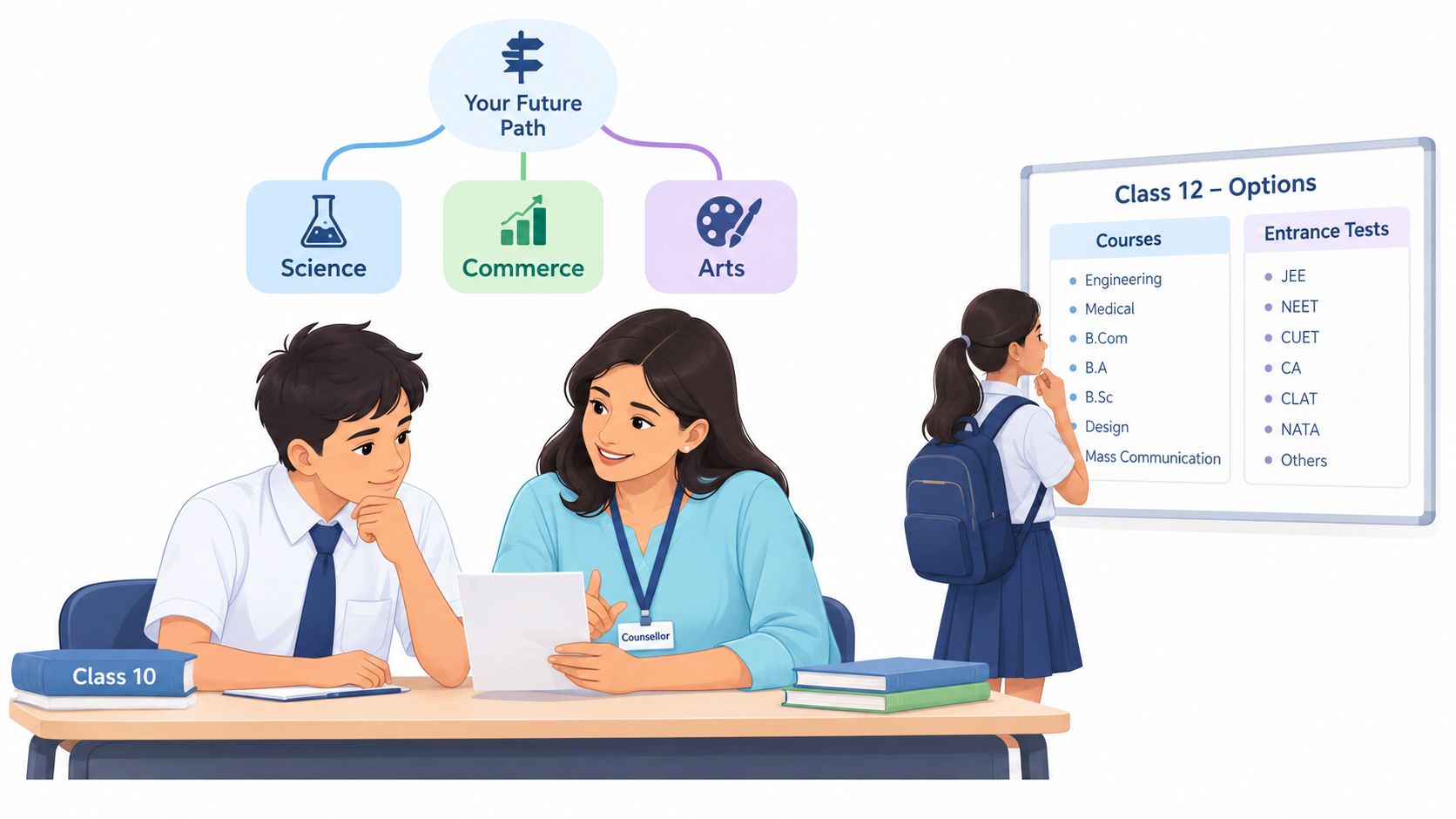
A counselling discussion should make the student's reasoning visible, as this school-guidance setting illustrates.
After Class 10, compare subjects rather than reputations
Science, Commerce and Humanities should be examined through their actual subjects and demands, not family rankings. A student who scores well in mathematics but consistently avoids mathematical work needs a different discussion from one who enjoys it but needs stronger study support.
A subject exploration assessment may help frame that discussion. School subject availability and current eligibility requirements still need direct verification.
Low motivation needs careful interpretation. A student may dislike a subject, feel exhausted, fear disappointing the family or struggle with a particular learning method. A career recommendation alone can't establish which explanation applies, and persistent distress deserves appropriate human support.
After Class 12, compare routes and daily realities
A hypothetical student choosing between a degree near home and an unfamiliar course elsewhere needs more than an appealing job title. Course content, total affordability, location, prerequisites and the work involved all deserve attention.
National guidance resources can widen the discussion beyond engineering and medicine. India's Career Guidance Book contains 500 career cards across 21 domains, with information including qualifications, entry routes, fees and financial support. Such resources make vocational, skill-based and less familiar routes easier to investigate.
The following video provides another starting point for a family discussion about academic and career choices.
Family expectations also deserve examination rather than dismissal. Reporting on ASER 2023 findings about rural young people notes that approximately one in five respondents aged 14–18 didn't know what they wanted to pursue, while leading aspirations varied by state and gender.
Those differences are a reason to ask what exposure and expectations have shaped a student's preferences, not to assume everyone starts with the same opportunities.
A useful family question: Which part of this choice reflects the student's experience, and which part rests on an untested assumption?
Reasonable outcomes are greater self-awareness, improved decision clarity and a better understanding of personal strengths and learning preferences. These are goals to work towards, not guaranteed changes after an assessment or session.
Knowing the Limits and Choosing Your Next Step
More information doesn't automatically produce a sound decision. A student can collect course lists and assessment reports while still lacking someone who can explain their relevance.
Reporting on the 2025 Bharat Career Aspirations survey found that only about 10% of students received professional guidance, roughly 9% in government schools versus 11% in private schools, while students were typically aware of only six or seven career options. Those findings describe the surveyed students, not every student in India.
A practical test for trustworthy advice
Access is only part of the problem. A hurried appointment, advice shaped by family bias or a recommendation copied from social media can leave important questions unresolved.
Reliable support should pass a basic check:
- Explain the evidence: Distinguish assessment observations from assumptions and verified course facts.
- Offer alternatives: Explain why several routes may deserve consideration.
- Respect circumstances: Include budget, language, location, accessibility and family responsibilities.
- Protect privacy: Explain what student information is collected, shared and retained.
- Allow human involvement: Make space for a trained person when disagreement, distress or sensitive circumstances arise.
An AI recommendation alone can't resolve every issue in that list. Nor can a counsellor guarantee admission, employment, future earnings or a permanent absence of doubt.
Prepare a better next conversation
A student can use a personalised career report to identify suggestions that need checking, rather than treating the report as a final verdict. Questions for Vedu can then be recorded alongside points that require confirmation from a school, institution or counsellor.
Edvdo's assessment and reports can support that preparation. The next useful action is to carry the observations into a conversation with a parent, teacher or trained counsellor, with a clear distinction between what is known and what remains uncertain.
Common Questions About Career Counselling
What should a student do if uncertainty remains after counselling?
Uncertainty can mean that the student needs more direct exposure, not another label. A useful next step is to select a manageable activity linked to each shortlisted option, such as completing a design task, observing a professional where appropriate or examining a course's actual assignments.
The student should record what felt engaging, difficult or unexpectedly unappealing. A follow-up discussion can then use those observations to narrow the decision instead of repeating the original assessment.
Can a career choice change later?
A career plan can be reconsidered, but changing direction isn't always effortless. Before leaving a course or ruling out a route, the student should check prerequisites, admission rules, available bridge options, time commitments and financial implications.
An alternative pathway shouldn't be described as automatically open merely because a similar course exists. The safest approach is to verify the route with the relevant institution and compare the cost of changing now with the cost of continuing without a clear reason.
Is career counselling only for toppers or struggling students?
Neither label determines whether counselling could be useful. A high-scoring student may struggle to choose among several attractive subjects, while a student with uneven marks may need help identifying strengths that examination results don't fully describe.
Seeking support also doesn't mean something is wrong with the student. For families hesitant about help more broadly, Katy Teen & Family Counseling's discussion of how counseling can change your life offers a related resource about counselling misconceptions, rather than Indian career-admissions advice.
How can a student discuss a different preference with parents?
A prepared comparison is more useful than a confrontation about freedom or tradition. The student can bring evidence of sustained interest, examples of completed work, verified course requirements and an honest account of costs and uncertainties.
Parents can explain the concern beneath their preferred option, such as financial security, distance from home or unfamiliarity with a profession. If the discussion becomes repetitive, a teacher or counsellor can help separate factual disagreements from emotional concerns and agree on what needs investigating before a decision.
Edvdo offers structured assessments, self-discovery and career reports, and the Vedu AI mentor to support student understanding and decision clarity. Families can visit Edvdo to begin that exploration, note questions about subjects or courses, and bring those insights into a discussion with a teacher or trained counsellor.