

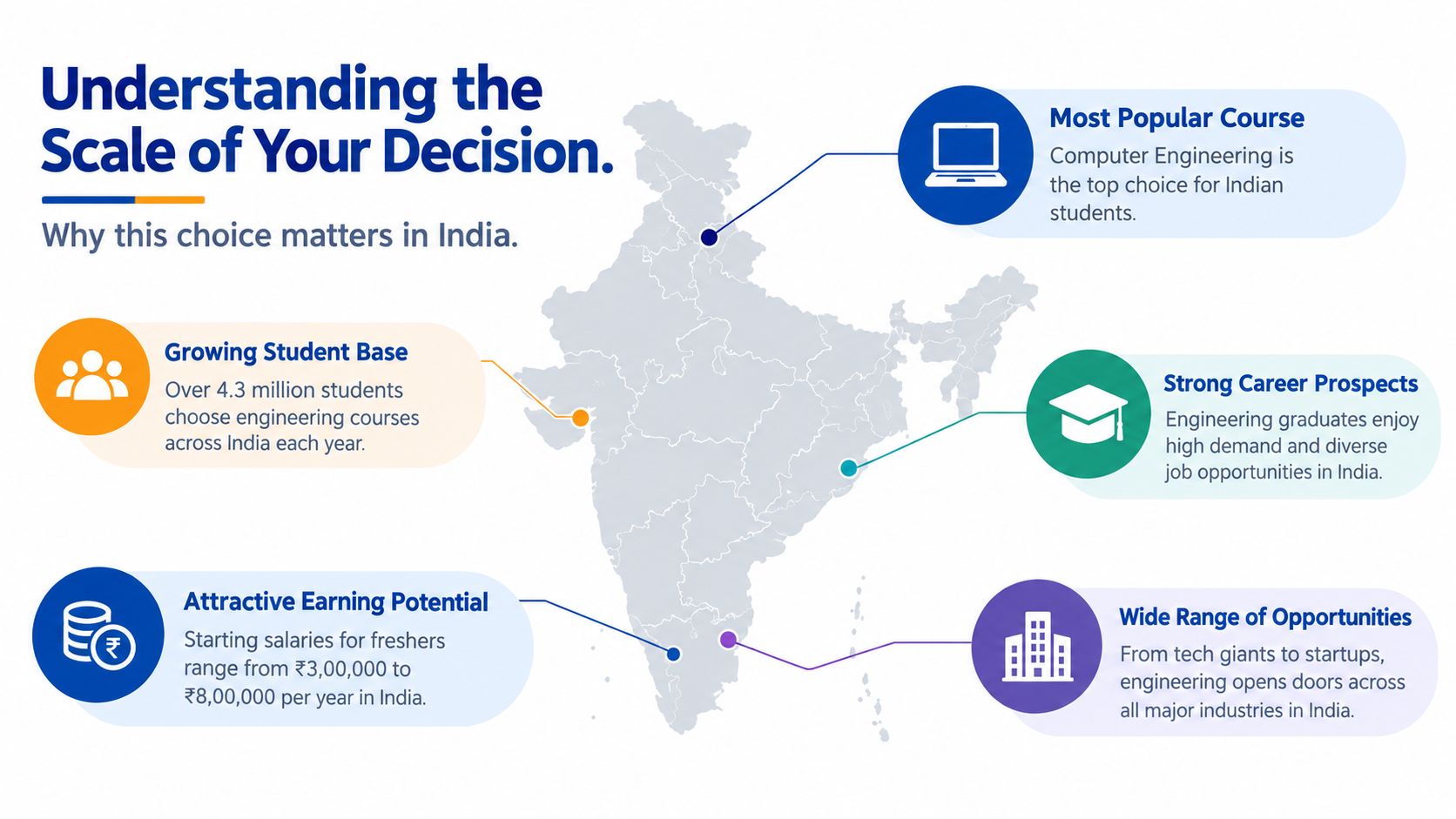
Computer Engineering accounts for approximately 39.7% of all engineering enrolment in India, with around 18,40,900 students. That scale makes bsc cs vs btech cs a serious decision, but the degree label alone does not decide employability, skills do.
| Factor | BSc CS | BTech CS |
|---|---|---|
| Duration | Usually 3 years | Usually 4 years |
| Structure | 6 semesters, 132 credits under UGC framework | 8 semesters, 160 credits under UGC framework |
| Learning style | Compact science-focused route | Broader engineering-oriented route |
| Best fit | Early specialisation, lower time commitment, later study options | Stronger campus recruitment pipeline, engineering-heavy roles |
| What matters most | Portfolio, internships, syllabus quality | Institution quality, projects, industry exposure |
The choice matters because it is not a cosmetic naming debate. In India, the UGC framework places standard B.Sc. Computer Science in a 3-year, 6-semester structure with 132 credits, while B.E./B.Tech. sits in the 4-year, 160-credit category UGC Computer Science framework. That extra year is real, and so is the different academic shape behind it.
For parents, the right question is not “Which degree sounds better?” It is “Which path gives this student the best chance to build usable skill, manage cost, and stay flexible?” For many families, that answer depends less on prestige and more on discipline, college quality, and the student's actual work habits.
If a student needs help mapping interests to streams and roles before locking in a degree, a tool for completing a dissertation can also sharpen research discipline and planning habits when used alongside college selection. For broader career context, see the career report overview.
Table of Contents
- Understanding the Scale of Your Decision
- Comparing the Academic Frameworks and Credit Structures
- Employability Realities and the Role of Individual Skill
- Evaluating Curriculum Depth and Practical Exposure
- Applying the Curriculum Resilience Test
- Planning for Higher Studies and Career Growth
- Making the Final Choice Based on Your Personal Goals
Understanding the Scale of Your Decision
The choice carries real weight. Computer Engineering is the largest engineering specialisation in the AISHE comparison, so the competition, hiring pipeline, and peer group are all sizeable AISHE 2023–24 coverage. A student comparing BSc CS and BTech CS is choosing between two different systems of preparation.
Big pipeline, different starting points
A B.Tech. CS student enters an engineering route with labs, internships, and campus hiring built around that structure. A B.Sc. CS student enters a shorter science route that can still lead to software, data, testing, IT support, or further study, but usually demands more self-building. The two routes differ by one extra academic year and a broader engineering credit structure on the B.Tech side, as set out in the UGC degree-nomenclature framework.
Practical rule: choose the path that matches your stamina, budget, and target roles, not the path that sounds better at family meetings.
For broader career context, the career decision guide works well as a checklist. Use it to test whether a degree fits the jobs you actually want, because the market rewards evidence, not labels.
What the scale means for families
Parents often focus on admission prestige, but fit matters more. A student who dislikes long engineering structures may burn out in a four-year path, while a student who wants structured campus recruitment may feel underprepared in a lighter programme. The better question is whether the student can keep building proof of skill throughout the degree.
A large pipeline can help, but it also means the market is crowded. That is where the curriculum-resilience test starts to matter. The student who stands out is usually the one who shows evidence of skill, not the one who memorised the degree title.
Comparing the Academic Frameworks and Credit Structures
The gap starts with structure, and parents should read it that way. The UGC's B.Sc. Computer Science framework uses 132 credits under the Choice Based Credit System, with theory and tutorial credits tied to one weekly contact hour and laboratory credits tied to two weekly contact hours UGC B.Sc. Computer Science framework. That makes the programme tighter, more focused, and easier to complete on a shorter timeline.
What the extra year really buys
A standard B.Tech. CS is normally a four-year, eight-semester programme with 160 credits under the UGC nomenclature framework. That extra year is not a badge of superiority. It gives more room for engineering foundations, professional electives, internship exposure, and a larger project load.
For a Class 12 student, the key question is bandwidth. BSc CS gets you to graduation faster and suits students who already want a science-led computing path. BTech CS gives a broader technical runway and more room for structured practical exposure, which suits students who want engineering-style training.
The day-to-day impact is real. A BSc student spends less time in the undergraduate phase, which helps if the plan is MCA, M.Sc., or earlier entry into work. A BTech student stays longer, but that extra time often leaves more space for internships, lab work, and academic breathing room.
Use the subject test to compare syllabi before you compare college names. Two institutions can offer the same title and still deliver very different training.
What parents should ask admissions teams
Ask for the semester-wise syllabus, not the brochure line. Ask how many credits go to programming, systems, mathematics, and project work. Ask whether the labs are real, scheduled, and assessed, or just listed on paper.
If the college cannot show the syllabus clearly, treat that as a warning sign.
That question matters because the degree title does not reveal the actual workload. The credit structure does.
Employability Realities and the Role of Individual Skill
The biggest mistake in this debate is treating the degree as a shortcut to a job. India Skills Report coverage shows broad employability differences between categories, but those numbers measure assessed readiness, not guaranteed hiring India Skills Report 2025 coverage. They also don't prove that every B.Tech student will beat every B.Sc. student.
The degree helps, the portfolio decides
A B.Tech. CS student usually gets smoother access to campus drives and engineering-linked hiring pipelines. That helps, especially for software engineering, infrastructure, cybersecurity, and technology services roles. But the student who gets shortlisted still needs coding skill, internships, and interview readiness.
A B.Sc. CS student can absolutely compete if the portfolio is strong. Employers care about GitHub work, internships, data structures and algorithms, problem-solving speed, and the ability to explain projects clearly. The gap is often not the degree, it's the proof of work.
For students exploring role-specific options, the backend roles for global candidates page is a useful way to see how technical responsibility is described in job markets outside the classroom. That kind of role clarity matters because many students confuse “computer science degree” with “automatic software job”.
What actually improves employability
Three things move the needle quickly:
- Projects with substance: not just college assignments, but deployable apps, tools, or data work.
- Internships with real output: even short stints beat empty resumes.
- Technical proof: competitive programming, open-source work, cloud certifications, or strong problem-solving samples.
The right conclusion is plain. B.Tech. gives a stronger default hiring environment. B.Sc. demands more self-driven proof. Neither path works without skill, and skill can narrow the gap faster than families expect.
Use the skill test if the goal is to judge readiness rather than emotionally. That mindset is more useful than arguing over labels.
Evaluating Curriculum Depth and Practical Exposure
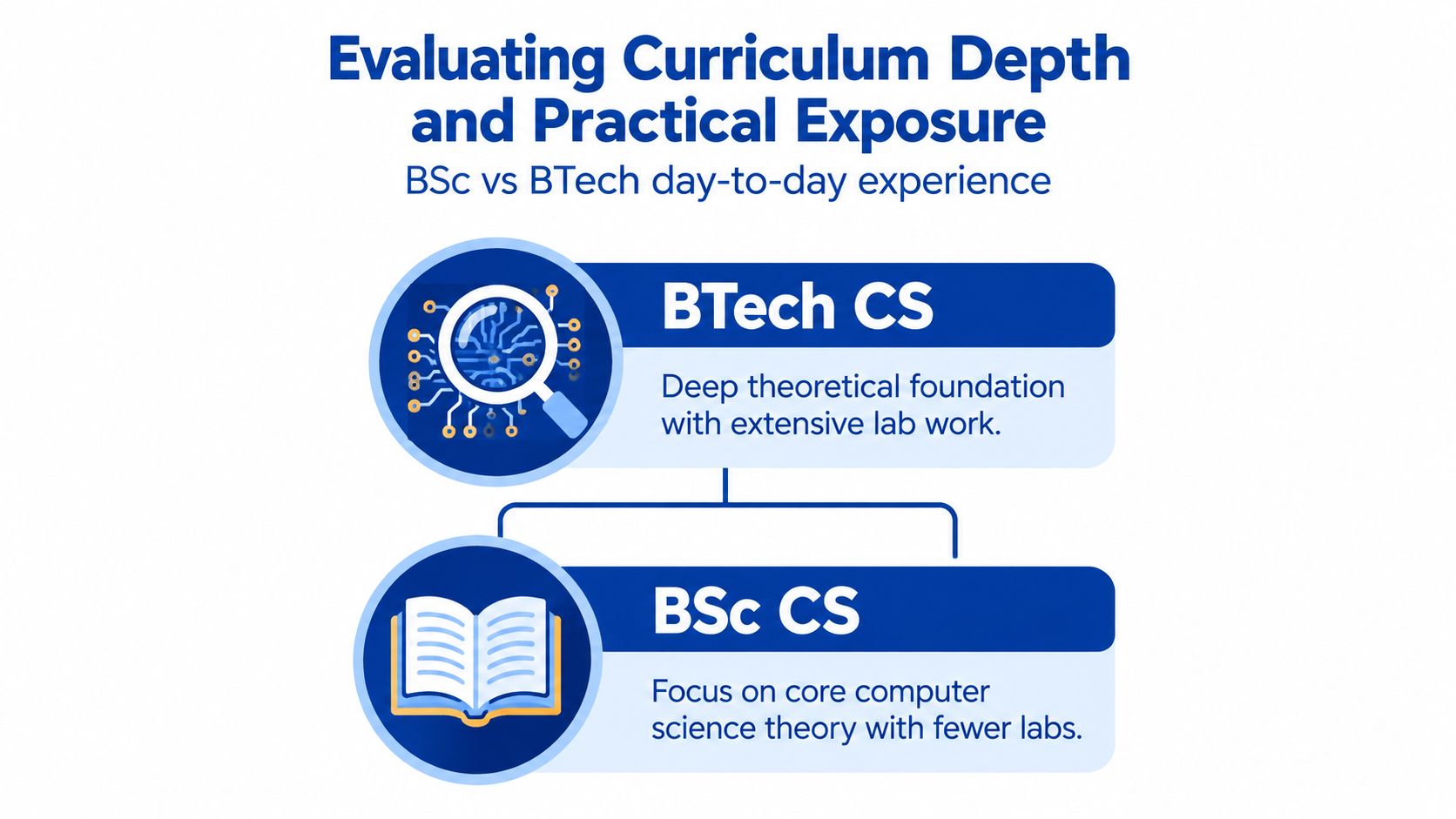
A B.Sc. CS programme is usually tighter and more focused. It gives students a shorter route through computing concepts, programming, mathematics, and lab work, which suits those who want speed and clarity. The catch is simple, its depth and practical exposure depend heavily on the university.
What to check inside the syllabus
Do not compare the degrees only by duration. Check whether the college teaches the subjects that matter for technical work:
- Algorithms and data structures
- Operating systems
- Databases
- Computer networks
- Software engineering
- Cloud computing
- Internships and capstone projects
If these pieces are present in a B.Sc. and are assessed seriously, the degree can hold up well. If they are missing, the student may finish with a degree title but weak job-ready proof. The UGC framework's explicit labour-hour split for theory and laboratory credits, covered earlier, makes lab intensity easier to judge.
Why BTech often feels broader
A B.Tech. CS usually leaves more room for engineering foundations and project work because it runs across eight semesters. That structure gives students more repetition, more lab exposure, and more time for industrial training. It is not automatically better, but it is often more forgiving for students who need time to build technical confidence.
Use this rule. If a B.Sc. curriculum looks thin, move on. If a B.Tech. curriculum looks theory-heavy but weak on internships and projects, be just as cautious. A programme should prepare the student for the market, not only for the exam sheet.
Applying the Curriculum Resilience Test
A student should judge the course the way a recruiter judges a candidate, by what still holds value when the market changes. That is the point of the curriculum-resilience test. It asks whether the degree keeps producing relevant skill when tools, frameworks, and hiring preferences shift.
The five questions that matter
Start with the syllabus and answer these questions openly:
- Does it teach fundamentals? Programming, algorithms, databases, operating systems, and mathematics should be visible.
- Does it force practical work? Version control, projects, labs, and assessment-based implementation matter.
- Does it include modern relevance? Cloud, software engineering, and responsible AI should appear somewhere in the structure.
- Does it create evidence? Capstone work, internships, or portfolio-building assignments should be built in.
- Does it fit the student's pace? Some learners need a more compact route, others need a longer engineering runway.
Best filter: if a college cannot explain how its students graduate with demonstrable technical output, the course is weak.
The test is useful because hiring is shifting fast. AI, automation, and cloud-heavy teams care less about decorative degree language and more about whether the graduate can learn, adapt, and ship useful work. That is why the title by itself should never be the main decision variable.
How BSc and BTech score differently
A B.Tech. often scores better on structure, institutional consistency, and recruiter familiarity. A B.Sc. can score well on efficiency and focus, especially for students who already know they want to specialise early or continue into postgraduate study. The better programme is the one that keeps producing value when the market changes.
Parents should treat this test as a buying checklist. Students should treat it as a reality check. If a programme fails the test, the name on the certificate won't rescue it later.
Planning for Higher Studies and Career Growth
The degree chosen after Class 12 shapes the next step, not just the first job. A B.Tech. CS usually sits more naturally on the engineering track, which is why it often feels like the smoother route for direct technical recruitment and future engineering-oriented study. A B.Sc. CS can still lead to strong outcomes, but students often need to plan their next layer more carefully.
Choose the route with the fewest hidden gaps
Students aiming at postgraduate engineering or direct technical roles should check whether the college and degree structure align with that goal. The B.Tech. path is usually cleaner for students who want engineering-style progression, while the B.Sc. path often makes more sense for those planning MCA, M.Sc., or a specialised skill route. That difference matters because hidden bridging costs can raise total time and expense later.

The right move is to compare three things before committing:
- Total tuition and living cost: the four-year path can carry a bigger opportunity cost.
- Syllabus depth: check whether the college covers the technical subjects needed later.
- Exit options: confirm how easy it is to move into MCA, M.Sc., or job applications after graduation.
For broader direction on future roles and skill alignment, the AI career report is a practical reference point. The value is in mapping the degree to the next five to ten years, not just the next admission season.
Parents should also ask a blunt question. If the student doesn't get the ideal first job, what is the fallback? A good degree answer should include that fallback clearly. A weak one leaves the student improvising under pressure.
Making the Final Choice Based on Your Personal Goals
The right choice depends on the student's working style, not on family status or social pressure. If the student wants a structured engineering environment, can commit four years, and is targeting campus recruitment, B.Tech. CS is the stronger default. If the student wants a shorter, science-led route and is willing to build a portfolio aggressively, B.Sc. CS is a smart and efficient choice.
The honest decision rule
Pick B.Tech. if the student:
- wants engineering-heavy roles,
- values campus placement systems,
- can handle a longer, broader programme,
- and wants more time for internships and projects.
Pick B.Sc. if the student:
- wants a shorter undergraduate route,
- plans to move into MCA or M.Sc.,
- prefers a tighter academic focus,
- and is ready to build skills outside class.
A student who thrives on discipline and external practice can do well in either route. A student who waits for the curriculum to do all the work will struggle in both. That is the uncomfortable truth parents should remember.
The AI era doesn't make the degree irrelevant, but it does punish passive learning. The future favours students who can show real output, adapt quickly, and keep learning after graduation. That is why the final choice should reward clarity, not prestige.
If the family wants a smarter way to judge streams, roles, and readiness, explore Edvdo for guided assessments, career reports, and practical next-step planning. It helps students compare their strengths with real academic and career paths, which is exactly what a bsc cs vs btech cs decision needs.