
Choose any stream, join a maritime course, and earn a high salary” is poor advice for a student considering the Merchant Navy after 12th. Different routes have different academic requirements, medical clearance isn't a formality, and admission doesn't guarantee a ship assignment. Before comparing colleges, students and parents need clear answers about subjects, medical fitness and access to onboard training.
Table of Contents
- Settle These Three Questions Before Choosing the Path
- Eligibility by Course After Class 12
- Medical and Eyesight Standards to Check First
- Fees and Hidden Costs to Budget For
- Career Roles and What Pay Actually Depends On
- Verify Before You Pay
- Frequently Asked Questions Before You Apply
Settle These Three Questions Before Choosing the Path
A Class 11 student chooses commerce or humanities, then hears that every Merchant Navy course accepts every stream. That misunderstanding can lead to unsuitable applications and wasted fees. The right starting point isn't an institute brochure, but an honest account of the student's interests and constraints.
Three answers worth writing down
Students should mark each question yes, no or unsure in a notebook. Parents should complete the same exercise separately before comparing answers.
Interest in science: Does the student enjoy Physics, Chemistry and Mathematics enough to keep studying them when the topics become harder? Enjoying travel isn't evidence of enjoying navigation calculations or machinery.
Medical readiness: Can an approved maritime doctor confirm that the student meets the relevant eyesight, colour-vision and wider fitness requirements? An ordinary spectacle prescription doesn't settle this question.
Financial readiness: Can the family fund training without depending on an immediate first sailing? Would a delay in sponsorship or an onboard berth make the financial plan unworkable?
A “no” doesn't close every maritime option. It changes which route deserves attention and which assumptions need to be dropped.
Separate ambition from expectation
Parents may favors the uniform, overseas exposure or perceived earnings. The student may prefer hands-on engineering, dislike prolonged separation from home, or have little interest in shipboard work. Neither side benefits from hiding that difference until after admission.
Reflective activities, such as an interest exploration exercise, can help students distinguish a lasting interest from an attractive career image. The purpose is self-understanding, not permission to ignore eligibility rules.
Decision rule: An honest “unsure” is more useful than a “yes” chosen to satisfy a parent or an admissions agent.
The student should finish this exercise with three written answers and a list of doubts requiring evidence.
Eligibility by Course After Class 12
Admission is the easy part to focus on. First check that you meet the course's published academic criteria and that the route leads to the qualification you want.
Eligibility by Merchant Navy route after Class 12
| Route | Class 12 subjects | Marks and English | Age limit | Entrance and medical |
|---|---|---|---|---|
| B.Sc. Nautical Science, deck-officer route | Physics, Chemistry and Mathematics | 60% aggregate in PCM; 50% in English, as stated on IMU's B.Sc. Nautical Science programmer page | Current admission-year age limits and unmarried-candidate condition apply | Prescribed IMU-CET admission route and maritime medical fitness |
| Diploma in Nautical Science, deck-officer route | PCM for the school-leaver officer pathway | Check the current DNS admission notice for the qualifying PCM and English thresholds | Check the current DNS admission notice for the age cut-off; unmarried-candidate condition applies | Prescribed admission route, applicable sponsorship conditions and medical fitness |
| B.Tech. Marine Engineering, engine-officer route | Physics, Chemistry and Mathematics | 60% PCM average; 50% English in Class 10 or 12, under IMU's B.Tech. Marine Engineering eligibility rules | Male General/OBC-NCL/SC-ST: 25/28/30 years; female: 27/30/32 years, under the same IMU rules | Applicable IMU-CET admission route and maritime medical fitness |
| GP Rating, ratings track | Entry can follow Class 10 or Class 12; check the approved route's subject requirements | Check the current approved course notice for academic and English criteria | Check the current approved course notice for the age limit | Approved training and maritime medical fitness; verify the applicable selection process |
The 60% PCM average, engineering age limits and category provisions apply to IMU's published B.Tech. Marine Engineering framework. It also provides a 5% relaxation in PCM eligibility marks for SC/ST candidates, but not in English. Check the applicable admission-year age date before applying.
Read the table as separate routes
PCM means Physics, Chemistry and Mathematics, not the overall board-examination percentage. Strong marks in other subjects do not make up for a shortfall in the required PCM average.
B.Sc. Nautical Science and DNS lead towards deck-officer certification. B.Tech. Marine Engineering leads towards engine-room officer work. Choose based on the qualification and type of shipboard work you are pursuing.
For DNS and GP Rating, use the current approved course or admission notice to confirm the exact academic thresholds, age limit and selection conditions. Don't rely on a verbal assurance from an institute.
GP Rating follows a different progression from an officer-degree route. The DGMA's maritime career guidance describes entry after Class 10 or Class 12 and progression through sea service and additional certification towards near-coastal officer qualifications. Check what training and sea-time steps the specific course supports before enrolling.
Make the eligibility check concrete
Use a skills reflection exercise to consider whether your interests fit the work, then check your marks against the course's published criteria. An interest in engines or navigation cannot replace required subjects or qualifying marks.
Before paying an application fee, write down the course's thresholds, age calculation, category concessions and any marital-status conditions from its current notice. Then ask the institute to explain how the training connects to the required sea service and qualification. A course offer alone does not confirm a future sea berth.
Medical and Eyesight Standards to Check First
Medical standards by department
| Requirement | Deck department | Engine department |
|---|---|---|
| Unaided distance vision | Stricter standard; confirm the current deck limit before applying | More permissive than deck for some candidates; confirm the current engine limit |
| Colour vision | Normal colour vision, assessed with Ishihara testing | Normal colour vision, assessed with Ishihara testing |
| Binocular vision and field | Good binocular vision, full field and no disqualifying eye or eyelid condition | Good binocular vision, full field and no disqualifying eye or eyelid condition |
| Who certifies | DG Shipping-approved medical practitioner | DG Shipping-approved medical practitioner |
Treat the table as the checklist, not the verdict. The applicable standard and the fitness decision have to come from a DG Shipping-approved medical practitioner using the current rules, and an optician's prescription alone cannot settle eligibility.
Colour vision is the trap. A candidate who misses the deck distance-vision standard may still have an engine option, but a colour-vision problem is not solved by changing departments.
A practical pre-screen routine
Record the existing prescription. Note whether the student wears glasses, the current power and any previous eye treatment.
Establish unaided vision. Ask an eye-care practitioner to record uncorrected distance vision rather than only corrected vision.
Discuss relevant history. Flag squint, suspected colour blindness and previous eye or eyelid conditions.
Arrange the approved examination. Book a DG Shipping-approved doctor for the maritime fitness assessment.
Resolve uncertainty before payment. Obtain a clear explanation of any restriction and its effect on the intended department.
Glasses do not establish eligibility because the assessment turns on unaided distance vision. Do not rely on assurances that a stronger prescription, treatment or a different institute will automatically make a candidate eligible.
When the result is borderline
A student whose unaided vision misses the deck requirement but meets the engine requirement may still have a marine engineering path, provided the academic, colour-vision and other medical conditions are also met.
That is a fork in the route, not an instruction to switch. A student who dislikes machinery should not choose engineering only because its eyesight threshold is different.
A medical certificate is a gate to the chosen route; treat it as an upfront clearance, before savings are committed.
Book the approved pre-screen early in the exploration period, before substantial training fees are paid.
Fees and Hidden Costs to Budget For
The seat is the cheap decision. The bill that hurts is the one your family did not itemise before paying.
| Cost item | What to request | What to confirm |
|---|---|---|
| Tuition and academic charges for the chosen programmer | The programmer-wise figure in the institute's current fee circular | Whether it is per semester, annual or one-time, and what it excludes |
| Programmer-specific or category-specific charges | A written list of extra charges and the categories they apply to | Whether they repeat, change or apply only to certain routes |
| B.Tech. Marine Engineering vs B.Sc. Nautical Science | Separate totals for each route under consideration | Whether a quoted comparison mixes different course lengths or inclusions |
| Hostel and mess | An itemized accommodation quotation | Whether residential stay is compulsory and meals are included |
| Uniforms, books and equipment | The compulsory kit list and prices | Whether purchases must be made through the institute |
| Medical examination, passport and travel | Current appointment, application and travel costs | Which expenses are payable before joining |
| Waiting period before first sailing | A household reserve estimate | How long loan repayments and expenses remain manageable without shipboard income |
A meaningful comparison of Merchant Navy fees in India needs more than the amount payable to reserve a seat. Ask for a written, itemized schedule covering academic charges, accommodation, food, equipment and every other compulsory institutional payment.
Ask three things every time: the payment period, the full-course liability and the withdrawal terms. A receipt labelled “registration” or “seat booking” does not explain the remaining liability, and refund terms belong in writing before money moves.
Build the budget around delay, not the best-case joining date. Combine the official course total, separately estimated personal and compulsory expenses, and a reserve for waiting before the first sailing. Keep loan repayments and household commitments manageable without assuming immediate shipboard earnings.
A common failure looks ordinary: a family accepts an admission offer after reading only the tuition amount, then the joining instructions show hostel and mess as separate compulsory charges and borrowing has to be reopened late.
Put every quoted charge in a spreadsheet, record its payment date and mark whether it is refundable after medical rejection, before joining and after training begins. If an institute will not give exclusions in writing, treat its “all-inclusive” assurance as sales talk, not a budget.
Career Roles and What Pay Actually Depends On
A merchant ship pays for certificates and sea time, not for the degree printed on an admission letter. The Merchant Navy is commercial shipping rather than the Indian Navy, and its shipboard roles carry different qualifications, different watches and very different pay slips.

Match the route to the work
Deck officers handle navigation, watchkeeping and related ship operations. Their progression depends on the required sea service, examinations and competency certification, not graduation alone.
Engine officers work with propulsion, machinery and maintenance. The marine-engineering route suits students drawn to mechanical systems, fault-finding and disciplined technical work.
Ratings perform operational and support duties across shipboard departments. Their progression must be checked against the relevant qualification and certification rules rather than assumed from a course advertisement.
Two official counts give a sense of scale. The Press Information Bureau reported 307,901 active Indian seafarers in 2024. The Directorate General of Shipping recorded 3,597 Certificates of Competency for foreign-going vessels in 2024, a 1.07% increase from 2023. Read those figures as context, not as a placement promise: the certified officer pool is the narrow gate, and reaching it takes years of documented sea service.
Students can compare role descriptions through a jobs and role exploration resource while checking the actual qualification each position demands. Port operations, logistics, marine services and maritime catering also deserve a look, although their entry requirements aren't interchangeable with shipboard ones.
The following video offers another format for exploring the topic.
Evaluate an offer rather than a salary headline
A reliable national average Merchant Navy salary in India isn't published, so quoting one would be misleading. Pay depends on rank, certificate held, vessel type and size, employer, contract terms and time at sea.
A family reviewing an offer should establish:
Role and certification: the appointed rank and certificate required.
Contract and leave: the sailing period, leave pattern and payment arrangements ashore.
Pay structure: basic pay, allowances, deductions and payment currency.
Additional work: whether overtime is paid and how it is calculated.
An advertised senior officer's earnings reflect accumulated sea time and higher certificates. A new entrant's first contract is the figure that matters, and it is usually the smallest number on the page.
Verify Before You Pay
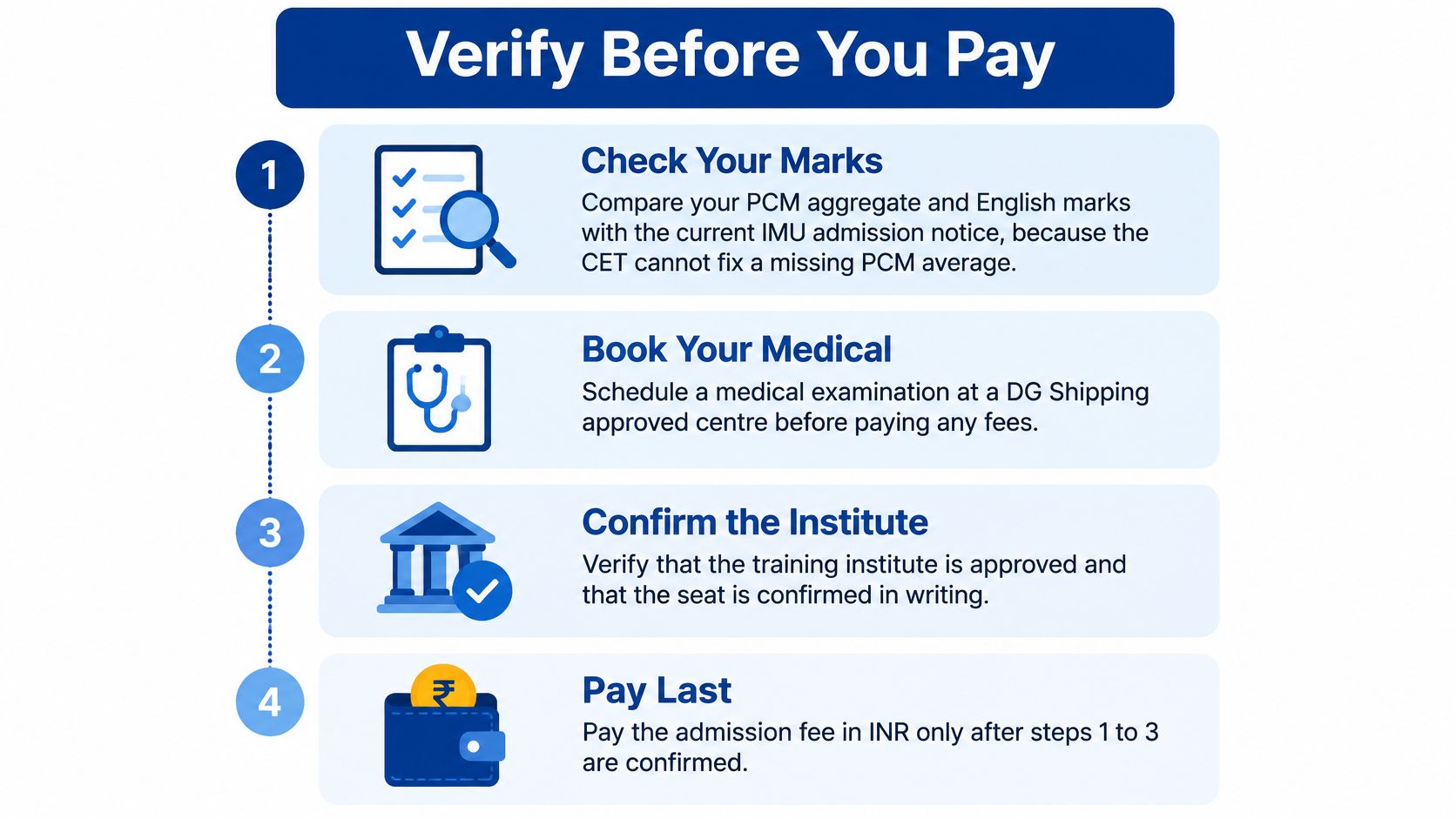
The Merchant Navy admission process should cost a family almost nothing until three checks are done: academic verification, medical clearance and institutional checks. Money comes last.
The seven-step sequence below puts every verification before every payment.
Follow the verification sequence
Check the marks against the current admission notice.
IMU states that a qualifying CET result cannot compensate for missing academic eligibility in its admissions guidance. The same guidance restricts IMU-CET admission to Indian nationals, strongly advises relevant marine-programmer entrants to hold a passport or have applied, and requires the approved physical-fitness certificate.Obtain the approved medical assessment.
The point is to establish suitability before a substantial non-refundable commitment. Any uncertainty should be settled by the approved doctor before a large fee changes hands.Start the passport application.
Identity documents and application details take time, so organize them early rather than waiting for joining instructions to arrive.Confirm the entrance and sponsorship route.
Check the current IMU-CET eligibility notice, application timetable and the requirements for the particular campus or affiliated institute. Where company sponsorship applies, get the selection conditions and sponsorship terms in writing.Verify the institute, course and onboard pathway.
DG Shipping approval of an institute does not prove that every course, intake or advertised arrangement is approved. Match the exact programmer and admission session to official records.Complete the approved training.
Residential academics and required safety training form part of the professional pathway. Understand attendance, assessment and completion requirements before joining.Complete compliant sea service and competency examinations.
Course completion, a first ship assignment and eligibility for a Certificate of Competency are separate milestones. The institute should explain who arranges the onboard stage and what happens if it is delayed.
Audit the promise of a sea berth
The government has reported 96 training berths on MV Swaraj Dweep for GP Rating and maritime-catering candidates in its maritime workforce update, an acknowledgement that onboard training capacity needs expanding. Those berths are no promise of placement for an individual applicant.
Each shortlisted institute should provide a batch-level account of:
Training completion: Students admitted and students completing the programmer.
Onboard conversion: Graduates receiving berths, with dates and median waiting time.
Company involvement: Sponsoring companies and the exact commitments they have made.
Certification progress: First-attempt competency examination outcomes for the relevant group.
Approval records establish regulatory status. Placement evidence needs its own audit: documents, identifiable batches and a clear definition of "placed".
Admission is a college decision. A sea berth is an onboard-training decision. A family needs evidence for both.
One written question exposes weak offers fast: what happens to the student's fees and place after a medical rejection or an extended berth delay? A serious institute answers with refund clauses, deadlines and named responsibilities. A weak one changes the subject.
Check personal readiness without confusing it with eligibility
Edvdo is a student-focused platform that helps students understand their strengths, motivations and learning patterns. Its career assessment can serve as one aid for organizing those patterns before money is committed. Jaya, a Class 12 science student, described gaining clarity while weighing engineering against research. Ananya described understanding her strengths when her parents preferred science after Class 10.
Neither account predicts Merchant Navy exam success or placement. Their value is narrower: separating personal fit from family pressure early enough to matter.
If an officer route fails an academic or medical requirement, the honest next step is comparing a genuinely eligible ratings route, a shore-side maritime field or another academic option. The mistake that costs families most is paying for a course before establishing that it leads to a viable professional next step.
Frequently Asked Questions Before You Apply
Can commerce or humanities students join?
Not through the standard school-leaver officer routes described here, which require PCM. A GP Rating application needs a separate check of the current approved entry conditions; “any stream qualifies for everything” is incorrect.
Does a good CET score guarantee admission or employment?
No. Academic eligibility, medical fitness and programme-specific admission conditions remain separate requirements. A qualifying result doesn't establish a future sea berth or guaranteed earnings.
What happens when eyesight is borderline?
The approved doctor should assess the intended department and explain any restriction. Engine eligibility must be evaluated independently, and acceptance of glasses or treatment shouldn't be assumed.
Is a passport compulsory before applying?
IMU strongly advises relevant marine-programmer entrants to possess a passport or have applied. Students should follow the current admission notice for document-submission deadlines and distinguish passport arrangements from IMU-CET nationality eligibility.
Does marital status matter?
Yes. B.Sc. Nautical Science and DNS carry unmarried-candidate conditions. The current admission notice should be checked for the exact declaration and applicable rule.
Can a self-understanding report confirm suitability?
A career reflection report can support comparison of interests and working preferences. It cannot certify medical fitness, replace academic requirements or guarantee admission.
Edvdo helps students understand their interests, strengths, motivations and decision-making patterns before committing to an academic or career route. Students and parents considering the Merchant Navy can visit Edvdo to organize that reflection, then test the preferred pathway against official eligibility rules, approved medical findings and written onboard-training evidence.