

How can a student choose a lifelong passion without having tried the work behind it? Enjoying biology lessons doesn't reveal whether someone would enjoy patient care, laboratory research or explaining science to children.
Learning how to find your passion starts with a more manageable question: which interest deserves a practical test? A student doesn't need a permanent career identity. A notebook, a small project and honest evidence can provide a useful starting point.
Table of Contents
- A Five-Step Map to Finding Your Passion
- How to Log Interests That Actually Hold Your Attention
- Test Your Interests Through Low-Risk Experiments
- Separating Your Own Interest From Family Pressure
- Turning Interest Into Subject and Career Options
- Fix Stalls and Plan Your Next Month
A Five-Step Map to Finding Your Passion
Passion is found by testing interests, not by taking one test and accepting its result. An assessment can suggest possibilities, but a student still needs to discover what happens during actual work, including its frustrating and repetitive parts.
The following map turns an uncertain feeling into a sequence of observable decisions.
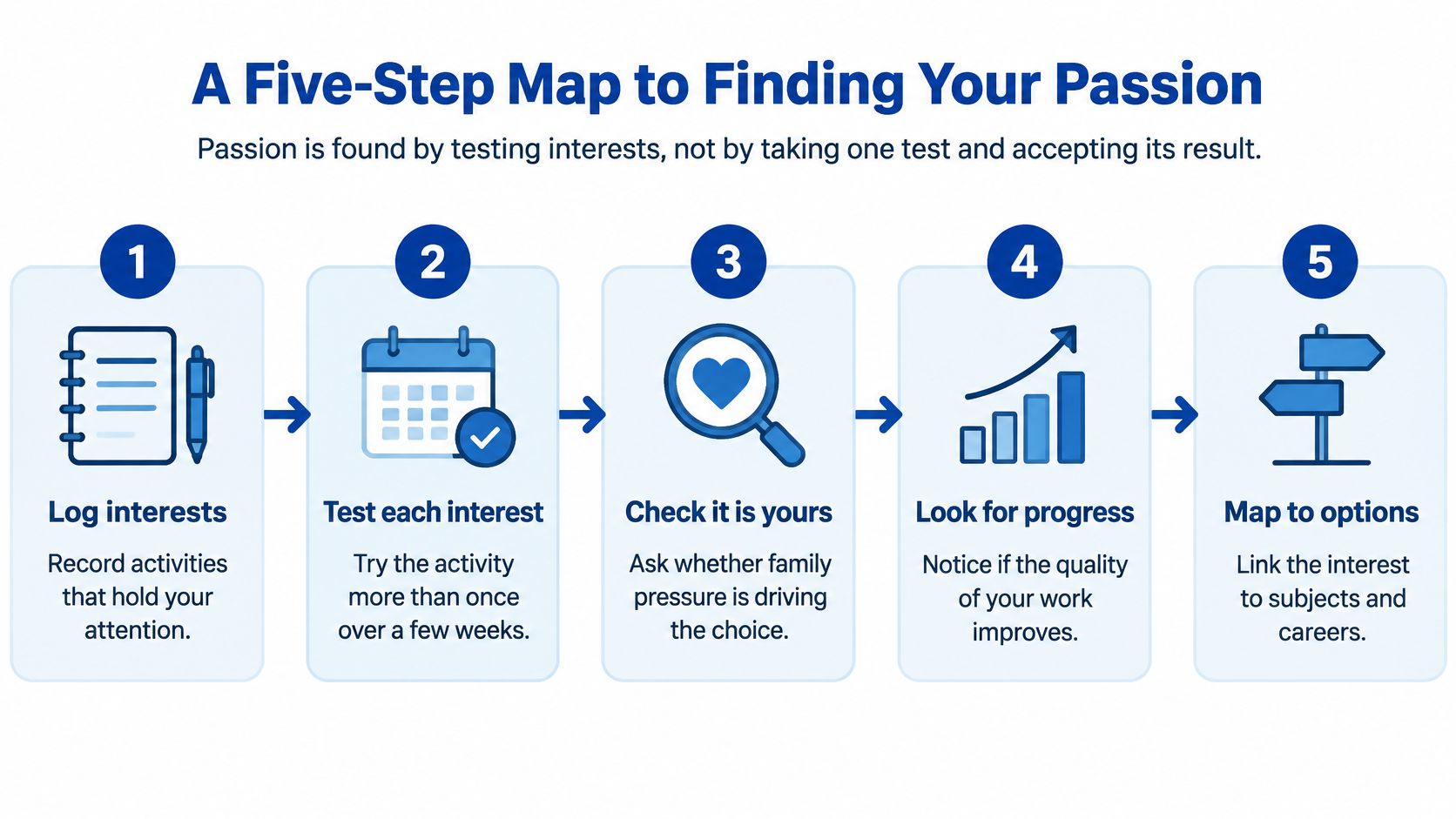
Five stages to find your passion
The timings below are a suggested practice schedule, not assessment cut-offs or guarantees.
| Stage | What You Do | Output | Time Needed |
|---|---|---|---|
| 1. Log interests | Record activities that hold attention for two weeks | List of about ten recurring interests | About 15 minutes a day |
| 2. Map to skills | Compare each theme with existing skills and preferred work settings | Shortlist of three to five themes | One sitting |
| 3. Run experiments | Try two low-cost tests per theme | Written evidence of interest after exposure | Two to four weeks |
| 4. Check outside pressure | Keep personal rankings separate from family and teacher views | Side-by-side comparison of both lists | One sitting |
| 5. Review and decide | Update the hypothesis and pick a direction with a fallback | One chosen path and a backup | One sitting |
Each stage produces something the next stage needs. The interest log supplies themes; the skills comparison narrows them; experiments produce evidence; the pressure check identifies whose preferences are influencing the decision.
This emphasis on practical exposure also fits the National Education Policy 2020, which calls for vocational learning to be integrated progressively across schools and higher-education institutions. For an individual student, the useful action is to connect classroom preferences with activities beyond the textbook.
Evidence note: The starting record should name the student's current stage and the first interest worth testing. A suitable hypothesis might be that building working models is enjoyable because it combines visual thinking with problem-solving, rather than because engineering sounds impressive.
How to Log Interests That Actually Hold Your Attention
A useful interest log records behaviour, not an ideal personality. A student who wishes to become a designer might spend free time explaining mathematics to classmates instead of drawing. Both observations matter, and neither needs an immediate career label.
A paper notebook or Google Sheets works well. Suggested columns include activity, reason for choosing it, attention, energy afterwards and willingness to return.
A suggested logging routine
Record freely chosen activities. During an initial fortnight, the student notes reading, repairing, debating, drawing, cooking or helping someone understand a problem. Specific descriptions are more useful than broad labels: editing a school announcement says more than liking English.
Mark sustained attention. Moments of losing track of time can indicate absorption. However, concentration alone isn't enough, since scrolling through entertaining videos differs from making something or solving a problem.
Rate energy. A suggested scale runs from one for drained to five for energised. The rating should describe the student's actual response, not the response expected by a teacher or parent.
Group recurring activities. Related entries can form clusters such as making things, supporting people, persuading others or working with numbers. Clusters preserve possibilities that a narrow job title might hide.
Investigate the attraction. For each cluster, the student considers what would remain appealing without praise, which problem keeps returning to mind and which subject feels demanding but rewarding.
An interest assessment can provide vocabulary for patterns that are difficult to describe. Its suggestions should sit beside the log rather than replace observations.
Practical rule: Enjoying the idea of an activity isn't the same as enjoying the activity itself.
Consider a hypothetical Class 11 student whose log contains robotics club, debate and cooking. Cooking disappears after the opening week, while robotics keeps returning; debate remains enjoyable mainly because of the friendships involved.
If the pattern continues into a later week, robotics deserves further investigation. There's no universal duration that proves passion, but checking whether an interest returns across separate weeks helps distinguish a passing burst from a promising candidate.
Evidence note: The finished record should contain theme clusters and a sentence explaining each attraction. For robotics, that sentence could identify troubleshooting a mechanism as the rewarding part, rather than winning a competition.
Test Your Interests Through Low-Risk Experiments
Different experiments answer different questions. A conversation can clarify a career's routine, but it can't establish whether a student enjoys performing its tasks.
The table offers suggested trial formats. Costs should be checked before enrolment or travel, and school students need appropriate adult permission and supervision.
| Experiment | Suggested time commitment | Low-cost approach | What it can reveal |
|---|---|---|---|
| Home or school project | A few work sessions | Borrow materials or use existing supplies | Persistence when the task becomes difficult |
| Competition or quiz | Preparation and an event | Choose a school-run or free-entry activity | Response to deadlines and pressure |
| Volunteering | Regular sessions over a month | Join an accessible, supervised local activity | Interest during ordinary, repetitive work |
| Informational interview | A short scheduled conversation | Speak by phone or video | Daily responsibilities and entry routes |
| Short online course | A manageable introductory module | Use free lessons before buying a course | Motivation while learning unfamiliar skills |
| Workplace visit or shadowing | A school-approved visit | Arrange through a trusted adult | Comfort with the environment and working style |
Choosing a useful test
A project is often the easiest starting point. A student interested in communication could prepare a school newsletter, request feedback and revise it, rather than merely watch videos about journalism.
Volunteering offers a different test. Helping a community group organise materials may reveal whether someone enjoys dependable service, not just the excitement of a special event.
For students considering a longer exploration break, HeyLocals' gap-semester ideas for students can help generate possibilities. Any option still needs checks for school commitments, safety, supervision and affordability.
A suggested routine is to test each shortlisted theme through contrasting activities, then repeat the strongest candidate. An introductory skill assessment can help identify a skill to practise, while the finished work supplies evidence of performance.
After each activity, the student records:
- Attention: Whether concentration held and time passed unnoticed.
- Continuation: Whether returning still felt appealing after the novelty faded.
- Support needed: Which skill required help, feedback or further practice.
Evidence note: Each experiment should leave a short written record and, where possible, an output such as a model, article, spreadsheet or presentation. Difficulty isn't automatically a poor-fit signal; the useful distinction is between wanting help to continue and wanting only to escape.
Separating Your Own Interest From Family Pressure
In a study of 2,855 Class 12 students from districts in Chhattisgarh, Rajasthan and Karnataka, 82% identified a particular job they wanted, but only 42% strongly agreed that their own interests determined their post-school plans, while 63% strongly agreed that parent and family expectations influenced their choices.
The distinction matters: naming an ambition doesn't establish where it came from. Family advice may contain valuable knowledge about finances, education and stability, while still differing from the student's preferred work.
The choice becomes clearer when those influences are recorded separately.
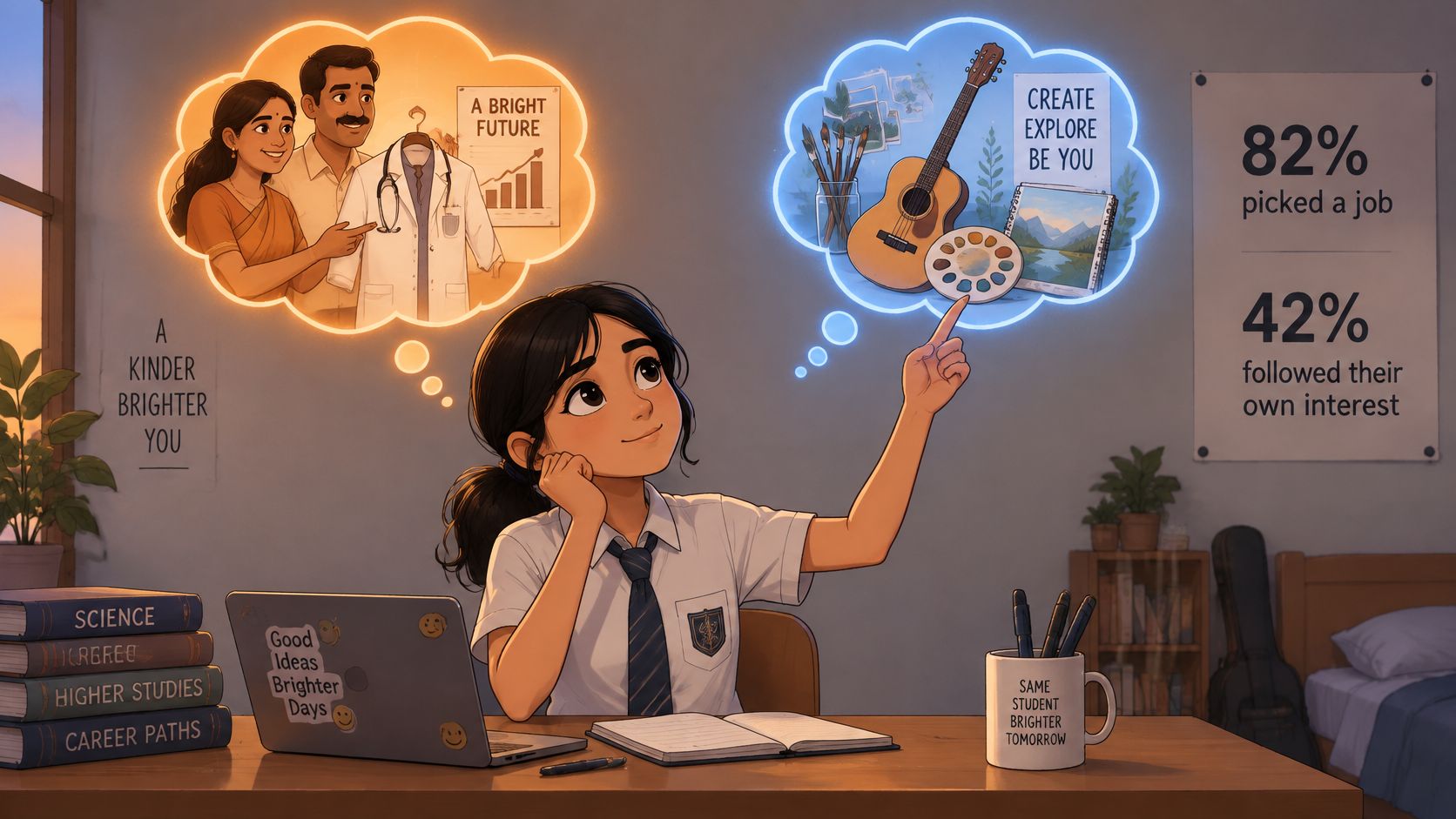
Comparing preferences without creating a conflict
- Independent ranking: The student ranks subjects and work themes before reading anyone else's recommendations.
- Separate recommendations: Parents and teachers explain their preferred options and the reasons behind them.
- Side-by-side comparison: The student marks shared preferences, family-only suggestions and personally preferred options.
- Practical checks: Authentic tasks test the student's preferred themes, while pathway checks address concerns about qualifications and affordability.
A values assessment can support reflection on priorities such as security, creativity, service and independence. Disagreement may concern these priorities rather than the activity itself.
Consider a hypothetical student preparing to choose Class 11 subjects in a family that expects science. Her independent ranking places writing and organising above laboratory work, so she edits a newsletter and coordinates a school activity before discussing her options.
This doesn't require dismissing science or rejecting family advice. It allows the discussion to include what she enjoyed, completed and improved.
A respectful career conversation can examine both the student's evidence and the family's practical concerns.
Evidence note: A shareable statement can name the interest, proposed activity and review date: the student plans to test editorial work through a school publication project, then discuss the completed work and subject requirements with the family.
Turning Interest Into Subject and Career Options
A promising interest needs both task evidence and a viable education route. Enjoying a project doesn't automatically make every related degree suitable, and a valuable hobby doesn't have to become paid work.
The checklist provides a visual reminder of the connections worth investigating.
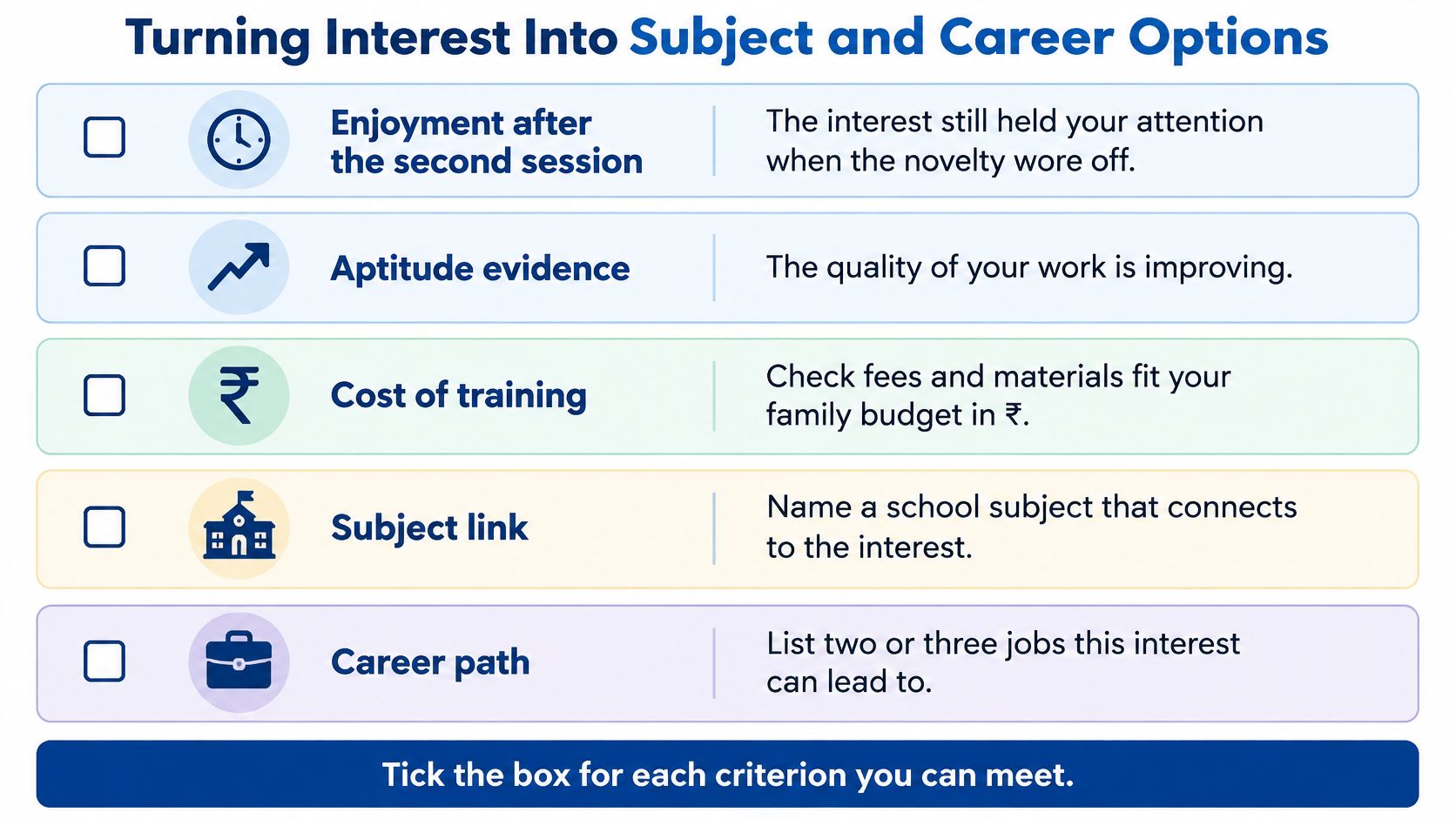
A practical shortlist checklist
- Enjoyment after repetition: Does attention remain once the activity becomes familiar? Evidence could include voluntary return visits to an unfinished project.
- Aptitude evidence: Is the work improving? An early draft and revised version, supported by specific teacher feedback, are more useful than general praise.
- Effort tolerance: Are the repetitive parts acceptable? A coding interest should include debugging, not only watching a finished game run.
- Learning progress: Can the student explain or demonstrate something previously unfamiliar? A brief explanation, demonstration or corrected mistake can show progress.
- Realistic opportunity: Which subjects, qualifications and training routes lead towards the work? The record should include current entry requirements, location, fees and materials.
Trade-offs deserve an explicit conversation. In The Quest Report 2024, covered by ABP Live, 62% of Indian Gen Z respondents said they were willing to sacrifice hobbies and other interests to achieve their career dreams.
That willingness isn't a requirement for commitment. A student should identify which sacrifices feel acceptable without treating exhaustion as proof of passion.
The accompanying video offers another starting point for reflection.
For pathway checks, the student should search the exact programme name on the institution's official admissions pages, then record required subjects, entrance routes and eligibility conditions. A subject assessment can support exploration, but official requirements determine eligibility.
Evidence note: As a suggested decision rule, a candidate can enter the shortlist after meeting four of the five criteria and identifying a named fallback route. Unmet admission requirements or unaffordable training still need resolution, regardless of the overall score.
Fix Stalls and Plan Your Next Month
The Bharat Career Aspirations Report 2025, covering 21,239 students across seven states, found that 81% faced barriers to career decisions, including limited information, low self-awareness, peer or family pressure and concerns about the future, according to Jagran Josh's coverage.
A stalled decision doesn't establish that a student lacks passion. Before changing direction, the student can check whether the missing piece is exposure, task evidence, family agreement or pathway information.
Common blocks, causes and fixes
These are working explanations to investigate, not diagnoses.
| Symptom | Likely Cause | Fix |
|---|---|---|
| No interest appears in the log | Too little exposure, not lack of passion | As a suggested routine, add two new activities a week, such as volunteering or a workshop |
| All themes feel equally interesting | Interests have not been tested yet | Run an experiment per theme before ranking |
| Enthusiasm fades after an initial session | Novelty effect | Repeat the same activity before judging |
| Family rejects every option | Pressure rather than poor fit | Bring experiment evidence notes to the conversation and identify specific objections |
| The passion feels impractical | Missing pathway information | Check prerequisites and name a fallback route |
Family objections also need careful interpretation. A concern about transport or training fees requires a practical response, while an objection based only on status calls for a different conversation.
A suggested next-month plan
Write a hypothesis. The statement names an interest and the observed reason it might fit. For example, a student may be drawn to teaching because explaining difficult ideas feels satisfying.
Schedule an experiment. A calendar entry should name the task, date, materials and intended output. An appropriately supervised tutoring activity is more testable than a vague intention to explore education.
Set a review date. A suggested interval is a fortnight after starting, with enough activity completed to compare expectations against experience. The review should distinguish task difficulty from dislike.
Update evidence notes weekly. Records should include changed opinions, feedback and unanswered questions. For students who keep postponing the task, Badger's guide to gentle time management for students offers a resource for making the work easier to start.
Seek guidance when comparison remains difficult. After a pair of contrasting trials, an optional career-counselling session can help interpret conflicting evidence. Academic background, career aspirations and completed experiment notes provide a useful basis for discussion.
Edvdo provides one-on-one guidance from dedicated career counsellors at every step. Its process follows Assess, Explore, Connect and Track, linking assessment of strengths, interests and goals with academic pathways, expert guidance and progress monitoring.
Evidence note: Changing a single variable at a time makes interpretation easier. If a group project feels uncomfortable, a solo task in the same field can help separate dislike of the subject from dislike of the working arrangement.
Passion is confirmed by repeated evidence, not by a single moment of excitement.
Edvdo offers a free assessment that takes less than two minutes to begin, with AI-powered personalised insights, strengths and interests discovery, exploration opportunities and personal growth insights. Students seeking a starting hypothesis can visit Edvdo, use those insights to choose a practical experiment, and bring the resulting evidence into a career-guidance conversation.