The Class 10 marksheet is on the table, the stream form is due on Friday, and three people in the room have three different answers. The student likes the look of a design career. An uncle points out that the maths score is strong and engineering is the safer bet. A website has just returned a percentile that nobody can interpret, and the school counsellor has forty minutes for sixty students.
Two separate questions are tangled inside that conversation. What is this student currently able to learn quickly? What does this student want to spend years doing?
Neither question has a settled answer at fifteen. What a family can do is collect better evidence on each, keep the two readings apart, and treat the conclusion as provisional until it has been tested against real work. Much of the confusion around the difference between aptitude and interest comes from treating them as rival scores competing for one slot, when they answer different questions and fail in different ways.
Table of Contents
- Aptitude and Interest Side by Side
- Why One Score Cannot Stand in for the Other
- How Interest Shifts While Aptitude Stays Steadier
- Context Checks Before You Trust a Score
- Reading the Four Aptitude and Interest Combinations
- Turn Both Signals Into a Provisional Decision
Aptitude and Interest Side by Side
Two students in the same Class 10 section are filing preference forms this month.
The first finishes the optional maths worksheets before anyone asks and scores 92 in the subject. Place that student in front of a costing spreadsheet for a manufacturer and the enthusiasm drains away inside a week. Numbers are a strength. Number-heavy work is not a pleasure.
The second reads every biology article that appears on a phone screen and watches dissection videos for fun, yet loses marks on the reasoning questions that a medical entrance paper rewards. The pull is genuine. The current preparation isn't there yet.
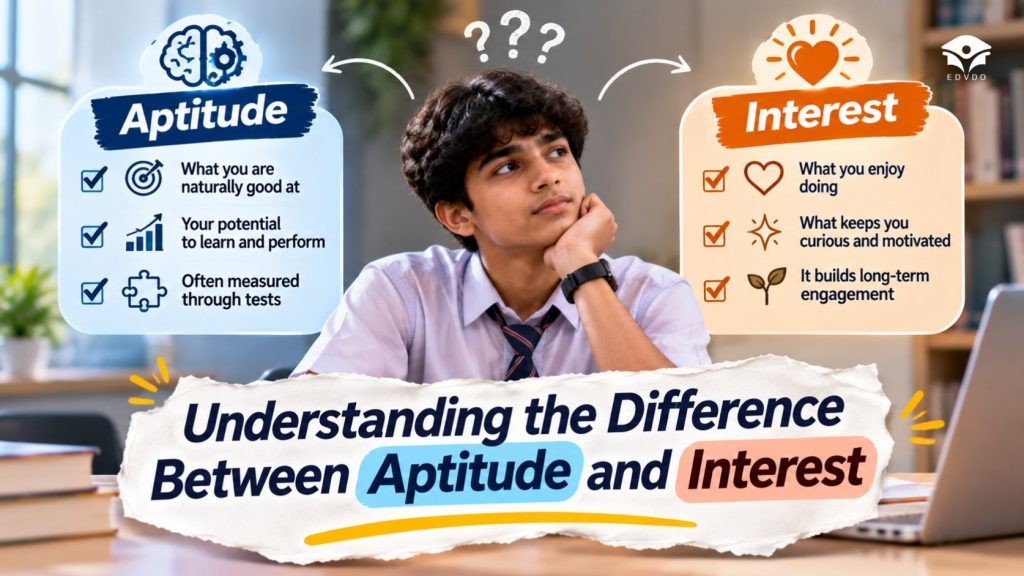
Both students are holding two pieces of evidence, and the two pieces point in different directions. Aptitude is a student's demonstrated or potential capacity to learn and perform in a domain, such as quantitative reasoning, verbal ability, spatial reasoning or mechanical understanding. Interest is the set of activities, subjects and work environments a student finds engaging or motivating. One is evidence about capability. The other is evidence about preference and motivation.
Five criteria that separate the two
| Criterion | Aptitude | Interest |
|---|---|---|
| What it measures | Capacity to learn or perform in a domain | Activities, subjects and work environments a student finds engaging |
| Typical examples | Verbal, numerical, spatial, mechanical or abstract reasoning | Science experiments, design, teaching, business or arts |
| What a high score predicts | Comparatively stronger learning potential at the time of assessment | Attraction and persistence toward an activity |
| Question it answers | Can I learn this efficiently? | Do I want to do this work? |
| Main risk if used alone | Ignores motivation and access to coaching or exposure | Ignores current ability and the demands of the pathway |
The rows explain why the two can't be swapped. An aptitude reading comes from how a student performs on a timed task that nobody can charm their way through, which is precisely what a skill test is designed to capture. An interest reading comes from what a student chooses when nothing is being graded and no relative is watching.
The distinction in one line: aptitude says what the student is currently prepared to learn efficiently, interest says what the student is drawn toward, and a stream decision needs both sentences read together.
Interest also describes appeal in the abstract, so it's worth testing against an honest account of the working day. A career guide for aspiring traffic controllers shows the pattern cleanly: the tasks that attract someone to a role and the tasks that fill an ordinary shift are rarely the same list. Neither a high aptitude score nor a strong preference decides a stream on its own, and the rest of this explanation tests that rule against the evidence Indian families have on hand.
Why One Score Cannot Stand in for the Other
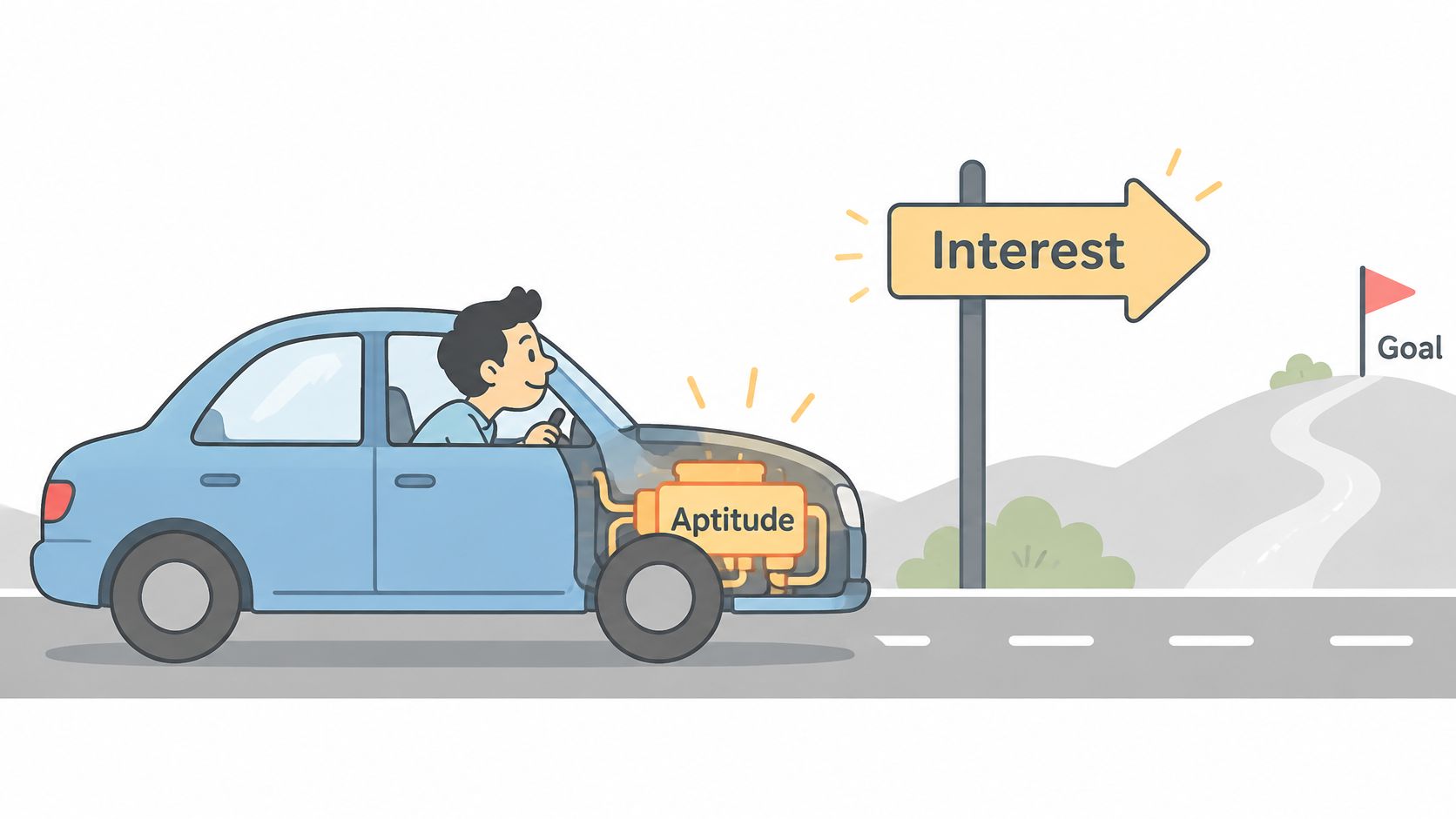
Aptitude is the engine's power. Interest is the destination marked on the map. A powerful engine pointed down the wrong road wastes its strength on distance nobody wanted to cover, and a clearly chosen destination with a weak engine stalls on the first climb. Neither reading is the trip.
India's National Education Policy 2020 describes student talent as a set of "interests, dispositions, and capacities" rather than one rank, and it recommends identifying both a student's strengths and their areas of interest when supporting career decisions. The same policy backs interactive questionnaires and learning data to locate strengths, interests and areas needing focus, and it asks schools to let students with strong interest and capacity in a field pursue it beyond the general curriculum. A single composite number can't carry that load.
That separation is easy to see in a picture.
What the two readings look like when they separate
A student with strong spatial reasoning who wants to work in animation isn't "good at art". The spatial score says the modelling and camera work will come quickly. The interest says the portfolio will get finished. A second student, verbally strong and set on psychology, will meet compulsory statistics papers inside the degree, and the numerical reasoning score, not the enthusiasm, predicts how that term goes.
The two signals are related without being interchangeable. A study published by NCERT, covering 1,000 adolescents across 19 secondary schools in Anantnag and Srinagar, reported significant relationships among vocational interests, creative-thinking ability and academic achievement, which is what a related-but-distinct pair looks like on paper (NCERT study).
The working rule: a capability reading without a preference reading produces a competent, restless student. A preference reading without a capability reading produces a plan that stalls in the first hard term.
The same logic holds outside school. Workforce programmes use certification and career fit screening to check whether a candidate's existing skills match what a credential demands before the training is booked, which is capability evidence meeting pathway requirements rather than a verdict on character.
An exercise worth doing on paper tonight: write down three signals about a subject the student is considering, then label each one. A test result, a grade or a timed attempt is capability evidence. An activity chosen freely, a topic read without a deadline, a project started on holiday is preference evidence. Count how many of the three are the same type.
How Interest Shifts While Aptitude Stays Steadier
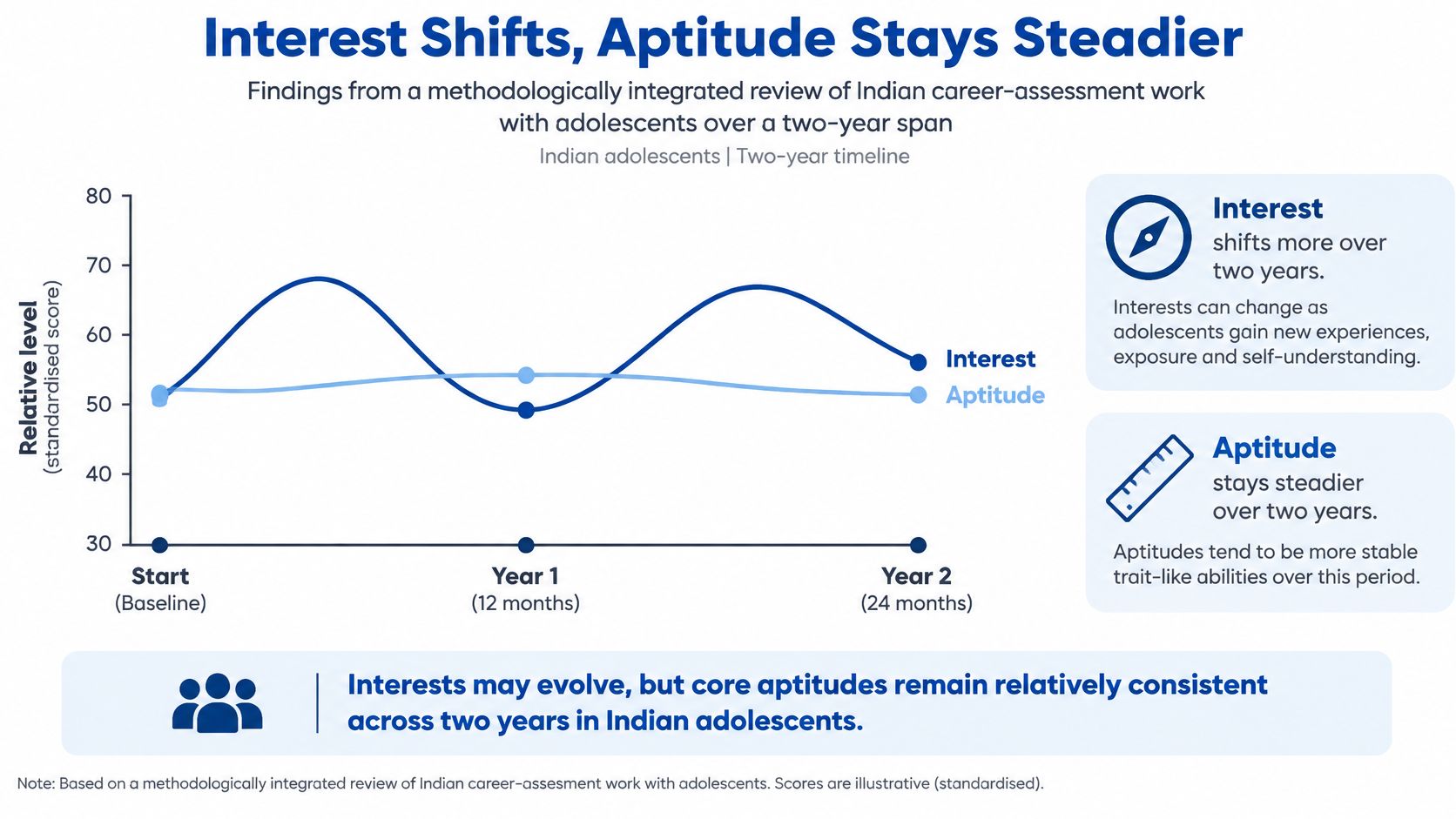
Start with the uncomfortable finding. A methodologically integrated review of Indian career-assessment work reports that interests were less stable than aptitudes over a two-year period among Indian adolescents. A single interest snapshot taken in Class 9 should not be treated as a career identity.
Why the interest line moves
Preferences respond to what a student has encountered. A new teacher, an older cousin in a lab, a family expectation about government service, a documentary about marine biology, or learning that a career exists at all can move a stated interest within months. That's why an early recommendation built only on stated preference ends up unnecessarily narrow: it locks in a reading taken before the student knew what the options were.
Aptitude behaves differently because it's measured against a task. The score can rise with practice and familiarity, but the underlying pattern of relative strengths tends to hold, which makes it the more dependable planning signal for the two-year window that covers Classes 9 to 12.
Four stages, in order
Stage one, an ability profile. Take one timed, task-based sitting early, so the baseline predates coaching and subject specialisation.
Stage two, a broad interest map. Map preferences across realistic, investigative, artistic, social, enterprising and conventional activities rather than job titles. An interest test built on those six domains gives a spread rather than a single label.
Stage three, contact with the work. Careers and their prerequisite subjects need to be seen, not described. A conversation with a working professional, a two-day workshop or a site visit does more than a brochure.
Stage four, a repeat. Reassess interest and confidence after that exposure. The question isn't whether the student still says the same thing, it's whether the same preference survives contact with the details.
For a walkthrough of how the two readings are usually presented to a student, this short video covers the ground before the reassessment plan below.
Schedule two or three reassessment points across the year, one before subject selection, one at the end of the first term and one after any real exposure to the field, and compare the interest reading before and after.
The actionable interpretation isn't that aptitude chooses the career. Aptitude estimates learning readiness, interest indicates motivational fit, and repeated measurement tests whether the apparent fit persists after informed exploration.
Context Checks Before You Trust a Score
A score is only as good as the conditions it was collected under. A high aptitude reading can reflect familiarity with English-medium testing, coaching access or prior academic opportunity rather than a complete measure of potential. An interest reading carries the same weakness in a different place: it can only reflect options the student has heard of.
Five questions to ask about any result
- Who administered it. A trained counsellor who explained the instructions, or a link forwarded on a family WhatsApp group with no context at all.
- In which language. A verbal reasoning task taken in a second language measures language exposure as much as reasoning.
- What exposure came before. Coaching, a well-resourced school and a home full of books all inflate a raw score.
- Whether the result repeats. Two sittings three months apart that agree are worth ten times one sitting.
- Whether the options went past the popular clusters. If the report offered doctor, engineer, civil servant and lawyer, the student's "strong interest" may only be a strong familiarity.
That last point shows up in the numbers. The 2025 Bharat Career Aspirations Report survey found that 70% of students' aspirations were concentrated in only seven of 21 career clusters, and just 22% had a backup career plan. In the same survey, only 10% knew course costs and 38% were unsure of their target education level.
Read those figures together and a pattern appears. A student reporting intense interest in medicine, government service or business may be reporting family expectation, perceived job security or limited exposure rather than personal preference alone. None of that makes the interest false. It makes it untested. A personality reading taken alongside the interest and ability results helps separate a preference for the work itself from a preference for the status attached to it, and a personality test is the cheapest way to get that third view.
The rewrite exercise: take any result in front of you and write two lines. Line one, what this result does show. Line two, what it cannot possibly show. Then pick the single context question from the five above that would change the reading most, and check that one first.
Who the question is really for
The underserved question for a student in Grades 7 to 12 isn't only "am I good at this?" It is "would I still pursue this after seeing realistic alternatives and understanding the pathway?" That's a question about exposure, not about scoring higher on the same test.
Reading the Four Aptitude and Interest Combinations
Aptitude is an ability or cluster of abilities indicating readiness to learn, acquire a skill or perform effectively in a domain: verbal, numerical, spatial, mechanical or abstract-reasoning capacity. Interest covers the activities and occupational environments a student prefers and finds intrinsically engaging, as NCERT's aptitude framework sets out. The two are measured by different mechanisms and read on different scales.
Which is why a mismatch is useful information rather than a verdict. High interest with weaker current aptitude may justify foundational practice, bridging coursework or a later reassessment, depending on whether the gap is skill or fit. High aptitude with low interest points to capability without sustained motivation, and it usually shows up as strong grades in a subject the student privately finds a chore.
The four cells
| Combination | What It Suggests | Typical Reason It Happens |
|---|---|---|
| High aptitude, high interest | Strong fit on capability and motivation | Subject matches both ability and what the student enjoys |
| High aptitude, low interest | Capability without sustained motivation | Good grades in a subject taught as a chore |
| Low aptitude, high interest | Motivation ahead of current skill | Limited prior exposure or weak preparation, not poor fit |
| Low aptitude, low interest | Weak fit on both signals so far | Little exposure yet, or a subject chosen under family pressure |
Why the low rows aren't verdicts
A weak aptitude reading in a specific domain is often produced by limited exposure or thin preparation rather than genuine inability. A student who has never handled a physics practical kit will score poorly on mechanical reasoning, and that says more about the school's lab than about the student's ceiling. A low-low cell is the least reliable of the four, because it can mean only that the subject has never been taught well in front of this student.
The most useful cell is the conflicted one. Strong pull with a weak skill asks for practice. Strong skill with a weak pull asks for exploration and an honest look at what the work involves on an ordinary Tuesday.
The rows also check family advice against evidence. When an uncle recommends a stream because the marks are good, the marks are genuine capability evidence. They say nothing about whether the student will still want the work at twenty-five. When a student insists on a field despite weak preparation, the preparation gap is usually closable, but only if someone names it early rather than in the final year.
Take the student's own result and place it in one cell. Then mark which cell would need more evidence before anyone signs a form, because that is the cell where a subject selection decision is currently being made on guesswork.
Turn Both Signals Into a Provisional Decision
A Class 11 student can name three careers she likes and still freeze when the form asks for one subject combination. She is not an outlier. The published findings of the 2025 Bharat Career Aspirations Report surveyed 21,239 students in Classes 9 to 12 across 14 districts in seven states and found that only 10.4% had received professional career guidance, while 81% reported barriers to career decision-making, including limited information, low self-awareness, family pressure and concerns about future prospects; the same survey found that 41% of private-school students and 35% of government-school students were unsure about their course choice.
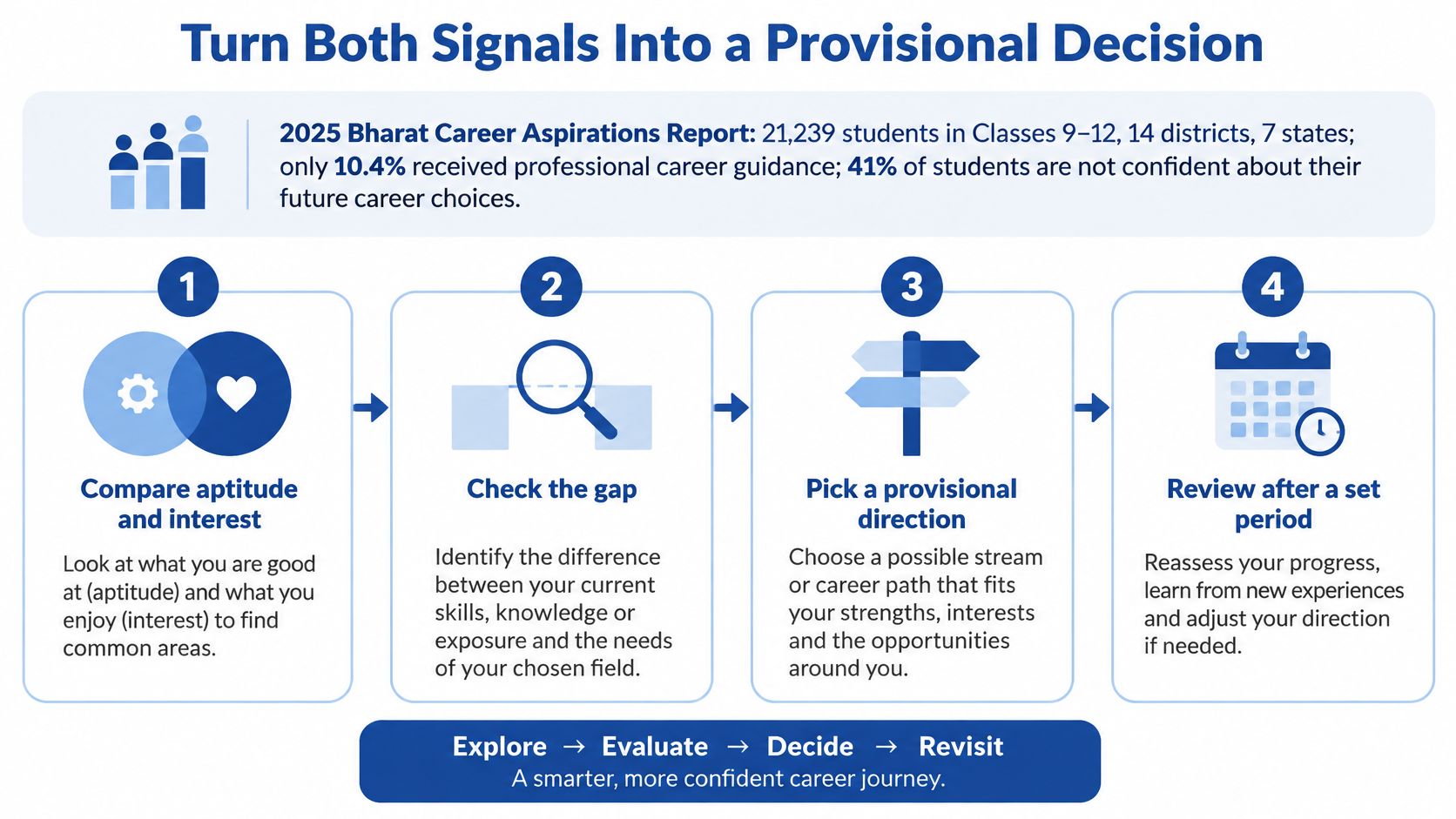
"Follow your interest" and "pick the highest score" each throw away half the evidence. A provisional decision works like a practice paper: you sit it, mark what is still untested, and sit a shorter paper again before anyone treats the result as final.
A six-step procedure for the next decision
- Write down the evidence behind each signal. Test results, subject grades, and activities the student chose without being asked. Anything added by a relative gets a separate column.
- Name the missing check. Say which signal still rests on a single exam, a parent's preference, or one good week, so the family knows what the next month has to test.
- Check persistence. Did the student keep going when the work stopped being fun? Persistence under difficulty is the strongest evidence that an interest is more than novelty.
- Run one small experiment. A short online course, a competition, a project with a real deliverable, or a shadowing week. Keep it cheap and time-boxed.
- Talk to someone who does the work. Ask what a normal week involves, what the boring part is, and what they wish they had known at seventeen. The answer usually reorganises the shortlist.
- Record the choice, the experiment and a review date before family expectations enter the room. Writing the review date first keeps the decision provisional in the way it should be.
Interest often grows after competence, feedback and real exposure, which is why step six matters more than the first reading. When aptitude and interest agree, a student can commit with reasonable confidence. When they conflict, the choice stays open until the review repeats the interest check, sets it against the earlier reading, and sets both against what the experiment showed.
What good guidance looks like in practice
Even a pathway that looks fixed from the outside still has room for a second look. Medicine is the clear case: the entrance route is standardised, but matching your strengths to a specialty still turns on how a person works under pressure, how much they like procedures versus long conversations, and what they can sustain for twenty years rather than what they scored at eighteen.
Software makes the same loop easier to run at home. Edvdo's process has four steps: assess strengths, interests and goals; explore personalised career options and academic pathways; connect with an expert counsellor; and track goals with progress tools. The career report that comes out of it sets out recommended streams, courses and roles aligned to the assessed strengths, giving the family a concrete starting point for the discussion.
Before the deadline: write three things on one page, the provisional choice, the experiment that will test it, and the date the student will review both. Sign nothing until the page exists.
When the stream form arrives, the useful question is what the student has already tested, not which score looks larger on its own. Edvdo brings interest, ability and personality readings into one place, then turns them into a report with recommended streams, courses and roles, and the free assessment takes less than two minutes to begin. Start with the readings, run one small experiment, and let the next decision be a reviewed one rather than a guess, at Edvdo.