

Somewhere in a Class 12 classroom this week, a student who is comfortable with mathematics is being handed the same short list of options. Engineering, medicine, or a BSc followed by a competitive exam. Actuarial science rarely appears on that list, which is strange, because it is one of the few careers where the mathematics a student already enjoys stays at the centre of the job twenty years later.
This guide is written for that student, and for the parents asking practical questions at the kitchen table. It is not a course list or a salary table. It is a way to judge whether the daily work, the examinations and the temperament would suit you.
Table of Contents
- Who Puts a Price on Uncertainty?
- What Actuaries Actually Do Across Industries
- The Mathematics Behind Each Actuarial Decision
- Navigating the ACET and IAI Exam Pathway
- Skills That Matter Beyond Mathematics
- Career Paths and Realistic Expectations on Pay
- Test Your Fit Before You Enrol
- Frequently Asked Questions About Actuarial Careers
Who Puts a Price on Uncertainty?
Say an insurer is finalising the premium for a family health policy that will stay on its books for decades. Claims will arrive from some policyholders next month and from others in twenty years. The company cannot know which ones. It can estimate how many will need hospital care, how long they will live afterwards, and what a hospital bed, a scan or a course of treatment will cost when the claim finally lands.

An actuary is the professional who uses probability, statistics and financial modelling to measure what uncertainty costs, and then advises how to price it, how much to hold back in reserve and how to invest so the promises can be kept. The output isn't a single confident number. It works more like a weather forecast. A 70 per cent chance of rain doesn't promise rain, and an actuarial model gives a range of likely outcomes along with the assumptions that produced it.
The profession in India is small and selective. In March 2025 the Institute of Actuaries of India awarded fellowship certificates to about 120 candidates, taking the total number of qualified actuaries to 761, against 9,155 registered students and 311 associate members, according to information published for Parliament. That gap between a large student pipeline and a small qualified pool says two things at once. The pathway is hard to finish, and finishing it puts you in rare company.
What follows is a fit test rather than a salary list. You'll see the daily work, the mathematics, the examination route, the skills that have nothing to do with calculus, and a self-check at the end. By then you should be able to answer whether this kind of thinking interests you.
What Actuaries Actually Do Across Industries
Strip away the job titles and actuarial work follows a four-step cycle. The steps repeat whether the actuary sits inside a life insurer, a pension fund, a bank's risk team or a consulting firm.
The four steps that repeat in every actuarial role
- Gather and clean the data. Policy records, claims histories, pension member lists or loan books. This stage takes longer than newcomers expect, because fields go missing, records duplicate, and a column may have been coded differently after a system upgrade in 2019.
- Build or update the model. Every model carries explicit assumptions about mortality, claim frequency, inflation and interest rates. Writing them down matters as much as the arithmetic, because someone will challenge them.
- Test the assumptions against experience. Compare what last year's assumption predicted with what happened, then shift each assumption to see how far the answer moves. A reserve that swings wildly when inflation moves by half a percent is telling you something.
- Write the report. A pricing committee, a board or a regulator needs the key number in plain language, with the reasoning and the uncertainty attached. A model nobody can act on is a hobby, not a decision tool.
The method stays constant. The uncertainty being measured does not.
| Area | Uncertainty measured | Indian example | Typical output |
|---|---|---|---|
| Life insurance pricing | How long policyholders live | A term life premium for a 30-year-old | Premium rates and mortality assumptions |
| General insurance pricing | Claim frequency and claim size | Motor and health policy rates | Rate filings and pricing models |
| Claims reserving | Claims reported or settled late | Motor claims reported months after an accident | Reserve estimate on the balance sheet |
| Health and care | Medical cost inflation and utilisation | Employer group health cover | Benefit design and premium loading |
| Pensions | Payouts over several decades | Employer pension scheme funding | Funding valuation and contribution rate |
| Investments | Gap between asset returns and guaranteed payouts | An insurer's bond portfolio backing long-term policies | Asset mix limits and stress tests |
| Banking and enterprise risk | Loan defaults and operational losses | Bank provisioning for stressed loans | Loss provisions and capital buffers |
| Agriculture and public risk | Crop losses from weather | Crop insurance under PMFBY | Product design and risk pricing |
The same cycle produces very different working lives. Life insurance leans on decades of mortality experience, so the questions are slow and the data is long. General insurance moves faster, because motor and health claims arrive constantly and reserving for late-reported claims becomes a weekly discipline. Pensions sit at the patient end, where inflation and longevity assumptions compound over thirty years and a small error early becomes a large funding gap later.
The Mathematics Behind Each Actuarial Decision
A model is a recipe. The assumptions are the ingredients. Change one ingredient, and the whole dish changes, which is why actuaries spend more time arguing about assumptions than about formulas.
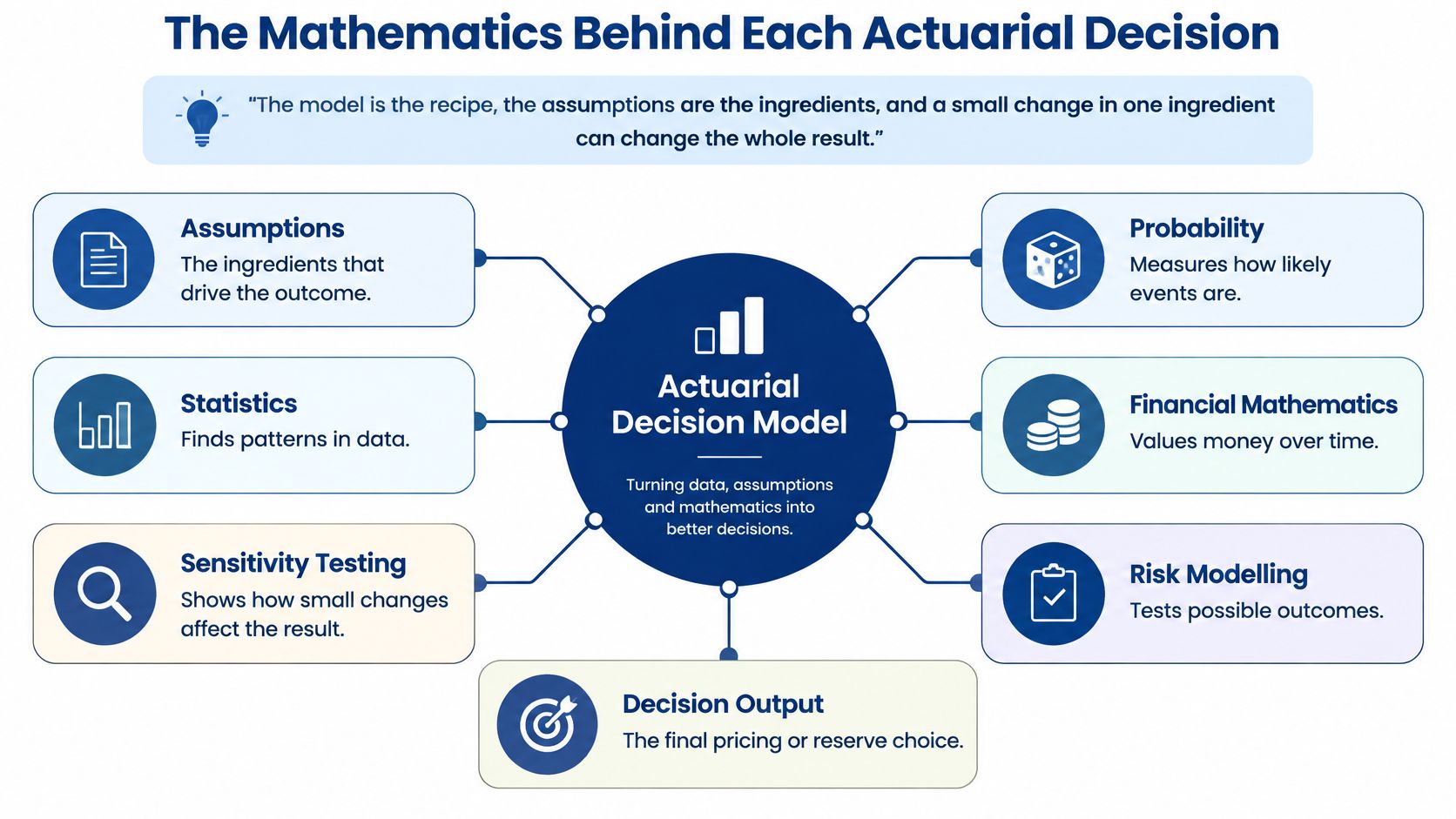
How each technique turns into a decision
| Technique | What it does in actuarial work | Where you meet it |
|---|---|---|
| Probability | Estimates how likely an event is | Claim frequency in motor insurance |
| Statistics | Fits distributions and regression to past data | Rating factors in health pricing |
| Survival analysis | Models time until death, lapse or claim | Life insurance and pension liabilities |
| Financial mathematics | Finds present value and compound growth | Annuity pricing and pension funding |
| Calculus | Measures how results change when a rate moves | Sensitivity and stress tests |
| Economics | Builds inflation and interest-rate scenarios | Long-term pension and health cost projections |
| Programming in R and Excel | Makes models reproducible and quick to rerun | Pricing models and reserving workbooks |
Present value is the idea that surprises most newcomers. A pension promised in 2050 is worth less today than the same amount promised next year, because money set aside now earns a return in between, and because inflation erodes what the eventual payment buys. Financial mathematics turns that intuition into a number a finance director can act on.
In India, the qualification's statistics and mathematics subjects carry practical assessment using tools such as R and Excel, so exam progress and employability move together rather than living in separate compartments, as the IAI's explanation of its examinations describes. That practical element matters. A candidate who can rebuild a model from scratch, explain why an assumption was chosen, and show what happens when it fails is far more useful than one who memorised formulas.
The IAI curriculum also points students to Indian mortality resources such as the Indian Assured Lives Mortality tables for 2012-14 and the Indian Individual Annuitant's Mortality Table for 2012-15, which show how observed experience becomes an assumption about future payments, as its college brochure sets out.
Programming, then, is worth learning early, but it isn't the core skill. Judgement about assumptions is. R and Excel make a model reproducible and quick to rerun; they don't tell you whether your mortality assumption is optimistic.
For a short visual introduction to how actuaries think about risk and uncertainty, this video is a reasonable place to start.
School calculus solves clean problems with one right answer. Actuarial mathematics works on incomplete data, where a defensible answer and a clear account of its limits carry more weight than elegance.
Navigating the ACET and IAI Exam Pathway
The route runs in gates. Each gate does a different job, and confusing them is where students lose years.
The first gate is ACET, the Actuarial Common Entrance Test. It is a three-hour, 100-mark online test of 70 multiple-choice questions, with one correct answer each, conducted only within India, and a pass stays valid for three years for IAI student membership. The IAI states that students who have completed or appeared for Class 12, or an equivalent examination, can take this route, including candidates from mathematics, statistics, econometrics, engineering, management and finance backgrounds who have numerical ability, as the IAI's ACET page confirms.
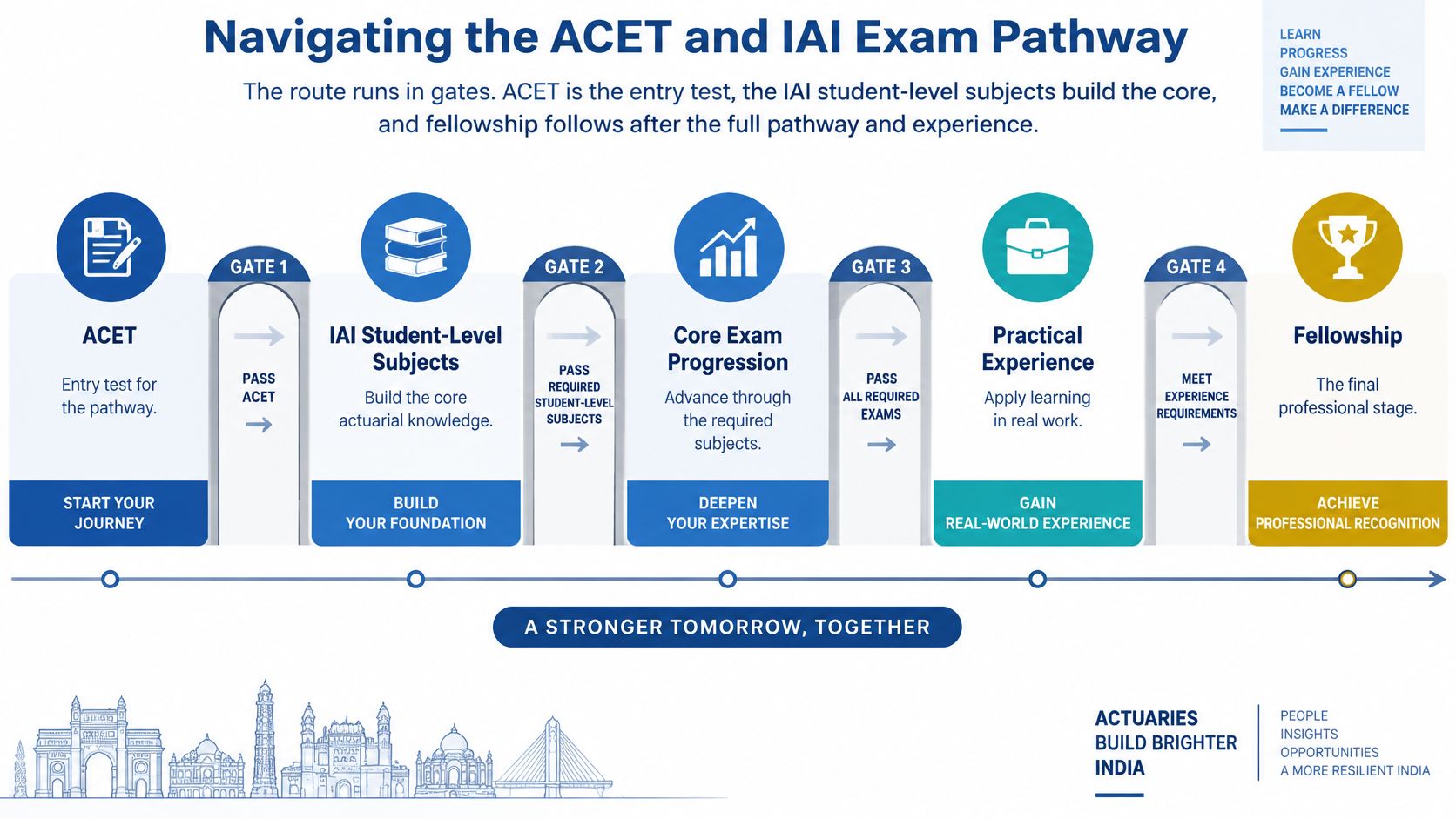
That eligibility bar is wider than most students assume. A Commerce student who is strong with numbers can enter, though the foundation stage will demand more mathematics than a Commerce syllabus covered. Clearing the entrance test also isn't the same as becoming an actuary. It buys you entry to the examination pathway, nothing more.
How the gates line up
| Stage | What it covers | What it signals |
|---|---|---|
| ACET | Entry test of 70 multiple-choice questions in three hours, 100 marks | Eligibility for IAI student membership, with a pass valid for three years |
| Core Principles | The foundation stage of the qualification | Grounding in modelling, including practical work in R or Excel |
| Core Practices | Applied subjects built on that foundation | Job-relevant modelling rather than theory alone |
| Specialist principles | Subjects in life, health, pensions, investments, pricing and reserving | A chosen specialisation |
| Fellowship | The full prescribed pathway plus relevant work experience | Senior technical, leadership and statutory roles |
Timing shapes everything. IAI examinations are generally held twice yearly, usually in May and November, so a failed or postponed subject can push progress back by roughly one examination cycle. The IAI's own career guidance notes that students may find relevant employment after graduating and passing at least two or three subjects, while fellowship requires completing the prescribed 13-subject pathway, as its examination FAQ explains.
Pass rates are worth seeing as a planning signal rather than a verdict. 2,207 candidates sat the February 2025 Core Principles examinations and 975 passed, a rate of 44.18 per cent, while earlier sittings came in at 47.26 per cent in May 2024 and 54.02 per cent in November 2024, according to the IAI's 2025 bulletin. Roughly half of a sitting clears, which means most candidates will repeat something. Budget for that in both money and calendar time.
The sensible plan is a multi-year timetable with slack built in for one repeat per year. Clearing subjects needs a study method, not just hours, which is where how to study beyond highlighting stops being generic advice and starts solving a real problem.
Skills That Matter Beyond Mathematics
A Class 12 student can enjoy integration and still dislike actuarial work. The entrance test checks whether school mathematics feels natural; the profession checks whether you can keep producing explained judgements through a long exam calendar, repeat a sitting when needed, and defend assumptions to people who do not share your shorthand.
The IAI's careers guidance lists logic, problem-solving, business awareness and communication among the qualities it expects, and its professional material treats CP2 as the paper where candidates explain a model to different stakeholders, as Actuary India describes.
The honest distinction: liking mathematics gets you to the entrance test. Staying in the profession requires tolerance for slow progress and for work judged by whether a non-specialist can act on your explanation.
Five habits the work demands
- Communication that survives a non-specialist audience. The actuary may build the model, but a manager, regulator or client has to act on it. If the explanation fails, the analysis fails with it.
- Accuracy under repetition. One mistaken assumption about how quickly claims get reported can move a reserve by enough to change a company's reported profit.
- Patience measured in months, not weekends. Checking a model and preparing a subject both reward sustained focus after the first burst of interest has gone.
- Curiosity about oddities. Why did claims rise in one district and not the neighbouring one? Asked often enough, that question is how actuaries find pricing errors and fraud.
- Deciding with incomplete information. Future outcomes cannot be known. The job is to make a reasonable call, write down why it was reasonable, and revise it when new data arrives.
A worked scene makes the mix concrete. A motor insurer's finance head asks why reserves rose after a surge in late-reported claims. The actuary has to separate three things: the assumption that changed, the uncertainty still attached to it, and the rupee effect on the balance sheet. Only the first is a modelling task. The other two are explanation.
A short self-test beats a long personality quiz here. Can you explain a result to a friend who dislikes mathematics, in three clear sentences, without a spreadsheet in front of you? Edvdo's AI career assessment is one optional way to reflect on that question. When a job, family duties and exam preparation claim the same evenings, how to rank competing demands becomes part of the study method.
Career Paths and Realistic Expectations on Pay
Two beliefs send students into this field and then disappoint them. The first is that clearing one examination buys a job. The second is that a senior salary arrives from day one. Both confuse a milestone with a destination: each cleared paper raises your ceiling, and the ceiling rises over years.
What the pay looks like at each stage
The IAI's careers guidance gives an indicative progression. According to the IAI careers FAQ, actuarial students may begin at approximately ₹4 lakh to ₹5 lakh a year, beginners with experience and qualifications around ₹8 lakh, and senior professionals roughly ₹40 lakh, with a newly qualified actuary reported at at least ₹15 lakh to ₹20 lakh annually.
Independent survey data sits inside the same band. A 2024 Glassdoor average for actuaries in India was reported at ₹11,30,000, with a listed range of ₹5,00,000 to ₹26,30,000, as summarised in a Society of Actuaries e-newsletter article. Read the range, not the average. It blends students, partially qualified analysts and fellows in very different roles, so it describes the spread of the market rather than your personal starting point.
Where those roles sit follows examination progress:
- Actuarial analyst, pricing analyst, reserving analyst or risk analyst after partial completion, usually with a degree and a few subjects cleared.
- Senior pricing, pensions or investment roles after fellowship, where the work shifts from building models to signing off judgements.
- Adjacent paths in risk analytics, insurance data science, underwriting and finance, which absorb people who enjoy the modelling but decide against the full pathway.
The opportunity is wider than the traditional insurance floor. Reporting on India's preparations for IFRS-related insurance reporting and risk-based capital frameworks describes actuaries as increasingly needed across service selection, accounting, reserving, audit and balance-sheet strategy, while India has fewer than one fellow actuary per million people against more than 40 per million in the United States and over 250 per million in the United Kingdom, as Business Standard's coverage sets out. That gap points toward government social protection work, hospitals, health coverage and climate risk rather than more of the same insurance jobs.
India does face a shortage of qualified actuaries. A shortage is not a shortcut. The distance between the starting band and the senior band is measured in cleared examinations and accumulated judgement, and employers pay for both. Students can compare actual role titles and requirements in the Edvdo jobs list before committing to a pathway.
Test Your Fit Before You Enrol
Fit for this work shows up in how you handle an uncertain, multi-step problem over several months. It doesn't show up in a mark sheet, which is why this section asks you to run a small experiment on yourself before paying a single fee.
Six questions worth answering honestly
- Do you enjoy problems with several defensible answers, or does the absence of one correct answer unsettle you?
- Would you willingly spend an hour checking a single assumption that might change the final answer?
- Can you study steadily for two or three years when results arrive in cycles rather than weekly?
- Do spreadsheets or code feel satisfying rather than tedious once the initial novelty wears off?
- Are you curious about how insurers, pension funds and banks handle risk, beyond the headlines?
- Do you enjoy explaining a result to someone outside the field, patiently, more than once?
None of these questions has a right answer. They exist to show what the next five years would actually feel like.

Notice what the list leaves out. It never asks whether you topped mathematics in school, because school maths is a solved puzzle with a marking scheme. Actuarial work is closer to question 2: a long, patient argument with your own assumptions. If questions 3 and 4 made you tired just reading them, take that seriously. The exam pathway rewards the temperament those questions probe far more than it rewards raw speed at calculus.
Three steps that cost little and tell you a lot
Test the interest cheaply. Spend three or four weeks on a free statistics course or a spreadsheet project built on public data. Clean the data yourself, because cleaning is where most real analysis time goes. If that stage feels like punishment rather than a puzzle, that is useful information about the years ahead, and it cost you weeks rather than an enrolment.
Check eligibility and sitting dates on the IAI website. Confirm the current ACET pattern, eligibility and examination calendar before enrolling in anything, because syllabi and schedules are revised from time to time.
Map the subjects and price a repeat attempt. Draft a multi-year timetable and budget for at least one failed subject along the way, then write down fallback roles such as risk analytics, insurance data science or underwriting. A plan with exits is easier to commit to than a plan built on hope.
At that point the choice narrows. Start with the first and third steps if the fit is still unclear, or prepare for ACET if the spreadsheet project already felt engaging.
Edvdo approaches the same decision from the other direction, through self-understanding rather than syllabus detail. Its process runs in four steps: Assess, where an assessment evaluates strengths, interests and goals; Explore, which surfaces personalised career options and academic pathways; Connect, where you can schedule a session with an expert career counsellor; and Track, which helps you set goals and monitor progress. The career assessment generates a personalised profile of your strengths, interests and learning patterns, and an interest test can serve as a prompt for reflection alongside a counsellor's advice rather than a verdict on a career. For a counselling session you only need your academic background and career aspirations, which makes it a low-cost way to stress-test your answers to the six questions above.
Frequently Asked Questions About Actuarial Careers
Can Commerce students explore actuarial science? Yes. ACET is open to students who have completed or appeared for Class 12 or an equivalent examination, and Commerce students with strong numerical ability can enter. Expect the foundation stage to demand sustained effort in probability, statistics and financial mathematics well beyond a Commerce syllabus.
Is Mathematics important? It's central. Probability, statistics and financial mathematics form the core of the work. Judgement, communication and persistence matter just as much, because a technically correct model nobody understands changes nothing.
What is ACET? The Actuarial Common Entrance Test is the IAI's entry gate, a single online multiple-choice paper held only in India. Clearing it makes you eligible for IAI student membership and opens the subject pathway. It is not a qualification in itself, and current details sit on the IAI website.
How long does qualification take? Longer than a degree and less predictable. Progress depends on how many subjects you clear in each sitting, and the calendar moves in examination cycles rather than academic years. Plan in years, not months.
Are programming skills useful? Yes. R and Excel feature in the IAI's practical assessments and in everyday pricing and reserving work. Coding makes your models reproducible and quick to rerun, but it supports judgement about assumptions rather than replacing it.
Students should verify the current syllabus, subject list and examination pattern on the official Institute of Actuaries of India site before finalising any plan, and Edvdo's career report can help translate an honest self-assessment into a first set of subjects to explore.
A career in actuarial science rewards a particular kind of temperament more than a particular kind of mark sheet, and the only reliable way to know whether you have it is to test the work before committing years to it. Edvdo is built for that stage of the decision, with an AI career assessment that maps your interests, strengths and decision-making patterns, a career hub covering more than 750 paths, and reports that turn those patterns into subjects and roles worth exploring first. Visit Edvdo to start with an honest picture of how you think, then judge the actuarial pathway against it.