
Ask a studio lead what's missing from the hiring pipeline and the answer is rarely a degree. Game design is one of the hardest roles to fill in India's gaming startups, with the talent shortage hitting design at 46.7% of startups, ahead of game development at 42.2%, according to Primus Partners' report on India's gaming boom. The gap isn't a shortage of people who want the job. It's a shortage of people who can prove, with something playable, that they can do it.
That single fact reshapes the whole question of how to become a game designer. The route isn't "pick a degree, then hope." It's a sequence: get clear on which design role you're aiming at, build the underlying skills, learn one engine well enough to prototype alone, then assemble evidence that survives a hiring manager's ten-minute review.
Tooling has changed the middle of that sequence. AI-assisted prototyping, asset generation, and documentation drafting are now normal parts of a solo designer's week, and the useful question is which tools earn their place. This set of evidence-based guides to AI tools covers that ground without the hype.
The eight steps below assume an Indian starting point: mobile-first players, a fast-growing but young studio base, and a lot of expensive courses that don't map cleanly to a junior job. Work through them in order and the portfolio builds itself.
Table of Contents
- 1. Understand the Game Designer Role and Its Specializations
- 2. Build Foundational Skills in Play Analysis, Math, and Writing
- 3. Learn a Game Engine and Basic Scripting
- 4. Prototype Ideas with Paper and Digital Tools
- 5. Build a Portfolio of Playable Prototypes and Design Documents
- 6. Participate in Game Jams and Build Collaborative Skills
- 7. Pursue Relevant Education and Structured Learning
- 8. Gain Industry Experience Through Internships, Entry Roles, and Networking
- How the 8 Game Design Steps Compare
- Turn Your First Prototype Into a Career Plan
1. Understand the Game Designer Role and Its Specializations
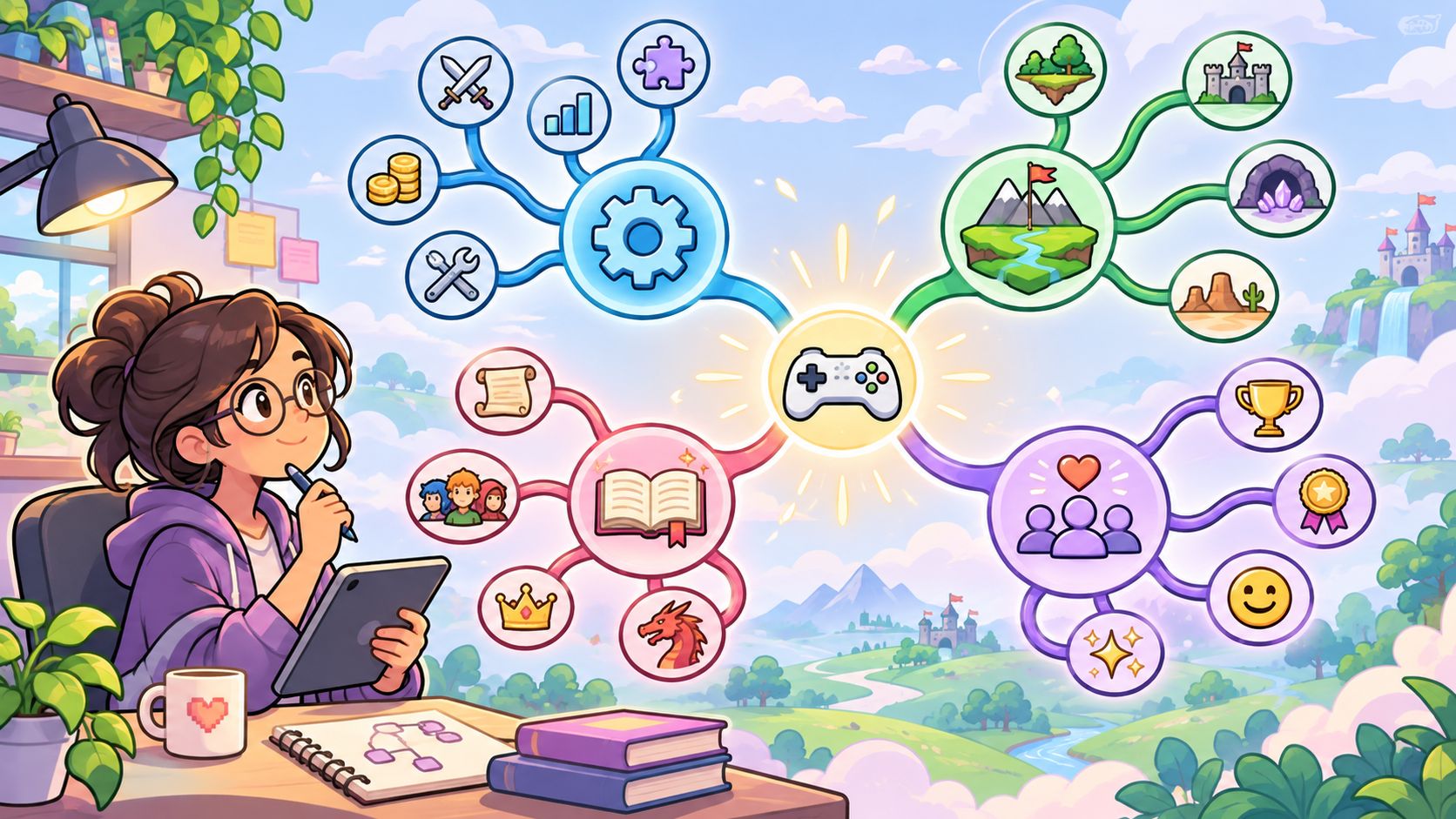
"Game designer" is not one job. It's a family of roles that share a vocabulary and differ completely in what fills the working day.
- Systems designers build machinery: combat formulas, economies, progression curves, reward schedules. Their output is tuning tables and rule documents, not screens.
- Level designers own space and pacing: encounter layouts, sightlines, difficulty ramps, checkpoint placement, and the blockouts that test all of it.
- Narrative designers own story structure and dialogue systems, including branching logic, quest flow, and character voice.
- UX designers own onboarding, HUD hierarchy, accessibility settings, and clarity when the screen is busy and the player is panicking.
- Monetization and live-ops designers own event cadence, offer structure, and the retention loops that run after launch.
India's studio base is wide enough to support these as separate jobs. In 2023 the country had more than 1,400 gaming companies, including over 500 studios, and the roles inside them spanned design, programming, animation, art, testing, production, content and user experience, per Indian Express reporting on gaming employment. Junior hiring is still broad. Specialization usually arrives after a year or two of production experience, once you've shipped something and know which part of the job you enjoy.
Pick a lane by noticing what you already do for fun
Say you open a mobile game and immediately start rewriting its upgrade costs in a notes app. That instinct is systems design. If you redraw a corridor because the pacing drags, that's level design. If you quit a game during its tutorial and can name exactly why, that's UX.
Read twenty job postings from Indian and global studios, list the responsibilities that repeat, and compare them side by side using Edvdo's interest test to check which pattern matches your own strengths before you commit to a course.
2. Build Foundational Skills in Play Analysis, Math, and Writing
Three skills carry a designer further than any engine: explaining why a game feels the way it does, doing the arithmetic behind balance, and writing so a stranger can build from your document. None of them require a formal course to start, and all of them compound.
Keep a play journal, not a review blog
Write one design observation per session, in one or two sentences. Not "the combat is clunky" but "the attack animation locks input for 400ms, so dodging after a whiff feels unresponsive." That habit builds the diagnostic eye that separates a designer from an enthusiastic player. Review mechanics rather than story when you analyse, because mechanics are what a junior designer is hired to work on.
The maths is school maths, applied
Probability, averages, and exponential growth do most of the work in balance. When a live game prices its third upgrade at a steep multiple of the second, that's an exponential curve doing retention work. Rebuild that curve in a spreadsheet, change the exponent, and watch how the grind changes. This is the fastest way to see why a system that "looks fine" on paper collapses in week two.
Write the one-page pitch
Core loop, target audience, key risk, and what you'd test first. One page, no art, no lore.
Practical rule: If you can't explain a mechanic in a paragraph without jargon, you don't understand it well enough to defend it in a review.
Strengthen the weaker of these three deliberately, and a structured skill test on Edvdo can show you which one is lagging before a studio interview does.
3. Learn a Game Engine and Basic Scripting
A designer who can't build a test gets blocked every time a programmer is busy. That's most of the week. Learn one engine well enough to prototype alone: Unity with C#, Unreal Engine with Blueprints and C++ when required, or Godot with GDScript. Ignore the engine wars until you've shipped something small.
The video below is a reasonable orientation for a first project in the engine you pick.
The hiring data points in the same direction. Core game-development positions, including Unity and Unreal roles, backend, 2D/3D art and design, made up roughly 70% to 80% of listed opportunities, and more than 80% of Indian developers' revenue comes from overseas markets, per The Hindu BusinessLine's reporting on gaming hiring. Read that second number carefully. Export orientation means your documentation, your text assets, and your UI copy will be read by people who don't share your context, so keep them clean and localization-ready from the first prototype.
Designer-facing tasks, not engine mastery
Focus on tuning exposed variables, building levels, wiring simple UI, and keeping the project in version control with readable commit messages. Leave shader work and backend architecture to specialists, and learn just enough to hold a useful conversation with them.
If you're choosing between engines for a 2D project, this comparison of Godot versus Unity for 2D games will save you a fortnight of second-guessing.
4. Prototype Ideas with Paper and Digital Tools
Paper is still the cheapest testing rig ever built. Index cards, dice, and a hand-drawn board will tell you in one evening whether a rule set creates interesting decisions, long before anyone opens an engine. Board game designers test this way for months, and digital designers skip it at their own cost.
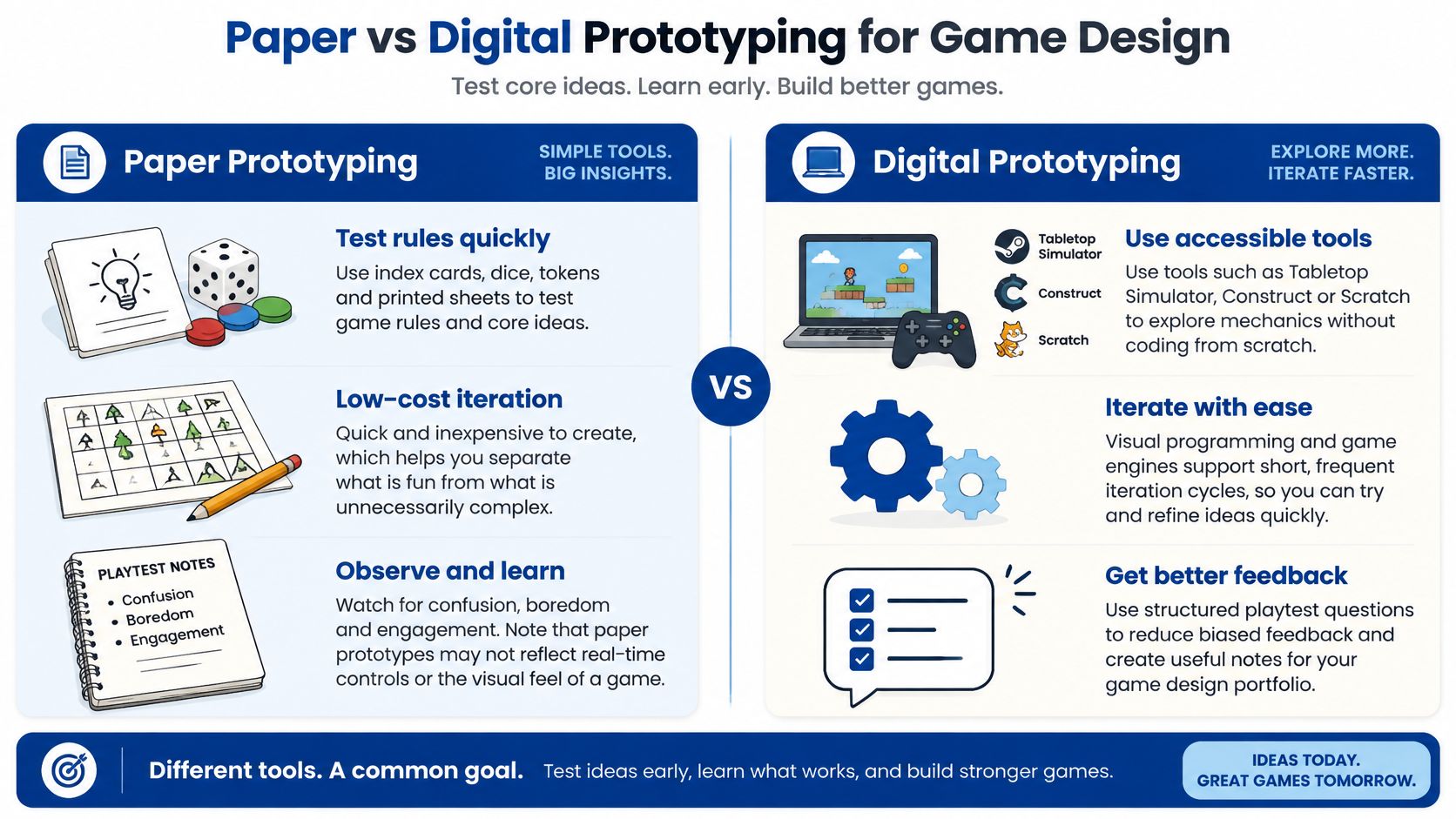
Once a rule survives paper, move to a digital build. Tabletop Simulator handles card and board logic without any code, Construct lets you assemble 2D mechanics quickly, and Scratch is enough to test a simple loop in an afternoon before you touch Unity. The point of this stage is speed of iteration, not polish.
Write the questions before the playtest
Three specific questions, written down in advance. Where do players get stuck? Which choice do they agonise over? What do they try that the rules don't allow? Vague sessions produce vague notes and teach you nothing.
A prototype that answers one question is finished. A prototype that answers none has quietly become a side project.
Keep an iteration log: what changed, why, and what the next session measured. That log becomes the backbone of your portfolio case study and, later, the evidence that your opinion about difficulty was tested rather than assumed.
5. Build a Portfolio of Playable Prototypes and Design Documents
Three to five projects beat fifteen unfinished ones. Each entry needs four things: a playable build, a one-page design document, the evidence from playtests, and a short postmortem on what you'd change. Hiring managers skim. A working link they can click in ten seconds decides whether they read the other three.
India's audience makes mobile the default testbed. The country had an estimated 511 million video-game players in 2025, with roughly 95% playing on mobile devices, according to Ken Research's India video games market report. A portfolio built only on high-end PC prototypes signals that you haven't thought about who plays here.
Design decisions worth documenting
Build two small playable projects in Unity or an equivalent engine and test them on mid-range Android hardware. Record frame rate (target a stable 30 to 60 FPS on representative low and mid-tier phones), loading time, APK size, and touch-target dimensions. Then show the softer evidence: a tutorial funnel with completion rates, five usability sessions, the revisions you made, and why.
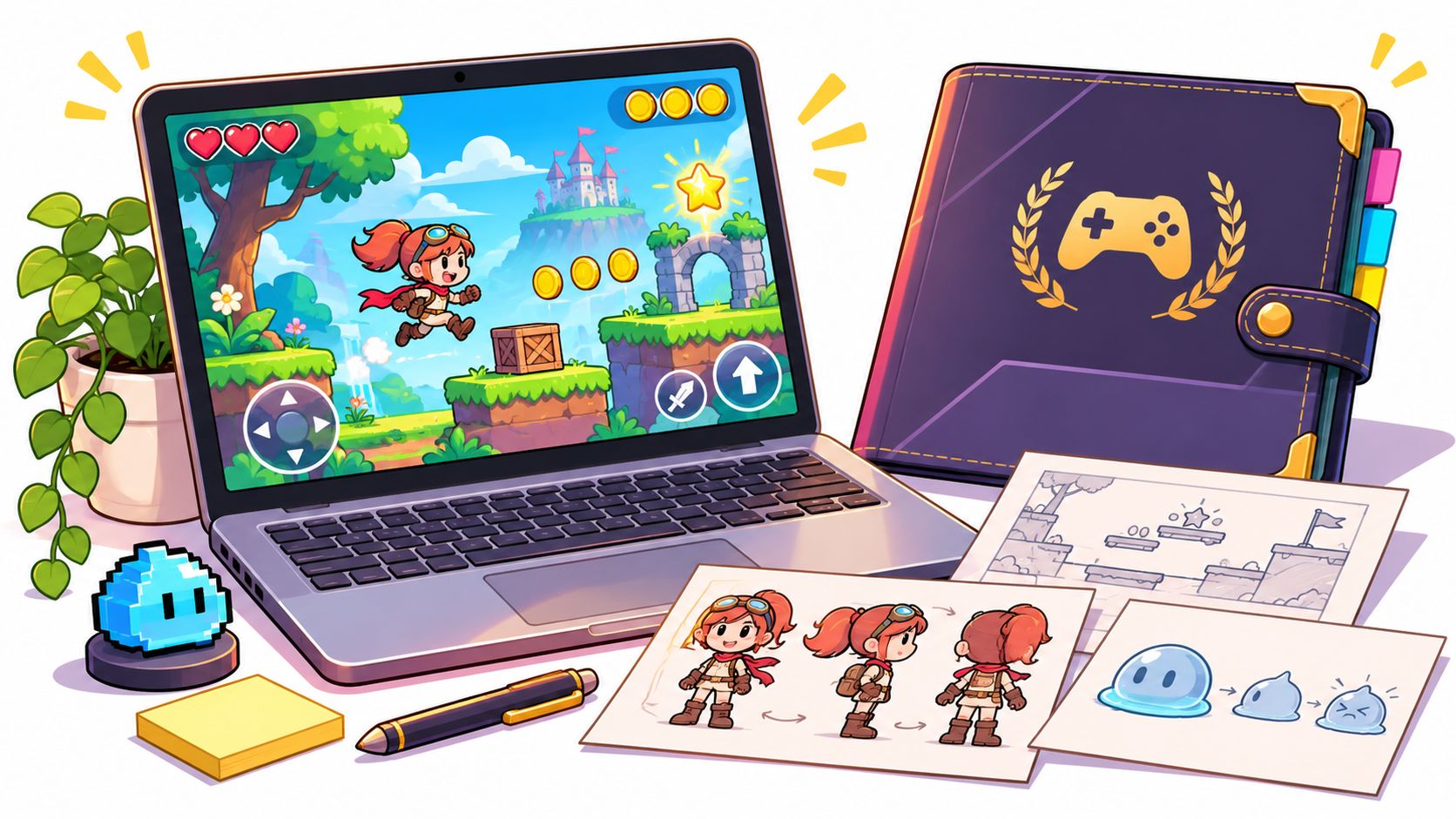
A strong case study reads like a lab report, not a brochure. Problem, hypothesis, what you built, what players did, what you changed. Include one project where the idea failed and you found out early, because that's the skill studios are buying.
6. Participate in Game Jams and Build Collaborative Skills
Jams compress a full production cycle into 48 hours or a week, which is exactly the pressure that exposes unclear design thinking. Global Game Jam runs annually with teams worldwide, and Ludum Dare hosts recurring solo and team categories. Both accept beginners, and both produce portfolio pieces with a deadline story attached.
Start with a solo jam. You'll learn your own working rhythm, where you lose time, and what scope you can finish. Team jams come second, once you know you can deliver a slice without supervision.
Finishing is the skill being tested
- Define the minimum viable game first: one mechanic, one level, one win condition, written before the theme drops.
- Cut features early and publicly: tell the team what's out on day one, not hour forty.
- Practise the two-minute explanation: describe one mechanic to a non-gamer without jargon. If they can't restate it, your spec is unclear.
- Write the postmortem within a week: what shipped, what broke, what you'd cut sooner.
Jams also generate contacts. Local developer communities in the major Indian cities are where jam teams form, and a teammate who has shipped with you is a stronger reference than any certificate. Read published postmortems from developers who finished real projects; they consistently describe the same pattern of cuts, and the pattern is the lesson.
7. Pursue Relevant Education and Structured Learning
Formal education is worth it when it buys structured critique, peers, and facilities. It's a poor deal when it buys a syllabus that hasn't been updated since the studio pipeline it describes changed shape.
Policy is moving toward the former. In November 2024, the Ministry of Information and Broadcasting announced the planned Indian Institute of Creative Technologies as a national centre of excellence for gaming, animation and related creative sectors, at the 16th India Game Developer Conference, under a public-private partnership with 52% equity from FICCI and CII and 48% from the Government of India, per the PIB release on the institute.
The gap that institute is meant to close is real. A PIB press note on gaming skills identifies demand for game designers alongside gameplay engineers, backend developers, 3D artists and animators, with about 50,000 to 60,000 open positions requiring those skills, while separate reporting highlights the distance between what Indian colleges teach and what studios require.
What to check before you pay a fee
Compare syllabi, not institute names. Look for a module that makes you ship something, a playtesting component, and someone on staff who has worked on a released title.
The title on the degree matters far less than whether you leave with three playable builds and a habit of taking notes on your own failures.
Institutions with credible design footprints include IIT Bombay's IDC School of Design, the National Institute of Design in Ahmedabad, and Srishti Manipal Institute of Art, Design and Technology. Check current admission requirements on their official pages, then use Edvdo's subject test to sanity-check whether the stream you're choosing supports the specialisation you want.
8. Gain Industry Experience Through Internships, Entry Roles, and Networking
Most designers don't start as designers. They start in QA, community management, customer support, or junior level scripting, then move sideways once they've proven they understand the pipeline. Those roles teach you how bugs get triaged, how feedback reaches the team, and how a build ships.
Studios with Indian operations, including Ubisoft Pune, Electronic Arts' Hyderabad operations, and publisher Nazara Technologies, hire across these functions. Internships convert more often than applications, because a producer has already watched you work.
The pay reality, stated plainly
A 2025 salary guide from upGrad reported that video game designers in India earned an average of ₹3.3 lakh per year with less than one year of experience, rising to ₹5 lakh for one to three years of experience, per upGrad's video game designer salary guide. That's modest next to engineering salaries, and it's the strongest argument for treating the first two years as paid apprenticeship rather than a payday. Proximity to a design team is worth more at that stage than a slightly higher salary in an unrelated job.
- Keep a bug log: every issue you report with a reproduction path and a suggested fix is portfolio evidence with a date on it.
- Ask for design-adjacent tasks: tuning passes, level scripting, tutorial copy. Small ownership beats large observation.
- Attend meetups with a prototype, not a résumé: feedback conversations turn into referrals far more often than cold applications.
Adjacent entry points exist outside studios too. Community and tournament work, including getting onto an esports team as an organiser or analyst, builds the same systems and audience instincts that live-ops roles need. Track openings as they appear on Edvdo's jobs list so your first application lands while the role is still fresh.
How the 8 Game Design Steps Compare
| Step | Main Focus | Core Skill Built | First Action | Portfolio Output |
|---|---|---|---|---|
| Understand the Game Designer Role and Its Specializations | Explore design specialties and career paths | Role research and self-assessment | Compare job postings from several studios | Specialty analysis and career notes |
| Build Foundational Skills in Play Analysis, Math, and Writing | Analyze games and communicate design ideas | Analytical thinking, math, and writing | Keep a play journal with one observation per session | Play analyses and design writing samples |
| Learn a Game Engine and Basic Scripting | Use an engine to prototype mechanics and levels | Engine skills and basic scripting | Complete a beginner tutorial and small project | Playable engine prototype |
| Prototype Ideas with Paper and Digital Tools | Test and refine game ideas | Rapid prototyping and iteration | Create a paper card-game prototype and playtest it | Prototype and iteration notes |
| Build a Portfolio of Playable Prototypes and Design Documents | Present practical design work | Documentation and case-study writing | Choose projects and write a case study for each | Playable projects, design documents, and case studies |
| Participate in Game Jams and Build Collaborative Skills | Finish games with a team under time constraints | Teamwork, communication, and scope management | Try a solo game jam | Completed jam game and project reflection |
| Pursue Relevant Education and Structured Learning | Build skills through formal or self-paced study | Structured learning and design knowledge | Compare course syllabi and admission requirements | Coursework and learning projects |
| Gain Industry Experience Through Internships, Entry Roles, and Networking | Enter the industry through adjacent roles and connections | Production experience and professional communication | Apply for QA or junior roles while building a portfolio | Work examples and documented production insights |
Turn Your First Prototype Into a Career Plan
Thirty days is enough to change how a studio reads your application, and it's enough to find out whether design is the right fit before you spend three years and a large fee on a degree.
Week one: paper
Pick one mechanic you find interesting. Build a paper version with index cards and dice, write three questions, playtest with three people, and record what changed. One evening of work, one page of notes.
Week two: digital
Rebuild the same idea in a single engine, at the smallest scope that still proves the mechanic. Test it on a mid-range Android phone, note the frame rate and load time, and fix the two worst issues.
Week three: evidence
Run five short sessions and log completion, drop-off, and confusion points. Revise the build once, then write the one-page case study: problem, hypothesis, decisions, evidence, what you'd change.
Week four: route
Publish the build with a playable link and the case study, then map the education and entry routes that fit your budget and location. This is the point where guidance earns its keep, because the choice between a design degree, a computer science degree with a design portfolio, and a QA-to-design route depends on your strengths, not on rankings.
Edvdo's four-step process of assessing strengths, exploring pathways, connecting with a counsellor, and tracking progress is built for exactly this decision, and its free first career counselling session is a sensible way to pressure-test your plan before committing.
If you want the route mapped before you pay for a course, Edvdo combines an AI career assessment, a searchable career hub, and one-on-one sessions with dedicated counsellors so you can compare game design specialisations, stream choices, and entry routes against your own strengths. Start with the free first career counselling session, bring your prototype and your case study, and use the conversation to decide which qualification, if any, is worth the money. Visit Edvdo to book that session and begin.