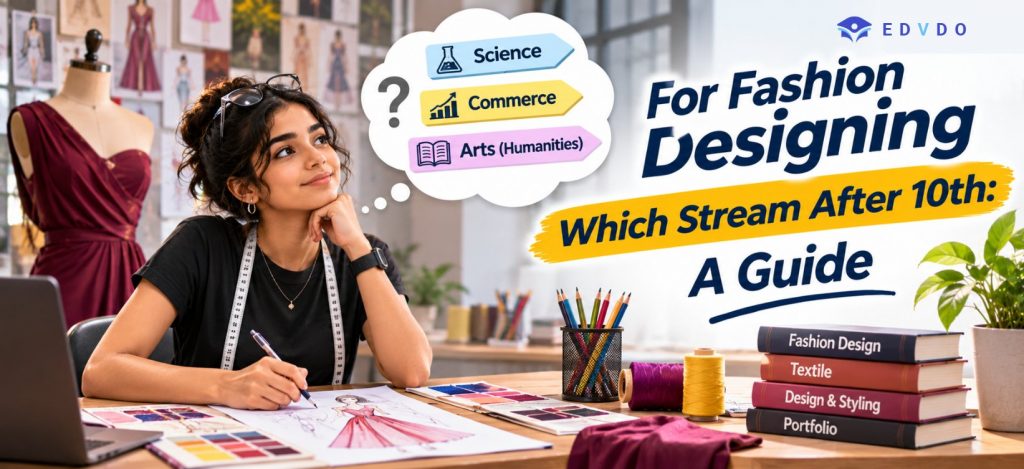
No Class 11 stream is compulsory for fashion designing in India. A student can pass Class 12 in Humanities, Commerce, Science or any other recognised 10+2 pathway and still apply for a Bachelor of Design, and a recognised three-year diploma completed after Class 10 also qualifies candidates for specified undergraduate admission routes at design institutes.
So why does almost every answer to for fashion designing which stream after 10th still come back as a single word, Arts? Because the advice repeats a habit rather than a rule. The habit dates from a time when design seats were few and portfolios were judged almost entirely on drawing. The rule today is narrower and far more useful: finish a recognised 10+2, keep the subjects you can score in, and build a body of work that proves you can turn an idea into a finished garment.
That gap between habit and rule is where families get stuck. A parent hears "Arts" and starts worrying about fallback options. A student hears "Science" and assumes design is closed to them. Both reactions come from a rule Indian design admissions don't apply.
Table of Contents
- Which Class 11 Stream Suits a Future Fashion Designer
- Whether Your Stream Limits Future Fashion Routes
- School Subjects That Build a Fashion Foundation
- Skills to Build Outside Class for Design Work
- Fashion Careers Open to Each Background
- Myths About Stream Choice and a Decision Rule
Which Class 11 Stream Suits a Future Fashion Designer
No Class 11 stream is compulsory for fashion designing in India, so the stream should match the specialisation you want to work in later. That single sentence settles most of the anxiety in this decision. What changes between streams isn't whether you're allowed in. It's which part of the industry you'll find easiest to learn.
| Stream or route | Best fit for | Add alongside | Main limit |
|---|---|---|---|
| Humanities or Arts | Illustration, textiles, fashion history, visual communication | Sewing practice, basic measurement, portfolio work | Less maths and costing exposure in school |
| Commerce | Merchandising, retail, costing, fashion business and brand management | Sketching, sewing, a design portfolio built outside class | Little hands-on design time in the timetable |
| Science | Textile technology, fibres, materials, quality control, sustainability | Sketching, digital design, garment construction practice | Creative subjects need self-study and portfolio effort |
| Vocational diploma after Class 10 | Hands-on garment construction, pattern making and CAD from an early age | A sample portfolio and industry exposure | Narrower route into some degree programmes; check eligibility first |
Read the table by the second column, not the first. A student who wants to sit and draw a collection all day belongs in Humanities or Arts if the school offers design, fine arts, home science or textile subjects, because those periods double as portfolio time. A student who loves the business side, pricing a kurti range, planning a store's seasonal buy, negotiating with a vendor, gets more from Commerce than from an extra drawing period.
Science looks like the odd one out until you look at what the industry runs on. Fabric behaviour, dyeing chemistry, testing standards and compliance paperwork are science-shaped problems dressed in fashion language. A student who enjoys that side can take Science and still build a design portfolio on weekends.
A useful test: pick the stream that gives you the most design exposure while keeping the subjects you're strong in, then check that choice against the role you want to hold in ten years.
Say a student is torn between Commerce and Arts. Both keep a Bachelor of Design open. Commerce keeps cost accounting and business studies, which help later in merchandising. Arts keeps history and drawing, which help in illustration. The tie-breaker isn't the label. It's whether the student already sketches without being told to, or already reads about how brands price and sell.
The vocational diploma row needs a warning label. It gets a student into pattern making and garment construction earlier than any classroom route, but it can narrow the path into some degree programmes. It's a strong choice for someone certain about the technical side and weak for someone still deciding.
Whether Your Stream Limits Future Fashion Routes
For a Bachelor of Design, the threshold students have to clear is completing Class 12 or an equivalent examination from a recognised board. Stream isn't the gate. The gate is finishing senior secondary, then clearing the institute's entrance test and eligibility checks.
NIFT is the clearest example to study. Its official admissions page sets out the senior secondary route for undergraduate applicants, and the 2024 guidelines confirm both the Class 12 route and a recognised diploma-after-Class-10 route, including diplomas in Fashion, Apparel, Textile and Accessories, Home Science, Handloom Technology, Visual Communication, Graphic Design, Industrial Design, Interior Design, Multimedia Design, Leather and Fine Arts. That list alone tells you how wide the doorway is.
So a student who picks Commerce in Class 11 and spends the next two years sketching on Sundays has lost nothing. They sit the same entrance test with the same eligibility.
| Route | Eligibility | Typical length | Leads to |
|---|---|---|---|
| Class 12 in any stream, then B.Des | Pass Class 12 or equivalent from a recognised board; entrance exam and portfolio | Four years | Bachelor of Design in fashion design |
| Class 10, then recognised diploma | Pass Class 10, then a diploma in Fashion Technology or Designing from a recognised body | Three to four years | Diploma-level designer or technician roles; some NIFT undergraduate routes |
| Class 10, then National Trade or Apprenticeship Certificate | Pass Class 10, plus the age requirement set for that qualification | Shorter than the diploma route | Skilled garment-making and production roles |
Read each row in three steps. Check the eligibility line first, because that's where people wrongly eliminate themselves. Then check duration, because the school route costs two extra years but buys a degree later. Then check where the row lands you: a diploma opens work sooner, while a degree opens postgraduate study, teaching and larger brand roles.
The trade-off is real on both sides. The Class 12 route keeps every degree option open and gives a student two more years of maturity before choosing a specialisation. A diploma straight after Class 10 puts a needle in a student's hand at fifteen and pays sooner, but a degree later may need bridging steps.
Check the institute's current admissions page every year, in the month the notification usually drops. Dates, eligibility wording and course lists change, and last year's PDF has sunk more applications than any stream choice.
School Subjects That Build a Fashion Foundation
Where a school offers Fashion Studies, it's the closest thing to professional training on the timetable. It doesn't replace the 10+2 eligibility requirement, but it makes the first year of a design degree feel familiar instead of foreign.
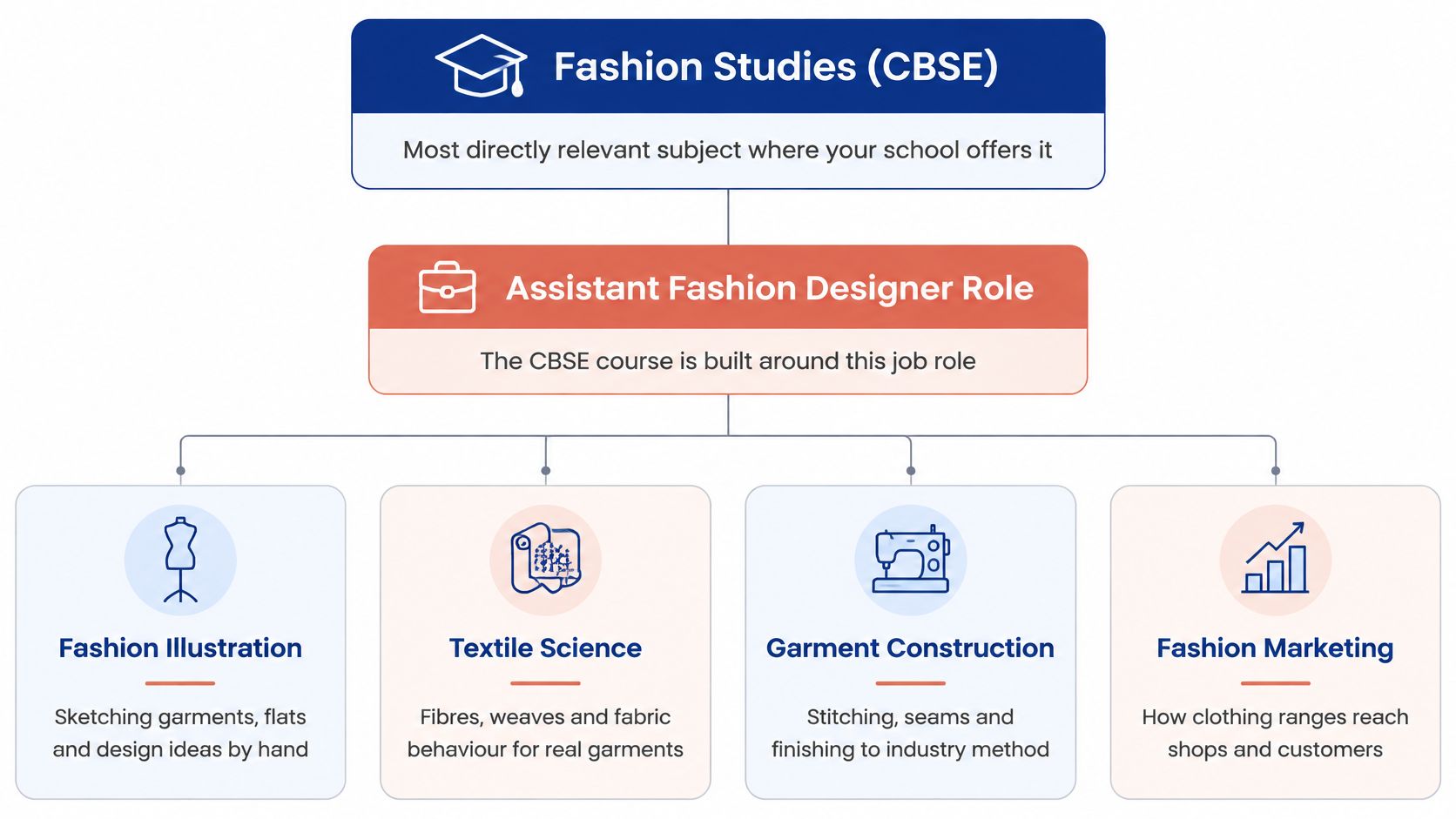
The CBSE Fashion Studies curriculum is built around the assistant fashion designer job role. It covers fashion history, fabrics, dyeing and printing, design fundamentals, materials, tools, product-making processes, pattern development and garment construction. In the 2022-23 framework it carries 100 marks in each of Class XI and XII, split into 60 theory and 40 practical.
That 40-mark practical share is the part worth defending in a conversation with a school. Fabric behaviour decides how a garment drapes. Body measurements decide whether a pattern is accurate. Seam allowances and construction methods decide fit. Colour, texture and proportion decide whether the finished piece looks deliberate or accidental. None of that gets learned from a textbook diagram.
A student who wants a head start on subject selection can use a short subject test to see which combination plays to existing strengths before committing to three years of study.
What to record during Class 11 and 12
A portfolio is built from evidence, and evidence has to be collected while the work is happening. These items are the ones that keep proving useful:
- A running design sketchbook: dated pages, including bad drawings, so growth is visible.
- Flat drawings and mood boards: technical flats for a garment idea plus the reference images behind it.
- Fibre and weave identification notes: labelled fabric swatches with a one-line description of behaviour.
- Stitch samples: hand and machine stitches on labelled squares, with the tension settings noted.
- Simple blocks and patterns: basic bodice or skirt blocks, with the measurements used written on them.
- Photographs of finished samples: shot in daylight against a plain wall, front and back.
Mathematics isn't usually compulsory for Bachelor of Design admission, but measurement, proportion, geometry and costing calculations run through every studio brief. A student who fears numbers should practise them in a fashion context rather than avoid them.
Judge a school by its workshop access and how much finished work students walk out with, not by the stream printed on the timetable. Fashion Studies availability varies by board and by school, so the CBSE course is one strong example rather than a universal standard. Confirm subject offerings with the school and programme requirements with each institute.
Skills to Build Outside Class for Design Work
The gap between the creative image of fashion design and what employers ask for shows up clearest in one number. An Apparel Made-Ups and Home Furnishing Sector Skill Council study reports that CAD is used by 63% of surveyed employers. The same study finds digital MIS and ERP skills preferred by 28% of employers but held by only 2% of workers, and flags sustainability compliance, automated-machine operation, quality systems and 2D and 3D CAD as emerging needs.
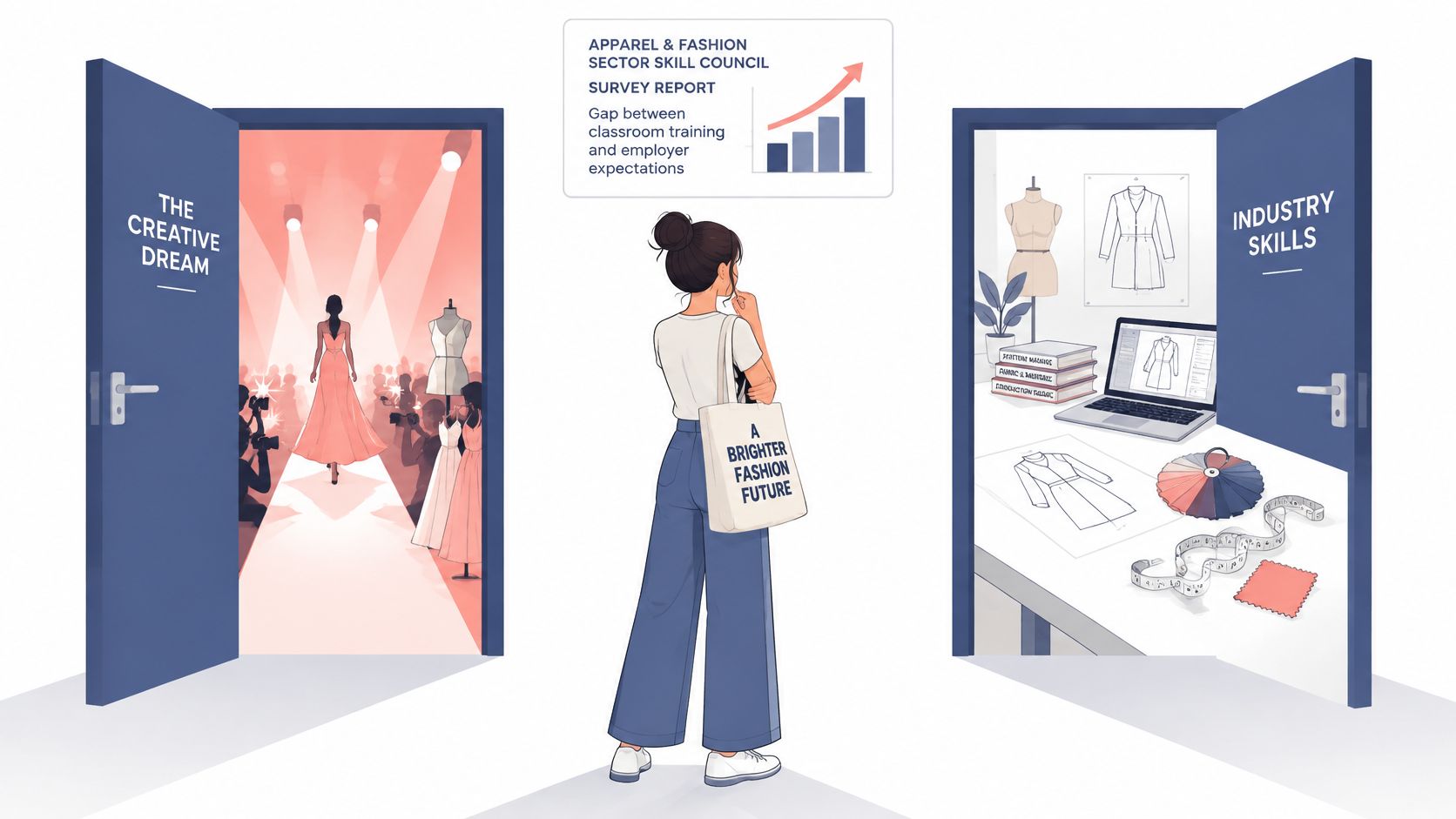
Training demand runs the same way. The study cites the Ministry of Textiles' position that around 67% of the garment workforce requires skill training and another 10% requires upskilling. A student choosing a stream is choosing the base layer of a much longer skill story.
So what should a Class 11 student do this term? Start with CAD, because it's the most widely used tool and the easiest to sample. Most packages offer student or trial licences, and free browser-based pattern tools exist for flat drafting. A student can learn the interface on a simple skirt block without spending anything.
Build a digital portfolio in a plain folder on the phone. Photograph finished samples in daylight, scan sketchbook pages at a print shop, and name files consistently so the folder can be shared with an institute or an interviewer later.
Practise sewing weekly, even badly. A starter kit sized for a teenager, with sharp shears and a decent seam ripper, removes the most common reason practice stalls; this guide to choosing a sewing kit for teens covers what to look for. Learn a handful of sustainability terms properly, such as fabric waste, deadstock and material sourcing, because they now appear in interviews and college briefs. Basic product photography is a skill too, and a phone, a window and a white sheet cover it.
Answering the most common question directly: a portfolio doesn't need expensive software. A paper sketchbook, scanned pages and well-lit photographs of three finished garments will outperform a badly documented digital file.
Students who want to know which of these skills fits them best can take a skill test and compare the result with the roles that interest them before investing in a course.
Fashion Careers Open to Each Background
The number of roles sitting around fashion design explains why the stream question feels so heavy. The Press Information Bureau reports that India's textile sector directly employed around 5.6 crore people by the end of 2023-24, according to PIB's sector blog. Design is one role inside that crowd, not the whole crowd.
| Role | Core skills | Helpful background | Usual entry route |
|---|---|---|---|
| Fashion designer | Sketching, fabric knowledge, portfolio building | Arts, or any stream with a strong portfolio | B.Des or recognised diploma |
| CAD pattern technician | 2D and 3D CAD, pattern making, measurement | Science or Maths | Diploma or certificate course with CAD training |
| Merchandiser | Costing, buying, market trends, sales planning | Commerce | Degree or diploma in fashion business or merchandising |
| Quality executive | Garment inspection, measurement standards, defect checks | Science | ITI or diploma in garment technology |
| Production coordinator | Scheduling, factory processes, supplier follow-up | Commerce or Science | Diploma plus industry experience |
| Textile developer | Fibres, weaves, dyeing, fabric testing | Science | Textile or fashion degree |
Read a row by its second column. If the core skills listed are the ones a student reaches for on a free afternoon, that row is worth exploring regardless of the stream they've already chosen. Nobody is locked out of design by taking Science, and nobody is locked out of merchandising by taking Arts.
The Display Guru guide for aspiring tailors is worth a look for students drawn to the construction side, since it describes the craft progression from alteration work to made-to-measure garments, which is the same skill ladder a production or quality role builds on.
Shorter routes into these roles are real and government-backed. The Ministry of Textiles' 2024 year-end review reports that more than 3.54 lakh people had been trained under the Samarth programme by 30 December 2024, with 2.79 lakh receiving placements. Employers on the factory and export side often weigh a short course plus a clean sample portfolio against a longer qualification, especially for technician and coordination roles.
Scale is still growing. Invest India's textiles and apparel sector profile projects the market reaching $350 billion by 2030 from $174 billion, which is a projection rather than a current figure, and reports annual output of about 22,000 million garment pieces. More volume means more coordination, quality and technical roles alongside design.
A student with a clear career picture can use a career report to compare recommended paths against these rows and see which one keeps showing up.
Myths About Stream Choice and a Decision Rule
The most persistent belief is that fashion designing needs Arts. Indian fashion-design pathways don't generally require one specific Class 11 stream, and National Qualification Register material recognises routes that begin at Class 10, including a three-year diploma in Fashion Technology/Fashion Designing and Technology and a Class 10 qualification followed by a one-year National Trade Certificate or National Apprenticeship Certificate, with a minimum age of 16 for that qualification.
That's the structural fact worth holding onto. Four myths tend to survive after it:
- Science closes the door on design. It doesn't. A 10+2 pass in any stream meets the standard undergraduate eligibility requirement, and Science strengthens textile technology, materials, production and sustainability work.
- Commerce means no creativity. Commerce students build portfolios like everyone else and then specialise in merchandising, retail, costing or brand management, where the creative decisions are commercial ones.
- A Class 10 diploma closes every degree door. Check each programme individually. Some undergraduate routes accept recognised diplomas, and some don't.
- Fashion design is only about how things look. Quality systems, production planning and CAD matter as much as the sketch, and the sector skill evidence points squarely at those gaps.
Consider a student pushed towards Science by family expectation, who then spends a weekend comparing subject combinations against the roles in the table above. The comparison usually reveals something concrete: the student enjoys fabric and construction more than formulae, but the Science base will help in textile testing. That's not a failed decision. It's a decision with a named specialisation attached, and it can be tested rather than argued about.
One student described the shift plainly: "My parents wanted me to take science, but I wasn't sure if that's right for me. EDVDO's career test helped me understand my strengths, and the AI chatbot gave me so many career options I never knew about." The point isn't the tool. It's that family expectations became a conversation about evidence.
A five-step decision rule
- Name the role you want most, using the six rows above rather than the word "fashion".
- List the subjects you already do well in and enjoy, because three years of a subject you dread costs more than a stream label ever will.
- Match role to stream, then confirm that the Class 12 route stays open so a degree remains possible.
- Verify eligibility and entrance requirements on the institute's current admissions page before deadlines, not after results.
- Start the portfolio now with a sketchbook, sample photographs and one small sewing project a month.
Step five is where most plans die. A student waiting for the "right" stream before touching fabric will lose a year that could have produced six garments.
An interest test is a reasonable first move when the role still feels unclear, and so is a conversation with a school counsellor. Both do the same job: they replace assumption with evidence. Edvdo's four-step process runs Assess, Explore, Connect and Track, which mirrors how a student should approach this choice. A student only needs to share academic background and career aspirations to book a session.
The stream is the first decision in this path, not the last one. The portfolio is what gets reviewed, and it's built in whichever stream the student happens to sit in.
Choosing a stream is the first of many decisions on this path, and it's the one where evidence beats guesswork. Edvdo helps students in Classes 8 to 12 work through exactly this kind of choice with assessments, a searchable career hub and an AI mentor named Vedu who answers the questions that come up at odd hours. Visit Edvdo to explore fashion roles, compare the subjects that lead to them, and build a plan that starts this term rather than after results.