

A Class 10 student may enjoy biology, feel curious about hospitals, and still have no clear idea what comes after the board examination. A parent may suggest the traditional science route, while the student wonders whether there's a practical way to enter healthcare sooner. That uncertainty is normal, especially because “DMLT after 10th” can refer to a different programme structure from the diploma offered after Class 12.
The Diploma in Medical Laboratory Technology, or DMLT, can provide an early vocational route into laboratory-based healthcare. It isn't a replacement for every higher qualification, and it isn't automatically accepted in the same way by every employer. The important decision involves comparing the institute, curriculum, clinical training, recognition, and future study options before admission.
Table of Contents
- Starting Your Healthcare Journey After Class 10
- Understanding DMLT Program Structures
- What You Will Learn in DMLT Classes
- After 10th vs After 12th – Which Path to Choose
- Career Opportunities and Salary Expectations
- Addressing Common Myths About Early Specialization
- Your Step-by-Step Admission Checklist
- Taking the Next Step in Your Career
Starting Your Healthcare Journey After Class 10
Riya has just completed Class 10. She enjoys biology, prefers careful practical work to public speaking, and likes the idea of contributing to patient care. Medicine seems attractive, but the long academic route feels intimidating. Nursing interests her less because she doesn't want constant bedside interaction. A school counsellor introduces her to medical laboratory technology, where trained professionals examine samples and support doctors with diagnostic information.
That conversation gives Riya a useful distinction. Healthcare isn't limited to doctors and nurses. Laboratories need people who can handle samples responsibly, operate testing equipment, follow procedures, and record findings accurately. A DMLT course can introduce students to that environment through a skill-focused programme.
An early route, not an automatic shortcut
Some Indian institutes allow entry after Class 10, while others reserve DMLT admission for students who have completed Class 12 with science subjects. Education sources describe DMLT as commonly structured as a two-year, four-semester programme, with selected institutes offering a longer route for students entering after Class 10 (eligibility and DMLT structure in India).
That difference matters. A student choosing the after-10th pathway isn't just joining the same course earlier. The programme may include more foundational learning, use a polytechnic-style structure, or follow local eligibility rules. The institute's prospectus should always be treated as the final reference.
Practical rule: Early entry is valuable only when the qualification remains credible, the training is supervised, and the next academic step is clear.
For families, the sensible question isn't “Can this student start immediately?” It's “What will this student be qualified to do after completion, and which recognised institutions or employers will accept the credential?” That question turns enthusiasm into a responsible career decision.
Understanding DMLT Program Structures
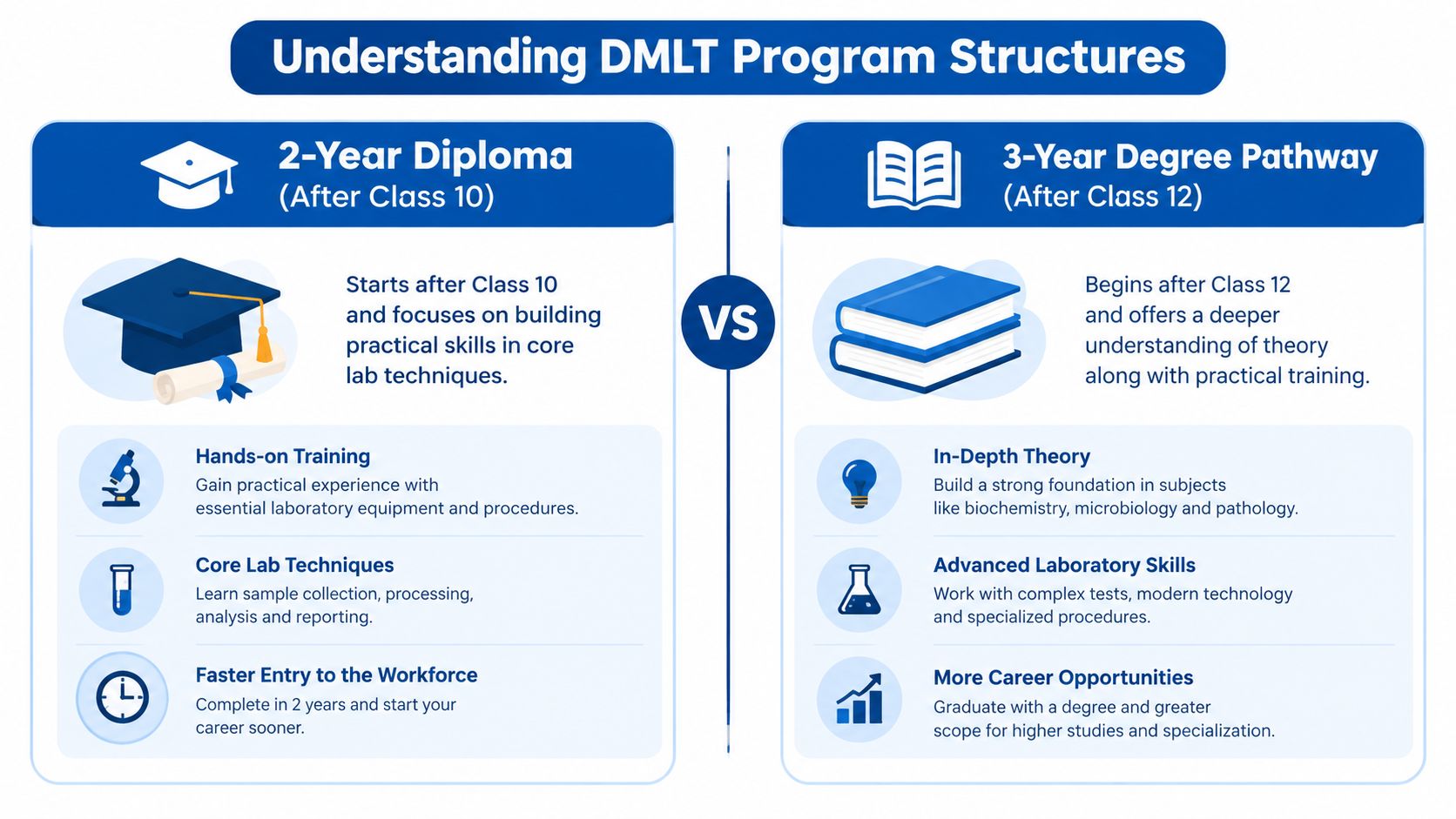
DMLT programmes in India don't follow one universal pattern. Confusion usually begins when a college uses the same course name for different entry levels. A student entering after Class 10 may be offered a longer diploma, while a Class 12 science student may be considered for the more standard post-secondary version.
The after-10th structure
The after-10th route is often designed as an early vocational bridge. Some institutions accept Class 10 or matriculation as the entry qualification, and the programme may run for three years rather than two. Govt Polytechnic Panchkula, for example, lists a pass in the Matric Examination from the Haryana State Board or an equivalent qualification for its medical lab technology programme (official medical lab technology eligibility details).
Students may study basic science alongside laboratory subjects before progressing towards more specialised practical training. This structure can suit a learner who already has a strong interest in healthcare and prefers applied education. It also means that institute selection deserves extra attention, because after-10th eligibility isn't universal.
The after-12th structure
The standard route generally begins after Class 12 science, commonly with Physics, Chemistry, and Biology. The DMLT diploma is commonly organised as a two-year, four-semester programme, although exact rules vary by institution. Several colleges expect minimum marks in the relevant science subjects, so a Class 12 student usually enters with a stronger academic foundation.
The difference can be summarised in this way:
| Feature | After 10th | After 12th |
|---|---|---|
| Entry point | Class 10 or matriculation at selected institutes | Class 12 science at many institutes |
| Course design | Early vocational and foundational route | More direct technical diploma route |
| Duration | Often longer, depending on the institute | Commonly shorter than the after-10th route |
| Main advantage | Earlier exposure to healthcare skills | Stronger science preparation before laboratory training |
| Main concern | Recognition and progression must be checked carefully | The student spends longer in school before specialisation |
The phrase “after 10th DMLT” therefore needs a question attached to it: which institute, which awarding body, and which programme structure? A course title alone doesn't answer those questions.
What You Will Learn in DMLT Classes
A student entering DMLT after Class 10 may first meet unfamiliar terms such as pathology, microbiology, and hematology. A useful comparison is a city's health system. Anatomy and physiology show how the city is built and how its transport routes work. Pathology studies what has gone wrong, while laboratory testing gathers evidence. Learning the subjects in this order helps younger students connect theory with practice.
The academic foundation
Anatomy and physiology cover the body's organs, systems, and normal functions. This foundation explains why a particular sample matters and how illness can change the body.
Pathology examines disease processes and changes in cells, tissues, blood, and other specimens. Students learn that a laboratory result is not just a number. It depends on correct procedures and must be understood in its clinical context.
Biochemistry explores substances and chemical reactions in the body. Practical classes may involve sample handling and the use of instruments for biochemical tests.
Microbiology introduces microorganisms such as bacteria and fungi, together with methods for identifying them safely. Students must work carefully because contamination can alter results and create risks in the laboratory.
Hematology focuses on blood, blood cells, and related investigations. Histopathology examines tissues. Blood banking introduces the controlled testing, storage, and handling procedures connected with blood services.
The curriculum commonly includes anatomy and physiology, pathology, biochemistry, microbiology, hematology, histopathology, and blood banking across four semesters (DMLT curriculum and career overview). For an after-10th student, these subjects form the bridge between school science and specialised healthcare work.
Practical work is central
DMLT classes require more than memorising definitions. Students practise the pre-analytical and analytical stages of laboratory work. Pre-analytical tasks may include confirming a patient's details, supporting sample collection, labelling, storage, and transport. Analytical work includes testing, instrument use, quality checks, and accurate record-keeping.
A practical session may follow this sequence:
- Confirm the sample identity and related information.
- Prepare the workspace and equipment.
- Follow the approved testing procedure.
- Record observations clearly.
- Complete quality-control checks before reporting a result.
The equipment and amount of clinical exposure vary by institute. Families should ask whether students use a functioning laboratory, receive supervision during procedures, and complete meaningful clinical training. These checks matter especially after Class 10, because programme titles can sound similar while their facilities, recognition, and progression options differ.
Modern laboratory science also uses molecular methods. Students seeking wider background can read about how DNA detects disease to see how genetic material can support diagnostic investigation. This resource can broaden understanding, but it should supplement the formal DMLT syllabus rather than replace classroom and laboratory training.
After 10th vs After 12th – Which Path to Choose
The right route depends less on speed and more on preparation. An after-10th student may gain earlier vocational exposure, but the longer programme can include foundational learning that a Class 12 science student has already completed. An after-12th student may enter with greater confidence in biology and chemistry, but must remain in general education before starting specialised laboratory training.
A decision framework for families
| Feature | After 10th | After 12th |
|---|---|---|
| Academic starting point | Secondary education, with science preparation that may vary | Completed higher secondary science education |
| Learning emphasis | Foundation building plus laboratory skills | More concentrated technical and laboratory learning |
| Entry timing | Earlier entry into an allied-health environment | Later entry, with stronger subject preparation |
| Course length | Often a longer institute-specific pathway | Commonly the shorter standard diploma route |
| Suitable for | Students seeking applied learning and early specialisation | Students comfortable continuing science studies first |
| Long-term question | Recognition, progression, and employer acceptance | Alignment with competency-based and higher-study pathways |
A student who already knows that laboratory work suits their temperament may favour early specialisation. Attention to detail, patience, comfort with repetitive procedures, and respect for safety rules are more important than an attractive course brochure. A student who remains uncertain about healthcare may benefit from completing Class 12 first, because the additional science education preserves broader academic choices.
The credibility question
The after-10th option deserves careful scrutiny because entry rules differ between institutions. The National Commission for Allied and Healthcare Professions has released a competency-based DMLT curriculum designed for Class 12 science students, a development discussed in India-focused career guidance on DMLT after 10th and its longer-term value. This suggests that formal competency and standardisation matter increasingly in the field.
A shorter route isn't automatically stronger, and a longer route isn't automatically weaker. The useful comparison is between verified outcomes, practical training, recognition, and future eligibility.
Parents should ask the same questions of both pathways. Does the awarding body have a clear identity? Are practical hours explained? Can the institute show its affiliation or approval documents? Do graduates receive guidance for higher study? A transparent answer is more valuable than a promise of quick employment.
Career Opportunities and Salary Expectations
A DMLT graduate steps into the part of healthcare that keeps diagnosis grounded in evidence. The work often begins in hospital laboratories, pathology laboratories, diagnostic centres, blood banks, and research settings, with the exact option depending on the qualification, local rules, employer requirements, and practical skill.
A fresh graduate may be hired as a medical laboratory technician, laboratory assistant, sample-processing technician, or in another entry-level support role. Job titles can sound similar while carrying different duties, so students should read the job description carefully instead of assuming every DMLT holder fits every laboratory post.
What employers tend to notice
A certificate opens the door to an interview. What happens after that depends on how ready the student is for real laboratory work.
Employers often look for sample discipline, meaning correct identification, labelling, storage, and handling. They also value technical accuracy, because one careless step can affect the result. Quality awareness matters too, since unreliable findings can influence clinical decisions. Alongside that, professional conduct, such as confidentiality, punctuality, teamwork, and respectful communication, helps a candidate stand out. Adaptability is also important, because laboratories keep adding new equipment, digital systems, and testing routines.
The work is close to patient care even when it happens behind the bench. A technician who handles samples carefully and communicates clearly supports safer treatment decisions.
Salary should be treated as an estimate
Pay varies by location, employer type, experience, job duties, and the recognition of the qualification. There is no single number that fits every first job, which is why salary should be read as a range of possibilities rather than a promise.
Students can also compare laboratory roles with other healthcare career opportunities to see how the after-10th route fits their long-term plans. The core decision should include course quality, travel or accommodation costs, practical exposure, and the option to study further later on.
Addressing Common Myths About Early Specialization
Myth one: “An after-10th diploma has no value.”
The qualification can have value when it comes from a recognised and transparent institution and includes relevant practical training. The concern isn't that every early diploma is poor. The concern is that course names can hide major differences in eligibility, duration, affiliation, and employer acceptance.
Myth two: “A diploma is the same as a degree.”
A diploma and a degree are different qualifications. A DMLT diploma can prepare a student for technician-level work, while degree-level study may offer broader academic depth and different progression options. Families should avoid comparing them as if they were interchangeable.
Myth three: “Starting early guarantees a job.”
Early entry creates an opportunity to build skills sooner, but employment still depends on competence, institute recognition, clinical exposure, local vacancies, and employer criteria. A student who treats practical training as a formality may struggle despite holding a certificate.
Myth four: “The diploma ends academic growth.”
A DMLT diploma can serve as a foundation for further study, subject to the admission rules of the next institution. Possible directions may include an advanced diploma, a relevant bachelor's programme, or additional laboratory specialisation. The exact progression route must be confirmed before enrolment rather than assumed after graduation.
The strongest argument for early specialisation is practical clarity. Students learn whether laboratory work really suits them before investing in a longer academic path. The strongest caution is equally clear: early choice should remain an informed choice. Guidance on career myths that still mislead Indian students can help families test attractive promises against actual admission and employment conditions.
Your Step-by-Step Admission Checklist
Admission becomes less stressful when families separate the decision into verifiable tasks. A student considering DMLT after 10th can use the following checklist before paying any fee.
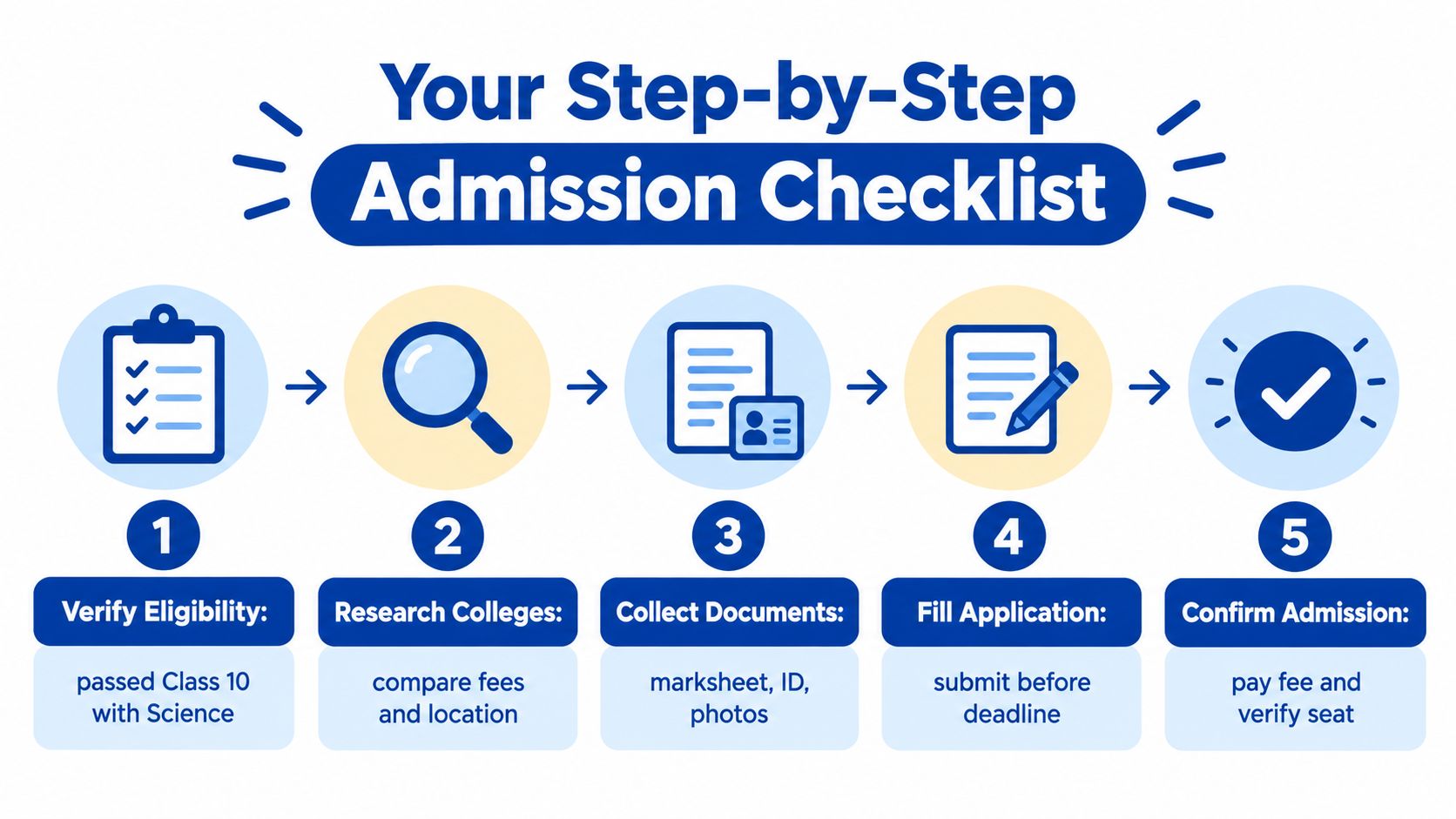
Verify eligibility. Confirm whether the institute accepts Class 10, whether science subjects are required, and whether the programme is specifically a diploma rather than a short certificate course.
Inspect recognition. Ask for the awarding body, affiliation, approval information, and the name printed on the final certificate. The institute should provide written details rather than relying only on verbal assurances.
Examine practical training. Check the laboratory facilities, equipment access, instructor qualifications, clinical tie-ups, and timetable for hands-on sessions. A course that promises laboratory careers should demonstrate where students practise.
Compare the complete cost. Include tuition, examination charges, uniforms, equipment, travel, accommodation, and any placement-related fees. A low advertised fee may not represent the full cost.
Prepare documents. Common documents may include the Class 10 marksheet, identity proof, photographs, transfer or migration documents where applicable, and category or domicile certificates if required by the institution.
Confirm selection rules. Some institutes use merit, interviews, or local admission procedures. The official notice should state deadlines, payment stages, refund rules, and whether an entrance examination applies.
Keep written evidence. Save the prospectus, offer letter, fee receipt, affiliation details, and correspondence. This record protects the family if the institute later changes its explanation.
A structured career planning resource for students can help organise questions about interests, subjects, and progression before the final application. The final decision should follow document verification, not pressure from an admission agent.
Taking the Next Step in Your Career
DMLT after 10th can suit a student who has a genuine interest in biology, practical work, and healthcare support. The route may offer earlier exposure to laboratory skills, but its value depends on the quality and recognition of the programme. A longer after-10th structure can be appropriate when it builds the foundation needed for safe technical work.
The after-12th route remains a strong alternative for students who want deeper science preparation before specialising. Neither pathway should be chosen just because it appears faster, cheaper, or more prestigious. The better route is the one that matches the student's academic readiness, learning preferences, financial circumstances, and long-term plans.
Before applying, a student can speak with a laboratory professional, visit an institute, inspect the practical facilities, and request written information about recognition and progression. Parents can support the process by asking questions without dismissing the student's early interest. Careful research now can prevent an expensive change of direction later.
A student who chooses DMLT should enter with realistic expectations. Laboratory work requires precision, discipline, patient safety awareness, and continuous learning. With the right training environment and a clear plan for future study, an after-10th diploma can become a purposeful beginning rather than a rushed decision.
Edvdo helps students explore strengths, learning patterns, courses, and career paths through assessments, guided activities, reports, and its AI mentor, Vedu. Students and parents can use these tools to compare DMLT with other healthcare options and visit Edvdo to begin a more informed career planning process.
Drafted with Outrank app