

After Class 12, a student may know one thing with certainty: technology looks appealing. The uncertainty begins when two course names appear on the application form, Bachelor of Computer Applications (BCA) and BSc Computer Science. Both can lead to software, data, networking, and other IT careers, but they don't ask students to learn computing in the same way.
A Commerce student who enjoys building websites may find BCA more accessible, while a Science student who enjoys mathematics and algorithms may feel more comfortable with BSc Computer Science. The important question isn't which title sounds more impressive. It's which academic route matches the student's background, learning style, and long-term plans.
Table of Contents
- Introduction to the Core Dilemma
- Structural Differences in Degree Design
- Eligibility and Admission Flexibility
- Curriculum Focus and Learning Style
- Career Outcomes and Salary Prospects
- Which Path Suits Your Goals
- Real-World Scenarios and Final Recommendations
Introduction to the Core Dilemma
Riya has studied Commerce in Class 12 and wants to become a software developer. Her friend Arjun has studied Science with Mathematics and is considering artificial intelligence or data research. Both search for computer courses, compare college websites, and discover that BCA and BSc Computer Science list many familiar subjects, including programming, databases, and computer networks.
That overlap creates the confusion. A student may assume that the two degrees are interchangeable because both can lead to IT jobs. In practice, BCA is generally an application-oriented route, while BSc Computer Science follows a more science-based and theory-heavy structure. Indian comparison guidance also identifies a common eligibility distinction, with BSc Computer Science often expecting Science and Mathematics, while BCA may accept students from other streams depending on the university's rules (comparison of BCA and BSc Computer Science pathways).
The difference affects more than admission. It influences how much mathematics a student encounters, how thoroughly algorithms and computation are studied, how practical projects are organised, and which postgraduate routes feel most natural later. Salary can differ in some early-career roles, but a degree title alone won't determine professional success.
The practical question: Is the student choosing a course for immediate application building, or for a deeper foundation in computing science?
The comparison below provides an initial map.
| Factor | BCA | BSc Computer Science |
|---|---|---|
| Academic identity | Professional and application-oriented | Science-based and foundation-oriented |
| Typical student fit | Students seeking practical computing and software development | Students comfortable with mathematics, theory, and analytical problem-solving |
| Entry flexibility | Often broader, depending on university rules | More likely to require Science and Mathematics |
| Learning emphasis | Applications, programming practice, and projects | Algorithms, systems, theory, and computing principles |
| Higher-study direction | MCA, selected specialised programmes, or employment | MSc Computer Science, research-oriented study, MCA, or employment |
A student who wants extra practice before making the choice can use structured resources such as MasteryMind computer science practice to test comfort with programming concepts and problem-solving. That kind of preparation won't replace checking university eligibility, but it can reveal whether a student enjoys the subject itself rather than only the idea of a technology career.
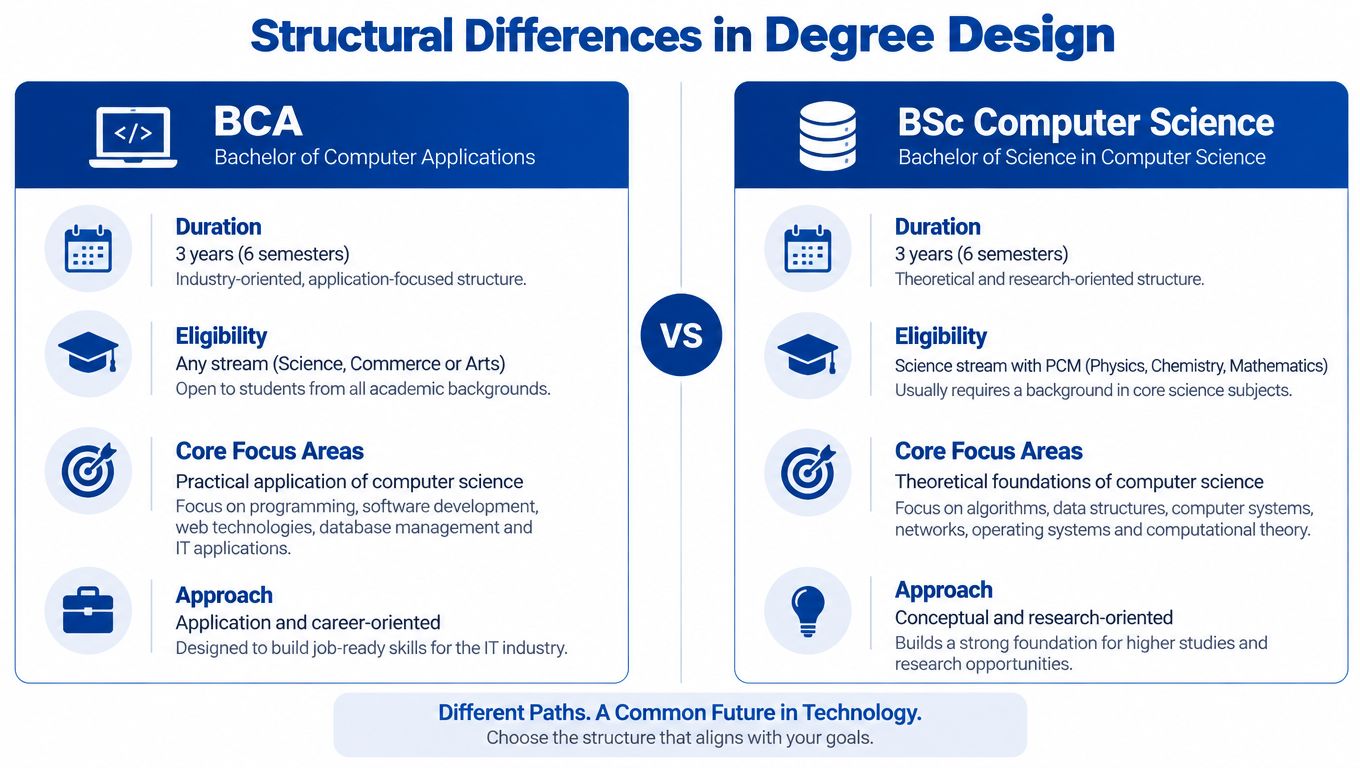
Structural Differences in Degree Design
The formal design of each degree reveals the difference in academic purpose. The UGC model for BSc (Honours) Computer Science describes a programme with 140 total credits, including 56 credits for core theory and 28 credits for core practical or tutorial work (UGC model syllabus for BSc Honours Computer Science). The structure gives substantial space to disciplinary foundations, not just software tools or application building.
The AICTE draft model curriculum presents a different structure for BCA. Its standard version is a three-year programme with 120 total credits, while four-year BCA Honours and BCA Honours with Research versions rise to 160 credits (AICTE draft model curriculum for BCA). Universities can apply their own admission and curriculum rules, so students must treat model frameworks as reference points rather than automatic guarantees.
What the credit pattern means
Credits don't measure a student's ability, but they indicate how a programme distributes academic attention. BSc Computer Science treats computing as a scientific discipline, so students usually spend more time developing formal reasoning about algorithms, systems, computation, and mathematical structures. BCA frames computing as a professional undergraduate pathway, so the programme tends to connect learning with applications, software development, and workplace-oriented outcomes.
The distinction also matters during the move to longer undergraduate degrees. A three-year BCA and a four-year BCA Honours programme may not offer the same academic experience or postgraduate options. Students should inspect whether the college offers a research component, how exit points operate, and which postgraduate programmes accept that exact qualification.
| Structural question | BCA | BSc Computer Science |
|---|---|---|
| Model credit structure | 120 credits for the standard three-year model | 140 credits in the cited BSc Honours framework |
| Honours variation | 160 credits for four-year Honours and Honours with Research versions | The cited framework describes an Honours structure |
| Main intention | Applied and professional computing | Scientific and disciplinary computing |
| Student concern | Whether the programme offers enough depth for later specialisation | Whether the student is ready for sustained theory and mathematics |
A higher credit count doesn't automatically make one degree superior. The useful interpretation is that the programmes organise learning around different priorities. A student should compare actual syllabuses, laboratories, project requirements, faculty areas, and postgraduate recognition before treating the course name as decisive.
Eligibility and Admission Flexibility
Admission rules create one of the most important differences between BCA and BSc Computer Science. A student from Commerce or Humanities may find BCA available at more institutions, while BSc Computer Science often expects a Science background with Mathematics or a related combination. Requirements vary, so the university's current prospectus remains the final authority.
The distinction has two parts. The first is eligibility flexibility, which determines whether an application can be submitted. The second is academic fit, which determines how comfortably the student can manage the first year. A student may qualify for a course but still need additional preparation in mathematics, programming logic, or scientific reasoning.
BCA as an entry route
BCA often suits students who want to move into computing without having followed the Science stream. Many Indian comparison guides describe BCA as open to students from any stream, with Mathematics or Computer Science preferred or required according to the institution (Indian guidance on BCA and BSc Computer Science eligibility).
That flexibility can help a Commerce student who has studied business and accountancy but also enjoys coding. It can also help a Humanities student who wants to explore web development, software testing, or digital products. However, broader entry doesn't mean mathematics disappears. Programming still requires logic, structured thinking, and persistence with abstract problems.
BSc Computer Science and subject preparation
BSc Computer Science commonly suits students who already have stronger exposure to Mathematics and Science. The course may feel more natural for a student who has practised algebraic reasoning, interpreted scientific models, and worked with quantitative problems before university.
| Student background | Likely question |
|---|---|
| Commerce with Mathematics | Can the student meet the college's subject requirements and handle programming? |
| Commerce without Mathematics | Does the chosen university allow admission, and is a foundation module available? |
| Science with Mathematics | Is the student comfortable with theory as well as practical coding? |
| Humanities | Would BCA provide a more accessible starting point for a technology transition? |
A student shouldn't choose BCA solely because it appears easier, or BSc Computer Science solely because it sounds more academic. The better test is whether the student can sustain interest in the course content. Admission flexibility opens the door, but preparation and motivation determine whether the student can walk through it confidently.
Curriculum Focus and Learning Style
The daily classroom experience often makes the difference more visible than the degree name. Both programmes can include programming, databases, networks, operating systems, and software development. The emphasis changes, however, and that changes the type of effort students make outside class.
BSc Computer Science is built around core computing principles. The UGC syllabus includes areas such as Programming Fundamentals using C or C++, Computer System Architecture, Data Structures, Operating Systems, Computer Networks, Algorithms, DBMS, Artificial Intelligence, and Theory of Computation (UGC curriculum reference for core Computer Science areas). A student may be asked not only to write a program, but also to explain why an algorithm works, how a system manages resources, or what limits computation.
BCA usually places greater weight on applying computing knowledge to software and organisational needs. Coursework may involve building applications, creating websites, managing databases, documenting a development process, or completing practical assignments. The exact mix differs by institution, so a student should inspect the syllabus instead of relying on a broad label.
Two different kinds of challenge
A BCA student may spend a project session turning requirements into a working interface or database-backed application. That student still studies theory, but the learning often becomes visible through a deliverable.
A BSc Computer Science student may spend more time proving an algorithm, analysing complexity, understanding operating-system behaviour, or studying formal models of computation. Practical work remains part of the course, yet the student must become comfortable with concepts that aren't always visible in a finished application.
| Learning preference | More natural fit |
|---|---|
| Building small applications and testing features | BCA |
| Exploring how software and hardware work underneath | BSc Computer Science |
| Learning through projects and applied assignments | Often BCA |
| Enjoying algorithms, mathematical reasoning, and abstract systems | Often BSc Computer Science |
Neither learning style guarantees a job. A BCA student still needs data structures, problem-solving, and strong programming practice. A BSc Computer Science student still needs projects, version control, communication, and the ability to turn concepts into working software.
A useful test: Students should review a sample syllabus and complete introductory exercises in both programming and logical reasoning before selecting a course.
Career Outcomes and Salary Prospects
Both degrees can lead to software development, web development, data analysis, database work, testing, technical support, networking, and cybersecurity. Employers often assess programming ability, projects, interview performance, communication, and relevant experience alongside the qualification. The undergraduate route influences preparation, but it doesn't replace the need for deliberate skill building.
The available India-focused comparison data shows a modest early-career difference in selected roles, with BSc Computer Science listed slightly higher in the cited ranges (India-focused BSc CS and BCA salary comparison).
| Role | BSc CS, ₹ LPA | BCA, ₹ LPA |
|---|---|---|
| Software developer | ₹3.5–6 LPA | ₹3–5.5 LPA |
| Web developer | ₹3–4.5 LPA | ₹2.8–4.2 LPA |
| Data analyst | ₹4–6 LPA | ₹3.5–5 LPA |
These figures are comparison ranges, not promises. A graduate with a strong portfolio, practical experience, and sound interview preparation may compete effectively regardless of the degree. A graduate who relies only on classroom attendance may struggle even with a theoretically stronger foundation.
The postgraduate difference
The more important distinction may appear after graduation. BSc Computer Science often provides a direct academic foundation for MSc Computer Science, specialised computing study, and research-oriented programmes. Its theory and mathematics can also support later study in algorithms, AI, data science, or computational areas, subject to the target institution's admission rules.
BCA graduates commonly consider MCA as a way to deepen technical knowledge and add further academic grounding. That route is not a disadvantage. It reflects a different sequence, where the undergraduate degree develops application-oriented capability and postgraduate study adds greater depth or specialisation.
A student researching future roles can consult a guide to IT jobs in demand for the future while checking the education and skill requirements of each role. The better decision is not based on salary alone. It considers whether the student wants early application work, a research-oriented route, or flexibility to specialise later.
Which Path Suits Your Goals
A useful decision framework starts with the student rather than the course brochure. Four questions can reduce much of the uncertainty.
1. What is the academic starting point?
A Commerce or Humanities student who wants to enter software development may find BCA the more practical entry route, provided the chosen university accepts that background. The student may need extra practice in mathematics or programming, but the degree can make the transition more manageable.
A Science student with Mathematics may find BSc Computer Science better aligned with existing preparation. The course can suit a student who enjoys formal reasoning and wants to keep research, teaching, or advanced computing study open.
2. What type of learning keeps the student engaged?
A student who learns best by creating a website, testing an application, or completing a practical project may prefer BCA. A student who enjoys understanding algorithmic logic, system architecture, and computational limits may prefer BSc Computer Science.
That preference matters because both degrees require independent work. Motivation is easier to sustain when the course's central style matches the student's natural curiosity.
3. What does the longer plan look like?
A student seeking an early move into application development may choose BCA and build a portfolio alongside the degree. A student considering MSc study, AI research, or mathematically demanding data work may benefit from the stronger scientific foundation of BSc Computer Science.
Newer four-year BCA Honours and Honours with Research formats also change the old assumption that BCA always means a shorter, purely professional route. The programme's exact structure, research opportunities, and postgraduate recognition need careful checking.
A student can also explore broader guidance on starting a career in IT before comparing colleges. The decision should then be tested against practical details, including fees, travel, laboratories, faculty support, internship access, and the institution's rules for postgraduate applications.
Decision rule: Choose the route that reduces academic friction without narrowing the student's serious long-term interests.
Real-World Scenarios and Final Recommendations
Consider three students making the decision.
A Commerce student with an interest in websites wants to start building applications and enter software work after graduation. If the selected college accepts the student's subjects, BCA may provide the more comfortable entry route. The student should still add programming practice, data structures, SQL, and projects rather than treating the degree as job preparation by itself.
A Science student with Mathematics enjoys statistics and asks how computer systems work. That student may be better matched with BSc Computer Science, especially if later plans include MSc study, AI, data analysis, or research. The degree's scientific foundation can make advanced academic material easier to approach, although practical projects remain essential.
A third student is choosing between a three-year BCA and a four-year honours option. That student should compare the actual curriculum, exit rules, research content, college facilities, and acceptance of the qualification by intended postgraduate programmes. Duration alone doesn't reveal the quality or usefulness of the academic route.
India's interest in computing education also makes the choice more consequential. Computer science and related engineering streams recorded 3,90,245 enrolments in 2024–25, the largest branch by a wide margin, according to the cited university discussion of the BCA and BSc choice (discussion of computer science enrolment and degree pathways). More students entering computing means a student must make the degree work through skills, projects, and thoughtful specialisation.
A student focused on cybersecurity can review the pathway into a career in cybersecurity alongside the chosen degree. The final recommendation is straightforward: BCA suits a flexible, application-led entry into computing, while BSc Computer Science suits a science-grounded route towards deeper theory and advanced study. Neither is universally better. The stronger choice is the one that fits the student's prior subjects, preferred learning style, and intended next step.
Edvdo offers assessments, guided activities, career reports, an AI mentor, and a Career Hub to help students connect their strengths with courses and career paths. Students comparing BCA and BSc Computer Science can visit Edvdo to turn uncertainty into a more structured academic decision.
Made with Outrank