

A Class 10 student chooses Science because friends have chosen it, relatives approve, and the marks seem good enough. Once Class 11 begins, the student discovers that solving Physics problems feels exhausting and Chemistry revision holds little interest. The problem isn't a lack of ambition. It's a decision made without testing the daily work.
A Class 11 subject combination influences which entrance examinations and degree routes remain realistic. Science commonly means Physics, Chemistry and Mathematics (PCM), Physics, Chemistry and Biology (PCB), or both Mathematics and Biology (PCMB). Commerce usually brings Accountancy and Business Studies alongside options such as Economics and Mathematics, while Arts or Humanities can include History, Psychology and Economics.
These aren't permanent identities, but subject prerequisites matter. A student can change career ambitions more easily than replace a missing qualifying subject. The National Education Policy supports greater flexibility across academic and vocational subjects, rather than rigid divisions between streams.
Before submitting a preference form, students and parents should:
- Check strengths: Look beyond the total percentage to subject-level understanding.
- Test the work: Try a problem set, coding task, source analysis or bookkeeping exercise.
- Reverse-check careers: Start with possible work after graduation, then trace the required subjects backwards.
Confusion before choosing subjects is a reason to investigate, not follow the crowd. Families comparing school schedules can also understand trimester calendar lengths, but subject fit deserves priority over timetable convenience.
Table of Contents
- 1. Physics
- 2. Chemistry
- 3. Mathematics
- 4. Biology
- 5. Computer Science
- 6. Accountancy
- 7. Business Studies
- 8. Economics
- 9. Psychology
- 10. History
- Class 11 subjects at a glance
- Choosing Your Class 11 Subjects Without Closing Doors
1. Physics
Physics belongs in the high-commitment group. It suits students who enjoy explaining physical events through diagrams, equations and experiments, and who will keep working after an unfamiliar problem resists the first attempt.
The subject involves mathematical modelling, measurement, motion, forces, energy and related physical principles. Its practical attraction is the connection between an explanation and something observable, such as a moving vehicle, an electrical device or an experimental result.
The comparison below offers a starting point for judging that fit.
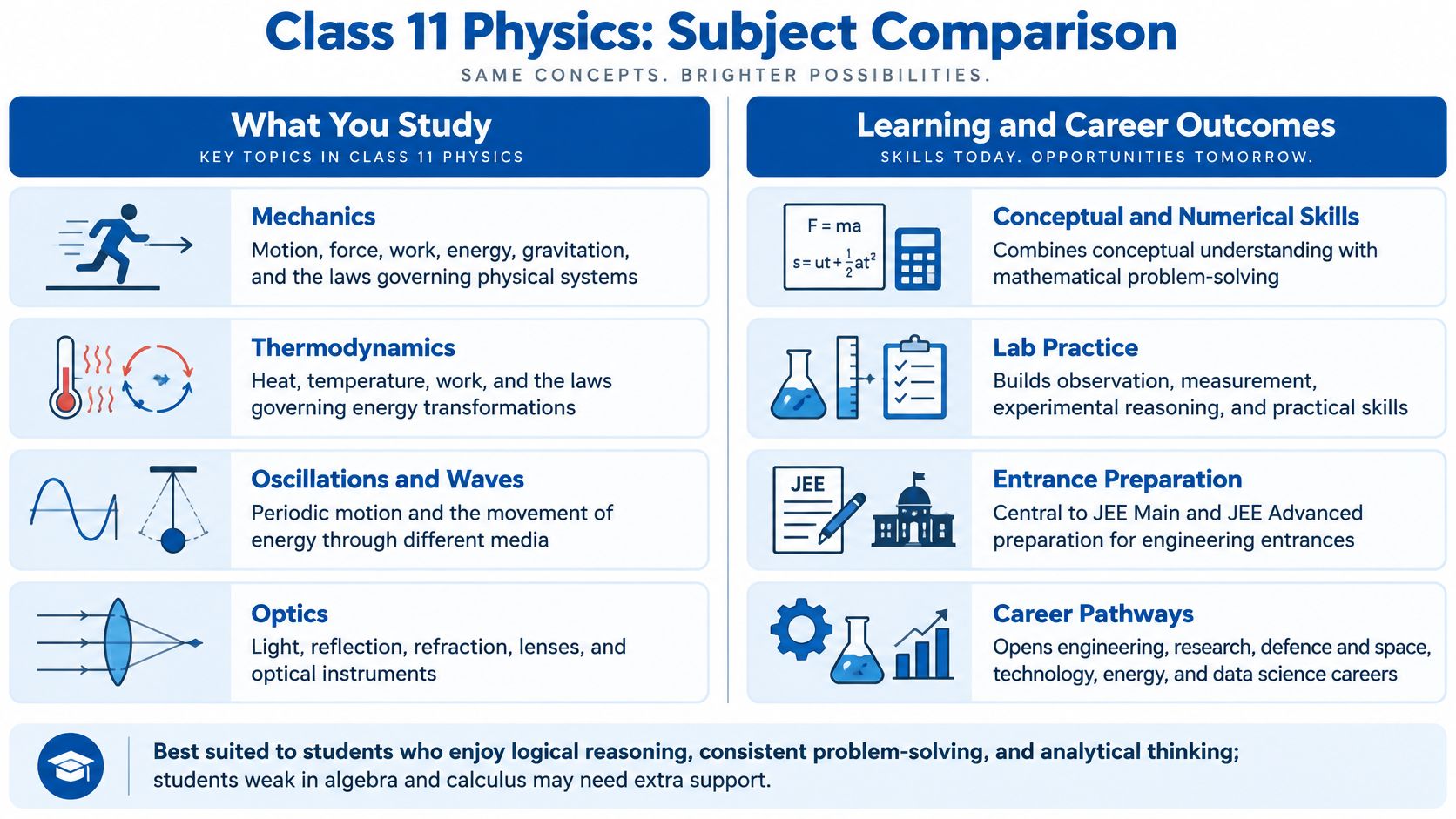
The Science reverse-check
For a student considering engineering or physical-science study, Physics must be evaluated alongside Mathematics and course-specific eligibility. Physics alone doesn't preserve every technical route, and choosing PCB rather than PCM changes the available options.
A useful trial is a mechanics problem involving forces on a slope. The student should draw the situation, identify the relevant quantities and explain the equation before calculating. A subject-understanding assessment can support that review, but the student's response to actual problem-solving matters.
Practical rule: Enjoying science videos isn't the same as enjoying Physics homework.
Parents should assess algebra and trigonometry readiness with a teacher rather than demand advanced preparation before school begins. NCERT worked examples offer a better starting point than immediately buying difficult entrance-preparation books.
The following video provides another opportunity to sample the subject.
2. Chemistry
A student might enjoy biological systems but dislike calculations, or enjoy numerical Chemistry while struggling with reaction patterns. Chemistry requires both conceptual reasoning and careful recall, so a verdict based on memorisation alone will be misleading.
Classroom work moves between quantities, atomic structure, bonding, chemical behaviour and organic principles. Students need to explain why substances behave differently, not merely reproduce a reaction from a notebook.
Choose Chemistry when the intended Science combination needs it and its working methods remain tolerable. It supports preparation for medicine, pharmacy, chemical engineering and laboratory-oriented study, although each course's current requirements need separate confirmation. Dropping it without that check can remove an intended route.
Test the less glamorous work
A practical trial should include contrasting tasks:
- Quantitative reasoning: Work through a mole-concept example and explain the units.
- Conceptual explanation: Explain how bonding affects a substance's properties.
- Structured revision: Organise related reactions by the changes taking place, rather than copying an unconnected list.
Say a student is interested in developing medicines. Chemistry deserves serious attention because that interest involves understanding substances and their interactions, not learning about diseases.
The honest trade-off is regular revision. A student who postpones basic concepts will struggle to connect later material, while one who studies only formulas will miss the explanations behind them. A combined formula, concept and reaction notebook is more useful than a reaction notebook alone.
3. Mathematics
Mathematics is the strongest cross-stream option to examine before dropping it. It supports quantitative routes across engineering, computing, economics, finance and analytical work, but keeping it requires sustained practice rather than a vague desire to preserve options.
The daily work involves functions, algebra, geometry, trigonometry, probability and increasingly abstract reasoning. A strong Class 10 mark helps, but willingness to revisit errors matters just as much.
An India-focused CBSE results study found that boys were 19.12 percentage points more likely than girls to choose Mathematics in Class XI. That finding describes unequal participation, not differences in individual ability.

Keep options open deliberately
A Commerce student considering an Economics degree should check shortlisted universities' Mathematics requirements before accepting a combination without it. A Humanities student interested in quantitative research should make the same check.
Without Mathematics, some quantitative programmes become unavailable or require a different route. That doesn't make Commerce or Humanities without Mathematics inferior. It means the student should accept the restriction knowingly.
For a practical trial, the student can solve a mixed algebra-and-graph exercise, correct the mistakes and attempt similar questions again. Improvement after feedback is more informative than speed on the first attempt.
Parents should separate a repairable foundation gap from persistent dislike. Tuition can support missing knowledge; it can't supply a convincing reason to study a subject the student doesn't want.
4. Biology
Biology is a high-commitment choice when medicine or biological study is a serious possibility. It suits students who want to understand living systems and can manage precise terminology, diagrams and detailed explanations.
Interest in helping people isn't enough to establish subject fit. The student must also tolerate learning how cells, organs, organisms and physiological processes work, including material that feels far removed from clinical practice.

PCB versus PCMB
PCB prioritises biological and medical preparation; PCMB retains Mathematics but adds a substantial workload. Families should choose PCMB only when the student has a credible reason to preserve both directions and enough capacity for the work.
A student considering medicine should reverse-check the qualifying subjects and examination requirements using the current official admission documents. A student interested in biotechnology or another interdisciplinary field should check individual programmes rather than assume every institution accepts the same combination.
Keeping both Mathematics and Biology is useful only when the student can study both properly.
A low-cost trial is to study a physiological process, draw its stages from memory and explain how a disruption would affect the system. This tests understanding as well as recall.
Biology without Mathematics does not preserve every technical or quantitative route. Conversely, dropping Biology can complicate biological pathways with specific prerequisites. The decision should follow the intended courses, not the belief that Biology is the easier Science option.
5. Computer Science
A student builds a quiz programme, fixes an input error and changes how the score is calculated. Enjoyment of that debugging process is stronger evidence of Computer Science fit than enthusiasm for using apps.
Computer Science introduces programming, computational thinking and computer-system concepts. Python is a practical language for an exploratory project, while the school's prescribed syllabus should determine formal preparation.
Unlike the core Science prerequisites, school Computer Science is often an exploration subject rather than the sole gateway to a technology career. Students must distinguish learning to code from satisfying entry requirements for a computing degree.

What it does and doesn't preserve
- Keeps exploration practical: Students can test programming, automation and data-handling interests through projects.
- Doesn't replace Mathematics: A coding elective cannot satisfy a separate Mathematics prerequisite.
- Doesn't guarantee fit: Enjoying devices or gaming doesn't establish interest in algorithms and debugging.
A Humanities student interested in digital research could use programming to organise information. A Commerce student could build a simple expense tracker. Neither needs to pretend that every coding interest must lead to engineering.
If the school doesn't offer Computer Science, students can still practise programming independently. The key distinction is that external learning develops skills but doesn't automatically count as a recognised board subject. Formal eligibility must remain a separate check.
6. Accountancy
Accountancy suits students who like orderly records, consistent rules and explanations that can be checked. It isn't advanced Mathematics disguised as Commerce, but it does require numerical accuracy and patient practice.
Students learn how transactions become journal entries, ledger balances and financial statements. The underlying question is practical: what happened financially, where should it be recorded, and how does it affect the business?
A useful worked example is a small stationery shop. The student records stock purchases, cash sales, credit sales and an unpaid expense, then explains why profit and available cash aren't identical.
The Commerce reverse-check
Accountancy provides an early foundation for accounting, audit, taxation and finance-related study. It is preparation, not a professional qualification, and families should check the current entry routes for CA, CMA or CS rather than assume school Accountancy is universally compulsory.
The main trade-off is specialisation within the timetable. Choosing Accountancy alongside Business Studies and Economics creates a coherent Commerce combination, but omitting Mathematics can affect access to particular quantitative degrees.
Factly's analysis of CBSE examination choices shows that subject selection is highly concentrated despite a broad catalogue. Popularity should therefore prompt investigation, not substitute for it.
For students considering Commerce, the best trial is to explain debit-and-credit logic aloud and complete a transaction exercise without copying the pattern. A student who enjoys finding and correcting an imbalance has useful evidence of fit.
7. Business Studies
A student planning a school merchandise stall must decide who owns it, who supplies stock, how customers pay and what happens when an order goes wrong. Business Studies suits students interested in those organisational decisions.
The subject introduces business ownership, services, organisational arrangements, commercial activity and responsibility. It rewards clear explanations and application, not merely familiarity with famous entrepreneurs.
Its lock-in is lower than that of a Science prerequisite. Business Studies offers useful preparation for management and entrepreneurship, but it shouldn't be treated as the only route into those fields. Equally, choosing it doesn't remove the need for quantitative skills in business roles.
Judge interest through decisions
Students exploring business-related interests should compare the appeal of running an organisation with the challenges of studying how organisations work.
- Ownership: Explain why a small venture might choose one organisational form over another.
- Operations: Describe how a delayed supplier affects customers and cash.
- Responsibility: Assess a complaint from the customer's and business's perspectives.
For a student considering management after graduation, the reverse-check should include the target degree, its admission process and any Mathematics requirement. Business Studies alone doesn't establish eligibility.
Parents should reject the claim that this is an effortless subject. A student must learn terminology, distinguish similar concepts and write structured answers. The practical verdict is clear: choose it for genuine organisational curiosity, not as a supposedly easy replacement for another subject.
8. Economics
Economics is a bridge subject, but it isn't automatically a substitute for Mathematics. It suits students who enjoy explaining choices, incentives, prices and competing uses of limited resources.
School Economics combines conceptual arguments with graphs, evidence and statistical reasoning. A student might enjoy discussing inflation yet dislike analysing a graph or questioning how a statistic was constructed. Both responses belong in the decision.
Say a local café raises prices after ingredient costs increase. The student can distinguish a change in production costs from a change in customer demand, then explain what evidence would help assess the decision.
Reverse-check the degree, not the job title
A student interested in economics research, finance or public policy should examine actual degree requirements before choosing Commerce or Humanities without Mathematics. The important question isn't whether Economics appears on the school timetable, but whether the full combination qualifies the student for the intended programme.
- Keeps open: Early exploration of economic reasoning, policy questions and analytical work.
- Can restrict: A combination without required Mathematics can exclude particular quantitative degrees.
- Needs testing: Enjoying business news doesn't necessarily mean enjoying formal economic models.
A career-path comparison should distinguish economics, accounting, banking and management rather than place them under a single finance label.
For preparation, students should draw and explain graphs, practise statistical interpretation and connect a news claim to its underlying assumptions. Those activities give a clearer verdict than memorising definitions alone.
9. Psychology
Psychology suits students curious about behaviour who also respect evidence, research methods and uncertainty. It isn't mind-reading, informal advice-giving or a shortcut to becoming a therapist.
School study introduces ways of investigating learning, memory, development, motivation and related psychological processes. Students need to separate personal impressions from observations that can support an argument.
The Bharat Career Aspirations Report coverage reports that only 10.4% of surveyed students in Classes 9–12 had received professional career guidance. Uncertainty about a subject's real content deserves investigation, not embarrassment.
Explore behaviour without diagnosing people
A practical activity is to compare recall after passive rereading with recall after self-testing. The student should record the method and results, then explain why a casual exercise cannot establish a universal conclusion.
A personality reflection can prompt useful questions, but it isn't a diagnosis or proof that counselling is the right career.
Boundary to remember: Studying Psychology at school doesn't qualify a student to provide mental-health treatment.
Psychology offers early exposure to counselling-related interests, education, behavioural research and people-focused work. However, professional practice requires further qualifications and applicable registration or licensing requirements.
The Humanities reverse-check should therefore begin with the eventual role and recognised training route. School Psychology can be valuable preparation without being a universal entry requirement. Students shouldn't reject an otherwise suitable school solely because it lacks this elective.
10. History
History suits students who enjoy reading closely, comparing explanations and building an argument from evidence. The daily work is not just remembering dates. It includes understanding context, interpreting sources and explaining change.
A useful trial is to compare a textbook account with an extract from a historical source. The student identifies the author's position, distinguishes evidence from interpretation and writes a supported conclusion.
History provides preparation for historical study and develops skills relevant to law, journalism, public affairs and research. It doesn't automatically qualify a student for those courses, nor is it a compulsory school subject for every related career.
The Humanities reverse-check
A student interested in civil services should avoid treating History as a guaranteed route to success. The stronger reason to choose it is sustained interest in reading, analysis and evidence-based writing.
School availability matters too. EducationWorld reporting published by The Economic Times describes how staffing, infrastructure and demand constrain access to less conventional electives.
- If History is available: Inspect the prescribed syllabus and sample source-based questions.
- If it isn't available: Compare related reading-and-writing subjects against intended degree requirements.
- If family pressure dominates: Compare actual tasks across subjects rather than rank streams by prestige.
History's principal trade-off is opportunity cost: the timetable space could support another interest or prerequisite. It is a strong choice when its methods suit the student, not merely when Science and Commerce have been ruled out.
Class 11 subjects at a glance
| Item | Stream | Key Entrance or Pathway | Best Suited For |
|---|---|---|---|
| Physics | Science (PCM or PCMB) | JEE Main and Advanced; engineering and research | Students who enjoy mathematics, logical reasoning, and problem-solving |
| Chemistry | Science (PCM or PCB) | NEET, JEE, pharmacy, and chemical engineering | Students who enjoy conceptual reasoning, patterns, and practical lab work |
| Mathematics | Primarily Science (PCM); optional in some combinations | JEE; engineering, computing, finance, and data science | Students who enjoy abstract reasoning and regular problem-solving |
| Biology | Science (PCB) | NEET; medicine and life sciences | Students curious about living systems, diagrams, and detailed study |
| Computer Science | Optional across streams | Software, data, and technology careers | Students interested in coding, algorithms, and technology |
| Accountancy | Commerce | CA, CMA, and CS pathways | Methodical, detail-oriented students comfortable with numbers |
| Business Studies | Commerce | Management, MBA, and entrepreneurship pathways | Students interested in organisations, management, and business |
| Economics | Commerce or Humanities | Economics, civil services, policy, and finance | Students interested in markets, data, and public policy |
| Psychology | Humanities | Psychology degrees; counselling and clinical pathways | Students curious about behaviour, learning, and human development |
| History | Humanities | Civil services, law, teaching, and journalism | Students who enjoy reading, interpreting evidence, and writing arguments |
Choosing Your Class 11 Subjects Without Closing Doors
The safest Class 11 subject choice isn't the combination containing the most demanding subjects. It's the combination that preserves credible ambitions, fits the student's working habits and is available at school.
Start with careers that sound interesting after graduation, including possibilities beyond the professions familiar to the family. Then separate mandatory prerequisites, useful preparation and skills that can be developed outside school. Confusing these categories leads to unnecessary restrictions or false reassurance.
Under the CBSE senior-secondary curriculum, students can offer a minimum of five subjects. Families must therefore evaluate the complete combination, including language requirements and school-approved options, rather than choose an isolated favourite.
Build a combination that survives the reverse-check
- Science: Compare PCM, PCB and PCMB against named courses, qualifying subjects and entrance requirements.
- Commerce: Check whether dropping Mathematics affects the economics, finance or analytical programmes under consideration.
- Humanities: Identify which degrees accept varied school backgrounds and which require particular subjects or assessment routes.
- School constraints: Obtain the actual subject list, timetable restrictions and change procedure before finalising preferences.
Next, test the daily work through low-cost activities. A coding project, bookkeeping exercise, Biology explanation or source-based History answer provides evidence that a stream label cannot. A structured career assessment can organise interests and strengths, but it shouldn't overrule a clear prerequisite or replace the student's own response to the work.
Students and parents should bring the resulting shortlist to a school counsellor or subject teacher. The discussion should cover academic readiness, likely workload, available support and a fallback combination. Current official university and examination documents should settle eligibility questions, rather than an old admissions screenshot or an informal promise.
Treat an early change as a planned option
A subject choice can be reversible for many students during the first term, but a change isn't an automatic entitlement. The school must confirm its deadlines, board rules, available places and arrangements for missed work before the family relies on switching.
Parents should ask what the student can sustain on an ordinary school day, not only what sounds impressive at a family gathering. Students should distinguish temporary difficulty from persistent mismatch by seeking feedback and trying targeted support.
The aim is an informed choice, not a perfect prediction of adulthood. A sound decision keeps the most relevant doors open while leaving enough time and motivation to prepare properly for them.
Edvdo offers structured assessments, guided activities and personalised reports to help students examine their strengths, motivations and learning patterns before choosing subjects. Students and parents can visit Edvdo to explore possible combinations and ask its AI mentor, Vedu, specific questions before confirming eligibility and school rules with a counsellor.