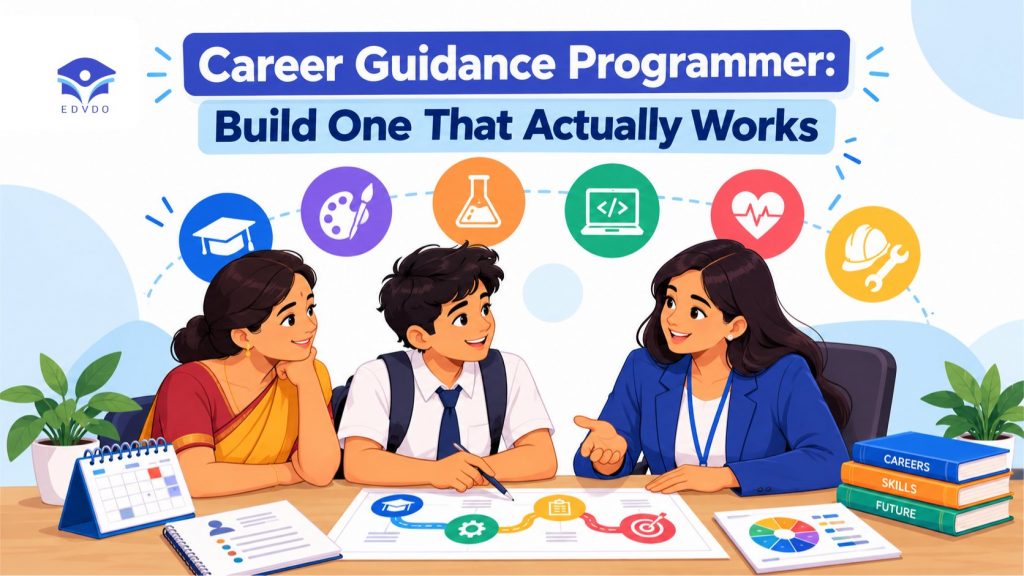
A student stays behind after class to ask which stream to choose. The teacher suggests science because the marks are strong; at home, the family favours commerce; the student wants to explore design but doesn't know what studying it involves. The school has a career talk booked, yet nobody owns the follow-up.
That's the practical test of a career guidance programme: can the school turn uncertainty into a reasoned choice, then help the student act on it? A useful programme needs more than speakers and assessment reports. It needs protected time, clear responsibilities and a workable route for students whose school has no counsellor.
Table of Contents
- Why One-Off Workshops Fail Indian Students
- Set Objectives Schools Can Actually Measure
- Build a Curriculum That Spans Grades 7 to 12
- Integrate Assessments Without Overweighting Any Single Test
- Schedule Sessions That Survive Exam Season
- Measure What Actually Matters Beyond You Surface
- Address Parental Pressure and the Access Gap Honestly
Why One-Off Workshops Fail Indian Students
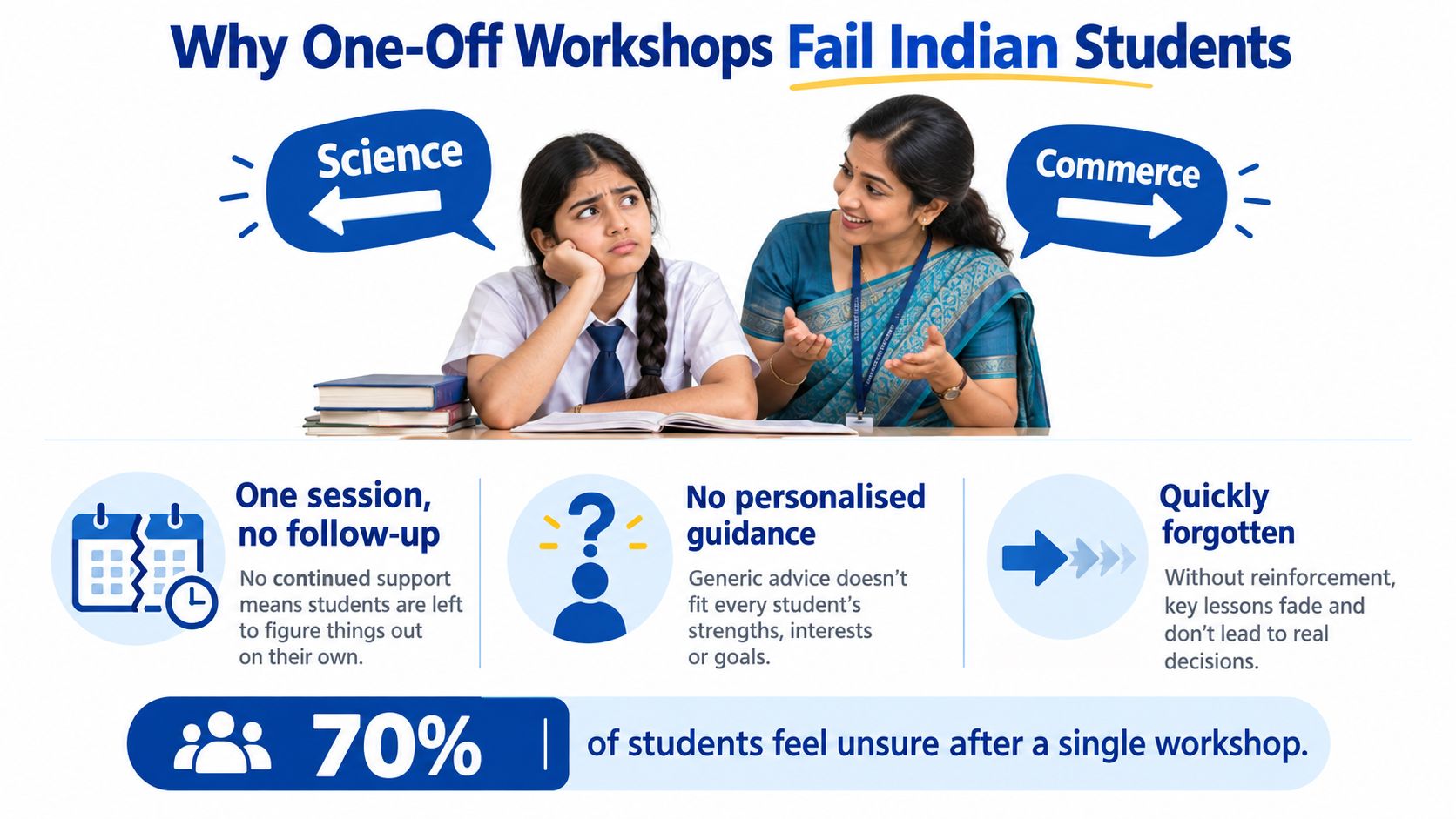
Consider that classroom conversation. The teacher isn't necessarily giving careless advice. The teacher knows the student's marks, but may know little about their interests, financial constraints or willingness to pursue particular kinds of work. The student has asked for a decision when the school hasn't yet gathered enough information to support one.
A career fair can introduce unfamiliar occupations. A motivational speaker can encourage exploration. Neither can resolve an individual student's subject prerequisites, family disagreement and application questions during a crowded assembly.
The distinction between an event and continuing support matters.
Access isn't the same as attendance
A survey of rural and semi-urban students found that 10.9% had attended formal career guidance, while 91.6% wanted free guidance. It also identified greater familiarity with traditional professions than with fields such as artificial intelligence and cybersecurity.
Schools should therefore distinguish between:
- Exposure: The student encounters a career or course.
- Interpretation: The student understands its demands and relevance.
- Action: The student completes a meaningful next step.
A student interested in art, for example, needs more than encouragement to pursue a creative career. The Online College of Art & Design's resource offering help choosing your art course can become a research task, followed by a discussion about course level, preparation and suitability. It shouldn't substitute for checking the requirements of the student's intended institution.
Replace the event with a sequence
An 18-month programme provides a useful organising model. The documented Career 360 Degree initiative at Delhi Public School Bilaspur followed assessment with interpretation, exploration, planning and implementation, reporting personalised roadmaps and informed stream selections among its outputs.
Those outputs aren't proof of a universal success rate. They demonstrate a more useful design principle: organise guidance around a sequence of student decisions, not a calendar of isolated events.
Set Objectives Schools Can Actually Measure
Create awareness is too vague to guide a timetable or justify staff time. Before choosing activities, school leaders should agree on what students must be able to explain, produce or complete.
India's policy direction supports treating guidance as a school responsibility rather than an optional enrichment activity. The Ministry of Education's account of NEP implementation describes individualised counselling, digital access and career resources, including 500 career cards across 21 domains.
The practical challenge is converting that policy intent into observable student behaviour.
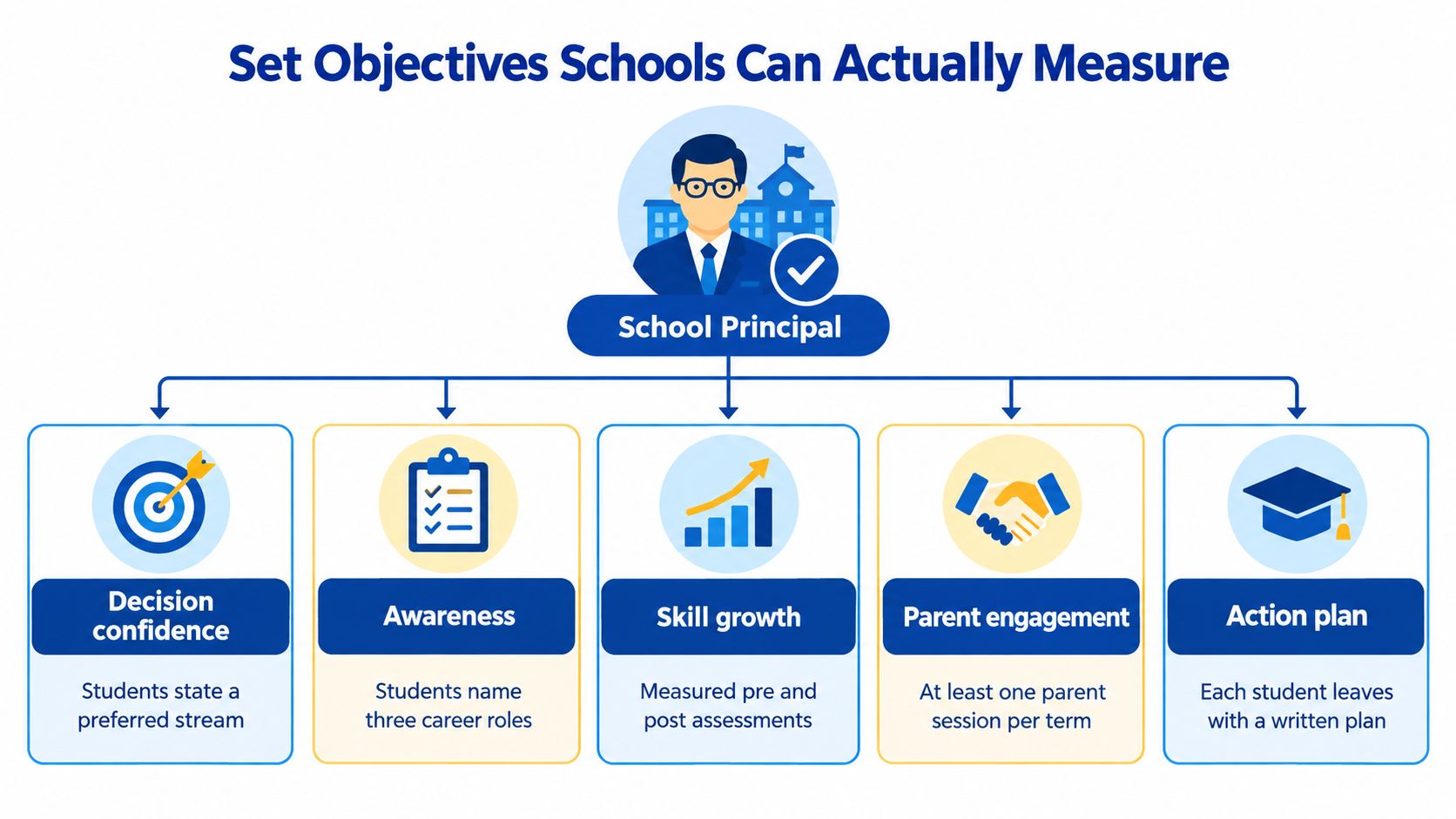
Define success before choosing sessions
- Decision confidence: Students explain why an option currently makes sense and what remains uncertain. A confidence rating needs an accompanying reason, otherwise certainty can be mistaken for readiness.
- Options awareness: Students distinguish related roles by everyday tasks, preparation and working conditions. Naming an occupation isn't enough.
- Plan ownership: Students describe their next action without relying on a parent or teacher to answer. Their written plan should use language they understand.
- Stream-and-course readiness: Students identify relevant subjects, eligibility requirements and unresolved information gaps. Staff can mark entries as unsupported, partly verified or verified.
- Post-school follow-through: Students report whether they entered their intended route, changed direction or still need support. A changed plan should be recorded, not automatically labelled failure.
Judge reasoning, not confidence alone
Suppose a student confidently selects engineering but cannot explain the course requirements. Another student remains undecided after comparing several credible routes. The confident answer isn't necessarily the stronger outcome.
A school rubric should reward evidence, explanation and realistic action. Reflection prompts can ask what changed the student's view, which requirement remains unclear and whose help is needed next.
Planning principle: A programme objective should describe something a student can demonstrate, not something a school can merely claim to have delivered.
Principals can then approve activities against these objectives. A visiting speaker earns timetable space when students have a defined research question and a follow-up task, not because the speaker is available.
Build a Curriculum That Spans Grades 7 to 12
A whole-school curriculum and a focused guidance cycle serve different purposes. The curriculum establishes age-appropriate learning across grades; the focused cycle supports a cohort through a consequential decision. Younger pupils shouldn't be pushed towards premature career labels just because older students need application support.
The progression should move from understanding personal patterns to investigating options and preparing for transitions.
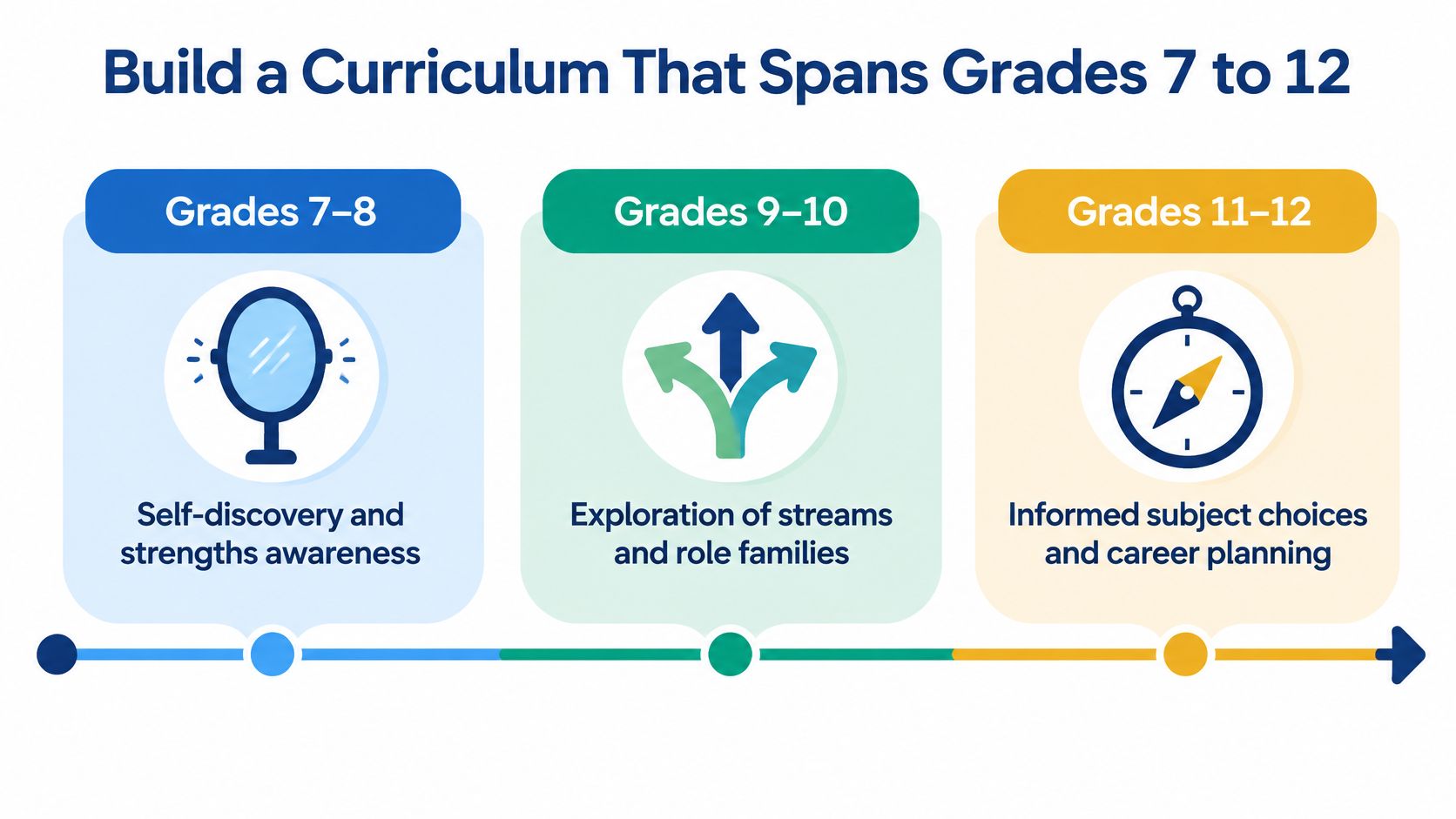
Start with experience, then introduce choices
Grades 7–8 need self-discovery without labelling. Students can document tasks they enjoy, situations in which they persevere and feedback from classroom projects. Allow time for an activity, reflection and later reconsideration; the deliverable is a developing personal profile, not a fixed occupational match.
Grades 9–10 need structured exploration. Students can compare role families through interviews, research and small practical tasks. A shortlist should explain what each role involves and which assumptions still need testing.
For unfamiliar technical fields, Magna Education's cybersecurity AP course starter can serve as a discussion resource. Staff should distinguish learning about a field from verifying whether a particular course suits local curriculum and admission requirements.
Subject exploration can also include a subject assessment, followed by a teacher-led discussion about classroom evidence and preparation.
Convert exploration into transition work
At Grade 10, the central deliverable is a written stream rationale. Students should connect subject choices to plausible pathways and identify consequences for options they may wish to retain.
In Grade 11, the emphasis shifts towards application readiness. Students investigate institutions, entrance requirements, portfolios where relevant and financial support, producing an application research list rather than a collection of prestigious names.
By Grade 12, students need a transition file containing verified deadlines, documents, application status and a workable alternative route. Schools should allow preparation time outside discussion periods because document gathering and institution research require sustained attention.
A video can provide a shared starting point for classroom discussion, provided the teacher checks its relevance beforehand.
Students should leave the discussion with a question to investigate, rather than receive credit merely for watching.
Integrate Assessments Without Overweighting Any Single Test
An assessment result becomes dangerous when adults treat it as permission to close a conversation. A student whose interest profile points towards creative work shouldn't automatically be steered away from a demanding scientific ambition.
Assessment should generate hypotheses, not verdicts. Aptitude, interests and personality address different questions, and staff should explain those differences before administering tools.
The useful task is interpreting apparently conflicting evidence.

Build an evidence conversation
Introduce interest exploration after students have encountered varied activities. Discuss aptitude alongside subject performance and opportunities to learn. Use personality descriptions cautiously, particularly when students begin treating them as permanent restrictions.
An interest assessment can support a reflection journal. The follow-up should ask which findings match lived experience, which don't, and what experience could help resolve the disagreement.
- Classroom evidence: Compare the result with completed work, persistence and teacher observations.
- Student interpretation: Record agreement and disagreement in the student's own language.
- Family context: Consider opportunities, responsibilities and constraints without allowing adult preferences to become test evidence.
- Practical investigation: Choose an activity that tests an assumption about the preferred pathway.
Separate reflection from diagnosis
A student who disputes a recommendation doesn't need to be persuaded that the software is right. Staff should investigate whether unfamiliar questions, language, fatigue or limited exposure affected the response, then plan a relevant experience.
AI-generated explanations also need review. Schools should check course prerequisites and consequential recommendations against current institutional information rather than accepting fluent wording as verification.
Igneous AI, LLC's resource on why testing boosts memory can prompt a separate discussion about classroom learning. Retrieval practice and career assessment should not be presented as interchangeable, nor should learning-related explanations be used to claim that a career match is accurate.
Practical rule: No high-stakes recommendation should rest solely on an assessment score, an AI response or an adult's impression.
The report belongs inside a conversation. It isn't the conclusion of that conversation.
Schedule Sessions That Survive Exam Season
A timetable that depends on spare periods won't survive competing priorities. The principal should identify a named programme coordinator, protected classroom time and the work that can reasonably happen outside lessons.
Limited counsellor hours should be reserved for interpretation, difficult choices and escalation. Teachers can supervise research, maintain records and check task completion without being expected to provide specialist counselling.
Use a rhythm the school can protect
A proposed rhythm can combine weekly homeroom check-ins, monthly theme workshops and a parent discussion each term. These are planning choices, not evidence-based dosage requirements. Schools should adjust them around examination calendars, staffing and student needs.
Sample Career Guidance Time Allocation by Grade Band
| Grade Band | Weekly Minutes | Termly Highlights | Primary Outcome |
|---|---|---|---|
| Grades 7–8 | Brief homeroom allocation, locally set | Strengths reflections and activity reviews | Developing personal profile |
| Grades 9–10 | Protected tutor allocation, locally set | Stream exploration and subject-choice clinics | Reasoned stream choice |
| Grades 11–12 | Flexible planning allocation, locally set | Application reviews and transition checks | Actionable transition file |
A useful check-in ends with a recorded next action. A workshop needs a defined product, such as a completed comparison sheet. Parent meetings should resolve specific questions rather than repeat a general careers presentation.
Protect the critical path
Schools should front-load research and family discussions before major examinations. Stream-selection clinics belong before subject forms are due, with enough space for students to investigate unresolved requirements.
During examination periods, staff can reduce new content while retaining deadline checks and access to help. Recorded explanations, printable worksheets and saved resources can support later review, but the school should still assign responsibility for unanswered questions.
- Protect decisions: Keep time-sensitive eligibility and application checks on the calendar.
- Move information: Shift general presentations into accessible review materials when necessary.
- Record disruption: Reschedule missed guidance explicitly instead of assuming students will catch up.
- Distribute responsibility: Give each task an owner so the programme doesn't disappear when a staff member is absent.
The practical trade-off is between breadth and continuity. A smaller programme with dependable follow-through is preferable to an ambitious calendar that staff cannot maintain.
Measure What Actually Matters Beyond You Surface
A positive workshop survey shows that students liked an experience. It doesn't establish whether they can make a defensible decision or complete an application.
Evaluation should use the objectives already agreed, but collect evidence at the level of individual students. Averages can conceal those who attended sessions yet remain unable to act.
Keep a decision record, not an activity count
An existing school spreadsheet or student-management system can hold the essentials. Each entry should identify the current decision, supporting evidence, next action, responsible person and review date.
| Indicator | Evidence to collect | Question for staff review |
|---|---|---|
| Decision confidence | Repeated reflection with a written explanation | Is confidence supported by understanding? |
| Options awareness | Student explanation of credible alternatives | Can the student distinguish the options? |
| Plan completion | Completed actions and unresolved tasks | What is preventing progress? |
| Stream persistence | Continued participation or documented change | Was the route suitable and adequately supported? |
| Post-school transition | Confirmed destination or support request | Does the student need further assistance? |
A career report can contribute to that record, but staff should distinguish generated recommendations from student-verified choices. Access should be restricted to people who need the information, with clear arrangements for storing sensitive reflections.
Investigate flat results before adding activities
Review records at meaningful decision points and during termly programme reviews. Staff should examine incomplete cases, not just produce a summary for governors or management.
If confidence remains flat, inspect the explanations. Students may understand the complexity better than before; alternatively, they may still lack trustworthy information or face unresolved constraints.
A changed preference can indicate learning. An unchanged preference can indicate either conviction or a conversation that never happened.
Likewise, stream changes deserve investigation rather than automatic classification as failure. The school should record whether the change followed informed reconsideration, an eligibility problem or insufficient support.
When progress stalls, the response should match the barrier. Missing course information calls for verification; incomplete tasks may require practical assistance; distress requires appropriate human support. Adding another assessment to every stalled case would confuse measurement with intervention.
Address Parental Pressure and the Access Gap Honestly
Inviting parents to a presentation doesn't guarantee that students retain a voice. Families may interpret a report as a ranking, favour socially familiar careers or reject an alternative before understanding its requirements.
The access problem is equally concrete. The Bharat Career Aspirations Report coverage reports professional guidance access of approximately 9% in government schools and 12% in private schools. A programme designed around readily available counselling appointments therefore needs an alternative operating model.
Make disagreement discussable
Parent-facing summaries should explain evidence and uncertainty without displaying a scoreboard of supposedly suitable careers. A values assessment can support discussion about priorities such as stability, autonomy, location and family responsibilities.
Separate the disagreement into manageable questions:
- Academic preparation: What does the pathway require, and what preparation remains?
- Affordability: Which costs and financial-support options need verification?
- Family concerns: Does the objection concern safety, relocation, reputation or uncertainty?
- Student preference: What attracts the student to the work itself?
Indian reporting on career-guidance barriers identifies family pressure, limited planning and counsellor workload as implementation risks. Schools should address those barriers directly rather than assuming that a clearer assessment report will settle them.
Provide support without pretending every teacher is a counsellor
A school without a counsellor can appoint a guidance coordinator to organise activities, maintain records and arrange referrals. Printed worksheets, regional-language discussion and downloadable materials should remain usable without dependable home internet.
An AI mentor can help students formulate questions and explore information when connectivity permits. Teacher review should check understanding and flag uncertainty, not imitate specialist diagnosis. Schools also need an agreed referral route to a qualified human counsellor for emotionally complex or consequential cases.
Questions that need candid answers
What happens when an assessment conflicts with a student's dream?
The disagreement becomes an investigation. The student can examine prerequisites and try relevant work before deciding whether to persist, prepare differently or reconsider.
How should staff respond when engineering is the family's default answer?
Staff should ask what the family values about it, then compare realistic pathways against those priorities. Dismissing the aspiration can make the conversation more defensive.
What makes a backup route credible?
It should have verified entry requirements, a feasible preparation plan and a reason the student could accept it. An alternative belongs in the plan as a workable choice, not as a punishment for missing the preferred destination.
Edvdo offers structured assessments, guided activities, career exploration, reports and the Vedu AI mentor as resources schools can consider alongside teacher review and qualified counselling. Schools planning a sequenced career guidance programme can visit the platform to explore how these tools could support student reflection, pathway planning and progress tracking.