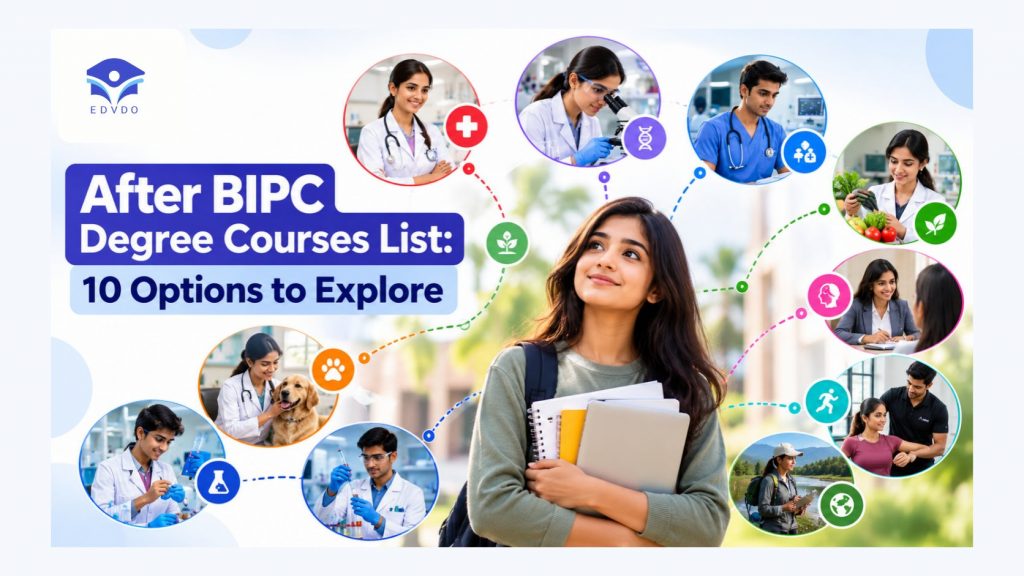
Which course comes next after BiPC if becoming a doctor isn't the only goal? Biology, Physics and Chemistry can lead to patient care, rehabilitation, laboratory work, research, agriculture, and careers that combine biology with technology. The useful question isn't which course is most popular. It's what kind of work a student wants to do, what admissions route each programme requires, and how much further study or practical training the path involves.
The five commonly considered options are MBBS, BDS, B.Sc. Nursing, B.Pharm, and B.Sc. Biotechnology. They're starting points, not a verified ranking of what BiPC students choose most often. There's no verified Edvdo usage data establishing a national or platform-based top-five order.
India's science pathways extend well beyond clinical degrees. In the Ministry of Education's AISHE 2021–22 data, science accounted for 14.8% of undergraduate enrolment, while arts accounted for 34.2%; science enrolment across higher-education levels included 57.2 lakh students. Those figures put BiPC in a broader ecosystem that includes life sciences, healthcare, agriculture, and research, rather than a single-track route to medicine (AISHE-linked enrolment data).
The ten options below focus on what graduates can study or explore after each course, alongside admission requirements and the realities of the learning environment. Course eligibility, entrance exams, and approved intake can differ by university, state, and admission year, so each college's current prospectus matters.
Table of Contents
- 1. MBBS (Bachelor of Medicine and Bachelor of Surgery)
- 2. BDS (Bachelor of Dental Surgery)
- 3. B.Sc. Nursing (Bachelor of Science in Nursing)
- 4. B.Pharm (Bachelor of Pharmacy)
- 5. BPT (Bachelor of Physiotherapy)
- 6. B.Sc. Biotechnology
- 7. B.Sc. Agriculture (Bachelor of Science in Agriculture)
- 8. B.Sc. Nutrition and Dietetics
- 9. B.Sc. Psychology
- 10. B.Sc. Environmental Science
- Top 10 Courses After BiPC: Comparison Guide
- Turn Your BiPC Result into a Clear Next Step
1. MBBS (Bachelor of Medicine and Bachelor of Surgery)
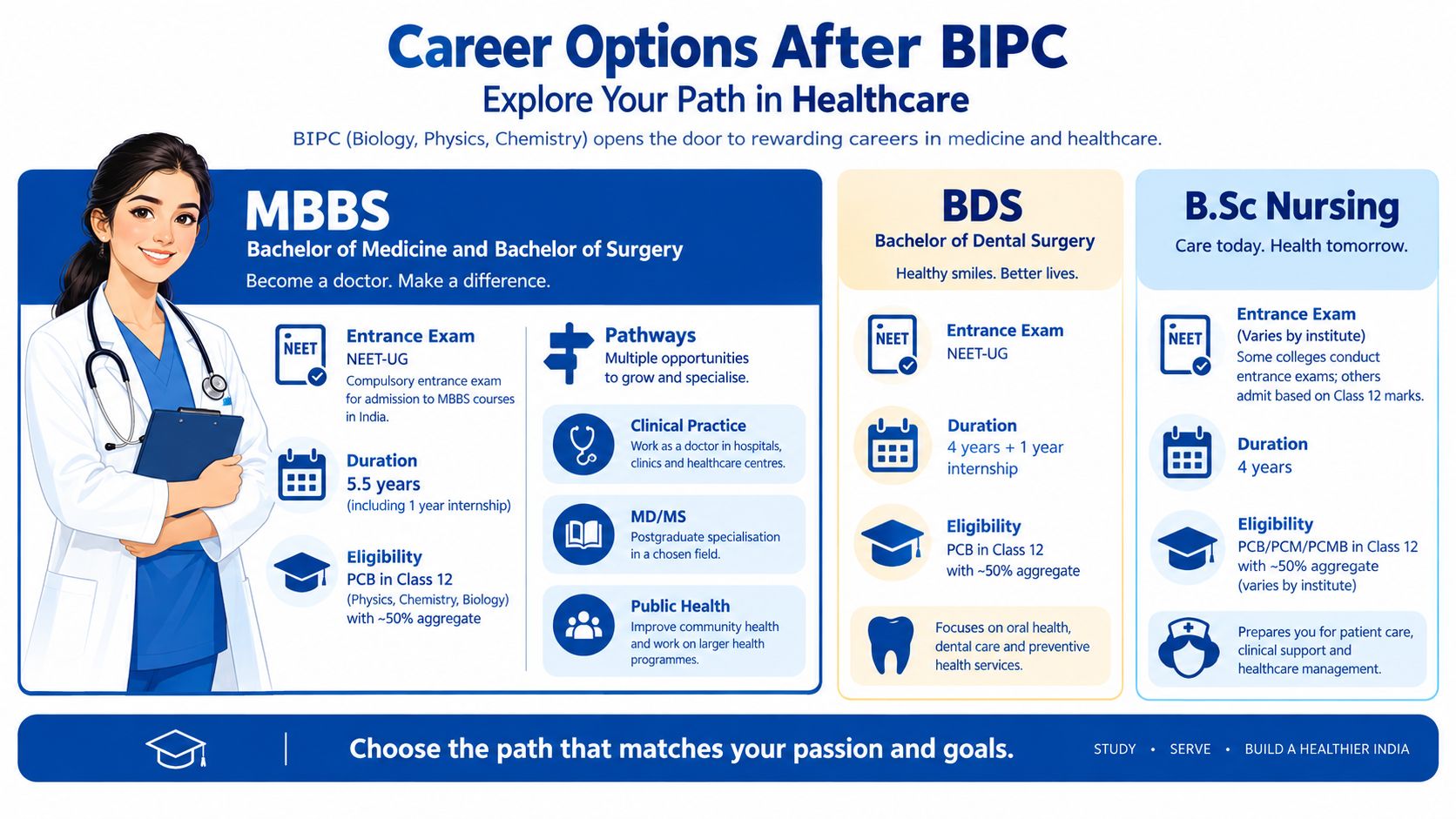
MBBS is the direct route for students who want to train as doctors and work in clinical medicine. It's a demanding choice for students who enjoy Biology and Chemistry, can manage sustained exam preparation, and want regular patient contact. Admission depends on qualifying NEET-UG and meeting the applicable eligibility rules, not having studied BiPC alone.
The National Medical Commission's eligibility material specifies Physics, Chemistry, Biology or Biotechnology, and English at the qualifying level, alongside age and other applicable requirements. It also sets category-specific NEET-UG qualifying thresholds. The course structure is 4.5 years of academic study followed by a one-year compulsory rotating internship, so students should plan for both extended study and supervised clinical training (NMC eligibility and course requirements). NEET-UG is the national admission gateway, and admission must also follow current counselling rules and sanctioned seat capacity (NMC admission requirements).
During training, students encounter clinical settings and patient-care responsibilities. After qualification and the required registration process, graduates may pursue clinical work and postgraduate specialisation, including MD or MS pathways. A student interested in patient interaction might use internship rotations to identify areas for further study. Potential work settings include hospitals, clinics, medical colleges, and community health programmes.
Practical rule: Check the current NMC and NEET-UG information before applying. A previous year's eligibility or counselling notice isn't a substitute for the rules in force for the target admission year.
Before committing, students can explore whether their interests match clinical work through Edvdo's interest test. A separate Access to Medicine course overview can also help readers understand preparatory study in a broader context.
2. BDS (Bachelor of Dental Surgery)
BDS trains students in dentistry, oral health, and dental patient care. It can suit someone drawn to clinical work who also enjoys detailed, hands-on tasks. Compared with MBBS, the focus is narrower: students study dental anatomy, oral pathology, dental materials, and clinical dentistry rather than preparing for the full scope of medical practice.
Admission is generally through NEET-UG, but students must confirm the current rules with the relevant counselling authority and institution. The programme typically includes four years of study and a one-year compulsory internship. That practical component gives students supervised experience caring for patients and applying clinical skills.
After completing the degree and internship, graduates can explore work in private dental clinics, hospital dental departments, or public health programmes. Postgraduate study, including MDS, allows further specialisation. For example, a student who enjoys precise clinical work could investigate orthodontics as a later specialisation, rather than assuming the undergraduate degree alone determines a single career.

Before applying, compare the college's clinical training arrangements, fees, internship structure, and current eligibility rules. Visiting a dental clinic or speaking with a practising dentist can help a student judge whether close patient contact and hands-on procedures feel like a good fit.
3. B.Sc. Nursing (Bachelor of Science in Nursing)
B.Sc. Nursing prepares students for professional nursing practice across hospital and community settings. The programme combines subjects such as anatomy, physiology, microbiology, pharmacology, nutrition, and nursing foundations with substantial clinical practice. It suits students who want direct responsibility for patient care and can work as part of a busy healthcare team.
The programme is four years. Admission requirements aren't uniform across India: some states and institutions use NEET-UG, while others conduct their own tests or follow separate admission procedures. Students should check the current prospectus for subject requirements, entrance routes, age rules, and counselling details. Course standards are associated with nursing regulators, and graduates generally need to register with the relevant state nursing council to practise.
Nursing graduates may work in hospital wards, intensive care units, community health settings, or other specialised care environments. Further experience and study can support progression into areas such as critical care or nursing education. A student who enjoys helping people through recovery, for example, may find ward-based work meaningful, while someone who prefers community outreach may investigate public health nursing.
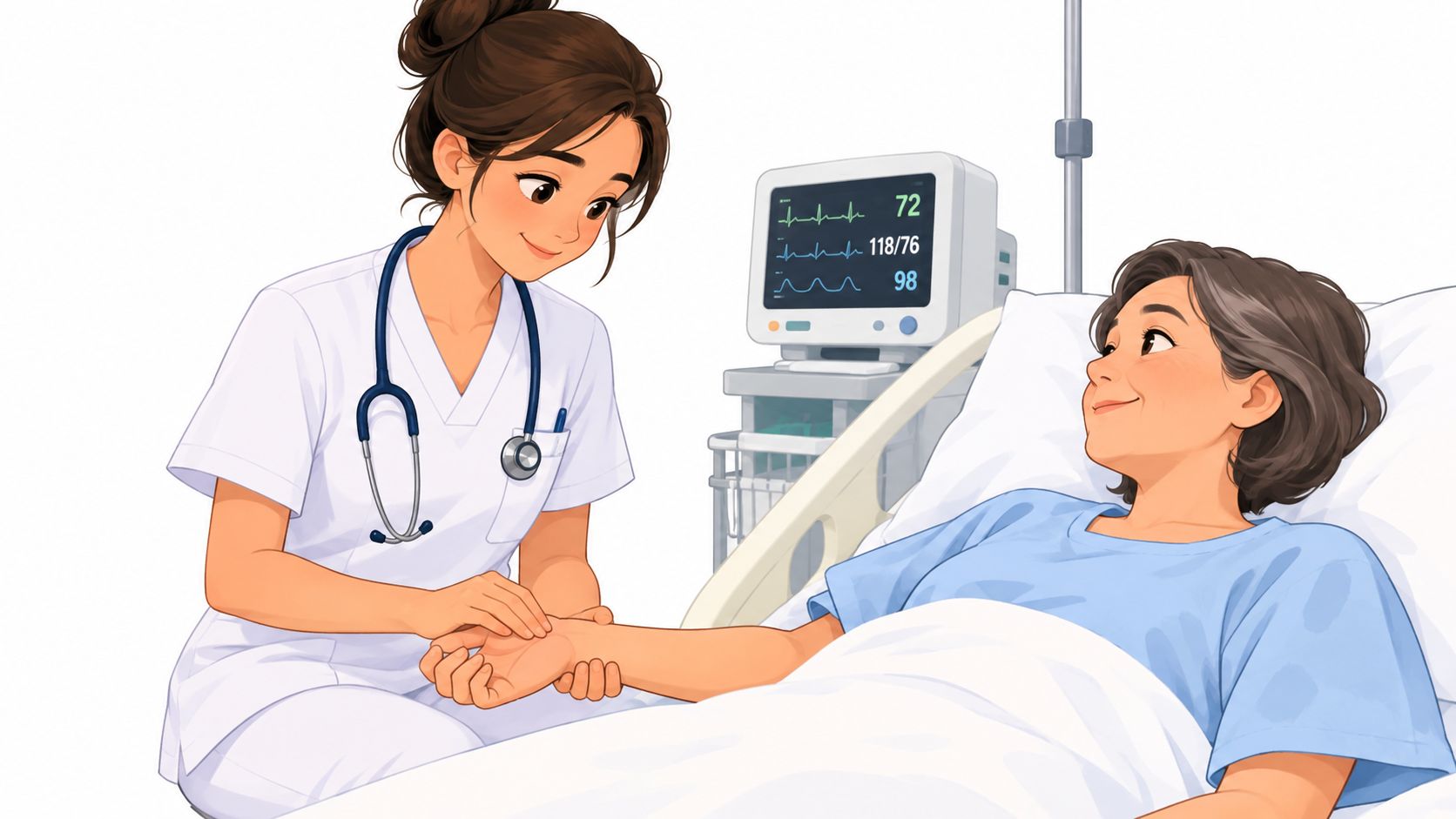
The day-to-day reality can involve shift work, clear communication, and emotionally demanding situations. Students should ask colleges about clinical placements and practical training, not just classroom subjects. They can also use self-assessment to reflect on whether caregiving and team-based work match their motivations.
4. B.Pharm (Bachelor of Pharmacy)
B.Pharm is a pharmacy degree focused on medicines, not a substitute for medical training. Its subjects include pharmaceutical chemistry, pharmacology, pharmaceutics, and related areas of medicine development and use. It may suit students who like Chemistry and careful, structured work but don't want a physician's clinical role.
The Pharmacy Council of India regulations define the regular B.Pharm programme as eight semesters over four academic years. The eligibility framework includes a recognised 10+2 or equivalent qualification with English and Physics, plus Chemistry and Mathematics and/or Biology as individually studied optional subjects. State or university rules may add conditions, so students should check the institution's current admission notice (PCI B.Pharm regulations).
Graduates can explore pharmacy practice, pharmaceutical manufacturing, quality control, regulatory work, or further study. For example, a student who enjoys laboratory precision might investigate quality assurance, while another may prefer community or hospital pharmacy. These options have different work settings and responsibilities, so course and internship details deserve close attention.
Check the qualification carefully: B.Pharm and Pharm.D are different programmes with different structures and admission rules. Applicants should confirm which degree a college offers before comparing its curriculum or career pathways.
Entrance routes vary by institution and state. Before applying, students should verify whether a relevant state test, university process, or counselling route applies. Edvdo's skill test can help students reflect on the kinds of strengths they want to use in pharmacy and related fields.
5. BPT (Bachelor of Physiotherapy)
BPT focuses on movement, rehabilitation, and helping people improve or regain physical function. Students study anatomy and human movement alongside approaches relevant to musculoskeletal, neurological, cardiopulmonary, and sports-related rehabilitation. The course is a strong consideration for someone who likes applied Biology and working with people over the course of their recovery.
The programme commonly runs for 4.5 years, including a six-month compulsory internship, but students must verify the structure with each institution. Admission requirements vary by state and university. Some use their own entrance test or a state-level process, while others may use NEET-UG. Check the current eligibility notice rather than assuming the rules match MBBS or BDS.
Graduates can explore rehabilitation units, clinics, sports settings, and community health work. A student interested in sports and anatomy, for instance, might later investigate sports physiotherapy. Other areas of further study can focus on different patient groups or rehabilitation needs.
Before enrolling, students should ask about supervised clinical practice, internship arrangements, and registration expectations in the state where they hope to work. Volunteering at a rehabilitation centre or observing a sports setting can help clarify whether practical, movement-focused care suits them. Edvdo's AI mentor, Vedu, can help prepare questions to ask a physiotherapy college.
6. B.Sc. Biotechnology
B.Sc. Biotechnology applies biological science to research and practical problems in healthcare, agriculture, industry, and the environment. Courses commonly introduce molecular biology, genetics, microbiology, biochemistry, and bioprocess concepts, with laboratory work forming an important part of learning. Students who enjoy experiments and biological systems should compare programmes by lab access, project work, and teaching approach.
The degree may be offered as a three-year programme, while some universities provide a different structure or an integrated programme. Admission can involve university-specific selection, CUET-UG at participating central universities, or other institutional processes. Integrated science programmes may have their own admissions route, so applicants should confirm the details directly with the institution.
A graduate may explore research laboratories, biotechnology companies, quality-control work, or further academic study. B.Sc. biotechnology is not the same as a guaranteed route to an independent research career; advanced study, practical experience, and specialisation can matter, depending on the role. Options include postgraduate work in biotechnology or related life sciences.
Less-obvious pathways are worth investigating too. Bioinformatics and computational biology combine biological questions with data analysis, so coding and statistics skills can strengthen preparation. Genetic counselling is generally a postgraduate pathway, while environmental biotechnology applies biological approaches to environmental challenges. A student interested in nature and research might investigate environmental biotechnology instead of a traditional medical course. That's an illustrative scenario, not a verified Edvdo success story.
Look for programmes with practical lab facilities and research projects. Edvdo's Career Hub can help students explore biotechnology sub-fields and compare the prerequisites they may need to develop.
7. B.Sc. Agriculture (Bachelor of Science in Agriculture)
B.Sc. Agriculture connects biological science with crop production, soil, food systems, and rural development. The course can include agronomy, horticulture, plant pathology, entomology, agricultural economics, and extension education. It suits students who want to apply science beyond hospitals and laboratories, including through fieldwork, food production, sustainability, or agribusiness.
The programme is generally four years. Admissions vary: ICAR-affiliated institutions and state agricultural universities may follow different entrance and counselling processes. Students should check the current ICAR and university notifications for subject eligibility, entrance examinations, and available seats rather than relying on a general course list.
Graduates can investigate agricultural research, extension services, agribusiness, seed or fertiliser companies, research institutes, and farmer organisations. A student interested in environmental issues and farming might focus on soil management or continue into postgraduate research. Other study pathways include an MSc or PhD, depending on academic goals and programme eligibility.
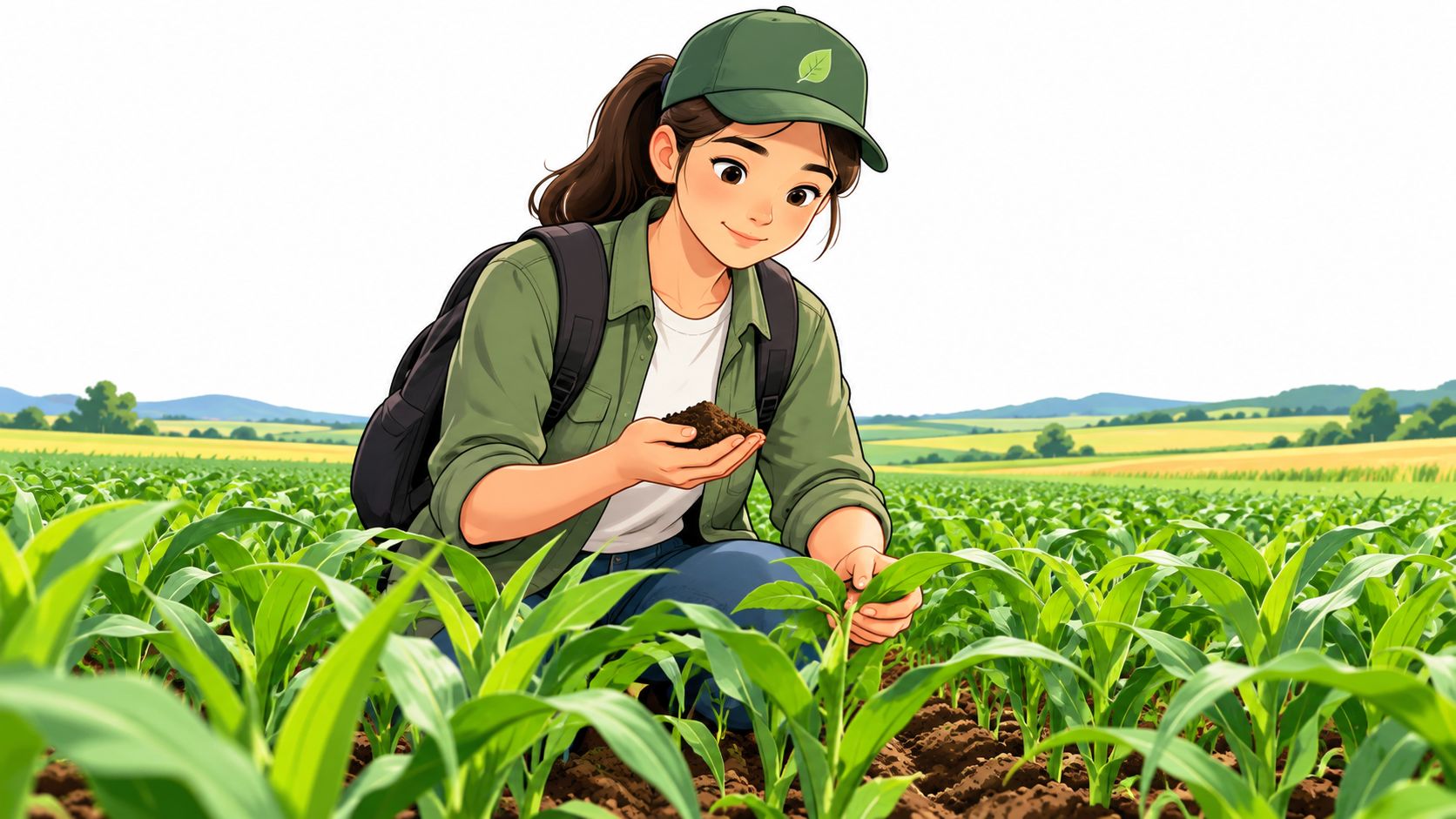
Don't choose agriculture based only on the course title. Ask whether the syllabus includes field visits, practical work, research exposure, and links to relevant organisations. Students should also consider whether they're comfortable with field-based work and possible geographic mobility. Edvdo's career blog offers further material for students comparing study and career directions.
8. B.Sc. Nutrition and Dietetics
B.Sc. Nutrition and Dietetics focuses on food, human nutrition, metabolism, and the relationship between diet and health. Programmes may include food science, clinical nutrition, and community nutrition. This option can suit students interested in health who prefer studying food and nutrition practice over diagnosing or treating illness as a physician.
The degree is commonly offered as a three-year undergraduate programme, but students should verify the duration, curriculum, and admission process with each university. Some institutions use CUET-UG or their own entrance process; requirements can differ. Check whether the course includes supervised practical experience and how it approaches clinical or community-based work.
Graduates may explore settings connected with hospitals, public health programmes, food businesses, sports nutrition, or wellness services. Further study can help a student focus on a particular area, such as clinical nutrition or community nutrition. A student interested in food science, for example, may prefer industry-facing study, while someone motivated by health education may investigate community work.
The title dietitian and the requirements for related clinical roles can depend on the setting and applicable rules. Students should confirm local practice expectations and ask programmes how they prepare graduates for the roles they advertise. Compare course content and placements, not just the degree name.
9. B.Sc. Psychology
B.Sc. Psychology explores human behaviour, mental processes, and research methods. It can appeal to BiPC students who are curious about how people think and behave, but Biology isn't always required for admission. Some universities accept applicants from any stream, while others set subject or entrance-test requirements, so the institution's current prospectus is decisive.
The undergraduate programme is commonly three years, though structure and admission rules vary. Students should review the balance between theory, research methods, projects, and practical learning. Psychology can lead to postgraduate study and further specialisation, but a bachelor's degree alone should not be presented as a qualification for independent clinical practice.
Graduates may continue into research, counselling-related study, or other psychology-focused pathways. Clinical practice requires postgraduate training and applicable licensing or professional requirements. A student interested in mental health should therefore map the full study route before choosing an undergraduate programme. Someone more drawn to research may compare faculty interests, project opportunities, and methods training.
Psychology is a distinct option from a clinical healthcare degree. It focuses on behaviour and mental processes rather than the same clinical training as medicine or nursing. Edvdo's career report can help students reflect on interests and strengths when comparing psychology with other people-focused courses.
10. B.Sc. Environmental Science
B.Sc. Environmental Science is a route for students who want to study environmental systems, sustainability, and human effects on the natural world. Programmes may draw on Biology, Chemistry, and other sciences, but eligibility can vary: some universities accept PCB, some include PCM, and others have broader entry rules.
The undergraduate degree is commonly three years, with admission through CUET-UG or university-specific selection at some institutions. Students should check whether a programme emphasises fieldwork, laboratory analysis, environmental policy, or a mix. The course title alone won't tell applicants how much time they'll spend collecting data outdoors, working in a lab, or studying regulations.
Graduates can continue to postgraduate study or explore work related to environmental impact assessment, pollution control, sustainability, and research. A student interested in ecosystems and data, for example, could compare environmental science with environmental biotechnology or a life-sciences degree that offers relevant projects. Students assessing the subject's value should compare the curriculum and practical experience with their own goals, as discussed in this overview of environmental science degrees.
The field can involve varied work environments, including field sites, laboratories, and offices. Ask whether the university offers projects, field methods, and links to organisations doing environmental work. Those details help students judge whether the course matches their preferred way of learning.
Top 10 Courses After BiPC: Comparison Guide
| Course | 🔄 Study demands and entry | 📊 Duration and pathways | 💡 Ideal use case | ⭐ Key advantage |
|---|---|---|---|---|
| MBBS | High academic and clinical workload; NEET-UG; typically Class 12 PCB | 5.5 years, including internship; clinical practice, MD/MS, public health | Students committed to becoming doctors and providing patient care | Clear, regulated route with broad specialisation options |
| BDS | Intensive clinical training requiring precision and fine motor skills; NEET-UG; typically PCB | 5 years, including internship; dental practice, MDS, public health dentistry | Students interested in oral health and hands-on procedures | Direct clinical outcomes and options for independent practice |
| B.Sc Nursing | Substantial clinical postings and patient-care responsibilities; entrance requirements vary; typically Class 12 PCB | 4 years; clinical nursing, education, community health, MSc Nursing | Students drawn to practical, team-based caregiving | Multiple career routes across healthcare settings |
| B.Pharm | Chemistry-focused study and laboratory work; entrance tests vary; Physics and Chemistry plus Biology or Mathematics as specified | 4 years; pharmacy, industry, regulatory affairs, clinical research, M.Pharm | Students interested in medicines, laboratory work, or pharmaceutical industry | Career options beyond dispensing, including research and manufacturing |
| BPT | Practical, physically demanding rehabilitation training; entrance requirements vary; typically PCB | 4.5 years, including internship; clinical practice, sports rehabilitation, MPT | Students interested in movement, anatomy, and helping patients regain function | Hands-on work with visible rehabilitation progress |
| B.Sc Biotechnology | Laboratory-intensive science programme; university or institute tests, sometimes CUET-UG; PCB or PCM commonly accepted | 3 years; postgraduate study, research, bioinformatics, biotechnology | Students interested in biological research and applied science | Applications across healthcare, agriculture, industry, and the environment |
| B.Sc Agriculture | Combines classroom, laboratory, and field learning; ICAR or state-level tests; subject requirements vary | 4 years; agribusiness, extension, research, MSc Agriculture | Students interested in food systems, farming, or sustainability | Connects science with food security and rural development |
| B.Sc Nutrition and Dietetics | Study of food science and human nutrition; entrance and eligibility vary, often Biology-based | Typically 3 years; nutrition, food service, public health, further study | Students interested in nutrition, wellness, or food and health | Potential pathways across clinical, community, and food-sector settings |
| B.Sc Psychology | Study of behaviour and research; university tests vary; some universities accept any stream | Typically 3 years; postgraduate study, counselling, HR, research; clinical practice requires further training and applicable licensing | Students interested in human behaviour and mental health | May be accessible to students from different academic streams |
| B.Sc Environmental Science | Interdisciplinary study; CUET-UG or university tests; eligible streams vary | Typically 3 years; further study, sustainability, pollution control, environmental assessment | Students interested in environmental issues and sustainability | Applies science to environmental and sustainability challenges |
Turn Your BiPC Result into a Clear Next Step
Don't choose by course prestige alone. MBBS, BDS, nursing, pharmacy, physiotherapy, and science degrees prepare students for different responsibilities and work environments. A student who wants sustained patient contact may prefer a clinical or allied-health route. Someone who enjoys experiments may find biotechnology or another life-sciences programme a better match. Students drawn to food systems, sustainability, or fieldwork should look closely at agriculture and environmental science.
Compare each programme's entrance process, subject eligibility, curriculum, practical requirements, internship, cost, location, and likely postgraduate route. MBBS and B.Pharm have distinct official eligibility frameworks, and other courses may have separate regulators, university rules, or state processes. Eligibility for one programme doesn't automatically establish eligibility for another. The current official admission brochure for the target year is the best place to check subject combinations, marks, age conditions, entrance tests, counselling authorities, and approved intake.
A useful shortlist starts with what a student wants to do regularly. Does the preferred work involve patient care, rehabilitation, laboratory procedures, data analysis, research, fieldwork, or communication? Does the student enjoy Chemistry, biological systems, detailed practical tasks, or applied problem-solving? These questions won't replace checking admissions rules, but they can help remove options that don't fit a student's learning preferences or practical expectations.
The five frequently considered options, MBBS, BDS, B.Sc. Nursing, B.Pharm, and B.Sc. Biotechnology, are not a measured ranking and aren't the only credible choices. Broader possibilities include nutrition, psychology, agriculture, environmental science, microbiology, biochemistry, and allied-health programmes. Emerging interdisciplinary areas such as bioinformatics, computational biology, genetic counselling, and environmental biotechnology deserve investigation too. Some require additional technical skills or postgraduate study, so students should trace the full pathway before enrolling.
Talk to current students, graduates, or professionals about what their course and work involve. Ask colleges about labs, clinical placements, internships, fieldwork, accreditation, and progression into further study. Check whether a programme's published curriculum matches the kind of practical experience a student wants, and compare government and private institutions using current, verifiable information rather than broad assumptions.
Edvdo can support that decision-making process through assessments, a Self Discovery Report, an AI Career Report, a Career Hub, a Career Path Builder, and its AI mentor, Vedu. Those tools can help students examine interests, learning patterns, and possible role families, then turn that reflection into questions about prerequisites, skills, programmes, and colleges. They're a way to organise exploration, not a replacement for official admission guidance or a promise of a particular career result.
A strong next step is to shortlist two or three courses, verify the current admission rules for each, and compare their practical demands before applying. That gives a student room to pursue ambition while making a decision grounded in eligibility, course content, and the work they want to do.
Students comparing post-BiPC options can use Edvdo's assessments, Career Hub, Career Path Builder, and AI mentor Vedu to connect interests and strengths with possible courses and career paths. Explore those tools and start building a practical shortlist with Edvdo.