

A Class 10 student in India often sits with two voices in the room. One voice says Science, because that sounds safe, respectable, and familiar. The other voice is quieter, but smarter, it asks whether the student actually wants a life spent inside coaching centres, or whether a hands-on route into land, crops, machines, livestock, and agri-business might fit better.
Agriculture Study After 10th is not a consolation prize. It is a real pathway with state diplomas, short vocational courses, allied skills, and later progression into higher education, research, and enterprise. The mistake many families make is treating agriculture as one narrow degree, when the field has multiple entry points and very different outcomes depending on the state, the institution, and the student's goals.
Table of Contents
- Why Agriculture After 10th Is a Real Option, Not a Fallback
- Main Pathways You Can Choose Right After Class 10
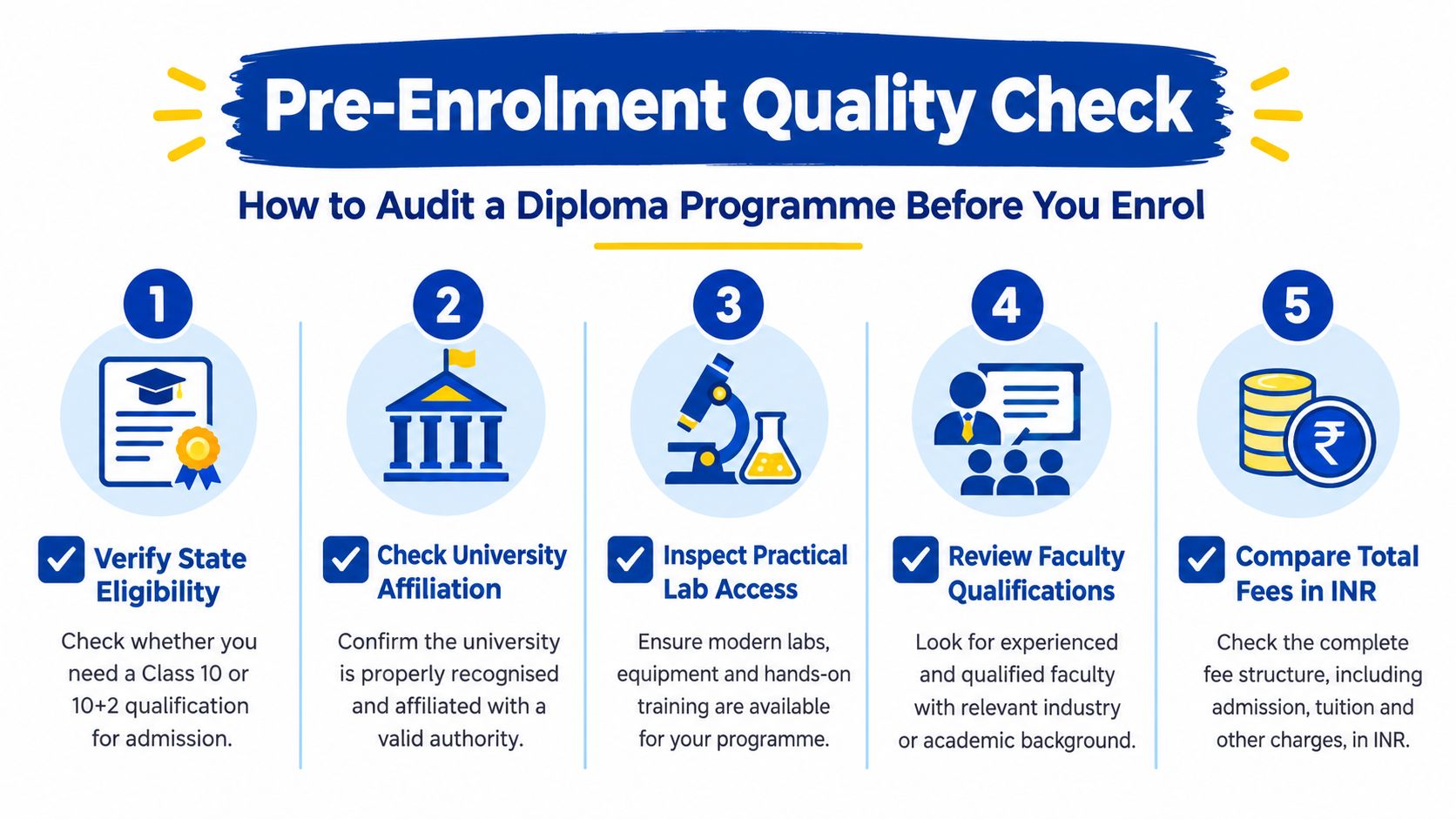
- How to Audit a Diploma Programme Before You Enrol
- Allied Skills That Pay Faster Than a Full Diploma
- What Agriculture Careers Actually Look Like Beyond the Farm
- Your 90-Day Action Plan to Start Agriculture Study After 10th
- Choosing the Right Path and Common Questions Answered
Why Agriculture After 10th Is a Real Option, Not a Fallback
A student in Class 10 doesn't have to wait until Class 12 to begin building an agriculture career. In India, state agricultural universities and related institutes already offer diploma-level routes in agriculture and allied sectors, and the entry point can begin at either Class 10 or Class 12 depending on the institution and state ICAR strategy paper. That alone should change the conversation at home.
The right way to think about it
The honest framing is simple. Agriculture after 10th is not a single course, it's a structured vocational system that can lead to more study or immediate work, depending on what the student chooses. Some students need a diploma with campus teaching and field exposure. Others are better off stacking shorter skill courses first, especially if they want to earn sooner or test whether outdoor work suits them.
The country's public education network also gives the field legitimacy. India has 63 State Agricultural Universities, 3 Central Agricultural Universities, 4 deemed agricultural universities, 4 Central Universities with agriculture faculties, and 11 Agricultural Technology Application Research Institutes Government of India factsheet summary. That is not the footprint of a dead-end stream. It is an ecosystem.
Students and parents should stop asking, “Is agriculture below Science?” That's the wrong question. The better question is, which agriculture route matches the student's stamina, budget, location, and appetite for field work?
Practical rule: If the student likes outdoor work, crop cycles, livestock, machinery, or rural problem-solving, agriculture can be a strong first-choice path, not a backup.
This is also why interest matching matters. A student who is pushed into any diploma because it sounds job-oriented often struggles later. A quick self-check through an interest test can help separate genuine fit from family pressure.
Main Pathways You Can Choose Right After Class 10
The post-10th agriculture field has two main tracks that matter in practice. One is a 2 to 3 year agriculture diploma through a State Agricultural University or affiliated institution. The other is a short Skill India or allied vocational course that aims at faster entry into work. They are not interchangeable.
Diploma versus short course
The diploma route is better for students who want depth, progression, and a proper academic structure. The short course route is better for students who want speed, lower commitment, and a practical skill they can test in the market. Eligibility is not uniform nationally, and that matters more than most brochures admit ICAR NAARM strategy paper.
| Feature | Agriculture Diploma (State Ag. University) | Skill India / Allied Short Course |
|---|---|---|
| Entry level | Often Class 10, sometimes Class 10+2 depending on state and institute | Usually Class 10 or similar, depending on role |
| Duration | Commonly 2 to 3 years | Weeks to months |
| Focus | Crop production, soil science, horticulture, livestock, machinery, practical training | One job role or a small cluster of related tasks |
| Progression | May support entry into B.Sc. Agriculture if the college allows it | Usually job-ready skill building, not a direct academic bridge |
| Best for | Students who want structured study and future progression | Students who want faster income or a low-risk trial path |
The safest move is to compare the two against the student's real life, not against prestige. A diploma makes sense if the student can stay committed for years, handle field practicals, and wants a genuine academic ladder. A short course makes sense if the family needs earlier earning power or the student wants to test agriculture before spending more time and money.
Bottom line: A diploma is a longer bet on academic progression. A short course is a quicker bet on employability and self-employment.
How to Audit a Diploma Programme Before You Enrol
Never treat “agriculture diploma” as a standard package. In reality, the programme can change a lot by state, university, and even campus. The first thing to verify is whether the institute accepts Class 10 directly or requires Class 10+2, because both models exist ICAR NAARM strategy paper. If the brochure is vague, that is a warning sign.
What to check before paying fees
The programme must be judged on content, not just the title. Students should ask how much time is spent on crop production, soil science, horticulture, livestock, farm machinery, and field practicals. If the course sounds broad but the hands-on component is weak, the student may finish with theory but little usable skill.
One ANGRAU-based study of 90 diploma students found that 80.00% identified low practical knowledge as a major academic constraint, while 90.00% reported limited seats for progression to B.Sc. Agriculture as the leading administrative constraint, and 61.11% reported inadequate study-hall facilities ANGRAU study. That is a clear warning. A diploma with weak practical training can look respectable on paper and still disappoint in the field.
A field audit that actually works
Use this checklist on any campus visit:
- Verify State Eligibility: Ask for the written rule on Class 10 vs Class 10+2 entry.
- Check University Affiliation: Confirm the campus is officially attached to a recognised agricultural university or institute.
- Inspect Practical Lab Access: See soil, plant pathology, irrigation, farm machinery, and protected cultivation labs yourself.
- Review Faculty Qualifications: Ask who teaches the practicals and whether staff are permanent or guest-based.
- Compare Total Fees in INR: Request the full prospectus and fee sheet before paying anything.
For a quick self-check on whether the student's skills and motivation fit this kind of course, the assessment page can help narrow down the fit before applications start.
Warning: If the college refuses to show practical facilities or gives vague answers about lateral entry into B.Sc. Agriculture, walk away.
Allied Skills That Pay Faster Than a Full Diploma
A lot of families want a faster return than a multi-year diploma can offer. That's where allied agriculture skills matter. Skill India recognises roles such as organic grower, mushroom grower, honey-bee farmer, vermicompost producer, hydroponics technician, precision-farming technician, micro-irrigation technician, soil-and-water testing laboratory analyst, greenhouse operator, and kisan-drone operator PIB agriculture skills release.
What these roles really offer
These are not “small” skills. They are different business models. Some are wage-based, some are enterprise-based, and some are seasonal. A mushroom grower can start small with relatively low capital compared with a multi-year academic route. A vermicompost unit can be tied to farm waste and local sales. A soil-and-water-testing role fits students who are comfortable with lab work and local advisory services.
The scale is real too. As of 30 June 2025, 1,087,743 candidates had been trained or oriented under agriculture-sector job roles through the skills system, and short-duration rural training had trained 20,940 candidates by November 2024, including 5,504 during FY2024–25 PIB agriculture skills release. Those numbers do not prove income, but they do show that the pathway is large, active, and not fringe.
How to judge the role, not the marketing
Students should sort these roles by risk profile.
- Low-capital, quicker entry: mushroom growing, vermicompost, organic grower.
- Lab-and-service oriented: soil-and-water testing, micro-irrigation, greenhouse operations.
- Tech-enabled and equipment-heavy: precision farming, kisan-drone operation, hydroponics.
- Seasonal or market-linked: beekeeping and some crop-specific enterprise work.
The wrong move is choosing a role because it sounds modern. The right move is asking who buys the output, what equipment is needed, and whether the student can live with irregular income. For students who want to compare role fit before committing, a skill test is more useful than scrolling random course ads.
Practical rule: Short courses make sense when the student wants a faster income path or an experiment before committing to a longer diploma.
What Agriculture Careers Actually Look Like Beyond the Farm
The old stereotype says agriculture study leads only to farm labour or a government officer dream. That is lazy thinking. Agriculture remains a major employment base in rural India, engaging 44.6% of rural male workers and 70.9% of rural female workers in April to June 2025 PIB labour and youth training release. But the career map is wider than traditional cultivation.
The real spectrum of work
Modern agriculture is tied to solar-pump technicians, climate-change and risk-mitigation managers, price-risk management for farmer-producer organisations, hydroponics technicians, precision-farming technicians, and drone operators PIB labour and youth training release. That means a student starting after Class 10 can think in terms of field services, input supply, advisory work, agri-operations, and local enterprise, not just sowing and harvesting.
Placement data needs careful reading. Agricultural-university enrollment more than doubled from over 25,000 in 2017 to over 54,000 in 2022, and graduate placement rose from 42% in 2017 to 67% in 2024 PIB higher-education release. That is encouraging, but those figures apply to university graduates, not every Class 10 entrant. A diploma holder should not borrow a degree-level placement claim and call it a guarantee.
The stronger takeaway is this: formal vocational training is still thin in India, with only 4.9% of youth aged 15 to 29 having received formal vocational or technical training in 2023-24 Economic Survey cited in PIB release. That leaves room for students who choose early and build practical skills with discipline.
For students looking beyond classroom theory, a good starting point is seeing how drone pilot training in agriculture is used in field operations, surveying, and agri-tech support. It's one example of how the field now touches technology, not just cultivation.
Reality check: A diploma can open doors in agribusiness, input dealerships, extension support, and farm management, but it is not an automatic ticket to a high-salary desk job.
The broader jobs market is worth scanning too, especially for students who want to know where agricultural skills can be used outside the traditional campus pipeline. A curated jobs list helps make that shift from course thinking to career thinking.
Your 90-Day Action Plan to Start Agriculture Study After 10th
The right move after Class 10 is not to panic and enrol somewhere cheap. It is to move in a tight sequence, so the student doesn't waste a year on a weak fit. The first month should be about honest self-checking, not forms.
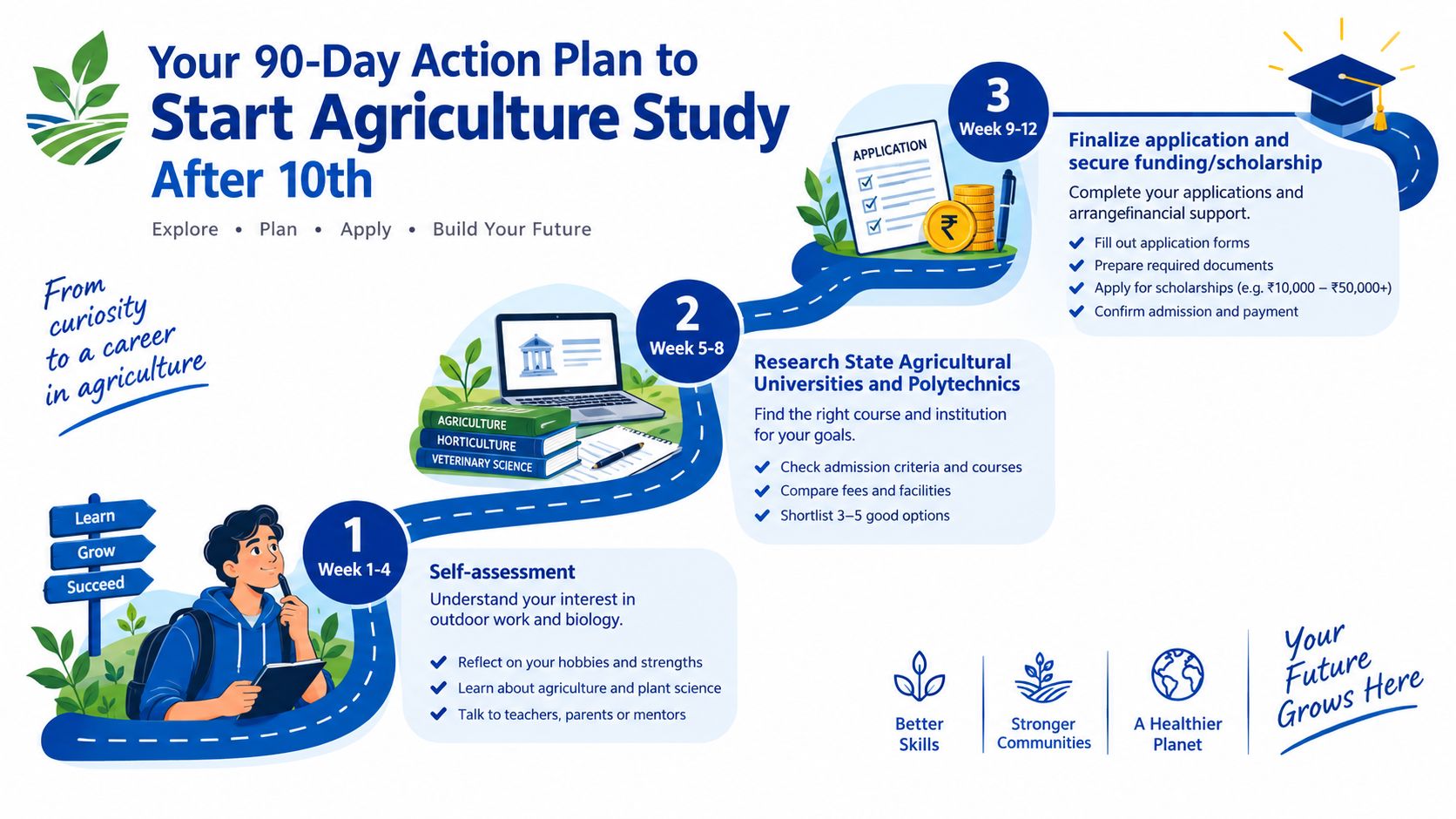
Days 1 to 30
The student should first ask whether outdoor work, biology, and machinery are actually appealing. Then shortlisting should begin. Three State Agricultural Universities and two Skill India agriculture courses is enough for a focused first pass, not twenty random options.
Days 31 to 60
Now comes the verification stage. Collect official prospectuses, confirm Class 10 or Class 10+2 eligibility, and make at least one campus visit. If the campus cannot show labs, field plots, or practical schedules, it should not be treated as a serious option.
Days 61 to 90
Applications come next, along with entrance preparation if a state institute requires it. Register on the Skill India portal if a short course is the backup plan. The student should also decide in advance what happens if the preferred diploma seat doesn't materialise, because waiting passively is how one year disappears.
A strong choice also needs a strong personality fit. That's where structured assessment helps. A system like Edvdo can surface patterns in learning style, motivation, and behaviour that subject names alone can miss, which makes the decision far less random.
Best practice: Apply to a primary route and keep one backup route alive. Students who do this stay in motion instead of sitting on one uncertain outcome.
Choosing the Right Path and Common Questions Answered
The decision comes down to four things. Interest in field work, family finances for a 2 to 3 year programme, willingness to stay tied to a specific state, and ambition for self-employment versus salaried work. A student who wants structure, can afford time, and likes formal study should prioritise the diploma route. A student who wants speed, lower cost, and quicker skill use should lean toward short allied courses first.
A simple decision rule
- Choose a diploma if the student wants depth, campus learning, and possible progression into degree study.
- Choose short allied courses if the student needs faster entry into work or wants to test agriculture before spending more years.
- Avoid weak private options if they hide practical training details or cannot explain progression rules.
- Prefer state-specific clarity over glossy national claims, because the pathway is not uniform across India.
Common questions come up again and again. Diploma holders do not automatically get all higher-study options, so lateral entry into B.Sc. Agriculture must be checked in writing with the institution. Class 10 marks may matter in admission screening, but the exact rule depends on the university. Recognition for government jobs depends on the post and the recruiting body, so the student should never assume a diploma alone settles it. Entrance exam eligibility also varies by programme, which is why the prospectus matters more than rumours from coaching centres.
The strongest long-term signal is that India's agricultural education system is broad enough to support movement from vocational learning into higher education and research. That makes the field worth taking seriously for students who start early and choose carefully.
If the goal is to make a smart post-Class 10 decision, Edvdo gives students a structured way to match strengths, interests, and learning patterns with the right stream or course. For agriculture study after 10th, that means less guesswork, better shortlisting, and a cleaner plan before fees or admissions are locked in. Visit Edvdo and use it to compare fit before choosing a diploma, short course, or backup path.