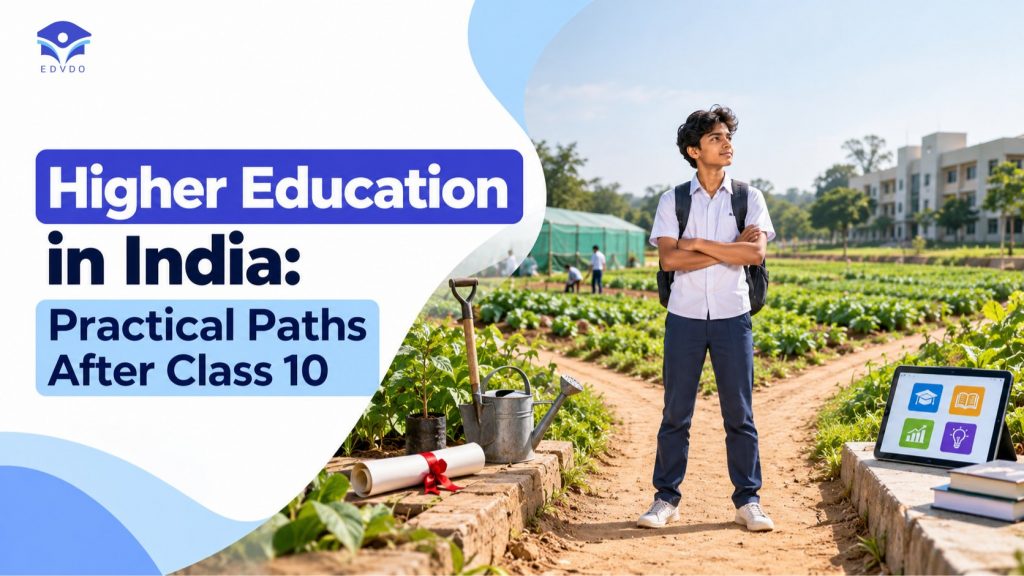
A Class 10 student sits at the dining table with a marksheet, a school form, and a parent asking the same question many Indian families ask at home: what comes after this, and what choice will still make sense five years later? The pressure usually pushes attention towards engineering or medicine, even when the student likes plants, animals, machines, food, or hands-on work more than abstract theory. In higher education in India, that narrow view misses a big part of the actual scene, especially for students who want agriculture and allied vocational pathways to be a first choice, not a backup plan.
India's higher-education system has grown into a very large and varied space. The Ministry of Education reports that universities or university-level institutions rose from 20 in 1950 to 677 in 2014, while colleges grew from about 500 to 37,204 by 31 March 2013, which shows how far the system has moved from a small, selective setup to a mass sector with many routes and provider types (Ministry of Education). For a Class 10 student, that means one thing in practical terms, there are now many more doors than the old “science, commerce, arts” shorthand suggests.
A family that wants a broader view can also look at how to create a virtual campus tour when comparing campuses, because a visit, even a virtual one, often answers the questions brochures leave out. For students who want structured self-reflection before shortlisting options, the career report can also help organise strengths, interests, and programme fit.
Table of Contents
- Why Agriculture and Vocational Paths Deserve a Serious Look
- Understanding Diplomas, Certificates, and Vocational Courses
- Main Agriculture and Allied Options After Class 10
- Eligibility, Admissions, and Entrance Reality
- What a Typical Diploma Programme Actually Looks Like
- From Diploma to Degree, Jobs, and Entrepreneurship
- A Class 10 Student's Preparation Checklist
Why Agriculture and Vocational Paths Deserve a Serious Look
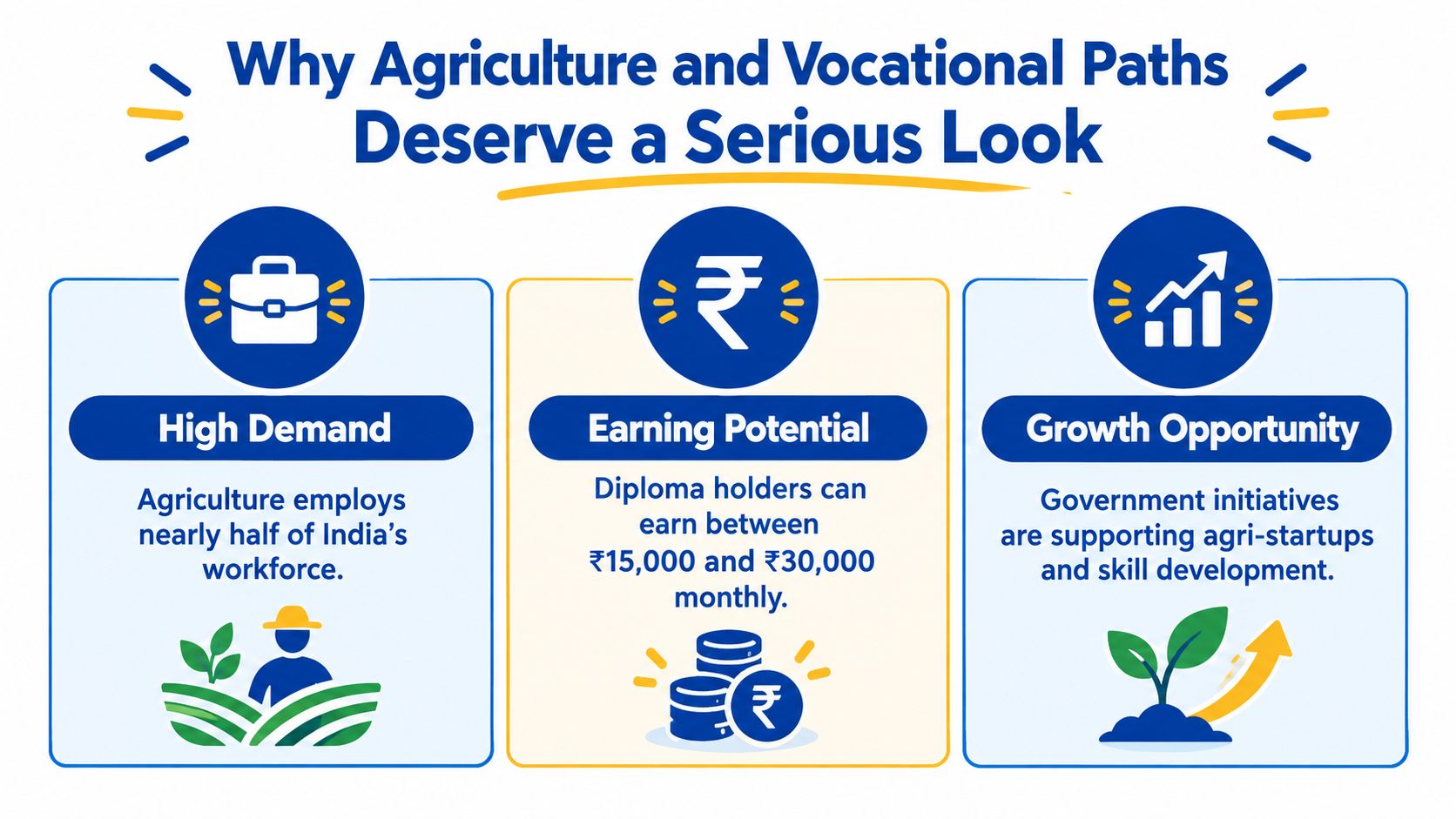
A Class 10 student who enjoys biology, a parent looking for a steady path, and a teacher who keeps hearing “what about engineering?” often arrive at the same question. Does choosing agriculture mean settling for less? It does not. Agriculture today reaches far beyond field work. It includes soil care, food processing, agri-business, equipment handling, animal care, horticulture, and rural services.
Practical rule: if a subject leads to hands-on work, further study, and a real labour market, it deserves the same seriousness as any mainstream stream.
Higher education in India now offers many routes, not just a narrow set of familiar ones. For a student who learns better by doing than by memorising, agriculture and vocational routes can fit more naturally than a purely classroom-based path. The Ministry of Education describes a system that has expanded into many institutional types and specialisations, and that variety is exactly why these options deserve attention.
The bigger point is simple. A Class 10 student is choosing a way of studying, not only a subject. Some learners want theory first and practice later. Others need practical exposure from the start, the same way a child learns to ride a cycle by riding it, not by reading a manual alone. Agriculture diplomas and related vocational courses suit that second group because they connect learning to farms, nurseries, food units, and field work.
Parents often ask whether this path still leaves room for degree study later. In many cases, yes. That is why these routes should be seen as entry points, not dead ends. They can lead to degree programmes, technical jobs, or self-employment, depending on the student's interest and performance. For families comparing options, a careful career report can also help organise strengths, interests, and programme fit.
A mainstream stream and a vocational path are different foundations, and the right one is the one the student can build on. Families who want a broader view can also look at how to create a virtual campus tour when comparing campuses, because even a virtual visit often answers questions brochures leave out.
Understanding Diplomas, Certificates, and Vocational Courses
Many families use diploma, certificate, and vocational course as if they mean the same thing. They do not. Each one has a different length, depth, and purpose, and understanding the difference helps avoid confusion later when admission notices start arriving.
The simplest way to tell them apart
A certificate is usually the shortest option. It focuses on one skill, such as nursery work, beekeeping, or organic farming, and often suits a student who wants a quick start or a trial step before a larger programme. A diploma is broader. It usually runs longer, covers more theory and practice, and is meant to prepare the student for work or further study. A vocational course is the training style that keeps the emphasis on doing, whether that appears in school-linked training, post-Class 10 study, or skill-based modules.
Consider it like farm equipment. A certificate is one useful tool, a diploma is the full toolkit, and a degree is the completed structure. All three can be valuable, but they serve different stages of learning.
A family should always ask two questions before applying, who recognises the programme, and what it allows the student to do next.
Recognition matters because different bodies can award or approve these programmes. Depending on the course, the qualification may come through a state technical board, an agricultural university, or a skill-based body linked to a specific trade area. That is why the name of the institute alone is never enough. The parent needs to check whether the qualification is recognised for employment or for lateral entry into higher study.
A certificate can be a test of interest. A diploma can be a serious professional start. A vocational course can be the bridge between school learning and a job-ready skillset. For students exploring options through Edvdo's skill test, the important outcome is not just “What is available?” but “What kind of learner does this student seem to be?”
Main Agriculture and Allied Options After Class 10
A Class 10 pass student interested in agriculture does not need to wait for a single perfect route. There is a menu of programmes that lean towards farming practice, technology, food systems, livestock, or business. The best choice depends on whether the student prefers soil and crops, machines and tools, or processing and enterprise.
A side-by-side look at the main routes
| Programme | Typical Duration | Focus Area |
|---|---|---|
| Agriculture Diploma | 2 years | Core farming, crop basics, soil, and field practice |
| Horticulture Diploma | 3 years | Fruits, vegetables, nursery work, and plant care |
| Sericulture Diploma | 3 years | Silk production, mulberry cultivation, and related systems |
| Dairy Technology Diploma | 3 years | Milk handling, dairy processes, and animal-linked operations |
| Food Processing Diploma | 3 years | Preservation, packaging, and basic processing methods |
| Agricultural Engineering Diploma | 3 years | Farm machines, tools, repair, and technical support |
| Organic Farming Certificate | Short-term | Natural farming methods and input reduction |
| Beekeeping Certificate | Short-term | Honey production and hive management |
| Nursery Management Certificate | Short-term | Seedlings, propagation, and plant sales |
The shorter certificate options are often useful for students who want to build confidence first. They can also suit families looking for a lower-cost starting point before committing to a longer diploma. The longer diploma paths are better for students who want a deeper base and a clearer bridge towards jobs or degree study.
Some options are more plant-focused, such as horticulture and nursery management. Others are more systems-oriented, such as agricultural engineering and food processing. That split matters because a student who enjoys repairing tools may not enjoy crop planning, while a student who likes plant growth may not want machine maintenance.
The family should also treat allied sectors seriously. Dairy, food processing, sericulture, and beekeeping all sit close to agriculture but lead to different workplaces and different skills. A student who dismisses them too quickly can miss a path that is both practical and employable.
The best way to shortlist is not by prestige alone. It is by fit. A student who likes laboratory work, field visits, and real-world tasks may thrive in one of these routes far more than in a classroom-heavy programme.
Eligibility, Admissions, and Entrance Reality
A Class 10 student looking at agriculture or allied vocational courses may find the admission process less uniform than school itself. One college may ask only for a recognised board pass, while another may also want Science and Mathematics, an age proof, or residence documents for state seats.
What families should check first
- Board recognition: The school certificate should come from a recognised board, not only a school-issued completion letter.
- Subject mix: Some programmes expect Science or Mathematics, especially where practical or technical training is central.
- Age and domicile: State quota seats may ask for proof of residence, and age rules can differ from one institute to another.
- Course recognition: Private training centres are not the same as recognised colleges, so the qualification must be checked carefully.
- Admission calendar: States and institutions do not always open applications at the same time.
A student in Maharashtra seeking an agriculture diploma may go through a state entrance route, while a student in Tamil Nadu looking at horticulture may face a different schedule, different counselling steps, and different document rules. That variation is normal. The mistake is assuming one set of rules fits every institute.
Some colleges admit students through merit lists, others use entrance tests, and some use both. Counselling rounds can also affect seat choice, because rank, category, and available seats all matter. Students who wait until the last week often lose better options, since form submission, document collection, and fee payment all take time.
For entrance preparation, a steady routine works better than panic revision. Families can use evidence-based study methods to guide revision for a state exam while school work is still going on. The same careful approach helps with applications too, check the official notice, keep copies ready, and track deadlines closely.
The wider system also explains why the process can feel crowded. AISHE 2021-22 recorded 1,168 universities, 45,473 colleges, and 12,002 standalone institutions, with nearly 4.33 crore students enrolled and female GER at 28.5% and male GER at 28.3%. That breadth means a Class 10 graduate may see many kinds of providers, so each institute must be checked on its own terms (PIB). For state-level admission patterns and course recognition, see the guides on the Edvdo blog.
What a Typical Diploma Programme Actually Looks Like
A student who joins an agriculture or horticulture diploma does not spend the whole year in a classroom. The week usually mixes theory, field work, practicals, and visits to farms, nurseries, processing units, or cooperatives. That mix is why many students who dislike purely textbook-based learning find these programmes easier to stick with.
A week can look very different from school
On one day, the class may cover soil health, plant breeding, or crop protection. On another, the student may be in a demonstration plot, learning how to observe plant growth, note pest issues, or compare seed varieties. The point is not just to hear terms, but to see how those terms work in real conditions.
A two-year agriculture diploma often stays broad and practical, with attention to core farm systems and local fieldwork. A three-year horticulture diploma usually goes deeper into fruits, vegetables, nursery routines, and plant handling. Both can include project work, internships, and assessments that check whether the student can apply knowledge, not only repeat it.
Students also meet basic digital tools during training. Farm record apps, simple data entry, and online learning resources are becoming part of daily study in many places. That matters because even a field-based career now expects some comfort with technology.
Practical exposure is not an extra in these programmes, it is the centre of them.
The best fit is usually visible in the student's reaction to routine. A learner who enjoys observing, trying, fixing, and recording often settles in quickly. A learner who wants only board-style theory may still succeed, but will need more adjustment.
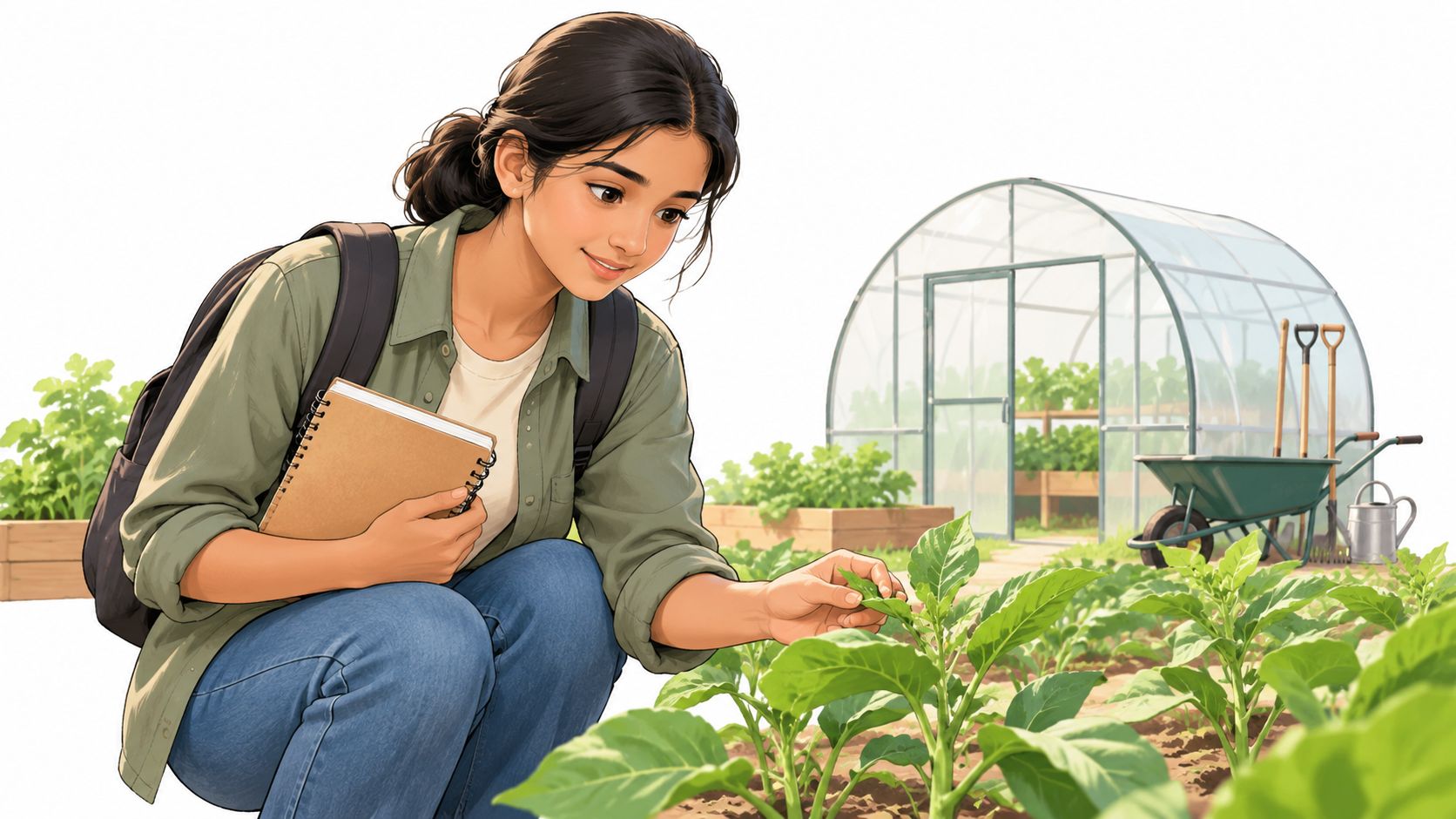
Parents sometimes worry that a practical course is “less academic.” That fear usually fades when they see the workload. These diplomas ask students to learn concepts, handle tools, keep records, and work outdoors, often all in the same term. The key question is not whether the programme is serious. It is whether the student enjoys that style of seriousness.
From Diploma to Degree, Jobs, and Entrepreneurship
A diploma is not an ending. For many students, it is the point where study and work start to meet. Lateral entry routes can allow a diploma holder to move into a degree programme such as B.Sc Agriculture or B.Tech in Agricultural Engineering, subject to the institute's rules, entrance requirements, and seat availability.
Where the diploma can lead
The first lane is further study. A student who wants stronger subject depth can use the diploma as a stepping stone into degree-level education. That route suits families who want flexibility, because it keeps both work and study open.
The second lane is employment. Government roles may appear in agriculture, horticulture, or animal husbandry departments, while private opportunities can arise in agri-input companies, food processing units, and dairy cooperatives. Some students also move into banks or institutions linked to rural finance and development, where their field understanding becomes useful in the economy.
The third lane is enterprise. A small nursery, an organic farm, a custom hiring centre, or another agri-startup model can suit students who want to work close to their own land, district, or local market. That option is not easy, but it is real, and it can grow steadily when the student builds practical skill first.
The national participation picture makes sustainable planning important. AISHE 2023-24 placed enrolment at 4.50 crore with a GER of 30.0%, yet roughly seven in ten people aged 18-23 remained outside higher education, which underlines why diploma-to-degree planning matters more than aspiration alone (AISHE 2023-24 summary). A practical route is often stronger than a vague dream because it gives the student an actual next step.
The strongest message for families is simple. A diploma in agriculture or an allied field can support a degree, a job, or a business. It does not trap the student, it gives them more than one door to open.
A Class 10 Student's Preparation Checklist
A student does not need to wait for admission season to begin getting ready. A few small actions taken now can make the next decision calmer and smarter.
- Choose subjects with the next step in mind. If Science and Mathematics are available and the student can handle them, they keep more agricultural and technical options open later.
- Build field familiarity early. A visit to a local farm, nursery, dairy unit, or school gardening club makes the work feel real instead of abstract.
- Shortlist two or three institutes. Compare recognition, course length, location, and later pathways instead of chasing every advertised option.
- Track entrance dates and document needs. Mark dates early, because forms, certificates, and photographs often take longer to organise than expected.
- Talk to current students or alumni. Their daily experience usually reveals more than a brochure about workload, transport, practicals, and support.
- Use a guided self-check. A tool like Edvdo's interest test can help a student notice whether the fit is more plant-based, technical, or business-oriented.
The clearest path is rarely the loudest one. It is the one that matches the student's strengths, family budget, willingness to relocate, and patience for practical learning. That is the kind of planning that turns uncertainty into direction.
For families trying to make sense of streams, diplomas, and realistic career routes after Class 10, Edvdo helps students connect strengths with suitable pathways, then turn that understanding into a plan. Visit Edvdo to explore tools that can support career clarity, self-assessment, and next-step decisions around higher education in India.