What kind of thinking should an aptitude test measure before anyone tries to interpret the result? A student who solves number problems quickly may approach a challenge differently from someone who spots visual patterns, reasons carefully from text, or notices small errors. The useful question is not whether a score is high or low. It's what the test asked the student to do, and what that performance can reasonably suggest.
An aptitude test measures particular abilities or ways of reasoning. It doesn't establish a student's entire potential, guarantee future success, or choose a career on their behalf. A result can help identify a strength to build, a skill to practise, or a pathway worth exploring. It becomes more useful when a student considers it alongside interests, school experience, motivation, and access to learning opportunities.
The eight formats below are organised by the reasoning skill they examine. Each connects a familiar question type to preparation methods and Indian academic or career contexts. They also show why a score should start a conversation, not end one. A numerical result, for example, can prompt a student to try data interpretation or explore quantitative courses. It shouldn't, by itself, decide whether that student belongs in science, commerce, or any other stream.
Table of Contents
- 1. Numerical Reasoning Questions
- 2. Verbal Reasoning and Reading Comprehension
- 3. Abstract and Non-Verbal Reasoning
- 4. Spatial Reasoning Questions
- 5. Mechanical Reasoning Questions
- 6. Clerical Speed and Accuracy Tests
- 7. Logical Deduction and Puzzle-Based Reasoning
- 8. Situational Judgement Tests
- Aptitude Test: 8 Types Compared
- Turn Test Results Into a Smarter Next Step
1. Numerical Reasoning Questions
Numerical reasoning asks students to interpret numbers and use them to solve practical problems. A question might present a chart of a school event's attendance, then ask the student to compare categories, calculate a ratio, or identify a change. Other common formats use percentages, averages, profit and loss, speed and distance, simple interest, or data in tables and graphs.
Indian students encounter related skills in competitive exams and recruitment assessments. Examples include quantitative aptitude in the Common Admission Test (CAT), numerical ability in banking exams such as IBPS PO and SBI PO, and quantitative questions in SSC CGL. GATE's General Aptitude section also includes numerical ability. Familiarity with those contexts can help students recognise the format, but an aptitude result isn't the same as subject mastery or exam readiness.
Build accuracy before speed
Start with untimed practice. Students can work through a set of data questions carefully, show each step, and check whether the answer makes sense before adding time pressure. A student who misreads a graph needs a different practice activity from one who understands the chart but makes calculation errors.
For engaging practice, students can interpret a newspaper graph or compare statistics from a sports match. A skill assessment can also help identify which quantitative tasks feel comfortable and which deserve more practice, using Edvdo's skill test.
A strong score may suggest that quantitative tasks currently feel manageable. If a student also enjoys mathematics, that can provide a useful reason to explore commerce, engineering, or other number-intensive pathways. The score alone shouldn't determine a stream. Read it alongside verbal and logical reasoning, academic experience, and the student's interests.

2. Verbal Reasoning and Reading Comprehension
Verbal reasoning tests how a student understands language and draws conclusions from written information. Questions may use a reading passage, word relationships, sentence completion, verbal logic, or an odd-one-out task. A student might read a short argument and decide which conclusion follows from the text, rather than from personal opinion or outside knowledge.
The format has clear connections to Indian entrance exams. CAT includes Verbal Ability and Reading Comprehension, while CLAT assesses reading and legal reasoning. Corporate assessments, including those from SHL, may also include verbal reasoning. The abilities involved can support study and work in fields such as law, humanities, management, and media, but one test result doesn't establish whether a student will enjoy those fields.
Practise reading for meaning
Daily reading can help students become more comfortable with complex passages. Editorials, science news, and long-form articles offer varied topics, but the practice works best when students stop to check their understanding. A useful exercise is to summarise each passage in one sentence and point to the text that supports the summary.
Students can also use a subject assessment to reflect on which areas interest them, alongside reading performance. Edvdo's subject test can be one prompt for that broader exploration. If a student wants to explore law or writing, interest in debate, reading, or creating media offers context that a verbal score can't provide on its own.
Scores also need a fair reading. Students from non-English-medium schools may have less experience with English test wording, even if they reason well in another language. A low result could reflect language familiarity, test format, or reading practice, rather than a fixed limit on a student's capacity to analyse ideas.
Reading rule: Ask what the question tests before judging the student's ability. A language-heavy format can reflect both reasoning and familiarity with the language used.
3. Abstract and Non-Verbal Reasoning
Abstract reasoning asks students to find rules in shapes, figures, or symbols. A familiar example is a matrix question: a grid contains a sequence or relationship, one position is blank, and the student selects the figure that completes the pattern. The challenge is to identify the rule, such as a change in position, number, direction, or shading.
Because these items rely less on written language, they can offer a different view of how a student approaches unfamiliar problems. Raven's Progressive Matrices is a recognised example; figure-based reasoning also appears in some recruitment assessments and engineering or design selection tests. The results can be relevant to students curious about coding or design, but they don't prove that a particular career is the right choice.
Explain the rule, not just the answer
A student may choose the correct figure by guessing or by noticing the pattern. Asking them to explain the rule helps distinguish those approaches and gives them a chance to make their reasoning clearer. If a student feels anxious about tests, low-pressure pattern puzzles can provide a gentler introduction to problem solving.
Games and puzzle activities can make practice feel less like another examination. Edvdo offers activities and exploration tools for students, including those in Grades 7 to 9 who are beginning to learn what kinds of challenges they enjoy.
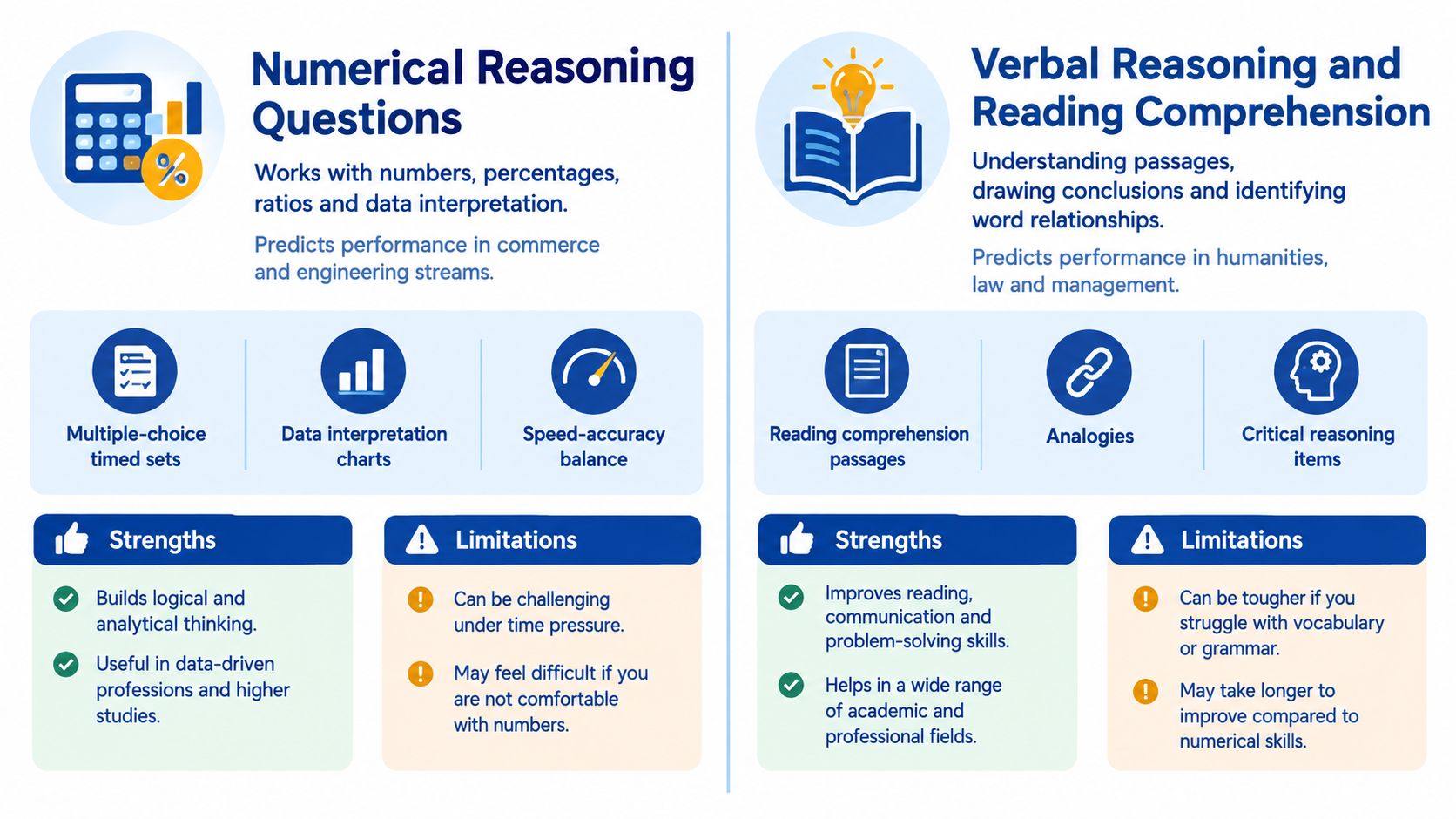
The chart below compares numerical and verbal reasoning formats. It can help students notice that different tests call on different skills, even when both require careful attention.
Students looking for another explanation of this format can read MyCulture.ai's abstract reasoning insights. Any interpretation should still treat the score as one piece of evidence, especially when students are considering technical, creative, or analytical fields.
4. Spatial Reasoning Questions
Spatial reasoning measures how students visualise and mentally manipulate shapes. A question might ask how an object looks after rotation, which three-dimensional solid can be made from a flat net, or how blocks fit together in a stack. These tasks test the ability to work with visual relationships, not to memorise facts.
Spatial questions have links to architecture and design admissions, including drawing and three-dimensional aptitude in NATA. GATE's General Aptitude paper also includes spatial aptitude. Technical and engineering selection tests may use similar items. Those examples show where spatial thinking can matter, but they don't mean that a student needs a particular score to explore architecture or engineering.
Make rotation visible
Hands-on activities can help students practise visualising objects. Origami asks them to imagine how folds change a sheet; building with Lego or sketching simple objects lets them compare a flat view with a three-dimensional form. A teacher can also guide students to rotate an object one step at a time, rather than trying to picture several changes at once.
A student who does well might enjoy building or visual design, while another student may need more practice with mental rotation. Either result is a starting point. Before discussing an engineering or architecture pathway, consider whether the student enjoys design, machines, construction, or related classroom activities.
Edvdo's visual activities can offer another way to practise spatial tasks. A short video can also help students see how visual shapes and spatial questions work:
Visual tasks may be more accessible to some students than text-heavy questions, but the format still matters. Students need a clear explanation of what each score represents before anyone draws conclusions about their potential.
5. Mechanical Reasoning Questions
Mechanical reasoning questions use diagrams or everyday situations to test how students understand forces and moving parts. Items may involve levers, pulleys, gears, friction, energy, or simple machines. A question could show two connected gears and ask which direction the second one turns, or present a lever and ask how the placement of the load affects movement.
The Bennett Mechanical Comprehension Test is one example used in technical and industrial hiring. Mechanical aptitude questions also appear in some recruitment and apprenticeship assessments. Physics-based reasoning in engineering preparation can involve related principles, although a school exam and a mechanical aptitude assessment aren't interchangeable.

Connect diagrams to everyday objects
Students can build familiarity through simple projects, repairs, or science experiments. A bicycle offers a chance to notice gears and movement; a toy mechanism can help demonstrate how parts transfer force. Starting with a real object may make a diagram easier to understand because the student can connect the picture to something familiar.
A test result can support exploration of engineering, mechanics, manufacturing, or technical trades. It can also prompt a conversation about polytechnic, ITI, and diploma pathways, not only degree programmes. A student's interest in practical problem solving and access to hands-on learning are important context.
Students with limited access to tools or building projects may have had fewer chances to become familiar with mechanical systems. That context matters when interpreting an unfamiliar question. A lower result can point to a need for instruction and exposure, rather than a lack of potential.
6. Clerical Speed and Accuracy Tests
Clerical tests measure how carefully and quickly a student compares or processes details. A task may ask them to match names, check codes, find errors in records, or sort information. The test isn't asking whether a student can solve a complex abstract problem. It focuses on attention to detail and perceptual speed.
The Minnesota Clerical Test is a recognised example. Related tasks may appear in hiring for administrative or office roles, as well as data-checking activities in some banking and government recruitment processes. Skills such as careful comparison and record checking can be relevant to accounting, bookkeeping, and administrative support, but a test alone can't show whether a student would enjoy the work.
Separate speed from accuracy
A student might work quickly and miss details, or check each item carefully but complete fewer tasks. Those patterns call for different strategies. Students can practise comparing paired information, checking their work twice, and noticing whether errors come from rushing or from losing focus.
Presenting the activity as a short game can make it less tedious and reduce test anxiety. If a student struggles with accuracy, a structured habit, such as a second review of the completed work, may help. If the student works carefully but slowly, timed practice can introduce pace without encouraging guesswork.
Career exploration should include preferences as well as performance. A student who likes organised tasks and enjoys handling information may want to learn more about office-based work. Another student might score well but prefer a different environment. The result describes performance on a particular task, not a whole working style or a fixed career match.
7. Logical Deduction and Puzzle-Based Reasoning
Logical deduction tests whether a student can draw valid conclusions from statements and constraints. Common formats include syllogisms, blood relations, direction questions, coding-decoding, seating arrangements, and multi-condition puzzles. For instance, a seating problem may give several rules about who sits beside whom and ask the student to find an arrangement that satisfies every condition.
Indian students may recognise logical reasoning sections in SSC CGL, IBPS PO, and SBI PO. CAT and CLAT also include analytical or logical reasoning. Similar puzzles may appear in coding or software recruitment assessments. The format can help students examine how they organise information, but it doesn't measure every skill needed for programming, law, or management.
Put the constraints on paper
For a seating or ordering puzzle, a student can draw a diagram or build a small table rather than trying to remember every condition. That makes it easier to test one possibility at a time and avoid overlooking a rule. Logic puzzles can also work as regular warm-ups that encourage students to explain how they reached a conclusion.
An assessment can help students notice whether they prefer structured problems. A career assessment from Edvdo can support wider exploration of interests and strengths, rather than treating a logic score as a career recommendation.
Students interested in programming might try a beginner coding activity, while students drawn to debate could join a discussion or problem-solving club. These experiences let them test their interest in a real setting. Logical reasoning complements numerical and verbal abilities; it doesn't replace them.
8. Situational Judgement Tests
Situational judgement tests (SJTs) present realistic scenarios and ask students to choose or rank possible responses. A school-based example might describe a disagreement during group work and ask what the student would do next. The assessment looks at judgement, decision-making, and interpersonal considerations rather than a single correct fact.
Employers may use SJTs for graduate and early-career roles in management, healthcare, or customer service. Schools and colleges may use scenario questions to explore teamwork and ethics, while corporate programmes may use them to discuss leadership. The same scenario can prompt different reasonable answers depending on context, so the student's explanation often matters as much as the selected option.
Treat the response as a conversation starter
A counsellor or teacher can ask why a student chose a particular response. That discussion can reveal how the student thinks about responsibility, communication, conflict, and other people's needs. Scenarios should feel relevant to students' lives, including Indian school and family contexts, rather than relying only on unfamiliar workplace situations.
Assessment feedback can help students review results and consider what to do next. Edvdo's assessment feedback can be part of a broader process that also considers personality and interests. Students exploring recruitment processes may also find this guide to ATS resume filters useful, though resume screening and situational judgement measure different things.
Interpretation check: A selected response doesn't prove how someone will behave in every real situation. Ask what values or assumptions shaped the choice, then compare that explanation with other evidence.
Aptitude Test: 8 Types Compared
| Assessment | 🔄 Implementation complexity | ⚡ Resource and speed profile | 📊 Expected outcome | Ideal use cases | ⭐ Key advantage |
|---|---|---|---|---|---|
| Numerical reasoning | Moderate; requires varied arithmetic and data-interpretation questions | Usually timed, multiple-choice; basic test materials | Measures quantitative reasoning, speed, and accuracy | Commerce, engineering, banking, and recruitment assessments | Provides comparable evidence of quantitative ability |
| Verbal reasoning and reading comprehension | Moderate; requires passages and language-based questions | Reading-focused; timing depends on the test | Assesses comprehension, inference, and verbal logic | Law, humanities, management, and communication-focused roles | Relevant to communication across many careers |
| Abstract and non-verbal reasoning | Low to moderate; uses patterns, sequences, or matrices | Quick to administer and score; language-light | Indicates pattern recognition and fluid reasoning | STEM, coding, design, and general aptitude screening | Minimises reliance on language and prior subject knowledge |
| Spatial reasoning | Moderate; requires visual rotation, folding, or 3D tasks | Often timed; diagrams or visual displays required | Assesses mental visualisation and manipulation of shapes | Architecture, engineering, design, and technical fields | Highlights visual-spatial strengths not captured by standard academic tests |
| Mechanical reasoning | Moderate; requires diagrams and basic physical principles | Diagram-based; may require familiarity with simple machines | Assesses practical understanding of forces and mechanisms | Engineering, vocational training, manufacturing, and technical roles | Connects reasoning with real-world mechanical systems |
| Clerical speed and accuracy | Low; uses repetitive comparison and checking tasks | Short, timed tasks; minimal equipment or specialist materials | Measures perceptual speed, attention to detail, and accuracy | Administration, accounting, data entry, and office roles | Simple to administer and score |
| Logical deduction and puzzle-based reasoning | Moderate; often requires multi-step constraints or puzzle sets | Timed; diagrams or tables can support solving | Assesses structured reasoning and management of multiple conditions | Programming, law, management, and analytical assessments | Practice can strengthen systematic problem-solving |
| Situational judgement tests (SJTs) | Moderate to high; scenarios and scoring criteria need careful design | Written, video, or interactive; often paired with other tests | Explores judgement, teamwork, communication, and decision-making | Hiring, education selection, leadership, and counselling | Captures interpersonal judgement that academic tests may miss |
Turn Test Results Into a Smarter Next Step
A useful aptitude test plan begins with a question. Does the student want to understand how they handle numbers, written information, visual patterns, spatial tasks, mechanical systems, detail checking, logical constraints, or interpersonal scenarios? Choosing a format that matches the question makes the result easier to interpret. It also helps prevent a student from treating a test as a general measure of worth or potential.
After testing, record the pattern across all eight reasoning areas. Note which tasks felt engaging, where the student worked accurately, and where they needed more time or explanation. Then choose two strengths to develop and one targeted practice activity for each. A student who enjoys number problems might practise interpreting graphs, while someone interested in spatial tasks might build or sketch objects and compare the results from different angles.
Results become more meaningful when a student combines them with interests, school experience, motivation, and learning preferences. A student considering science or engineering can compare reasoning results with subject performance and willingness to work through the relevant material. Someone exploring law can consider reading, debate, writing, and the demands of the courses they're interested in. Neither pathway should rest on a single score.
Context matters, too. Language familiarity, access to hands-on activities, test anxiety, family expectations, and prior exposure to a format can affect how a student approaches an assessment. When a result appears surprising, a teacher or counsellor can ask what might have influenced it and whether a different assessment or practical activity would offer useful additional evidence.
Students can use Edvdo's quizzes, games, flashcards, assessment insights, Career Hub, progress tracking, and Vedu AI mentor to move from testing to exploration. The tools can help students compare relevant courses, streams, and career paths, while a career path builder can prompt consideration of prerequisites, skills, and education options. Results can guide those next steps, but they shouldn't be presented as a fixed verdict. Students preparing for law school might also browse LSAT prep tests as part of examining what an admissions assessment involves.
The goal isn't to collect scores for their own sake. It's to help students ask better questions, practise specific skills, and explore options with enough context to make informed decisions. A student may change direction as interests and academic experience develop. Good guidance leaves room for that growth.
Edvdo brings guided assessments, activities, career exploration, progress tracking, and Vedu, its AI mentor, into one student-focused journey. Students and educators can use these tools to turn aptitude-test results into practical questions about learning, courses, and career paths. Visit Edvdo to explore options with more context than a single score can provide.