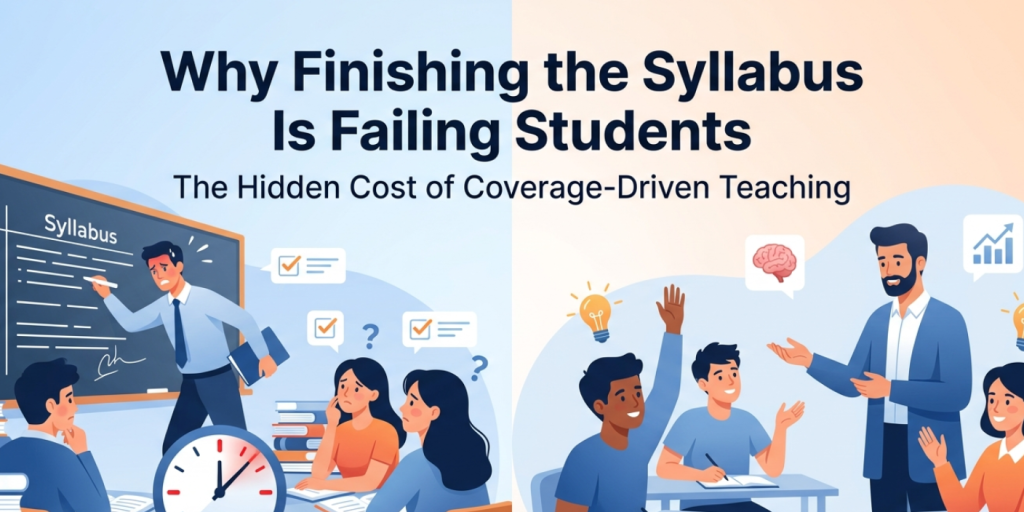
Why Finishing the Syllabus Is Failing Students The Hidden Cost of Coverage Driven Teaching
In many Indian schools finishing the syllabus is seen as a major achievement. Parents feel relieved teachers feel responsible and students feel pushed to keep up. But an important question often goes unnoticed. Are students truly understanding what they are learning or are they just completing chapters?
This research based article explores how coverage driven teaching is silently weakening real understanding in classrooms especially for students in Classes Eight to Ten. It explains why rushing to complete the syllabus is failing students and what schools parents and counsellors can do to change this pattern.
What Is Coverage Driven Teaching
Coverage driven teaching means focusing on finishing the syllabus within a fixed timeline regardless of whether students have fully understood the concepts. The goal becomes completion instead of comprehension.
Teachers are often under pressure from school systems board expectations and parent demands. This leads to a fast paced approach where chapters are taught quickly tests are conducted and then the class moves on.
- Limited time for deep discussion
- Focus on notes and memorisation
- Frequent testing without reflection
- Little space for questions
At first this may look efficient but over time it creates gaps in understanding.
Why Finishing the Syllabus Is Failing Students
When finishing the syllabus becomes the priority students begin to learn for completion not for clarity. They may score marks in exams but struggle to apply concepts in real life situations.
Research from organisations like OECD education insights highlights that deep learning requires time reflection and practice. Without these elements knowledge remains surface level.
For Indian students this becomes more visible in higher classes where foundational gaps start affecting confidence.
Common Signs Students Are Not Truly Learning
- They forget concepts soon after exams
- They hesitate to ask questions
- They rely heavily on memorised answers
- They struggle with application based questions
These are not student failures. They are signs of a system focused more on speed than understanding.
The Pressure Loop Between Schools Parents and Students
In India education is deeply connected to future success. Parents want their children to stay ahead. Schools want to maintain results. Teachers want to meet expectations. This creates a pressure loop.
Within this loop finishing the syllabus becomes a visible measure of progress. But real understanding is invisible and takes time. So the system chooses what is easy to measure.
Students feel this pressure strongly during Classes Eight to Ten. They are told to focus on completion and preparation for board exams. Slowly learning becomes stressful instead of meaningful.
How Coverage Driven Teaching Affects Student Confidence
When students do not fully understand concepts they start doubting themselves. Even if they score marks they feel unsure about their abilities.
This affects their confidence in subjects like Maths Science and English. Over time they may avoid these subjects or believe they are not capable.
Parents often misinterpret this as lack of effort. In reality it is lack of clarity caused by rushed teaching.
Why Teachers Also Struggle With This System
Teachers are not unaware of this issue. Many want to slow down and ensure understanding. But system expectations make it difficult.
- Strict timelines for syllabus completion
- Pressure of test results
- Administrative workload
- Large class sizes
This forces teachers to move ahead even when students are not ready. Over time this also leads to emotional fatigue and reduced teaching satisfaction.
Real Learning Needs Time Not Speed
Understanding develops through repetition practice and discussion. Students need time to connect ideas and ask questions. When learning is rushed this natural process is interrupted.
Real learning happens when students:
- Explore concepts in different ways
- Make mistakes and learn from them
- Apply knowledge to real life situations
- Discuss and reflect on what they learn
Without these steps education becomes information delivery instead of understanding.

How Schools Can Shift From Completion to Understanding
Schools can make simple but powerful changes to move away from coverage driven teaching.
- Focus on core concepts instead of finishing every topic quickly
- Include reflection time after each lesson
- Encourage questions and open discussions
- Use assessments to identify gaps not just measure marks
Modern tools like student assessment platforms and AI learning insights can help teachers understand student progress more clearly without rushing through content.
The Role of Parents in Supporting Real Learning
Parents play a key role in changing this mindset. Instead of asking only about marks they can ask about understanding.
- Ask children to explain concepts in their own words
- Encourage curiosity and questions
- Reduce pressure around completing everything quickly
- Focus on long term learning not short term scores
This helps children feel safe to learn at their own pace.
How Career Counsellors Can Bridge the Gap
Career counsellors can guide students to see learning beyond exams. They can help students understand how concepts connect to real careers and future opportunities.
Tools like career expert guidance and career exploration platforms show students the importance of deep understanding rather than memorisation.
Support systems such as AI based student support can also answer doubts anytime reducing dependency on rushed classroom explanations.
Connecting Learning With Real Life Success
Students who understand concepts deeply are more confident and adaptable. They perform better in competitive exams higher education and real life problem solving.
On the other hand students trained only for completion may struggle when they face unfamiliar situations.
Related insights on declining learning outcomes can be explored in this detailed analysis on student attention and outcomes.
A Better Way Forward for Indian Education
Finishing the syllabus should not be the final goal of education. Understanding should be the real measure of success.
When schools slow down and focus on clarity students become more confident. When parents support curiosity students become more engaged. When teachers are given flexibility they teach with more creativity.
This shift may take time but it creates stronger learners who are ready for future challenges.
Do you think finishing the syllabus is affecting real learning in your school Share your thoughts with your community and explore more insights to build a better learning environment for every student.